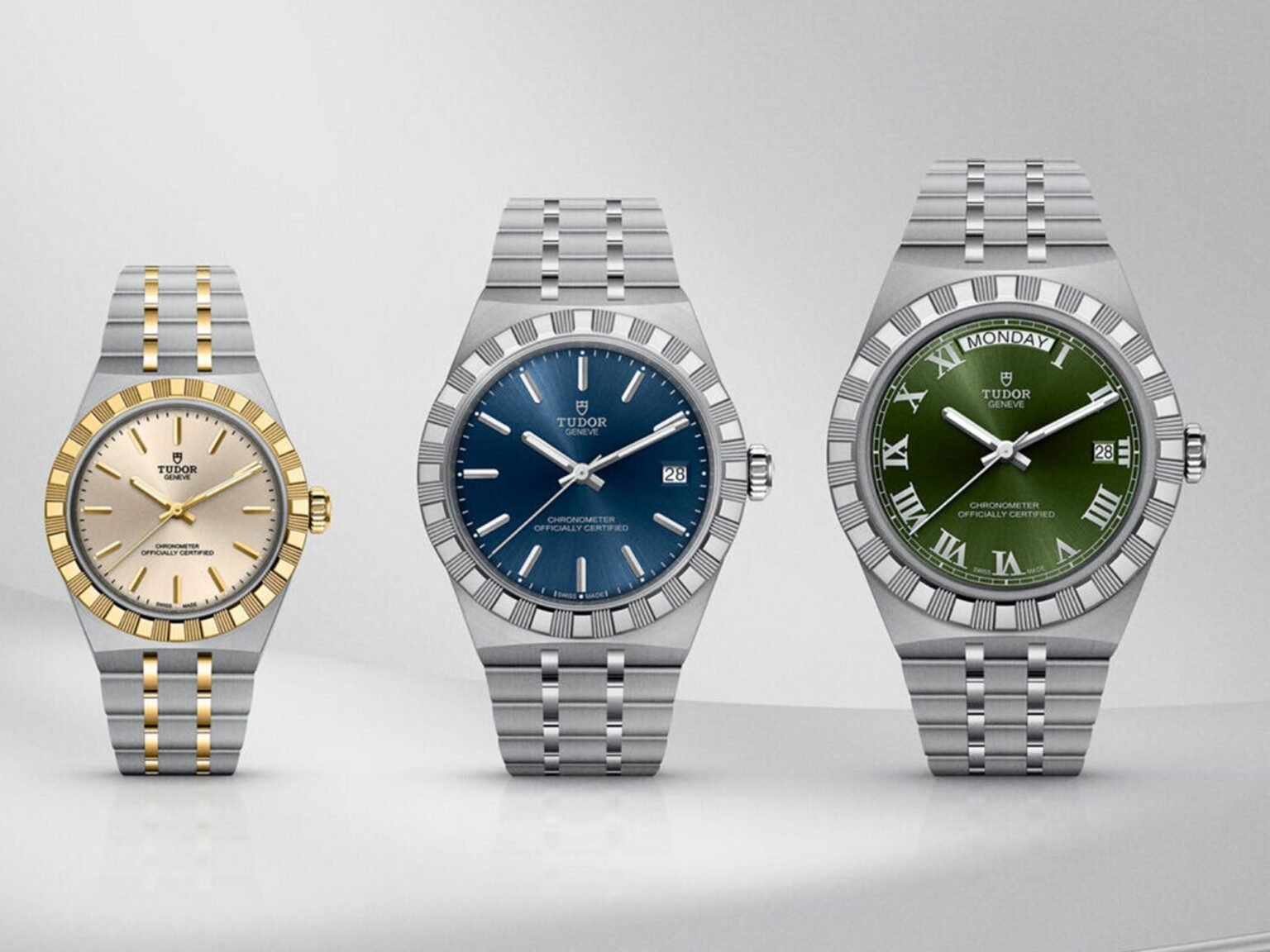

One of the biggest pieces of news to come from Tudor’s 2026 Watches & Wonders releases is the brand’s complete overhaul of the Tudor Royal collection. The original case sizes, which used to span 28mm, 34mm, 38mm, and 41mm, have been streamlined into a tighter, well-proportioned family of 30mm, 36mm, and 40mm models. Out go the old movements with their standard 38-hour power reserves, too. They’ve now been replaced entirely by in-house calibers that boast COSC chronometer certification and up to 70 hours of juice. Visually, while the traditional applied Roman numeral variants still exist in this new form, the brand has also introduced clean, luminescent stick markers, giving the collection a radically different, far more contemporary personality.

The sheer variety of configurations available throughout the newly revamped Tudor Royal watch collection is staggering. The series now spans traditional tones like black, silver, champagne, and ivory, alongside bold contemporary colors like green, light blue, burgundy, and salmon. Tudor has even introduced versions with eight diamond-set hour markers and full-diamond bezels within the smaller sizes. Given all these changes (and more), the Tudor Royal watch now feels like a front-row contender in the integrated sports-watch arena.
[toc-section heading=”History & Context of the Tudor Royal”]
Tudor first began stamping “Royal” on its dials back in the 1950s. In those days, however, the name wasn’t shorthand for an integrated bracelet or a specific case shape. Moreover, the Royal name was a conceptual label used to signal the brand’s premium offerings. These models within the tool-watch category were reliable, boasting an elevated sense of dressy elegance that made them perfect for wearing to formal dinners but also tough enough for daily wear.

When Tudor revived the name in 2020, it re-channeled that same dress-meets-sport philosophy through a purely 1970s lens. The collection gave us an integrated watch with a distinctive notched bezel inspired by the vintage engine-turned bezels from Tudor’s history, adorned with alternating polished sections and cut grooves. These models (example above) filled a gap in Tudor’s lineup, offering collectors something more elevated than the minimalist 1926 collection and significantly dressier than a fabric-strapped Pelagos or Black Bay diver.
Though it remained an appealing choice for buyers looking for an attainable entry point into the Tudor catalog, movement purists began to somewhat overlook it. These new 2026 offerings serve to reconcile the Royal with the rest of Tudor’s modern identity. The brand honors the collection’s 1950s origins, but the mechanics now equal the premium feel that has always defined the collection.
[toc-section heading=”Case and Wear”]
 It doesn’t take more than a passing glance to see that the physical layout of the new Royal collection has undergone a substantial makeover. The upgrades completely change how these elegant watches sit on the wrist. If we look back at the older generation, the sizing felt a little fragmented, with its four distinct case diameters. The jump from the 38mm mid-size straight to the 41mm day-date version left a lot of collectors stranded in between. After all, the 41mm model could wear quite large due to the rigid nature of the integrated bracelet’s first link. But the new architecture fixes this beautifully by introducing three newly proportioned cases: 30mm, 36mm, and a redesigned 40mm flagship.
The new 40mm version is a brilliant sweet spot, retaining the signature day-date complication of the old 41mm variant. The day of the week still arcs across the top of the dial, while the date window takes its usual position at 3 o’clock, but the slight trim in case diameter and a well-calculated 47mm lug-to-lug distance make it significantly more manageable compared to its predecessor.
 Finding that perfect wrist presence is always a highly personal balancing act, and though my wrists are incredibly slender for a 5′ 9” female, my comfort zone lies anywhere between an elegant 36mm up to a bold 47mm, depending on the vibe of the watch. The new 36mm Royal feels like an absolute triumph in proportions. The day display has been dropped in order to focus on a cleaner date layout, giving the timepiece more of a traditional look that feels natural while still packing enough visual weight to register as a true sports watch.

The smallest option has been bumped up from the old 28mm to a much more wearable 30mm. The new dimensions give this lady’s Royal watch a streamlined, jewelry-adjacent presence without making it illegible. Every case size in the current lineup retains a rock-solid 100-meter water-resistant rating, backed by a screw-down crown. As a mother of two, my daily routine jumps from chaotic morning school runs to formal industry meetings. Basically, I need a watch that can take a bit of a beating without losing its luster. The five-link integrated bracelet is going to drape like silk across the wrist, especially since Tudor has revamped its architecture, giving it the tool-free T-Fit clasp for on-the-fly adjustments, along with redesigned lugs and end links for a tighter hug. Other than that, the brushed outer links stay the same, framing polished central rows that catch the light beautifully.

Lastly, unlike many other two-tone models on the market at this price point, the warmth and presence you see in the steel and gold Tudor Royal offerings is achieved through genuine yellow gold capping on the steel bezel and case elements, paired with solid gold center links on the bracelet. Carried out at the brand’s Le Locle facilities, this level of finishing gives the watch a substantial, reassuring weight and a deep vintage glow that, to me, elevates the entire wearer experience.
[toc-section heading=”New Dial Configurations”]
 The original modern Tudor Royal collection was defined almost entirely by its applied Roman numerals. Those numerals undeniably imbued these watches with a stately, conservative aesthetic, but sometimes clashed with the inherent sportiness of a steel integrated-bracelet watch. This forced the Royal into a somewhat formal corner. This year, the introduction of applied baton stick markers as an alternative across the entire line gives the Royal a cleaner, sharper, and more contemporary look. Though a small detail, the markers open up the dial, aligning it much better with the iconic, integrated sports-watch designs of the late 20th century. These faceted batons are also packed with Swiss Super-LumiNova, pairing perfectly with the rounded baton hands to ensure each model remains highly legible at night.

Then there is the sheer breadth of the color palette itself. Tudor has expanded the configurations, providing collectors with one of the most comprehensive dial selections in its entire history. You have the rock-solid, evergreen options like deep black, clean silver, and a warm champagne or rich ivory color that look phenomenal on the two-tone variants. But the brand has also leaned into more contemporary flavors, with a punchy green, a soft and modern light blue, and a dramatic burgundy red. These sunray dials, including chocolate brown, salmon, and grey, are beautifully executed, interacting with the light to create spectacular shifts of shades and tone depending on the environment. Two of my favorite options are the sunburst blue, which fluctuates from a bright, vibrant cerulean under direct sunlight to a moody, sophisticated navy indoors, and the radial brushed salmon, bestowing a warm, sophisticated copper tone that feels deeply vintage.
 Additionally, with the high-end jewelry configurations that the brand has brought to the table here, Tudor is clearly trying to bridge the gap between pure tool watch and high elegance. If the standard stick markers or classic Roman numerals feel too plain, you can now opt for dials featuring eight brilliant diamond-set hour markers that add a stunning layer of texture to the display. For those who want to go all out, Tudor has even introduced full diamond-set bezels that completely swap the traditional notched, engine-turned look for a ring of pure brilliance. These diamond bezels are kept exclusive to the smaller 30mm and 36mm case sizes.
[toc-section heading=”New Movements”]

We need to talk about what is happening under the hood, because this is where the gap between the old Royal and the new generation becomes a Grand Canyon. A departure from the previous generation, the latest Tudor Royal models introduce in-house calibers customized for each case size.

The 40mm day-date gets the robust MT5633, while the 36mm date variant is powered by the MT5412. Both share an impressive (and vastly improved) 70-hour power reserve. Even the compact 30mm model receives the miniature MT5201 manufacture movement, which packs in a respectable 50-hour power reserve. The performance upgrade here is nothing short of extraordinary. The older models would run out of gas after roughly 38 hours, meaning if you took your watch off on Friday evening, it would be dead by Sunday morning. The new MT calibers, in particular the 36mm and 40mm versions, allow you to put it down for days and pick it up on Monday morning without missing a single beat.

Mechanically, these movements are built like tanks, featuring antimagnetic silicon hairsprings that protect against the digital hazards of modern life, alongside a full traversing balance bridge anchored at two points for superior shock resistance. Most importantly, every single piece across all three sizes is now officially certified as a chronometer by the COSC, meaning the watches are subjected to rigorous testing across multiple temperatures and positions to guarantee incredible daily accuracy. In many ways, the mechanical upgrade alone completely rewrites the value proposition of the entire Royal line, shifting the collection away from being an entry-level design piece and more toward being a serious piece of horological engineering.
[toc-section heading=”Final Thoughts”]
 Looking at the watch market today, it’s impossible to ignore the sheer volume of integrated-bracelet sports watches competing for our attention. But the new Tudor Royal watches combine tighter case dimensions, contemporary stick markers, and even COSC-certified engines that elevate what was once a handsome entry point model into a primary destination for upper-tier collectors. Still, the modest pricing remains, as do characteristics like the distinctive engine-turned bezel and integrated bracelet, now framing a vast array of stunning dial colors. The Tudor Royal has grown up, and is now a self-assured, high-spec, and beautifully executed option for anyone who values real historical character and serious mechanical substance.
For more information, visit the brand’s website here.