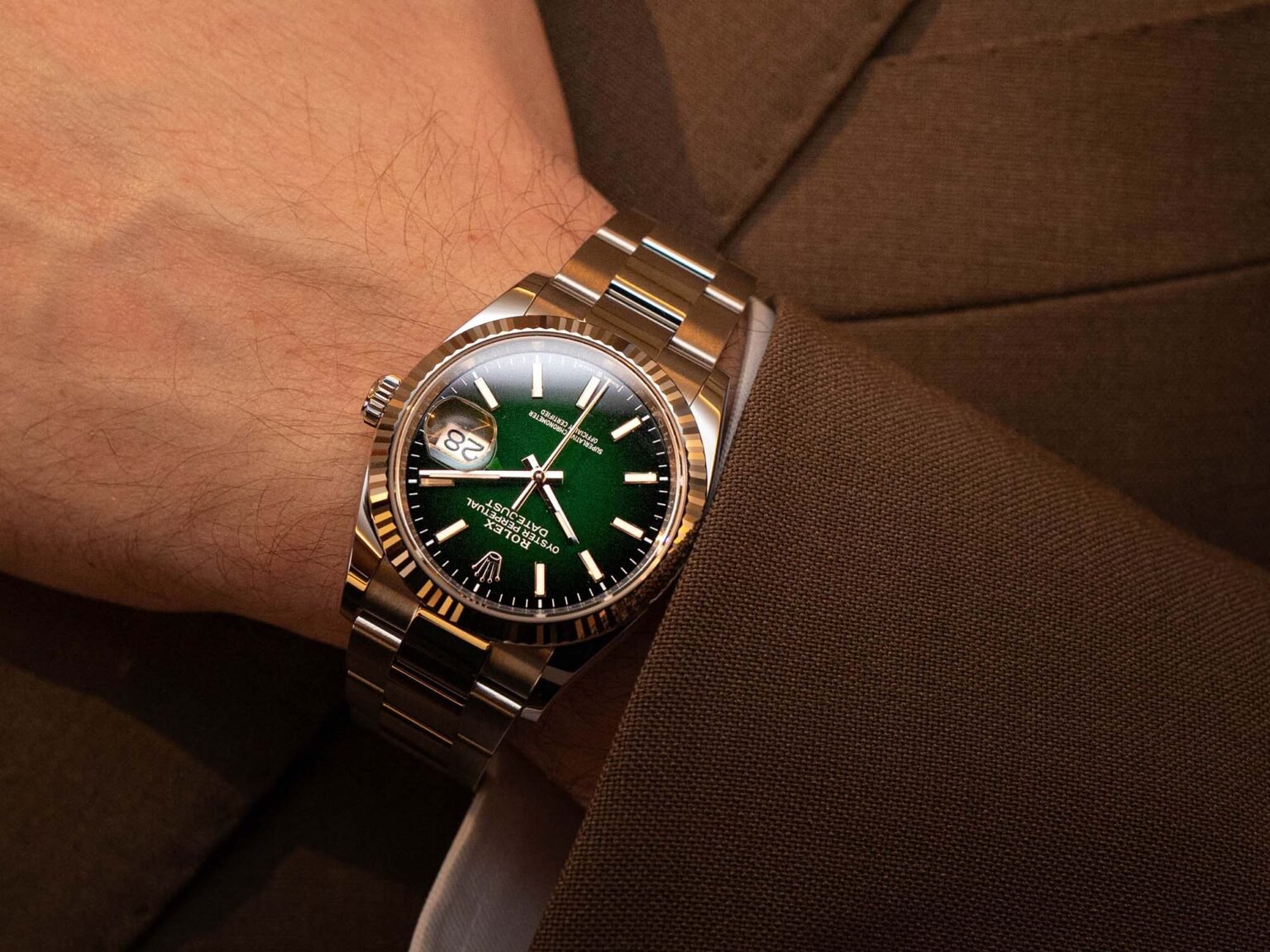

The modern Datejust is perhaps the most versatile watch in the Rolex catalog, expressed in a variety of mixed metals with varying options for the bezel, the bracelet, and most of all, the dial itself. As a result, the watch can take on a wide range of personality traits, from low-key and informal to unmissable. In some configurations, the Crown’s staple can walk a fine line between those two states, and that’s exactly what we find in one of the newest configurations released at Watches & Wonders 2026, the Rolex Datejust Green Lacquer Ombré (ref.126334). Down below, we’re walking you through the key details of the latest addition to the Datejust family, as well as what this could mean for the collection moving forward.
History and Context

We may take the humble date complication for granted today, but there was a time when this represented a serious level of innovation for the wrist-worn watch. The first date window appeared in a watch called the Mimo-Meter from a brand we now know as Girard-Perregaux, but the first date complication to come with an automatic movement appeared in the aptly named Datejust, from a brand called Rolex, in the year 1945. The watch has been a staple of the Crown ever since, thriving in the midst of the sport-watch boom that would follow, and maturing into an icon all its own.
Looking back over the previous decade, you’ll notice a clear rise and fall in the trendline when it comes to green dials. They have appeared across all manner of brands, from large to small, and in a staggering array of flavors, from deep and earthy to bright and vibrant. With this green ombré dial, Rolex has somehow taken a dab from both of those categories thanks to the transition from dark to light and, of course, to the rest of the polished hardware present within the dial itself.
Key Details and Wear

The green ombré dial of the Datejust is unique in that it is the only available dial option that features such a transition. As such, it brings out a different side of its personality that invites an element of intrigue. Further, depending on how the watch is specced, from a domed bezel with an Oyster bracelet, to a fluted bezel with a Jubilee bracelet, there’s a lot of space for deciding just how prominent a role the dial is playing in the overall vibe of the watch. Oh, and it can be had in both 36mm and 41mm sizing.
Stepping back, the Datejust is an eminently wearable watch, and that’s a big part of the appeal. Don’t let the naming convention fool you, the 41mm Datejust actually measures closer to 40mm, and with a thickness clocking in at just under 12mm, it’s a much easier watch to get along with than you might imagine from the spec sheet. The 36mm case also measures 12mm in thickness, so it picks up a slightly tanky quality as a result, but still wears just as easily. Either size will make for an easy daily-wear candidate, though if that’s what you’re after, the green dial may not be the best choice.

While black, white, or even blue will offer the most wardrobe versatility, the green ombré is special in a different kind of way. It feels luxurious without being over-the-top, and it comes across as something special as a result. It could easily work with a t-shirt and jeans just as well as fully suited up, but regardless it will make a statement either way. There’s a lot of personality here, which is a very good thing for a watch like the Datejust, which is generally pretty good at taking a backseat role (which is exactly what makes it such a great daily-wear candidate).
Rolex has found a way to elevate the formula with the green ombré dial. The watch remains just as accessible thanks to the wonderful platform underneath, and that’s an easy thing to take for granted. The model can be had in full Oystersteel or a Rolesor mix of steel and white gold. References that incorporate yellow and Everose gold do not get access to this particular dial, and this choice feels very intentional.
When paired with an Oyster bracelet and domed bezel, the dial takes on a more understated nature. In some light, the dial can appear almost black, and the wide, flat surfaces of this spec play down the vibrancy of the ombré. Conversely, when paired with a Jubilee bracelet and fluted bezel, the dial comes to life in a manner that almost competes with all of the light being reflected off the bracelet and bezel.
The Dial

With this dial, Rolex sets a new precedent for the Datejust collection, and likely one that will see further evolution. This is a brand known for its methodical approach to even the smallest of changes, so a dial like this entering the Datejust collection will carry some weight for further iterations down the line. Exactly how that manifests remains to be seen, but I’d expect dials of a similar quality to appear in additional references in time.
The Movement
The rest of the platform is exactly what you’d expect from this generation of the Datejust. Both sizes use the Rolex Superlative Chronometer 3235 automatic caliber, which boasts 70 hours of reserve, and +/- 2 seconds per day of accuracy. This caliber also makes use of the brand’s Chronergy escapement, Parachrom hairspring, and Paraflex shock absorbers. All of this makes the watch just as robust as other sport references from Rolex. This is a tried and true movement family at this point, and represents about the most solid foundation you’ll find for a time-and-date movement.
Final Thoughts

Overall, this is the same great Datejust you know and love. The new green ombre dial brings a vibrant and dynamic personality to the watch, unlike anything else we’ve seen in the collection, and does so without compromising the underlying platform. There’s a new visual intrigue at play here that shines through in white metals and represents an exciting new development path for Rolex. Best of all, the new dial is priced the same as existing options, meaning a starting price of $8,150 in steel with a domed bezel and Oyster bracelet, and capping out at $11,850 in Rolesor with a fluted bezel and Jubilee bracelet.
For more information, visit the brand’s website here.