

Last year I took a trip to Swatch’s Sistem51 factory, and many people seemed to enjoy getting a glimpse of the other side of watchmaking that we typically don’t glamorize. Industrialization, in a way very opposite from classic watchmaking, is a different kind of technical art entirely. It’s diametrically opposed to the philosophies of construction and finishing that you would expect from a classic watchmaker or brand, but as a result, that visit was one of the most interesting manufacturing sites that I’ve ever seen. I had no idea that I’d be back so soon, but then again, I certainly would have no idea that a collaboration between Swatch and Audemars Piguet would be around the corner.
So a little more than a year later, I found myself back in Biel, Switzerland, right outside of Swatch headquarters, making my way back to the Swatch Museum (still some of the most fun you can spend in a watch museum), the Swatch Drive-Through shop right outside of Swatch headquarters, and finally making the drive back out into the Swiss countryside to go see some Swatch factory sites. Of course, this time, it was in the hopes of seeing how things might have changed with the addition of the Royal Pop as a product on the factory lines.
This trip wasn’t all just déjà vu, however. In my visit last year to the ETA Sistem51 site in Boncourt, it just so happened that the ETA site in Grenchen, responsible for the production of Swatch’s Bioceramic composite, was under renovation. They were in the middle of adding a third floor, intending to consolidate other ETA sites under one roof. So, I missed out on getting a peek at the dial and case-making for watches like the Moonswatch and Scuba Fifty Fathoms. Luckily, this year the facility was back up and running (undoubtedly in anticipation of the production of the Royal Pop), and there was something new to look forward to.
The Sistem51 Factory In Boncourt


As I expected, the visit to the Sistem51 site in Boncourt (W35, as it’s not-so-glamorously called) would prove to be quite similar to the last time I made my rounds. I won’t repeat myself too much here, so I’ll send you over to my photo report from last spring, when I had a chance to take a look while they were in full production mode, churning out Fifty Fathoms-themed automatic Sistem51 calibers. If you’d like, give that photo report a read, as it focuses purely on the movement side of things.
This time around, given the addition of the Royal Pop in the product mix, I asked the ETA team about the new manually wound calibers and how they affected production at the site. It wasn’t as simple as just omitting the rotor, after all. There are two new manually wound Sistem51 calibers for the Royal Pop: one with a small-seconds subdial and the crown oriented at 3 o’clock for two of the colors (the blue Lan Ba and the multi-color OTG ROZ), while the other is a two-hander with the crown at 12 o’clock for the remaining colors.
While most of the changes to the manually wound calibers, including 15 new patents, remain hidden, the new skeletonized barrel design stands out immediately. The holes in its cover showcase the mainspring, complemented by UV-printed decoration added before assembly. Those covers, already adorned with Ben-Day dots before they’re placed into the movement, offer a nice contrast in the production process to the typically drab components seen on the other trays.

The barrels, already decorated via UV printing, before installation.


There was no additional machinery installed to increase capacity for the Sistem51 movements, even with two more variants added and with the initial frenzy of the Royal Pop. Rather, all of the different movements run through the exact same line, with a program entered when each specific batch is produced, so the same machinery knows which variation of the movement to produce.
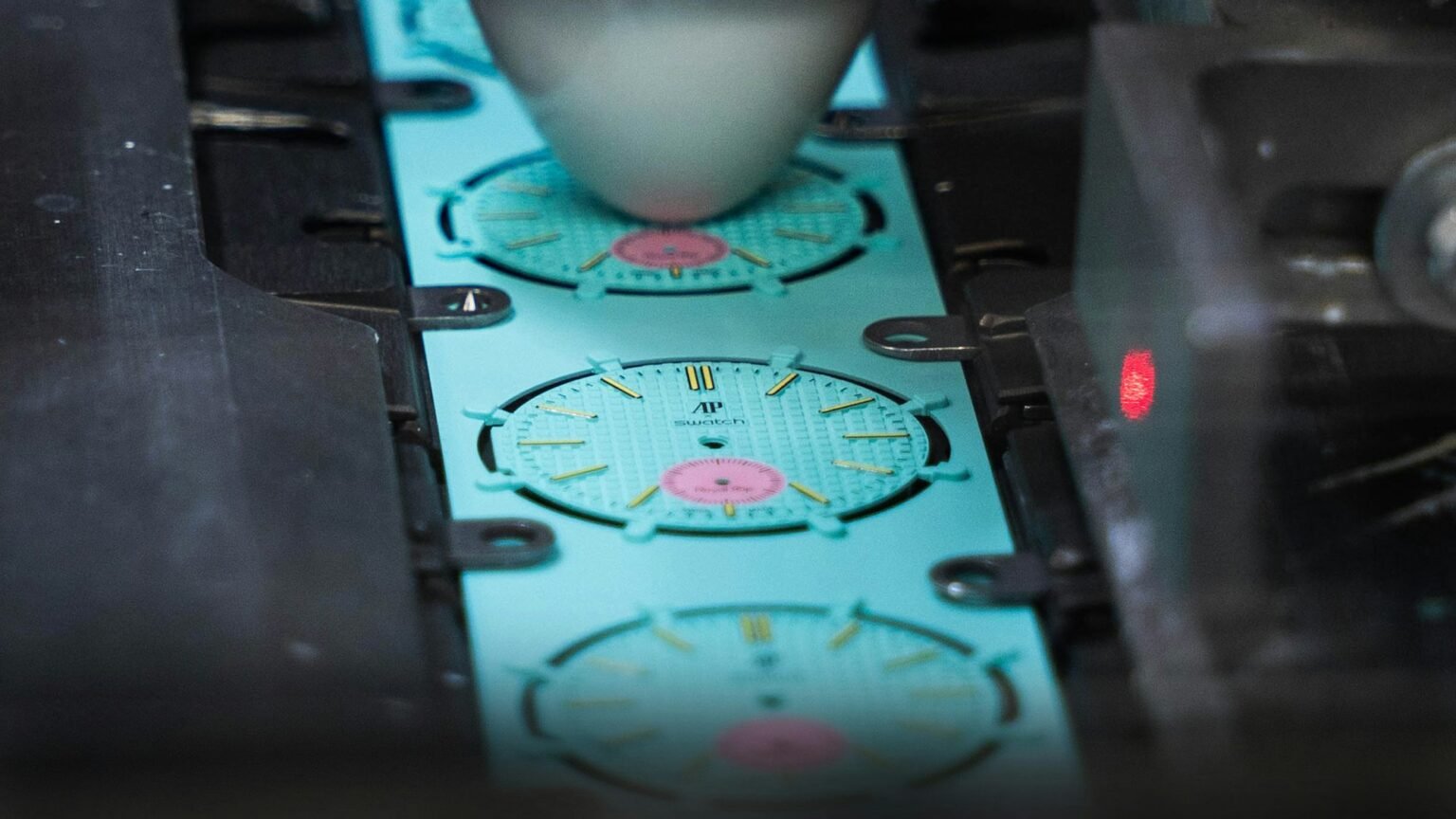
A new sight, of course, was the near-final touch of the calibers for the Royal Pop: the eye-catching Pop Art decoration for the entire movement, visible behind the pocket watch’s sapphire caseback. Just like with the other calibers, it’s decorated through a UV-printing process and a rather large industrial printer, which can handle a tray of 50 movements at once. Inks are dispensed layer by layer onto the fully assembled calibers, then dried and cured by ultraviolet light as the printer head makes many passes back and forth across the tray of movements. Watching the printer at work reminded me of waiting for a new Polaroid photo to develop. Starting from an initial priming coat of white, each pass slowly gives life to the ultra-saturated final artwork, and over the course of a few minutes, those different segments of the dial all get their respective finishes.

Before and after.


UV printing in progress.
The Bioceramic Site In Grenchen
After the visit to the ETA site in Boncourt, we hopped in a car and drove for an hour or so to Grenchen to make the second stop in the tour, ETA’s W18 facility. Whereas the Boncourt facility was specifically focused on producing mechanical movements, the processes at this Grenchen facility are a bit more diverse, responsible for many of the external components that go into Swatch watches. At a high level, the site produces the base Bioceramic composite, handles injection molding for everything from cases to plastic crystals, and also makes many of Swatch’s dials.


The first floor we visited handled the base Bioceramic production itself. It’s certainly the least glamorous portion of the visit—no rows of shiny new machines, nor any cool recognizable parts from any of the watches being made. Rather, you have a few rooms with a series of pelletizer machines to produce the final Bioceramic pellets that will be later sent to the machines upstairs to produce the actual watch parts.
Swatch defines its proprietary Bioceramic composite as a material combining two-thirds zirconium oxide ceramic powder and one-third bio-sourced material (read: plastic) derived from castor oil. And in this room, the various components of this blend are added in large scoops by ETA employees to a hopper that feeds a double-screw mixer, which both heats and mixes the various elements (and most importantly, the pigments for the resulting colors) together. Afterward, it’s sent through an extruder, which makes long, noodle-like (it was very close to lunchtime, okay) strands that are then cooled. Those strands of the final Bioceramic composite are then broken back up into pellets, ready to be used to make cases, dials, bezels, and more.
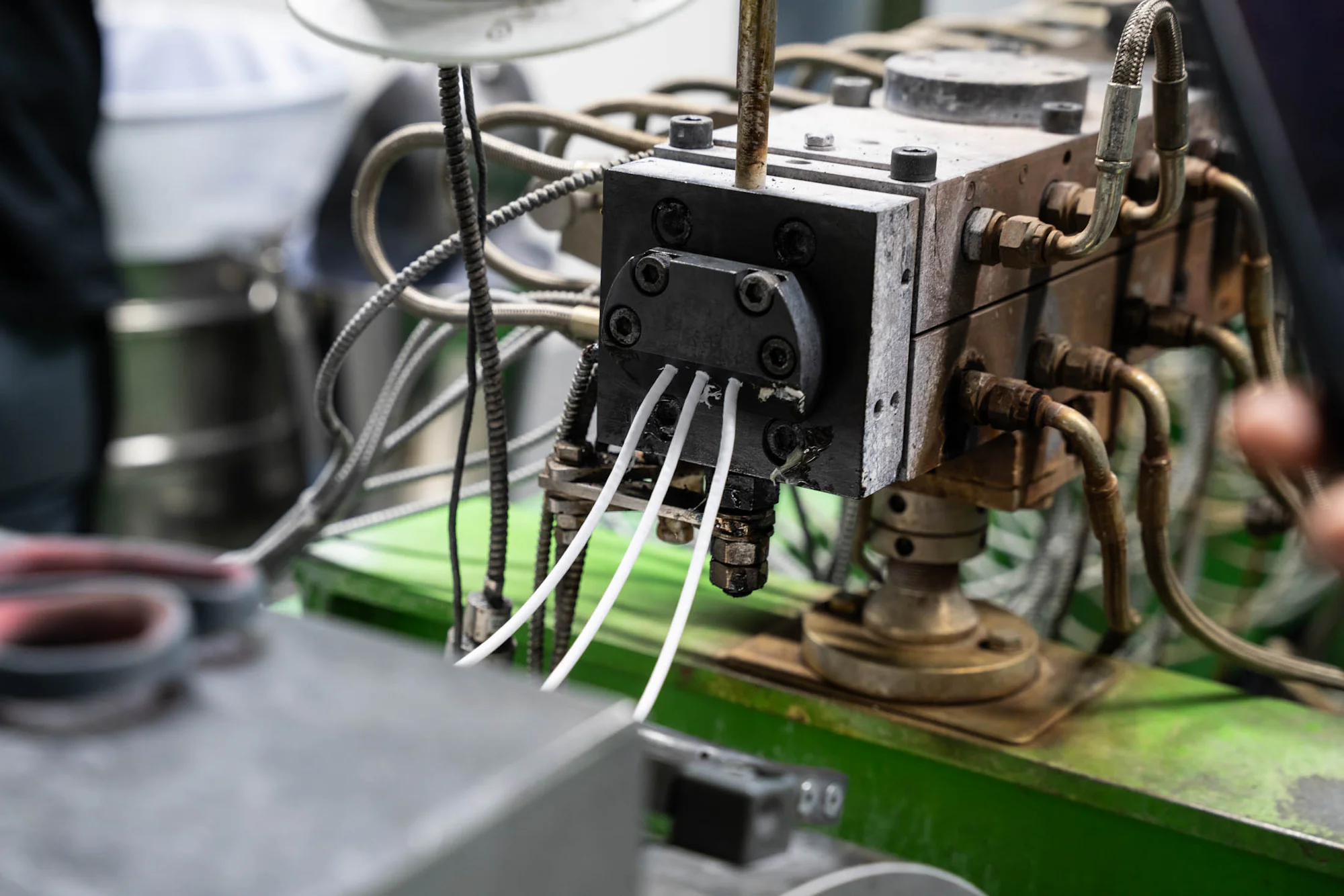


The final Bioceramic pellets.
A large adjacent room held a similar setup, just scaled up by many degrees for when large quantities are required for production. But back in the warm and very noisy room I was in, two identical versions of the smaller production line ran side by side. One, as I photographed for this piece, was making white Bioceramic, which admittedly isn’t all that engaging to look at in photos. It’s the saturated colors that are exciting, after all.
But one of the benefits of the smaller setups in this room, the site’s manager tells me, is that they allow for rapid prototyping and the development of new colors. This sort of in-house agility allows them to work quickly to develop new shades of the composite material, so that new releases, even on an accelerated development timeline, can showcase new colors. And yes, what I’m getting at is that the other setup that I was not allowed to photograph was indeed working on a fun new color, which I’ll have to keep a secret for now. I’ll be curious how soon we might see it on a future release, or if we’ll even see it used at all.

The bezel of the OTG ROZ Royal Pop, freshly injection molded.

Extracting the finished bezel from the mold.

Next, we proceeded to the injection molding department, where we saw cases and bezels being produced. Injection molding is a pretty similar process no matter where you go, and so the sights here were no different from many of the other facilities I’ve visited—heavy machinery injects heated liquid plastic into molds, which are then cooled, and the finished part is then removed from the molds and placed onto trays. Admittedly, what was a bit surreal was seeing, in addition to some more generic Swatch cases being produced during our visit, the extremely iconic octagonal bezel coming out of these injection molding machines in bright yellow for the Royal Pop.


The optical inspection of each plastic crystal.
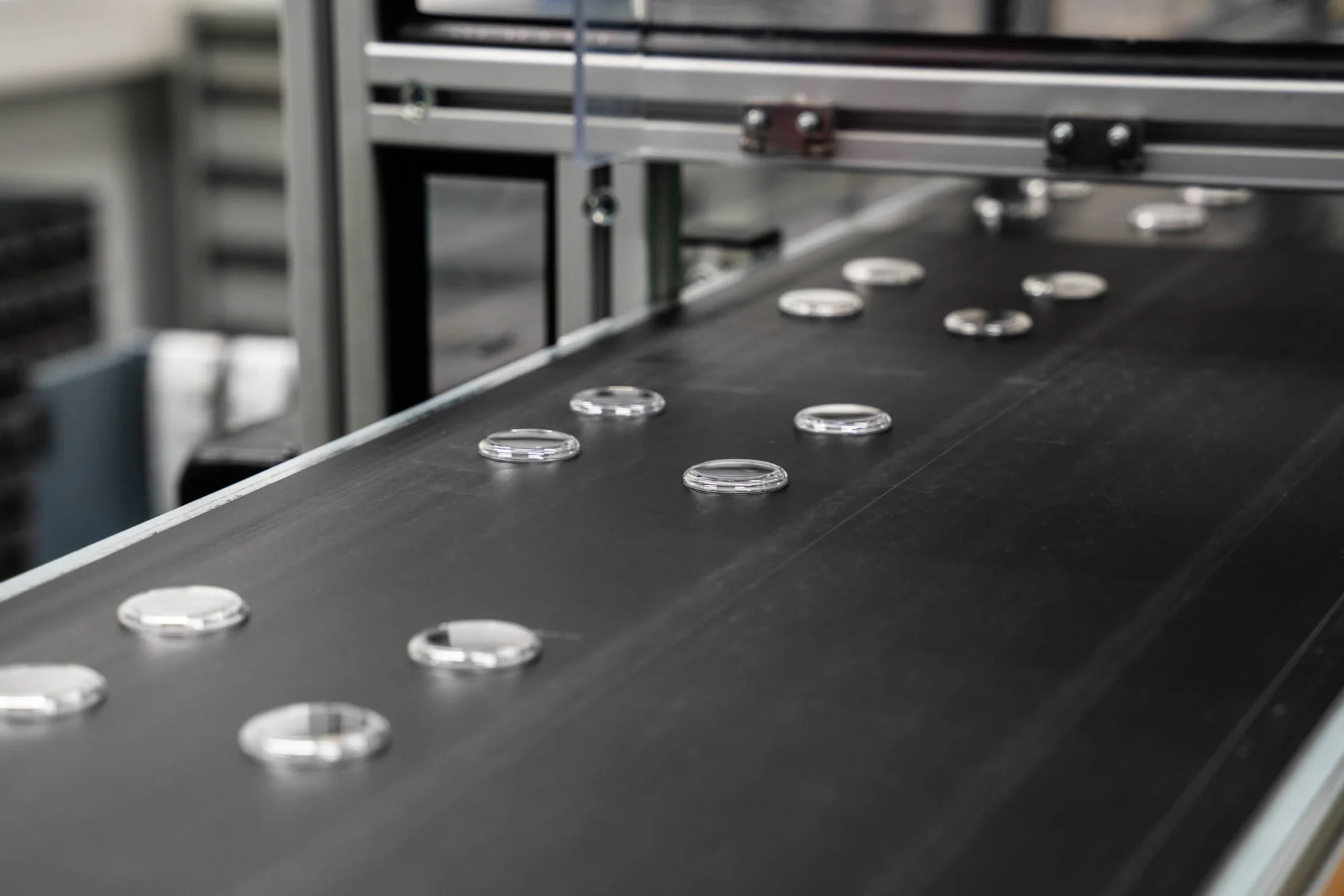
Also injection-molded here are the plastic crystals for many of Swatch’s watches, just not the Royal Pop, as it uses sapphire crystals on both the front and back, which are produced by a separate supplier. After molding, the plastic crystals are deposited onto a small conveyor belt that ends in a tiny version of a lightbox that illuminates each crystal for optical inspection before it is vacuumed onto a tray. At both the Sistem51 and Bioceramic facilities, the entire production line relies heavily on cameras for quality control at every step. Yes, there are still many points where employees perform manual checks, but mass production requires that to be the exception, not the norm.
Last but certainly not least was the dial-making process. As I noted previously, the dials for all three of Swatch’s major collaboration projects—Royal Pop, MoonSwatch, and Scuba Fifty Fathoms—are all produced here. Swatch uses a combination of different techniques, including lacquer paint, UV printing, pad printing, and injection molding, to produce these different dials.

The “Mission to the Sun” MoonSwatch dials.

Flik Flak dials being UV-printed.

The “Mission to Earthphase” MoonSwatch dials.
While the base dials for the MoonSwatch and Scuba Fifty Fathoms are metal, the Royal Pop dial is Bioceramic in its entirety. The dials are injection-molded onto metal support frames, and then individually separated once it is time to case them. While I was not able to photograph the actual negative mold used for the Royal Pop dials, Swatch did show it to me, and let me tell you that—excuse my French—it was an absolute mindf*ck to see.
If you’ve had the chance to see one of the Royal Pop dials in person, you’ll notice that it is surprisingly detailed, down to the snailed lines on the raised squares of the petite tapisserie you expect to see on a genuine engine-turned Royal Oak dial. But you know it’s a trick because the dial of the Royal Pop isn’t metal, and certainly not formed on a rose engine lathe. But what is metal is that negative mold, and boy, oh boy, was it absolutely bizarre to see a literally inverted copy of what looks like a classic dial of a Royal Oak, with its tapisserie squares sunken in.
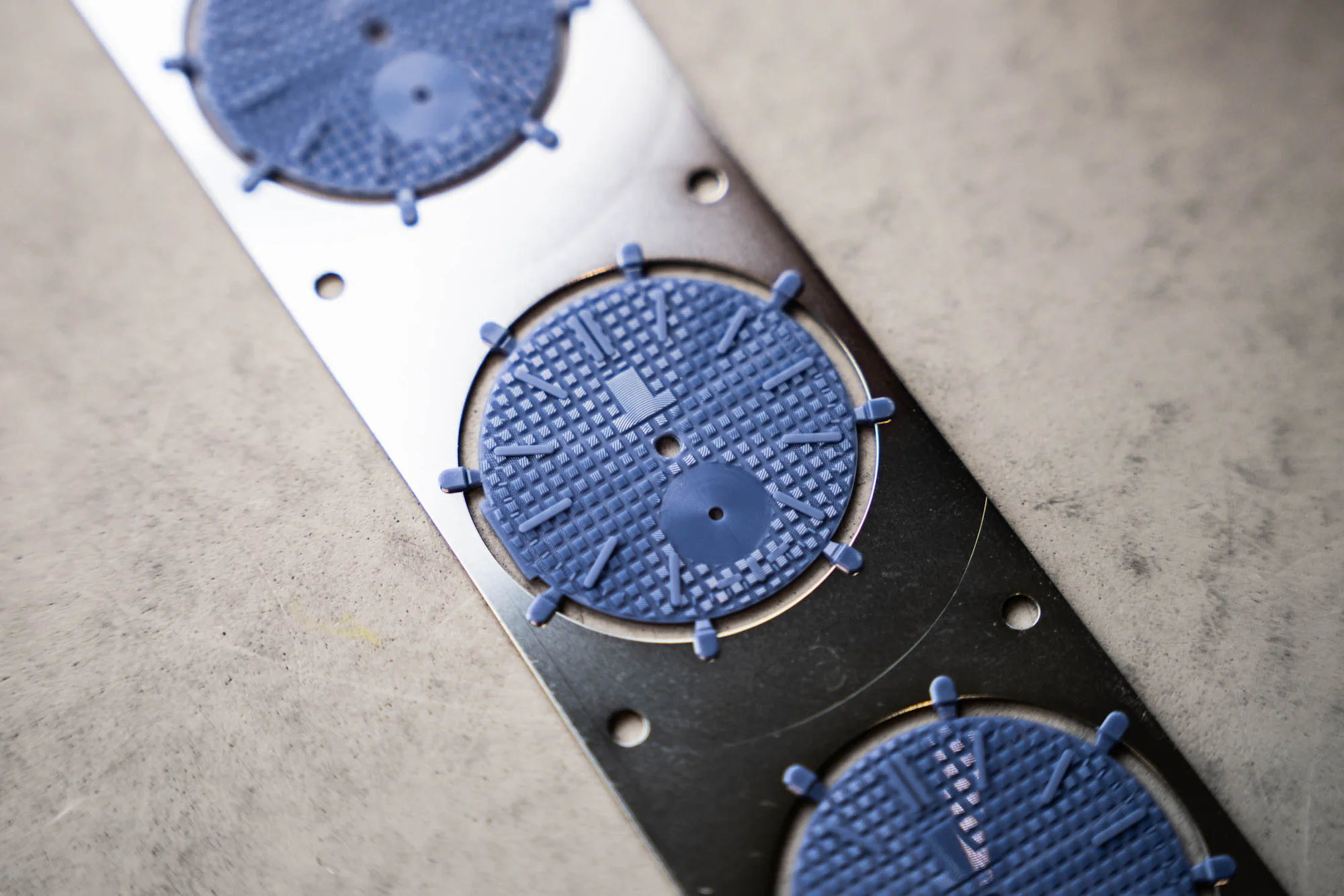
A Royal Pop dial just after injection molding, before the many steps needed for the final product.

What we were able to see that day was the injection molding of Scubaqua dials, made on the same machines as the Royal Pop dial.

Coating the dials for the Huit Blanc Royal Pop.
After the Royal Pop dials are formed by the injection molding machines, they are sent to receive several coats of lacquer paint. The dials of the white/rainbow Huit Blanc colorway were being produced during my visit, and yes, though white is not the most visually interesting color to photograph, you can see the texture of the final dial surface start to form over the petit tapisserie.


Pad printing on the sapphire casebacks.


The dials are then brought over to a rather long carousel of pad-printing machines, responsible for all the final touches on each Royal Pop dial, including the logos, minute markings, and the Super-LumiNova on the already molded-in indices. It’s quite a long undertaking, with each dial getting a solid number of prints to achieve the final result. One final pad-printed detail is the Royal Pop logo on each sapphire casebacks.
The Finishing Touches
After both the Sistem51 calibers and the external components of the Royal Pop are produced in their respective factories, they are then sent to another ETA facility down in the southern part of Switzerland for the final assembly process. I’m hoping one day I can—pun intended—pop over to that site because I think the assembly of these is also quite intriguing to me. When the Royal Pop first launched, many were quick to talk about the random order of screw colors installed in the bezel of the Huit Blanc Royal Pop. I think there was an implicit assumption that this would yield quite a few bezels with repeating screw colors, but I also learned that it’s rather unlikely to happen, as it is a controlled randomness, of sorts, dictated by an algorithm that prevents such a scenario.

There’s beauty in the single watchmaker toiling away at a workbench, laser-focused on polishing a handful of inner angles on a complex mechanical caliber. But there is inherently a different kind of beauty when you witness the giant technical puzzle that is mass production being figured out, machines working nonstop to produce—whether you care for them or not—brightly colored, lighthearted watches. In fact, it’s quite amusing to think that in the twenty-first century, there are production lines full of high-tech, modern machinery producing manually wound pocket watches for the modern consumer. But that is precisely the silliness that is Swatch, and its full commitment to the bit, that has driven a major conversation in watches since the brand’s founding a few decades ago.