

It’s somewhat hard to believe (well, hard for me to believe, anyway) but 2026 marks the ninth year of Ming. If you had told me in the earliest days of the brand in 2017 that less than a decade later they’d factor in as one of the more important independent watch brands of their era, I’m not sure how I’d have reacted. For me, the early days were a tough sell. Ming had trouble meeting demand for their watches in those first years, which can be a good problem to have of course, but can also lead to all kinds of issues with would-be customers as the expectations game gets played out in public. They’ve solved for that largely with smart planning, and a release strategy that sees a mix of accessible pieces with more haute horlogerie oriented fare, all with a design language that is immediately recognizable and all their own.
To celebrate their ninth anniversary, Ming has introduced 57.05 Comet, a watch that features a worldtimer, one of the brand’s favorite complications, in an interesting new way. It’s also the latest watch in their fifth-generation design language, which incorporates a genuinely unique take on their own flying blade lugs, twisted with deep Art Deco tropes.

According to Ming, the 57.05 takes its name from the de Havilland Comet, which aviation enthusiasts will recognize right away as the world’s first commercial jet airliner. The watch, like many worldtimers, is meant as both a useful aid to travelers and an ode of sorts to a more romantic era when international air travel was still something of a novel idea. The Ming team, which is inherently decentralized and international, spread across the globe, is probably thinking about these things quite a bit, and it all leads to what is essentially a modern update to the classic Louis Cottier designed worldtimer, which has been foundational to this type of watch for nearly 100 years.

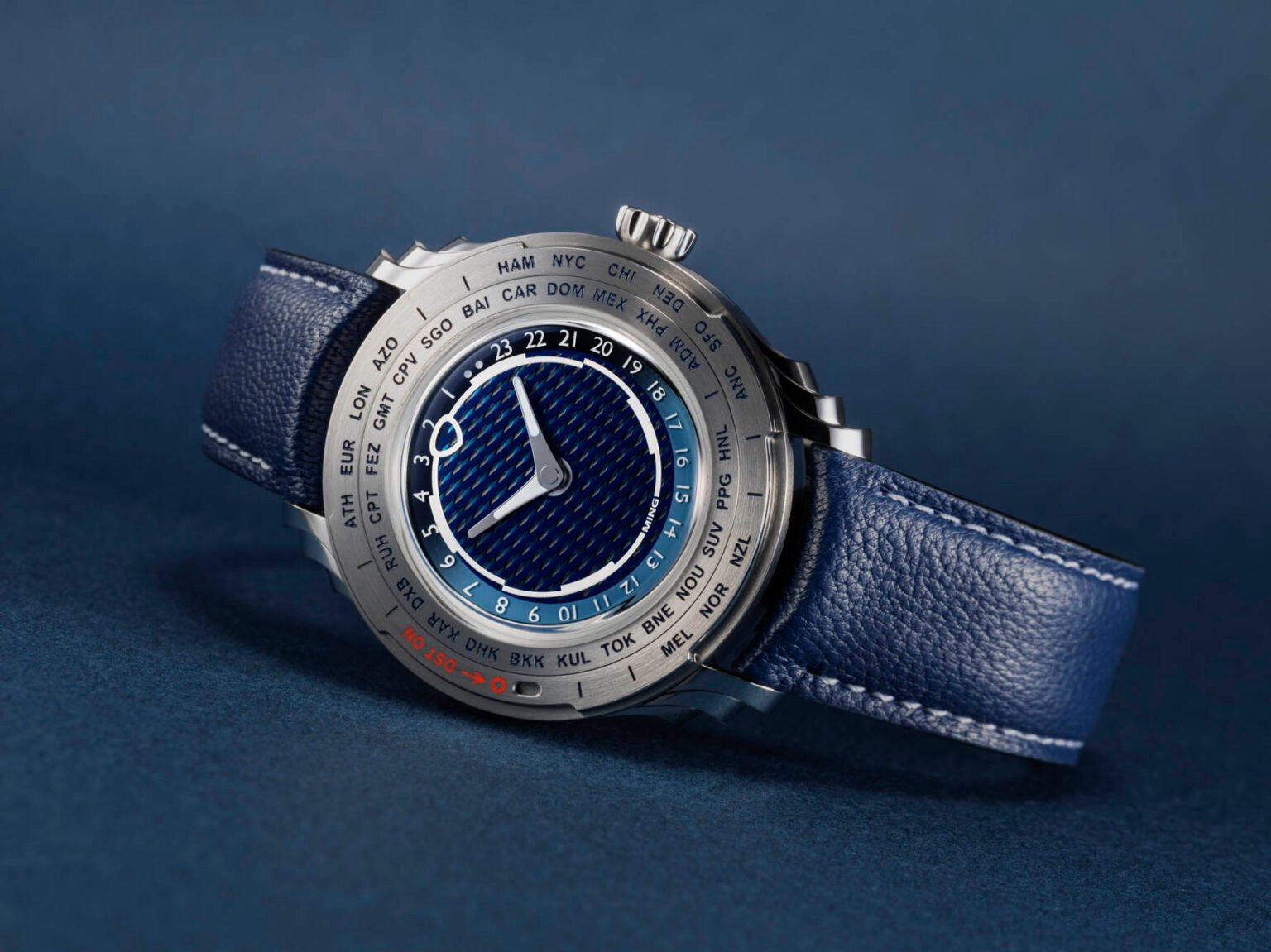
The party trick with the 57.05 is in its approach to dealing with daylight saving time (DST). Most multiple time zone watches simply ignore DST, instead showing standard time across 24 total time zones. In practice during periods where DST is observed, this can make a worldtime watch less than completely useful as certain time zones shift an hour to make more of the sunlight. Ming’s solution is to first delineate cities that observe DST and those that do not. Cities that are not impacted by DST changes are located in a fixed position on the inner bezel, while those that do observe DST are found on the outer bezel which can be rotated 15 degrees. This moves only the DST observing cities one hour forward on the watch’s 24 hour scale.

Ming says that the bezel locks into place in both standard and DST positions using a spring loaded ball and recesses built underneath the bezel assembly. A small aperture with a “DST ON” label is located between 8:00 and 9:00 to provide a visual reference for what mode the bezel currently sits in (it’s silver for standard time, red for DST). Of course, this being a Ming, there’s plenty of lume to help draw the eye in the dark.

The central dial is blue, and built in multiple layers with overlapping raster structures that create a unique visual signature as time marches on throughout the day. As the repeating grid rotates, patterns emerge and shift. It’s notable that this is the second watch Ming has released this year with a “moving” dial effect. It’s a fun little touch and speaks to Ming’s resourcefulness and creativity, executing on a purely aesthetic feature like this as a byproduct of the complication itself.
The case is rendered in stainless steel and measures 40mm in diameter and 10.33mm tall. It features the same Art Deco inspired lug design as the 57.04 Phoenix and the 57.04 Iris which necessitates nine individual components and allows meticulous finishing that wouldn’t be possible in a case with traditional construction. The movement is the Sellita for Ming calibre 330.M2 with 50 hours of power reserve. This is a caller GMT movement repurposed for worldtime use.

The 57.05 Comet is a limited edition of 200 pieces and is priced at CHF 6,950 on a leather strap and CHF 7,950 on a Polymesh bracelet. Orders open through Ming and their retail partners tomorrow, and we’ll have hands-on impressions of the Comet at Geneva Watch Days very soon. Ming