

I’ll keep it simple: when someone says “Vianney Halter,” the first thing that comes to mind is the Antiqua. Okay, well, that assumes you are a watch nerd who knows who he is, but if you are, an image of this bizarre, visually challenging, yet brilliant watch should appear in your mind’s eye. A perpetual calendar spreads across three decentralized portholes with riveted frames that cut through the central body’s perimeter; it’s a relic from another dimension. It’s also a late-1990s design, predating the modern era of haute horology, making it a truly important artifact of independent watchmaking.
And it’s ultra-rare, with a production of just over 100 units in total. All were in precious metal, and one recently set a record at auction, fetching over a million USD. This isn’t surprising, as Mr. Halter’s name has gained new relevance in the last couple of years through collaborative launches. At the last two Geneva Watch Days, watches bearing his name were likely the most talked-about launches. In 2025, he teamed with Behrens to release the KWH, an unexpected design with a peripheral “snake” time display that the brand continues to manufacture in different case materials. Though five-figure, it’s actually one of the more accessible Halters available.

While unique and exciting, the KWH speaks to a wholly different aesthetic than the Antiqua, which is why this year’s GWD launch, the Bvlgari Octo Finnissimo Dual Time x Vianney Halter, was so exciting. Though highly limited and priced to match, the watches merged the Octo’s brutalism with the Antiqua’s nautical sci-fi aesthetic with surprising success. The watch was nothing short of stunning, putting Mr. Halter’s unique design language back in the spotlight.


Typically, this story would end with our appetites whetted for something that was never meant to be obtainable, but not this time. Enter Louis Erard and their approachable collaborations. Erard has a history of working with Vianney Halter that predates this recent resurgence. Their first collaboration was a regulator in 2020. An intriguing design with a heavily layered dial, it emphasized the typographical elements of Vianney’s work and his hand designs, but left out the distinctive gauge-like case elements of the Antiqua. In 2024, they teamed up again with a design that began to scratch that itch.
Another regulator (Louis Erard is known for using the complication/layout), these 43mm all-metal creations had the rivets, indices, grained surfaces, and distinctive crowns that evoke the Antiqua design, but still didn’t go the full monty. The missing element was portholes or individual dials for each function. Given the fixed positioning of the hands of the regulator design, especially the central minutes, as well as the standard case (which they had modified with a different bezel), that was likely not within the realm of possibility. It was a gorgeous watch nonetheless, and is actually still available in a monochromatic variant.

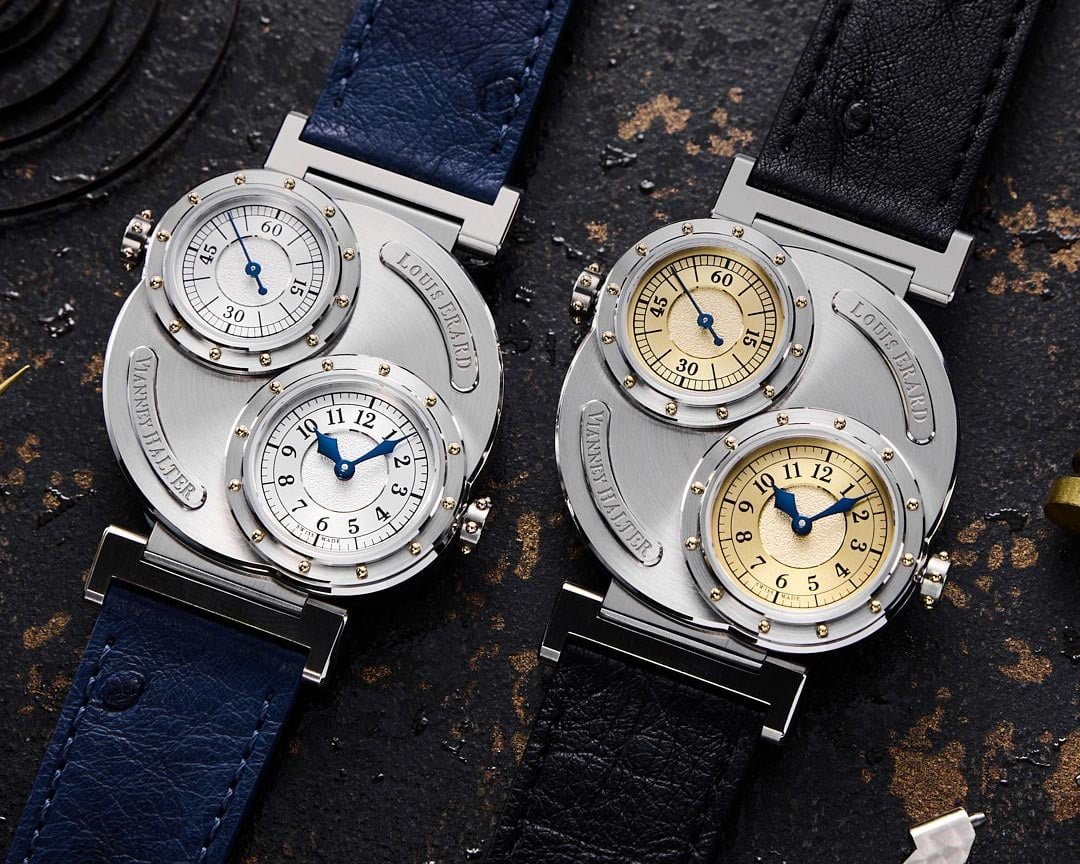
Jump forward to right now (October 2026), and Louis Erard and Vianney Halter have gone the extra mile with the Futur Antérieur, creating the most Antiqua-esque watch possible while keeping a semi-approachable price point, though not without one peculiar decision along the way. One of the two biggest roadblocks in the previous designs was the case, so this time, they went all out and designed a new one from the ground up. With a central cylinder, portholes at four and ten, articulating lugs, and contrast rivets around the perimeter, the DNA isn’t abstracted; it’s there, though calling it Antiqua Jr. is perhaps too on the nose. Assembled from 67 components and made of steel, it measures a reasonable 38mm in diameter and 8.85mm thick, though it is hard to say how that accounts for the portholes. With the articulating lugs, that should wear very nicely, despite the strange shape.
As for the dials, the window at four contains hours and minutes, while the window at ten shows the seconds. The dials are layered and textured in a way that speaks directly to the Antiqua, and they feature heat-blued hands in the same style. No reinvention, no interpretation. This is really meant to bring a semblance of that watch to a new generation. And that brings us to the second roadblock: what movement could they use for such a layout? Well, the answer is either quite clever or bafflingly silly: they used two small movements.


The two crowns are a dead giveaway, but under each dial is a Sellita SW100. These automatic movements are only 17.2mm in diameter; thus, they can be nestled within what are essentially two independent watches. The rest, I suppose, is empty space or solid metal (hopefully the latter for heft). Watches with two small, independent movements are a thing, but typically both tell the time. Here, it is merely the illusion of a single movement, and the ability to “hack” an unattached seconds hand.
Yeah, that’s really weird. Perhaps it’s funny? Quirky? Ingenious? I can’t decide, especially given the price tag (which I’ll mention shortly). This is literally a dual-time watch with functionality removed for aesthetic effect. It looks great, but is fake, in its way. One dial could have had two hands, the other three. One dial could have featured an hour index, the other minutes, to create the effect, at least, of two scales. Perhaps they could have modified one movement to be 24-hour instead of 12 (likely easier said than done, but still). My guess is that they feel the “quirkiness” factor wins out given the watch’s aesthetic.

At 4,950 CHF, which, with tariffs in the US, is about $6,757 (at the time of writing), I’d prefer function, even at the cost of the illusion. Yes, this is a four-figure watch that gets you about as close to a high six- to low seven-figure watch as many of us would ever come, and frankly, it’s gorgeous, but you’re paying for two Swiss-made mechanical movements, and only using one (ok, if you were really trying you could maybe make some argument about resonance, but that would be a very long stretch). Another option I wish they had considered is a compass. That would have fit thematically and have possibly cost less too.
At launch, there are two versions of the Futur Antérieur: one with silver dials and a blue ostrich leather strap, and the other with contrasting 1N gold-toned dials and a black ostrich leather strap. They are priced the same and limited to 178 pieces per color. Like the Alain Silberstein titanium line and the Konstantin Chaykin “Unfrogettable” models, I imagine Erard will keep producing new versions of the Futur Antérieur, given how far they went to develop the new case, but that is just an assumption.

Final thoughts. I owe much of my taste in watches to the Antiqua. In the late 90s, one was on display at what was the Tourneau Time Machine on 57th in Manhattan. I have distinct memories of admiring it through the glass as a teen when I would visit the shop with my dad. I had never seen anything like it and was enamored. These days, I own two watches with very uncommon “porthole” designs: the Seiko Sportura SLQ009 kinetic chronograph and the Otsuka Lotec 7.5. I also love watches with decentralized dials in general. I think this all goes back to the Antiqua.
I want to love the Futur Antérieur. I want to feel the need to make a bad financial decision and buy one. I know I will never own an Antiqua and am ok with that. I like the previous Erard x Halter collab, but at 43mm it’s too big for me. The Futur Antérieur should be the one I run to. It nails the look, but I also know that gimmicks get under my skin. When I’ve owned watches that felt too novel for their price tags, I’ve ended up selling them, and I don’t think I could get over having a movement that’s just used to make a seconds hand tick. Louis Erard
The post The Third Louis Erard x Vianney Halter Collaboration is So Close, and Yet, So Far appeared first on Worn & Wound.