

When the Tudor North Flag came out in 2015, it was met with a collective “what?” Tudor had chosen it to debut its in-house movements, a genuinely big moment for the brand. But the watch itself was a totally unexpected throwback to the fairly obscure Ranger II, an integrated bracelet sports watch from the ’70s that I don’t think anyone expected to see revived.
It was interesting, though. The North Flag had a design language entirely separate from the Black Bay and Pelagos lines, plus a hybrid steel-and-ceramic bezel, a display caseback, and a power reserve. That last feature is still the only time Tudor has used a power reserve on one of its modern movements.

The reaction was mixed. Tudor was arguably too far ahead of the curve: integrated bracelet sports watches weren’t trending; vintage divers were. Six years later, the North Flag was discontinued.
In the meantime, integrated bracelet sports watches didn’t just become popular; they became almost a requirement. It feels like every brand has released one in the last five years, at prices ranging from a couple hundred dollars to a couple hundred thousand. People now look back at the original North Flag and think, “Oh, wait a second. Maybe that was a pretty cool watch after all.”
So while the first North Flag was ahead of the curve, the new Northflag is right on time, or maybe even a touch late. It’s also a GMT, though you won’t find “GMT” in the name. The question is whether Tudor has made a better watch by refining the original, or lost some of what made it interesting.
Review: The Tudor Northflag Gets a Second Chance
Stainless Steel
Tudor MT5652-U
Black Sunburst
Molded Ceramic
Sapphire
integrated bracelet
100m
40 x 48mm
12.7mm
mm
Screw-down
Yes
$5525
Case
At a glance, the 2026 Northflag looks a lot like the old one. It’s still a 40mm integrated bracelet steel sports watch. Look closer, though, and nearly every detail has changed, sometimes at the cost of uniqueness. The case no longer drops off bluntly at the lug. Now there’s a slight curve and a polished bevel, similar to Tudor’s approach on the Royal. It looks good and a touch higher-end. The original had a blunt, toolish charm that only comes from function-first design; it was ugly in a cool way.
The bezel also gains polished chamfers, but loses the black ceramic ring that encircled the original, which is a detail I’m disappointed to see go. The new bezel is very well finished, and I have nothing against it, but that ring was something distinctive.

Tudor kept the tapering crown, which I’m neither for nor against. It screws down, is easy to grip, and is inoffensive; it’s a crown. The tapering H-link bracelet received a smaller makeover, with polished chamfers on the middle links and a new clasp with Tudor’s excellent micro-adjust system. More on how it wears in a bit.
Dial
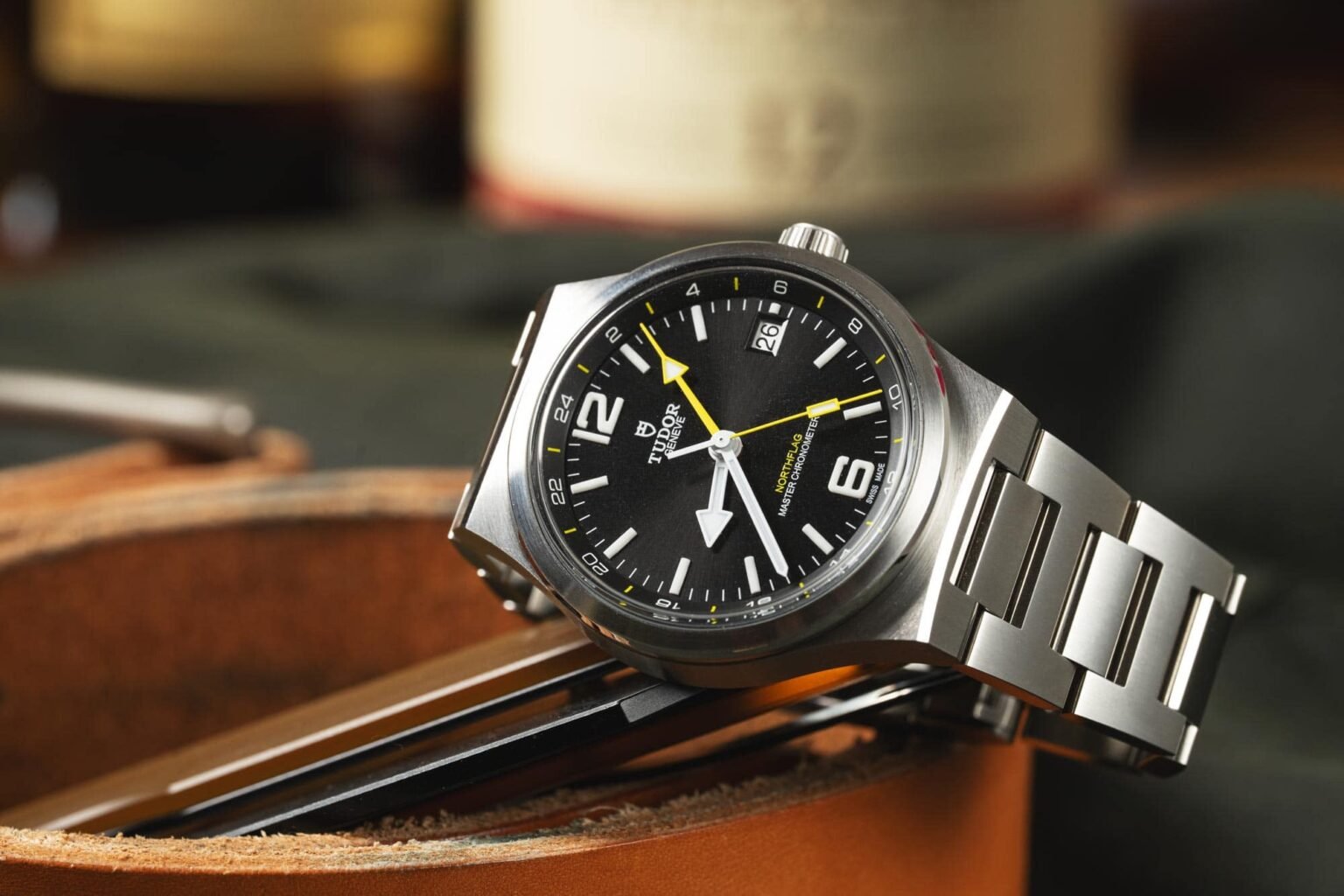
The dial has been more extensively redone, though it clearly speaks the same design language. It’s black with a subtle sunburst effect, large geometric numerals at 12 and six that recall the Ranger II, and rectangular hour markers with white hash marks between them.
Those hash marks are now on the main dial surface rather than the chapter ring, filling up the negative space. I found the dial on the 2015 was awkwardly open. It also frees the chapter ring for the 24-hour GMT index, where white numerals alternate with thin yellow marks. Tudor also added a small appliqué beside the date window and a marker at nine, where the power reserve used to sit, eliminating other open areas.

I have to say, the 2026 dial is way more balanced than the original. The proportions of the marks to the appliqués, the more limited use of yellow, and the filling of empty space make for a really tight, well-thought-out layout. The molded ceramic lume helps, too.
They haven’t used molded ceramic lume since the Black Bay Pro, one of its best features, and it’s been driving me nuts. The markers glow well from every angle and edge-to-edge. They’re also thin and shaped, with beveled top edges, which is just cool. That thinness matters most here. Compared with the previous markers, it’s like going from a bold font to a medium. It cleans up the dial enough to allow for the denser layout.


The hands remain familiar: a white arrow hour hand and straight sword minute hand. The luminous section of the seconds hand is now rectangular rather than tapered, and the yellow stops at the center, leaving a white counterweight. That likely keeps it from competing with the new, all-yellow GMT hand. The GMT hand is long and thin, tapering to a fine point, with a large luminous triangle. It stays out of the other hands’ way and maintains legibility, though it does look somewhat similar to the Black Bay Pro’s GMT hand.
Above six, “NORTHFLAG” appears in yellow, with “MASTER CHRONOMETER” below it in white. There’s a curious branding change here: the original was “North Flag,” two words; the new watch is “Northflag,” one. Tudor previously held a trademark for “Tudor North Flag” and now has “Northflag” for watches. To me, that reads as a more distinct name, like Pelagos or Black Bay. It makes me wonder if Tudor plans to build out the line, likely depending on how this first offering does.

The missing power reserve is both unfortunate and totally logical. It gave the original personality and highlighted its three-day reserve with a hand that was painted on a disk, which felt very modern. That said, it’s not really “needed” on an automatic watch, and likely would have added height to the already-thick GMT movement. It also would have disrupted the balance Tudor has achieved here. I’m torn. It could have become a Northflag signature, and maybe it should return one day.
Movement
“Master Chronometer” points to an important feature of the MT5652-U movement. COSC first certifies it as a chronometer, then it undergoes METAS testing as a fully assembled watch head rather than as a movement alone.
This is the same movement Tudor uses in the Pelagos FXD GMT and appears to be a METAS-certified version of the caliber used in the Black Bay Pro and Black Bay GMT, as indicated by the “-U” in the caliber reference. It’s a flyer GMT, so the local hour hand jumps rather than the 24-hour hand, and the date is set by advancing the local hand past 12 in either direction. Otherwise, it runs at 28,800 beats per hour, has a 65-hour power reserve, hacking seconds, and a silicon free-sprung balance.

You can see the movement through a display caseback, which is rare for Tudor. Don’t expect elaborate finishing, though. It’s fully matte, with a laser-engraved burst of lines that feels like the bare minimum of decoration. I don’t dislike how it looks, but it’s clear Tudor didn’t put extra effort into it, despite the price.
On the Wrist
The Northflag is 12.7mm thick, which is about 2mm thinner than the Black Bay Pro. Still, the Northflag isn’t thin. It’s fairly slabby, and the crystal doesn’t have much dome to absorb some of that height. That’s perhaps unsurprising given that the MT5652-U is over 7mm thick itself.

On my 6.75-inch wrist, I found it tolerable, though it stands a bit high. I’d welcome a little shaved off the top if that ever becomes possible. The 40mm diameter feels like a modern sports watch. Would I like it a bit smaller? Of course, but it’s fine as is. The effective lug-to-lug measurement, which is hard to pin down on an integrated bracelet watch, is in the 48mm range.
A lot of the fit depends on the bracelet because it’s so essential to the design. It starts at 22.6mm and tapers to 16mm at the clasp. As someone who isn’t huge on bracelets, less is more: the taper means less surface area against your skin, and it looks good. Tudor also left plenty of space between the links. I’m sure some people will complain about the gaps, but they add flexibility and breathability and are barely noticeable on the wrist.

What does bother me is the lack of a secondary strap option at launch, especially since the original had one. With an integrated bracelet, you can’t simply fit a standard strap. You’re limited to what the brand makes and, eventually, what third parties make if the watch becomes popular enough. I would get tired of wearing it only on the bracelet, and at $5,525, I think Tudor could have included another option.
Conclusion
At $5,525, the new Northflag costs about $2,000 more than the original. It’s also arriving more than a decade later with Master Chronometer certification. Among Tudor’s GMTs, it sits between the FXD GMT and the Black Bay 58 GMT, both of which are also Master Chronometers. At least Tudor hasn’t used the new watch as an excuse to jump above its other options. If anything, it has created more internal competition. Tudor now makes a lot of GMTs, and among them, the Northflag seems to take aim at the Black Bay Pro.

The original North Flag was charmingly awkward. It felt like the watch of a brand still figuring itself out, with more to prove and fewer customers to please. The new Northflag is more mature. It speaks to a company with another decade of experience making and selling watches. I think it’s undoubtedly a more successful design. If we didn’t have the old one to compare it with, there wouldn’t be much negative to say. That said, if it were thinner, smaller, cheaper, and had a better-decorated movement, it would be all the more compelling. But when isn’t that true?
Ultimately, it’s a very nice watch, and a genuine alternative to the dive-heavy flavor of Tudor’s other GMTs and sports watches. For existing customers, it offers a different experience. For the many people who want an integrated bracelet sports watch, Tudor finally has a competitive option. Tudor
The post Review: The Tudor Northflag Gets a Second Chance appeared first on Worn & Wound.