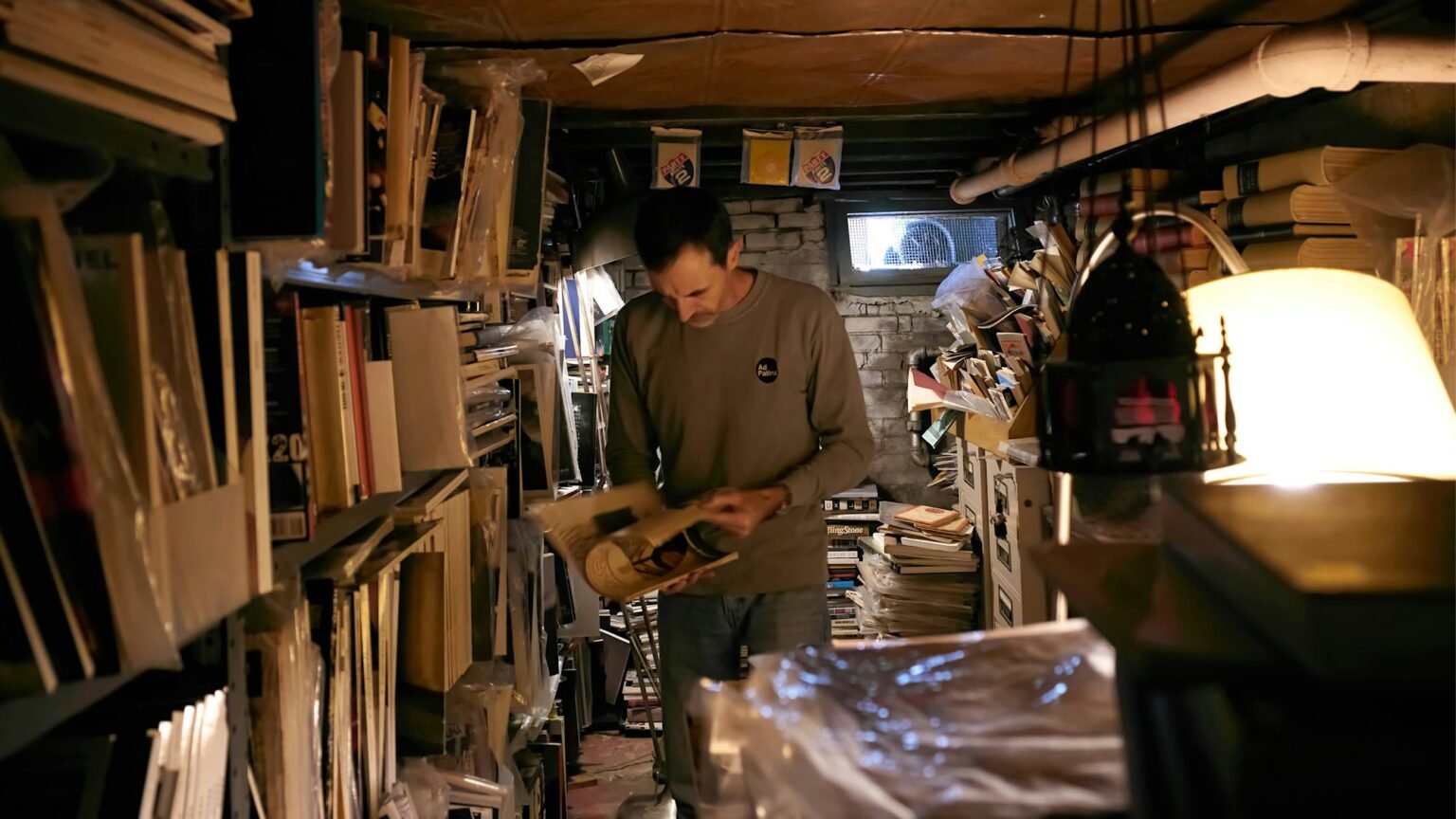


“I really need a November ’76. Gonna be tough.” I squeezed between floor-to-ceiling shelves of magazines and a table stacked high with glossy-covered issues to see what Nick Federowicz was rifling through. A stack of vintage Vogue piled up next to him. Federowicz, 45, who stands around 5′ 9″ with a slim build, is crouched so low he’s completely obscured by the table beside him. “The first hour is just planning how you’re going to attack it all,” he said before sliding a pile of lime green Geo magazines across the floor to reveal a shelf filled with Harper’s Bazaar.

A half hour earlier, I’d taken the L train to Bushwick, Brooklyn, and made the brief walk from the Bedford stop through McCarren Park before texting Federowicz when I arrived at our agreed meeting place at the corner of Lorimer Street and Bedford Avenue. “Ok, I’m just finishing a slice of pizza close by!” he replied. A few minutes later, he walked up and waved me over towards a nondescript townhouse. Behind a gated front door is High Valley Books, an appointment-only treasure trove of vintage texts accumulated and curated by Bill Hall. Throughout the collection are thousands of magazines, some over a century old, and hidden inside their pages is pay dirt for Federowicz. “There’s billions of pages in this building” he said, “you’re looking for 20 out of a billion.”
Federowicz’s business, Ad Patina, sells vintage watch ads as collectible art. Founded in 2016 as a side hustle while he worked at Nordstrom, Ad Patina became his full-time gig by 2019. “Instead of ducking into the bathroom at my job to do a post or answer an email,” he chuckled. Today, Ad Patina, headquartered in Chicago, has a showroom in the Windy City in addition to its online store, and it has sold thousands of ads, now proudly displayed in homes and offices around the world.
“All of my quote unquote ‘best customers’ don’t even have Instagram accounts,” Federowicz told me, “they’re just real people who are real collectors, and they’re not trying to buy stuff just to show it off.” One of his good customers who is on Instagram is George Bamford, best known in the watch community as the founder of Bamford Watch Department, a London-based outfit that gained notoriety for its custom-modified (often blacked-out) Rolex watches. In recent years, Bamford and his company have served as creative collaborators with various watch brands, designing limited-edition versions of TAG Heuer, Seiko, Zenith, and Bremont watches.

In what has become an annual tradition, Federowicz has visited Hall’s collection at High Valley Books to hunt for inventory while in town for New York Watch Week, a constellation of horological events orbiting around the binary stars of WatchTime New York and Windup Watch Fair. WatchTime, a ticketed event that celebrated its 11th year in 2026, hosted 48 watch brands at Gotham Hall on Broadway and 36th Street; its egalitarian, free-to-the-public counterpart focused on so-called “microbrands,” Windup, was held just a few blocks away at Center415 on 5th Avenue and 37th Street. Ad Patina has exhibited as a vendor at Windup New York for the last four years. New York Watch Week has grown in popularity in recent years, spawning dozens of satellite events hosted by retailers, brands, and collector groups. This year, WatchTime New York and Windup New York celebrated record attendance, with Windup boasting queues that’d make Disney World jealous; watch enthusiasts from all around the country encircled an entire city block.

I visited the Ad Patina booth at Windup New York Friday afternoon and was greeted by a smiling Federowicz, who’d set up hundreds of carefully extracted and individually wrapped magazine ads for visitors to flip through like a record store. There were the usual suspects: Rolex, Omega, Patek Philippe, along with some curveballs from Doxa, Citizen, and even a small framed vintage map of Central Park Federowicz had found on the road trip from Chicago to New York for the show. The following three days were a blur with hundreds of visitors at the Ad Patina booth leafing through inventory and talking shop. By all accounts, the show was a success for the organizers and for Ad Patina. After packing any remaining inventory in his car Monday morning, he drove out to Brooklyn for one last stop before making the long drive home.
Federowicz’s fascination with watches (and their ads) started early. Growing up in New England, he had decorated his childhood bedroom with posters of Lamborghinis, Cindy Crawford, and Rolex ads he had “really crudely” torn from the pages of magazines from the local library, Federowicz confessed. Then, as a high school senior while on a class trip to Paris, Federowicz convinced his art teacher to float a $1,800 Rolex Datejust on her credit card until he and his classmates returned to the States and could repay her with the funds he’d saved up while working at a local grocery store.

Years later, Federowicz was a full-blown collector, prowling Craigslist for vintage Speedmasters. At the time, watch literacy wasn’t what it is today, “they didn’t know if it [was] a 2915, it [was] ‘just a Speedmaster.’ And so, for a year or two, I was having pretty good luck finding really awesome watches for fair prices.” He recounts meeting people “in a parking lot with an envelope of cash,” even flying to “meet a guy at the airport” to buy a Speedmaster for $3,000. “Within a year or so it got really hard to collect that way because there were just more watch dealers popping up. More competition.” With that competition, prices rose, and hidden treasures became fewer and farther between. Returning to a childhood pursuit, collecting ads rather than the watches they depicted, Federowicz’s collection grew in number and scope.
After exhausting the selection on the first floor, we made our way through a narrow hallway to a steep set of stairs. The basement was crammed even more tightly with rows of shelves, each filled with titles neatly grouped together. Lighting was infrequent, with the occasional bare bulb, an oversized floor lamp, and one vaguely Moroccan-looking hanging lantern with red-tinted glass. “I think I have an itch to collect and an itch to hunt and an itch to acquire things in a hard way,” he said while shuffling a stack of Fortune like a deck of cards. “This is hunting and digging. This is getting your hands dirty. I remember the last time I was here I whacked my Explorer against this thing” gesturing at a lantern. “I loved it because it put a big scratch on it doing this.” Looking all around the dimly-lit cellar, he continued, “I’ll always remember where I was: in a basement in Brooklyn, looking for magazines. That’s where this gouge came from. And so I like the idea of hunting for things and finding things, the journey to get it.”

“Italian ads are so crazy,” Federowicz said abruptly, sliding an open magazine toward me. On the page was a risque tobacco advertisement, a suave man doing his best Charlie’s Angels impression, albeit with a cigarette instead of a pistol, flanked by scantily clad women. Federowicz’s job is part print-media merchant, part advertising archeologist, with much of his effort spent uncovering long-since-forgotten-about materials; “it’s a shame if a great image just stays in a magazine, never comes out, because someone took the time to draw it, to photograph it, to illustrate it, and that’s still work,” he said, leafing through a yellowed Fortune. “Let’s take something great out and let’s put it in front of us to see. I think that you get more out of it that way than having it in here,” he said, waving at the small stack of keepers found thus far.
Federowicz’s work as an archivist helped inspire Brendan Cunningham, PhD’s 2022 book Selling the Crown, a seminal look at the relationship between Swiss watch juggernaut Rolex and its American mad-men counterparts at the J. Walter Thompson advertising agency. JWT’s work on the Rolex account in the 1960s and beyond spawned many of the most famous and desirable ads sold by Ad Patina today, including the legendary “If You Were” campaign, which depicts various high-octane jobs paired with a Rolex watch. For example, “If you were looking for lost empires here tomorrow, you’d wear a Rolex” or “If you were flying the Concorde tomorrow, you’d wear a Rolex.”
Hall stuck his head around the dimly lit corner. “I’m worried about this table,” he cautioned, pointing at the waist-high slab between the two of us. The thick wooden legs looked sturdy enough to my eyes despite the towers of titles arranged in neat stacks, but Hall goes on to explain, “It’s my project for tomorrow; don’t want it to end up on your feet,” exiting with a thumbs-up. “Fair enough,” we agreed, giving the table a wide berth.


Continuing with our search, I asked, “How about this one? Rolex GMT.” Flashing a vintage GQ in his direction. “Is there a guy on it?” he asked without looking up. There was: William T. Seawell, Chairman and Chief Executive Officer of Pan Am, according to the ad copy. “Probably not.” After flipping through dozens of issues all I’d come up with was a single Datejust ad, “you know a lot of people ask for Datejust ads” Federowicz tells me, continuing “it’s such a common watch. So many people have a DJ and want a good DJ ad.” While Ad Patina is most well known for watch ads, in recent years Federowicz has broadened his jurisdiction to include select automotive advertisements–primarily Porsche and Land Rover–Nike, and booze brands including Campari and Absolut (the latter at the request of Mr. Bamford).
“Have you seen this Movado ad before?” I asked, holding up a full page spread: a picture of a wrist sporting a chromed-out watch with an owl perched on it. “That’s neat, I’ve seen it with a cat,” he replied. Less popular models and brands are often a catch-and-release for Federowicz if the demand simply isn’t there. For better or worse, the watch ad market mirrors the real-deal market, where Rolex is king.


Fittingly, the most expensive ad in Ad Patina inventory is a 1973 Gobbi Jewels Rolex ad from the Italian market, featuring the profile of a woman wearing nothing more than the watch on her wrist and the copy “elegant even in the shower,” listed just shy of $3,000 on his site due to the rarity, condition, and–candidly–absurdity of the piece. Conversely, Federowicz’s white whale is an Omega Speedmaster ad featuring the portrait of an Apollo-era astronaut in his Extravehicular Mobility Unit (EMU) suit with copy that reads “How can a man in a $27,000 suit settle for a $250 watch?” “I mean, I don’t know when that’ll ever be available again, because the next one I’m keeping and then that second one I find…” he trails off. “I don’t even know, how do you price that? I just think it’s one of the best.”
While Ad Patina sources ads from as recently as the 2020s, Federowicz has a soft spot for the 90s: “When I see ads and magazines from the ’90s, I find myself looking and flipping the pages slower, because I’m seeing things that remind me of growing up.” He continued, “It just takes me back to a time in my life where I was like, man, I wish I, I wish I savored it more. I wish I knew it was on the palm of my hand.” Watches and the ads that portrayed them allow Federowicz and his clients to recapture that moment.

A few hours into our search, we found only a small pile of titles; perhaps he’d been too comprehensive in his search the year before. “Sometimes it’s like that,” Federowicz says. “The thing about looking through magazines this way, you’re not really going page by page. So you might miss that one page.” Last year, his search had uncovered a Vacheron Overseas ad he had never seen before, one which may have otherwise been completely lost to the sands of time.
Federowicz had a long drive ahead of him, roughly 400 miles to Youngstown, Ohio, where he’d drop anchor for the night before tackling the back half of the journey to Chicago. After checking that his inventory was properly stowed in his 4Runner, he was off, eyes undoubtedly peeled for vintage and antique shops and flea markets on the way home.