

Four years ago I spent a fortnight with the Archival 1930, and ultimately proclaimed it the closest Fears has come to parting me from my hard-earned money. Since then, two things have happened. Firstly, Fears did earn my business by way of the Alliance 01 collaboration with Christopher Ward. Secondly, the modest lineup of rectangular watches from the brand has grown ever so slightly but remains overshadowed by the flagship Brunswick and sporty Redcliff families, and are perhaps therefore a little underappreciated. With so many iterations based on the Brunswick template, including the hugely popular cocktail trilogy produced in collaboration with Studio Underd0g, I find myself rooting for the Arnos – Fears’ first watch to build on the template of the Archival 1930 which captured my heart.

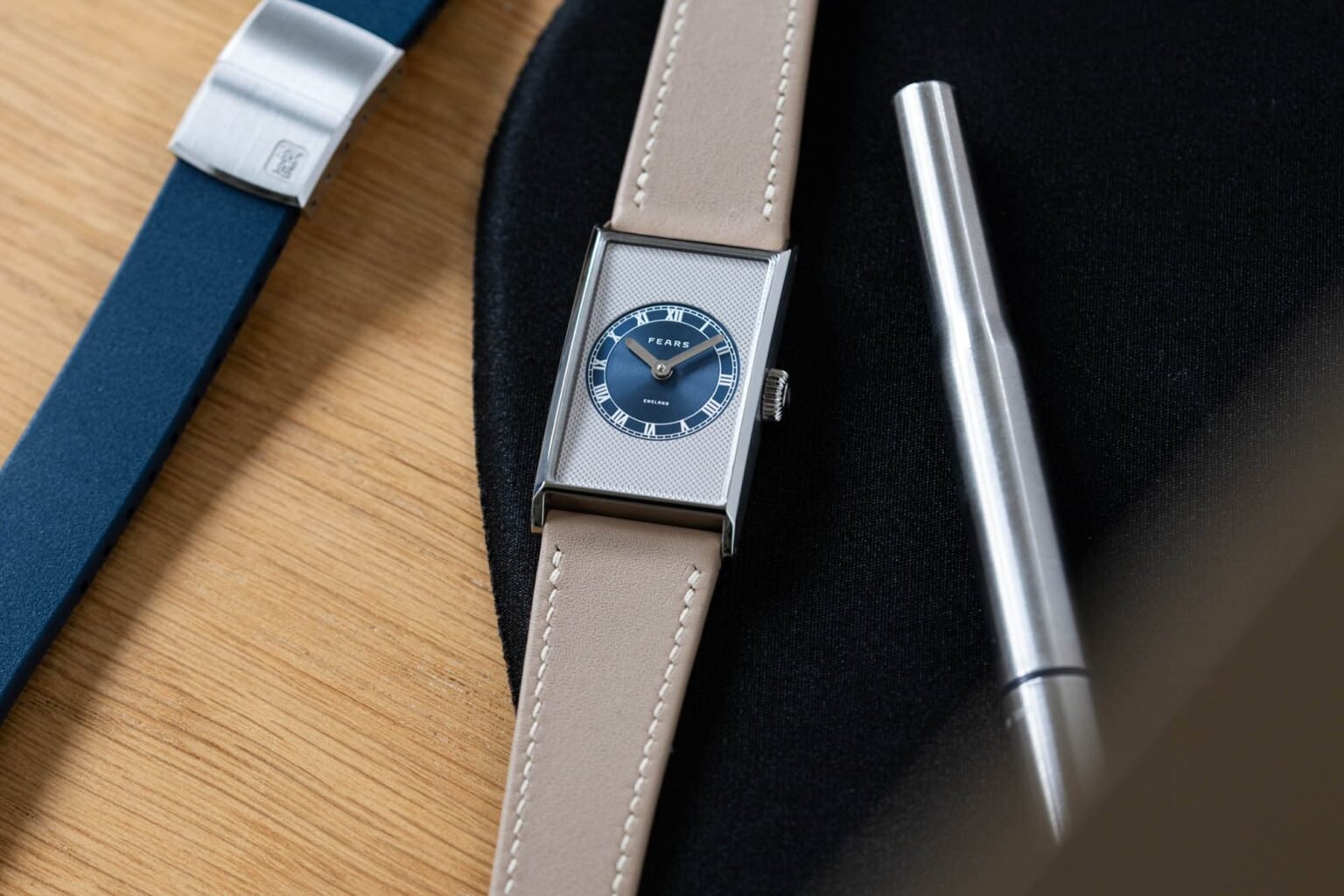
When analyzing the Arnos ($4,500), it feels appropriate to start with the dial. I haven’t sought out common opinion in preparation for going hands on with the watch, but I fully expect the dial to be a polarizing factor. As is the case with any rectangular watch, there’s going to be a lot of space to fill. Space where the hands just can’t reach. That’s true of square dial watches too, but exacerbated further in a rectangle. Some watches fill this space with stretched indices, or an inner minute track matching the same outer rectangular shape. Even the aforementioned Archival 1930 (in two-hander form) lined the indices up vertically to cleverly use the corner spaces. Here, however, Fears is highlighting the big disparity between the ‘outer dial’ (as Fears themself refer to it) and the inner time-telling dial.
Review: The Fears Arnos Pewter Blue
Stainless steel
Sellita SW1000-1b
Pewter Blue in two sections: ‘Outer dial’ with hobnail pattern cut
None
Sapphire
Leather/Rubber
30 meters
22.6 x 40mm
8.4mm
20mm
Push/pull
Yes
$4500
And I don’t know how to feel about that. Or, more accurately, I can’t make up my mind how I feel about that.

Sometimes I’m drawn to the sweeping expanse of Rhodium-plated Clous de Paris. After all, it’s captivating, unusual and dynamic aspects like this that make a watch interesting. But, at other times there’s just too much of it, becoming the main focus rather than an attractive and balanced embellishment. The hobnail outer dial, in isolation, is lovely though, casting a combination of shadows, shimmers or speckles depending on the presence of light and the angle of viewing.
The inner dial is necessarily small, barely measuring 17mm across inside a 22.6mm wide case, with crisp white Roman numerals and minute track printed over a blue dial. Although named Pewter blue, the dial only really hits that shade in direct sunlight. Most of the time it is closer to a slightly desaturated navy blue. The tiny pyramids of the Clous de Paris outer dial are echoed in the tips of the hour and minute hands. Both are Rhodium-plated and mirror polished with a central bevel for most of the length. Usually, polished hands with a sharp crease down the center tend to catch the light on one side or the other, but these hands with three competing angles add another dimension.

Just as when I reviewed the Arnos’ predecessor, I’m struck but how reassuringly robust the case feels on the wrist, despite its delicate appearance from the front. At its thickest the case measures 8.4mm deep, but it’s the curvature seen from the side which has more bearing on how the Arnos feels. That gentle curve is seen on the front of the watch as the crystal gently arcs from almost touching the dial at either end rising above it in the center. The corresponding curve on the rear is mostly felt rather than seen.

The solid case back, marked only with ‘Fears Watch Co Ltd’ and ‘Hand Built in England’ features brushing along the full length, which is the same as the case sides. Only the chamfer around the top side of the watch is polished steel, continuing the theme of ‘less is more’.
Beating inside is the Sellita SW1000-1b, a Swiss automatic movement similar in layout to the more common SW300-1 but notably with a much smaller diameter, making it a suitable choice for smaller ladies’ watches or a narrow model such as the Arnos. The ‘b’ suffix indicates the time-only version of this caliber, so there is no crown position that would normally be associated with date setting. Although the Sellita SW1000-1b usually accommodates a seconds hand, Fears has opted for cleanliness and simplicity, displaying hour and minute hands only. The advertised power reserve should keep the watch running for 46 hours once fully wound.


On paper, I find it difficult to judge the appropriate size of any watch that doesn’t confirm to the circular standard. Lug to lug length is generally a more important factor for both comfort and looks than diameter, yet an unusual silhouette requires a new set of rules. With a total length of 40mm, I find that my 7-inch wrist could cope with a little larger, but in terms of the style of the watch, I wouldn’t want to. I’ve been experiencing the Arnos with two strap options. The first, and my favorite, is the cut-to-size blue FKM rubber strap. I wear similar straps often on other watches, and find the comfort of the straps and the operation of the spring loaded clasp to be satisfying.
The shade of this particular blue strap does a decent job of matching the inner dial most of the time, and the smooth finish ensures the strap complements the watch without distracting – with a 40mm lug to lug, more of the strap is visible than would often be the case. The other strap option is a Taupe calf leather, again with minimal grain. My own feeling is that this option removes some of the punchiness that comes from the blue inner dial and strap bookending the expanse of shimmering Rhodium.

So, what are my overall thoughts? Is it better than the Archival 1930 that I almost fell in love with? The case, and accompanying watch size, is still a winner for me. I appreciate the conflicting sensations of seeing a slim and refined watch with the comfort and presence of a nice nugget of stainless steel, molding itself to my wrist. What I perhaps struggle more with here is the overwhelming presence of the Clous de Paris. At times, the beauty and texture is a welcome use of negative space. But that deliberately impactful statement is also its downfall, at least for me anyway, and creates a watch that I would personally find less easy to live with. The result is that I love what the Arnos does, and how it achieves it, but choosing to wear the watch would depend on what side of bed I got out of. Fears