
[toc-section heading=”Girard-Perregaux; A Brief History of the Brand”]
The long and somewhat convoluted history of Girard-Perregaux begins in 1791, when watchmaker Jean-François Baute established a watchmaking atelier in Geneva under his name. Another watchmaker, Constant Girard, founded Girard & Cie. in 1852, which became Girard-Perregaux after he married Marie Perregaux in 1854 and shortly thereafter moved the firm to its current home in La Chaux-de-Fonds. Constant’s son took over the company in 1906 (still following?) and acquired the Baute company to merge it into the family firm. This series of business maneuvers allows the modern Girard-Perregaux to claim a pedigree back to 1791 even though neither Girard nor Perregaux had yet been born.
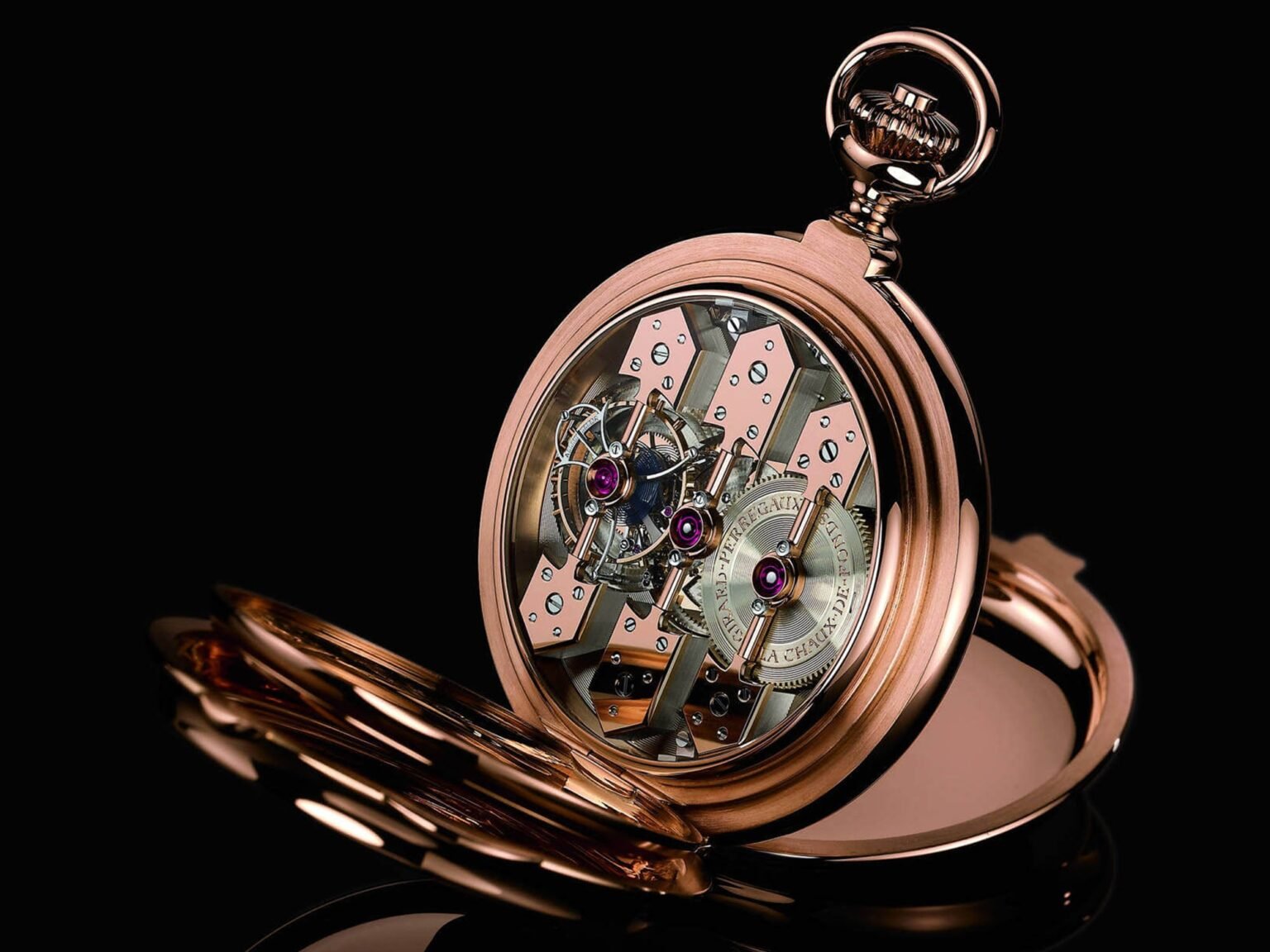
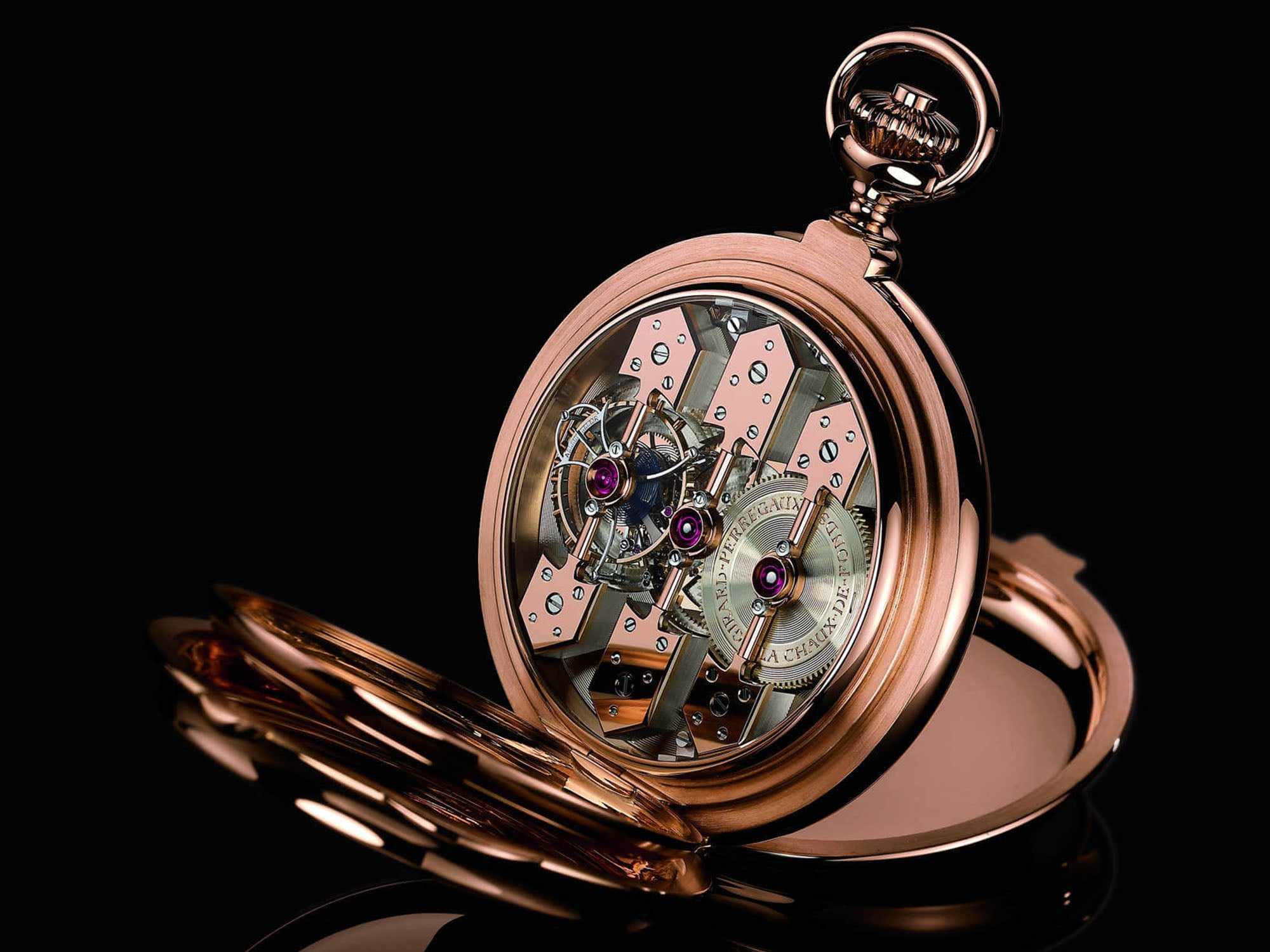
In any case, Girard-Perregaux boasts an undeniably historic pedigree in the annals of high horology, one of its most notable milestones being the Three Gold Bridges Tourbillon (below), Constant Girard’s patented, award-winning take on Abraham-Louis Breguet’s hallmark horological invention, the tourbillon. The “Bridges” design continues to influence Girard-Perregaux’s watch innovations today from both an aesthetic and technical standpoint. However, here in the 21st Century, it is likely a watch of more recent pedigree that defines the character and spirit of Girard-Perregaux, and that watch is the Laureato. Born in the 1970s, revamped for a modern audience in the 2010s, and still somewhat striving to claim its rightful place among the icons of sport-luxury timepieces, the Laureato enters the second decade of the 21st Century as a watch with both a historically significant past and a future full of infinite potential.
[toc-section heading=”The Original Laureato (And Why It Matters)”]
In 1975, the luxury watch industry was in an interesting place. Quartz movements had been around for a little over five years but had yet to become dominant, and historic, tradition-bound brands were beginning to take risks in terms of design, materials, and marketing, spurred chiefly by Audemars Piguet’s controversial release of the Royal Oak in 1972. That watch, now an acknowledged industry icon, ushered in a timepiece style that we now refer to as “sport luxury,” an admittedly far-too-vague term that encompasses several key elements, including an integrated case-and-bracelet construction, distinctive dial treatments, angular, geometrical silhouettes, enhanced waterproofness, and surface finishes that straddle the line between tool watch and dress watch. The Royal Oak lit the fuse for the style, and watchmakers like Patek Philippe (with the Nautilus), Vacheron Constantin (with the 222) and Cartier (with the Santos) stoked the flames of its proliferation throughout the decade.

Girard-Perregaux, which already had a century-plus of watchmaking milestones to look back upon, made its own lasting contribution to the nascent genre in 1975 with the Laureato. And while those with a, shall we say, more rudimentary knowledge of the subject tend to place it in a lower tier of historical importance than the Royal Oak, Nautilus, and perhaps even the 222, it was a milestone in its own right. (In fact, it preceded both the Nautilus and 222 to the market.) It was the first such watch to be developed in-house by the watch company that manufactured it (Gérald Genta, who designed the Royal Oak, Nautilus, and IWC’s Ingenieur, another of the era’s standouts, was a hired gun who worked for many companies), and it stood apart from all its contemporaries as the only member of the club with a quartz movement inside rather than a mechanical, self-winding one. Moreover, it was a quartz movement made in-house, whereas all the other “sport luxury” pioneer pieces sourced their automatic movements from outside makers.

In fact, also largely unacknowledged is the significance of the movement inside the first Laureato, the quartz Caliber 350. While the Japanese generally (and Seiko specifically) tend to receive most of the accolades for bringing quartz movements to watchmaking, Girard-Perregaux was one of the very few Swiss watch brands to embrace the disruptive technology early on. The company founded a research division devoted to it in 1966, and the fruits of the effort, Caliber 350, came to the market in 1971, just shortly after Seiko’s groundbreaking Astron (1969) and the short-lived but impactful Beta-21 produced by a consortium of Girard-Perregaux’s Swiss competitors (1970). Developed with the aid of the integrated-circuit specialists at Motorola, Caliber 350 achieved a frequency of 32,678 Hz, higher than both those predecessors, and setting the standard for all quartz calibers to follow.

Why “Laureato?” Italy was a huge market for Girard-Perregaux in the 1970s, and as one legend has it, the maison’s Italian distributor was heavily involved in its development from the start. Also, the 1967 movie The Graduate, starring Dustin Hoffman, was a longtime favorite among Italian audiences (who called it by its Italian translation, Il Laureato), and the name struck the distributor as perfect for the watch. Another version of the origin story says that the name references the wreath of laurels symbolizing victories in ancient Rome; in this instance, the victory was the awarding of a COSC chronometer certification to Caliber 350 — the first such accolade ever bestowed on a quartz movement. The earliest models were even delivered with a COSC certificate that may have reminded owners of a diploma. Despite all of this, however, the watch was not officially given the name “Laureato” until the release of the first automatic model in 1995; the first generation was marketed simply as the “Quartz Chronometer,” with “Laureato” as its popular nickname, akin to the “Jumbo” moniker that fans gave the Royal Oak.

While the first Laureato (Ref. 4266) undoubtedly gave off some Royal Oak-esque vibes, it was distinctly its own watch: the octagonal bezel was on a round base, had no exposed screws (a hallmark of Audemars Piguet’s watch to this day), and had more rounded edges; its dial texture was a clous de Paris pattern with pyramidal shapes, in contrast to its predecessor’s waffled Petit Tapisserie motif. It had a date window at 3 o’clock and a bi-material construction, with yellow gold for the bezel, crown, hands, and hour markers and steel for the main case and bracelet. (the Royal Oak, famously, was all in steel, as was the original Nautilus). The bracelets were also notably different in design, with large monolinks and a two-tone steel-and-gold treatment. And there was nothing “Jumbo” about the first Laureato: its case was a diminutive 30mm in diameter, with 26mm and 35mm sizes added later.
[toc-section heading=”The Second Generation: Laureato Equation”]

The Quartz Crisis — as it has become retroactively and pejoratively dubbed by the Swiss watch companies that struggled through it — was in full swing in the 1980s, when the second generation of the Laureato made its debut. These “Laureato Equation” models anticipated the high-complication renaissance to come in subsequent years, with quartz base movements enhanced with mechanical modules (what we’d call “mecha-quartz” calibers today) that powered astronomical functions like calendars, moon-phases, equation-of-time displays, and indications for solstices, equinoxes, and zodiac signs. In another preview of industry trends to come, many of these watches had transparent casebacks that showed off these complex, battery-powered movements. Even more noteworthy to collectors, this generation also marked the debut of a new, and more familiar bracelet design, with H-shaped outer links flanking polished, domed interlinks.
[toc-section heading=”The Third Generation: Laureato Goes Mechanical”]

After several decades of quartz dominance over the watch industry, the luxury mechanical wristwatch started showing the first stirrings of a comeback in the 1990s. In 1995, the 20th anniversary of its launch, Girard-Perregaux released a new version of the Laureato, the first with a mechanical, self-winding movement rather than a quartz one. Aesthetically, the 1995 Laureato (Ref. 8010) was very similar to its 1970s ancestors, just slightly larger in case dimensions — 36mm in diameter, up from the largest model’s 35mm — and sporting a scratch-proof sapphire crystal rather than the original’s Plexiglas. Inside the case, Girard-Perregaux installed its in-house, automatic Caliber GP 3100, with a 46-hour power reserve. The bracelet, still designed to integrate smoothly into the steel case, carried forth the design established in the 1984 versions: more evocative of the Patek Philippe Nautilus bracelet, with brushed H-shaped links and polished center links. The Ref. 8010 and its variations were all limited in production — the resurgent demand for high-end watches having not yet peaked — but they set the template for the Laureato going forward as a luxury timepiece equipped with in-house mechanical calibers.
[toc-section heading=”High Complications and the EVO 3 Era”]

Just one year after the Laureato joined the ranks of Girard-Perregaux’s luxury mechanicals, the venerable Swiss watchmaker expanded the collection by adding complications. One standout was the Laureato Olimpico, a chronograph released in celebration of the Summer Olympic Games held that year in Atlanta. This 40mm steel watch contained another in-house movement, Caliber 3170, with a vertical-clutch chronograph function via a Dubois-Dépraz module. Limited to 999 pieces (and eventually dropping its name, thanks to the inevitable trademark-infringement lawsuit from the notoriously litigious Olympic Committee), the Olimpico was the first Laureato chronograph, paving the way for others to come, notably the recent Aston-Martin editions.

In 1997 came the Laureato Tourbillon, which ushered in the use of Girard-Perregaux’s historic and exclusive Three Gold Bridges architecture into a wristwatch with an integrated bracelet for the first time. Apropos to a watchmaking era in which bold experimentation with avant-garde materials was a defining trait, the brand didn’t stop with gold for the bridges in future editions, eventually making bridges from sapphire (in a 2006 edition) and blue spinel (in a 2012 model). By uniting the two most iconic designs in its history — the 1970s’ Laureato wristwatch and the 19th-Century Three Gold Bridges tourbillon pocket watch — Girard-Perregaux made a strong statement that the milestones of its past would not only continue to evolve but would achieve a certain level of synergy in the 21st Century.

The turn of the millennium marked an era in the watch industry defined by bold sizes, aggressively sporty designs, and a horological arms race, for lack of a better term, toward achieving the highest levels of complication possible. With the Laureato EVO 3 series, inaugurated in 2003, Girard-Perregaux strove for all of these elements. The cases were the largest they’d ever been, reaching 44mm in diameter. Many models featured high complications, including chronographs, tourbillons, and perpetual calendars, and this generation of the Laureato (which incorporated the numeral “3” but was really the 4th major evolution of the series, taking the 1980s revamp into account) brought in elements that were just starting to trend heavily in the sport-luxury sector, like the use of titanium for cases and swapping out some bracelets for integrated rubber straps. All in all, the Laureato EVO 3 was a product family well-suited to its time.
[toc-section heading=”A Return to the Roots”]

Like so many other long-tenured watch models that strayed a bit (in some case more than a bit) from their original conceptions to accommodate the tastes of the Nineties and Aughts, the Laureato began swinging back to more period-appropriate, vintage-revival territory in the later 2010s. The Laureato limited edition released in 2016 — not really a significant Laureato anniversary year but the 225th anniversary of Girard-Perregaux itself — offered a modern take on the original three-handed timepiece, with contemporary dimensions of 41mm in diameter and 10.10mm thick, and it contained the in-house Caliber GP03300-0030. After years of the EVO editions and subsequent haut-de-gamme executions, the stainless steel watch, limited to 225 pieces in two dial colorways, was embraced by fans who’d long awaited the return of a more basic timepiece.
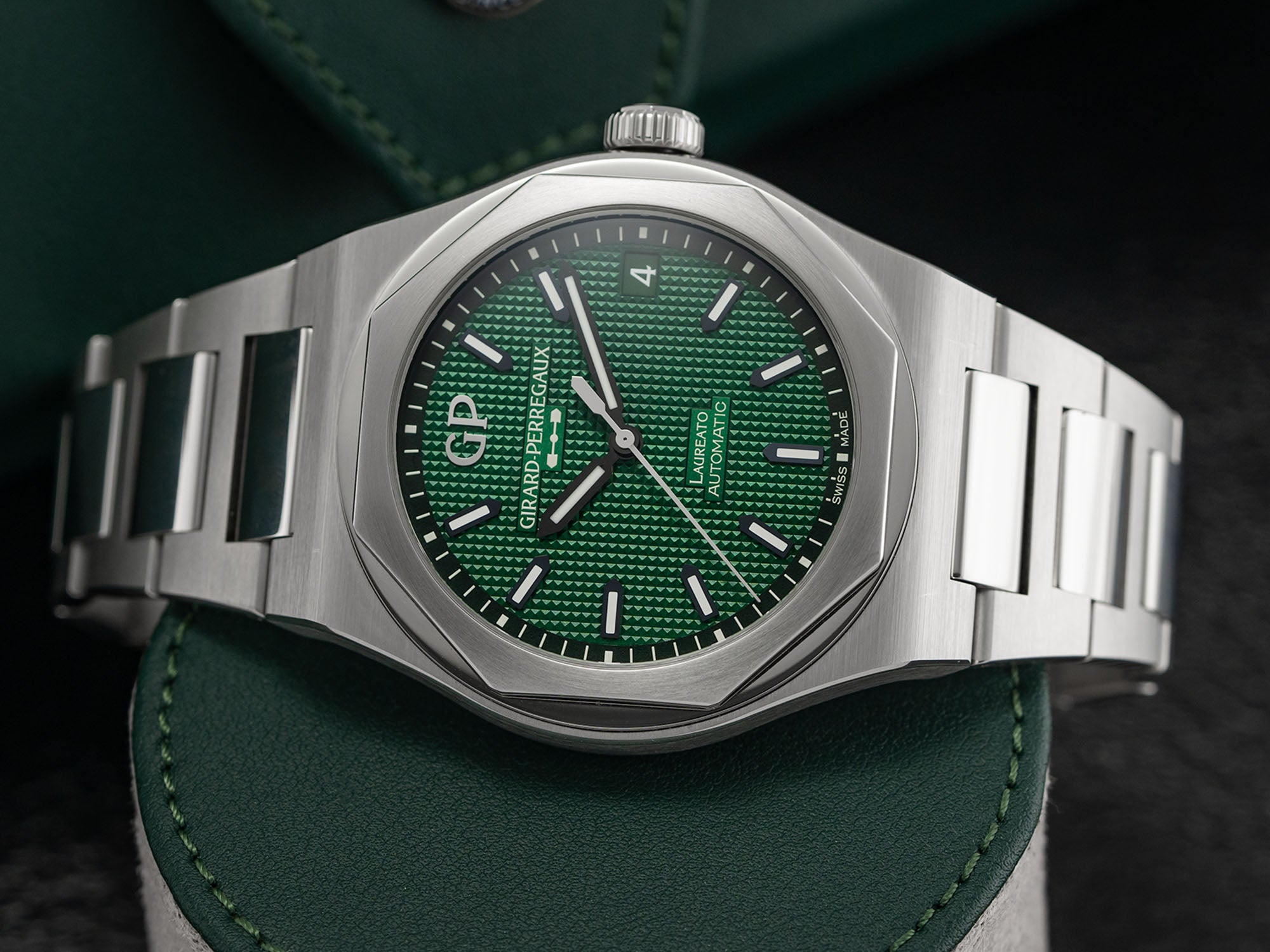
The success of the limited edition heralded the return of the neo-vintage version of the Laureato to the regular collection the following year. A few small but significant changes were made, including the case size being upsized, just slightly, to 42mm and a new movement, the in-house, automatic Caliber GP01800-0008, making its debut inside. Whereas the limited edition sported a largely polished finish, the regular-production models have a more balanced combination of satin-brushing and polishing on their facets and surfaces The dials feature a contemporary version of the classic clous de Paris hobnail texture and luminous baton hands and indexes, and the case resists water pressure to 100 meters, lending some sport-watch toughness to the overall dress-watch elegance. And while the limited edition offered only two dial-color options, silver and blue, the 42mm unlimited versions expand the palette considerably, with options including the green-dial edition above.

As in previous generations, the new-old Laureato family started expanding almost immediately, with the first Laureato Skeleton dropping in 2017. In this 42mm variation, the classic octagonal bezel frames an intricately openworked dial formed by the hand-finished, anthracite-coated bridges and plates of the in-house Caliber GP01800-1652.

The Laureato Chronograph returned to the lineup in 2018, in a 42mm case and powered by the manufacture Caliber GP03300-01, with 63 jewels, a 28,800-vph frequency, and a 46-hour power reserve. The dial’s classical clous de Paris checkerboard pattern sets the stage for the three subdials, two for tallying the elapsed hours and minutes, the third for running seconds — and a keen eye will note that these subdials are not quite round but octagonal-shaped, echoing the look of the bezel. Both the Skeleton and Chronograph have been fully integrated into the modern collection, with various case-and-bracelet options, including rose gold, titanium, and ceramic.

Channeling a bit of that boldly aggressive EVO 3 spirit, Girard-Perregaux unveiled the Laureato Absolute series in 2019. These models (many of them limited editions, and thus far, all chronographs) are characterized by large 44mm cases, black-dominant colorways, and the use of avant-garde, high-tech materials and processes, like forged carbon, PVD-coated titanium, and Carbon Glass, in the cases and, often, the dials as well. Some of the materials innovation in the Absolute family have borne results in the main Laureato line: the first all-titanium Laureato (case and bracelet) debuted in 2024.

On the more understated side of things, Girard-Perregaux responded to the industry’s pendulum swing back to smaller sizes by introducing 38mm versions of the core time-and-date Laureato, starting in 2017, installing the self-winding Caliber 03300 inside them. The smaller, more unisex subfamily has introduced some unusual and eye-catching colorways into the collection, like the “Copper” clous de Paris dial above, as well as diamond-set bezels.
[toc-section heading=”Laureato and Aston-Martin: A Classic Partnership”]

High-end watches and high-performance cars have long been linked in the minds and hearts of collectors, and Girard-Perregaux made news in 2021 when it established a partnership with British luxury carmaker Aston Martin. The collaboration has resulted in several co-branded timepieces in the years since, most of them hailing from the Laureato family. Like the coveted, stylish roadsters famously favored by James Bond, the watches have exhibited the marque’s traditional livery colors and utilized weight-reducing high-tech materials in their construction, including titanium, ceramics, and, recently, forged carbon. Among the initial releases was a Laureato Chronograph with a steel case and bracelet and a cross-hatch-pattern dial (inspired by the Aston-Martin’s quilted seats) in British Racing Green. Joining the collection shortly thereafter was a time-only model that used green ceramic for both the case and dial, along with the green-tinted, textured dial. Another Laureato Chronograph Aston Martin Edition (above) followed in 2025, limited to 188 pieces and distinguished by an exquisitely finished titanium case and an iridescent green dial. The distinctive shade of green on this particular dial is the product of a 14-step manufacturing process that emulates the intricate paint job on Aston-Martin cars, and features openworked hands that echo the look of their familiar grilles.
[toc-section heading=”Laureato Fifty: A Half-Century Milestone and a Revolutionary Movement”]
2025: Laureato Fifty: A Half-Century Milestone And a New Movement

The Laureato turned fifty years old in 2025 and Girard-Perregaux marked the occasion with a limited edition that not only garnered substantial industry and enthusiast-community buzz, but may also point the way forward for the Laureato collection in general. The first Laureato Fifty, of which Girard-Perregaux made only 200 pieces, comes in at a very crowd-pleasing 39mm diameter and 9.8mm thickness, and aesthetically it might be the most evocative yet of the very first Laureto models from 1975, with its two-tone steel-and-gold design. Girard-Perregaux has also put quite a bit of work into the small details of the tonneau case, sharpening the angles and bevels and enabling an even smoother integration between case and bracelet while also retaining the case’s robust 150-meter water resistance. (For those to whom this factor is important, it’s notable that the Royal Oak offers only 50 meters and the Patek Philippe Nautilus, only 30.) The new H-link bracelet tapers toward the ends and fastens to the wrist with a signed triple-folding clasp with on-theme octagonal push-pieces.

On the gray clous de Paris dial, the hands and indexes are in the same 3N yellow gold as the bezel and the bracelet’s center links. The date is color-matched, and the second hand has a double-arrow-shaped counterweight, evoking the brand’s ancestral Three Bridges architecture. That historic motif also makes its way into the new movement, automatic Caliber GP4800, which was several years in development and makes its debut in this anniversary edition. The emblem is the centerpiece of the skeletonized yellow-gold rotor, which is visible, along with a host of other components bearing no less than 10 distinct horological finishing techniques, through the sapphire caseback.
The movement beats at 28,800 vph and also improves upon its predecessors’ power reserve, offering a lengthy 55 hours of autonomy. Girard-Perregaux clearly has plans for the new movement, installing it in a handful of non-limited Laureato Fifty models (at the same 39mm case size) that have come out since the limited edition made its auspicious debut. As it enters its sixth decade, “the Graduate” appears ready and able to earn even higher grades and to rack up even more accolades. You can learn more at girard-perregaux.com