

Few small brands can claim to have the kind of success that anOrdain has experienced in recent years. Their enamel dials are so sought after that clients sit on a waitlist that reportedly stretches out to 2030. While some very high end, handmade or bespoke watches take that long or even longer to produce, waiting that kind of time for a watch that retails for around $2,500 is unusual. There’s so much competition at that price, you kind of don’t expect people to really commit for the long haul.
But they do commit, and as anOrdain slowly churns out their enamel dialed watches and delivers them to their very patient customers, the legend of the brand grows. Every so often, I’ll see an anOrdain pop up on the pre-owned market, and if the asking price is reasonable (retail + expected inflation over the next 3-4 years seems about right to me) they never last long. There’s a real, genuine hunger for these watches.
Review: the anOrdain Model 1 Porcelain
Stainless steel
La Joux-Perret G101
White Porcelain
None
Sapphire
Leather
5 ATM
38 x 46mm
11mm
20mm
Push/pull
Yes
$2950
That of course presents all kinds of interesting challenges for anOrdain as a business. How do you scale up (do you even want to?) when the artisanal nature of your production puts a hard limit on what you can make in a month or a year?

anOrdain has a multi-pronged strategy to generate revenue outside of their enamel dialed watch business. They recently launched a bespoke strap service, which falls in line with their commitment to traditional handcraft, and gives existing and prospective watch customers a way to buy into the brand. The straps are offered in a variety of leathers and are made to measure, and can be customized to the heart’s content of the customer in a wide variety of ways, from thread color to painted edges and more. The straps can be embossed with a personal message, a name or initials, or anything else the owner would like. The straps are expensive by most standards, around $500, but it’s a truly bespoke process that allows for real collaboration between the artisan and end user.
The larger gambit for anOrdain is really the increased production of porcelain dials, which were first introduced in a Model 2 reference in black last year (covered here). A few months ago, a new Model 1 in white porcelain with a custom typeface and hands appeared, and this watch felt like an announcement or statement of intent that it represents a business strategy and not a diversion, apparently proven out of the response to the porcelain Model 2.
The economics are fairly straightforward. anOrdain says that their seven enamellers can produce around 50 dials per month. With their porcelain dial operation, a single craftsperson can produce between 30 and 40 dials in the same time frame. It’s not hard to extrapolate from there what that means if anOrdain is able to scale the porcelain business.

The question becomes: will collectors want to purchase an anOrdain that doesn’t have an enamel dial? For better or worse, this single craft technique has become what the brand is synonymous with. It’s the reason people seek them out. And it’s not just the novelty of a traditional enamel dial at a relatively affordable price point (there have certainly been a number of enamel focused brands launched in anOrdain’s wake, no doubt an attempt to ride their coattails). The watches, at least the dials, are genuinely good and stand up to scrutiny.
The challenge then is to make a porcelain dial that feels like the equivalent somehow of the enamel in terms of quality. On top of that, I think anOrdain also has to teach their clients and potential clients why porcelain makes sense, and why it might make a good substitute for enamel (these watches are offered to those on the long enamel waiting list first). anOrdain, in their press materials, note that there’s a fairly high failure rate on porcelain dials (that 30-40 produced figure is from a total lot of 300 dials). So, if the degree of difficulty matters to you (whether it should or not would be a good topic for a podcast or editorial), porcelain has that angle covered.

So let’s get into the dial itself. I spent several weeks wearing the new Model 1 and while I was initially a bit skeptical, over the course of that time the watch really grew on me.
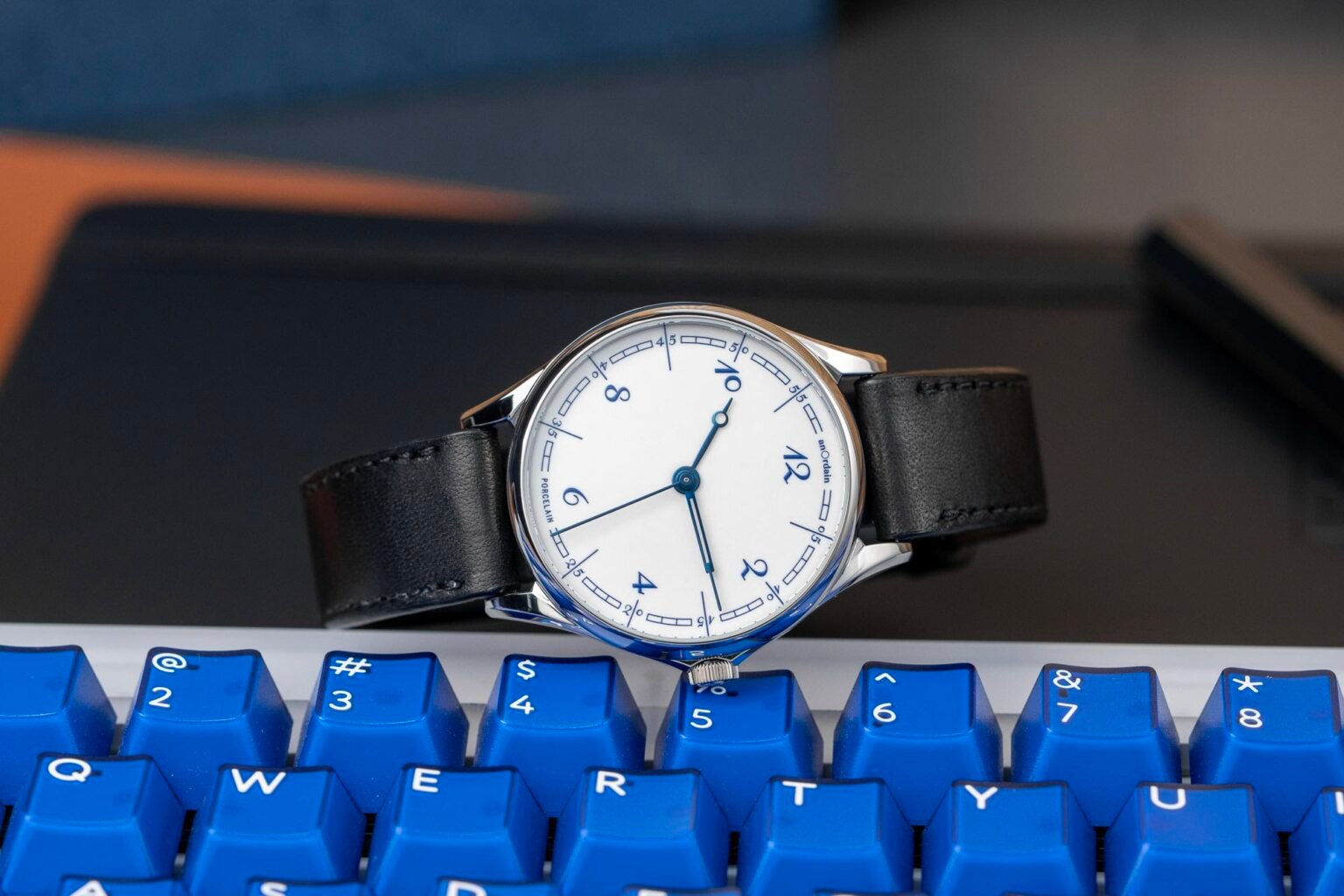
Enamel and porcelain can look quite similar in that both are often characterized by a high gloss finish. But whereas enamel is often described as glass-like for its depth (there’s always a sense that you’re looking through an enamel dial, particularly in lighter colors), porcelain is a ceramic, and has a more structural quality to it. Think of the finish of fine china and you’ll have a pretty good idea of the character of the dial on this Model 1 (some of the details of the typeface seem to almost intentionally reinforce this idea, but we’ll get to that).

Like enamel, porcelain can also exhibit subtle imperfections and irregularities in the finish that add to the handmade quality of the dial and lend it a lot of charm. On my sample, there were certainly some very minor irregularities that were visible when examined under magnification, but nothing that presents itself easily with the naked eye, which is as it should be. The overall impression I had of the dial was that it was highly lustrous, intricately made, and a very pure white. Porcelain doesn’t play with light in the same way as enamel, so some of the interesting optical effects that you can sometimes get with an enamel dial that feels like it’s almost translucent are missing, but it would be hard to feel shortchanged by the experience of porcelain.
When I first saw the press materials for the porcelain Model 1 before receiving it, I wouldn’t have expected that the thing I’d come to like most about it would be the typeface chosen for the numerals and the way it complements both the hands and minute track. I was a little turned off by the way these numerals appear to be riffing on Breguet-style numerals at first, but sitting with the watch for a few weeks changed my tune. The design, by Kia Tasbihgou, is ornate but feels modern to me in a way that standard Breguet numerals don’t. The minute track, a series of rectangles surrounding the dial’s perimeter, separated by hashes every five minutes, frames the large numerals nicely. Those hashes have smaller Arabic numerals on either side for every 5th minute, and I liked this effect a lot too.
The best decision on the part of the design team at anOrdain with respect to the dial is one they’ve been making consistently for years, which is to keep everything very simple, minimize text, and focus on the craft and material. There’s a small anOrdain wordmark at 12:00 but the rest of the dial is free of branding. This is possibly the busiest and most complex anOrdain dial yet in terms of graphic design, but it’s still mostly just a large expanse of white, and I think anOrdain deserves credit for finding ways to build interest and complexity without compromising a core idea present in their design language.


If there’s a weak link with the Model 1, it’s the same one present in all of them, and that’s the case. It’s not that there’s anything wrong with it necessarily – I’d describe it as “exactly fine,” a term I’ll use for a movie that gets 3 stars out of 5 on Letterboxd, or a meal at a good restaurant that I liked but wouldn’t rush back to eat again. It’s just that the dial gives us a lot to think about, both in terms of what it means for anOrdain’s future as a brand, as well as the success or failure of it as an endeavor in craft and design. The case doesn’t spark the same kinds of ideas. It’s generic, inoffensive, and recedes to the background of the discussion. That could very well be the point – anOrdain is first and foremost a brand associated with dial making, obviously.
If anOrdain doesn’t have ambitions of making more complex or craft oriented cases, I think there are potentially a lot of interesting collaboration possibilities for them to pursue. I promise I don’t have any inside information here, but I’d be surprised if this isn’t something they’ve discussed. Imagine an anOrdain dial in a case by Arcanaut, for example? Or how about one of James Lamb’s handmade silver cases? While I’m running through my own watch collection here, what about Ming? Just a thought.
All of that said, the Model 1 case is a very nice size, coming in at 38mm in diameter and 11mm tall. It is completely polished, which I think is appropriate for a watch in this style. It’s water resistant to 5 ATM and, on one version of the watch, a sapphire caseback reveals the La Joux-Perret G101 caliber with an elaborate custom rotor. The Model 1 Porcelain is also available with a solid caseback and a G101 with standard finishing.


The Model 1 Porcelain retails for $2,950 with a standard movement, and $3,400 with a decorated movement and open caseback. Personally, I’m not sure that paying the extra $450 for a mechanically identical movement makes a lot of sense on any watch, but on this watch specifically, that is so oriented around the dial, I find it particularly hard to justify. And coming in at under $3,000 makes the Model 1 Porcelain really enticing. As with their enamel dials, there’s a lot of craft and intentionality that you’re buying into here. What is interesting about the Porcelain watch though is that it’s more than just the dial itself – the typography feels legitimately tied to it, and the fact that the brand has brought someone in from the outside to pinch hit on this watch might offer a clue for how they’re thinking about expanding their options across not just porcelain dialed watches, but enamel as well. It would be really interesting if anOrdain became a hub for collaboration between artisans both within and outside of watchmaking.
And with respect to that long waitlist for enamel dialed watches, I think anOrdain is justified in finding alternative options for their customers if they prefer not to wait, if indeed that is part of their calculus with the porcelain work they’re doing. There’s a mental adjustment people make when they observe that a watch has a long lead time or is otherwise difficult to obtain. It can make people desire that watch to a point, but it can also be a turn off, and a source of resentment. There’s a futility in signing up for something that feels like it might never come.

I get the sense that anOrdain is actively trying to find the balance. Obviously, for a good enamel dial, there should be a wait. These are not industrially produced objects, and their objectively high quality means that people will likely always want them, and there will need to be a period of patience observed to own one. But it’s a tough business model when the only product you sell is so in-demand that no one can have one for years after putting their name down. Porcelain allows anOrdain to hopefully manage some of those waitlist gripes, while still offering a high-craft product that is in line with their watchmaking values. anOrdain
The post Review: the anOrdain Model 1 Porcelain appeared first on Worn & Wound.