

Experiencing a typhoon was not what I had on my bingo card for my first visit to Japan. But it was June, the start of the rainy season in Japan, when I hopped on a plane from New York to Tokyo on my way to visit Casio for the first time. Switching my phone off Airplane Mode right after landing quickly inundated my notifications with different alerts that the following day would be filled with heavy winds and massive rainfall. The following day’s visit to Casio Yamagata, as it turns out, would be cancelled thanks to tropical storm Jangmi—there was no way a bullet train would be running in a storm like this.


Luckily, after a day of massive rainfall and my fill of multiple bowls of ramen inside Tokyo Station, the storm subsided, giving me the green light to make the journey to Yamagata Prefecture after all. Yamagata Prefecture, more specifically the city of Higashine, is about four hundred kilometers north of Tokyo and roughly three hours by Shinkansen. It’s where Casio has its “mother factory,” very aptly named Yamagata Casio. While most of Casio’s high-volume production is achieved abroad, in countries like China and Thailand, Yamagata Casio functions as the brain of the whole operation and is responsible for any of the watches made in Japan.
Casio’s industrial factory stands in stark contrast to what Higashine is best known for—fruit. Yes, stepping out of the bullet train at Higashine Sakuranbo station, you’re immediately surrounded by fruit trees and bountiful advertisements for the region’s specialty fruits, most notably cherries, of which Higashine is the largest producer in the country. This is Japan, of course, and so we have mascots for everything. I’m obsessed with Higashine’s mascot Tanto-Kun, an anthropomorphic pear with a cherry-themed staff and cape.


After a brief stop at a soba restaurant for one of the best bowls of buckwheat noodles I’ve ever had, we drove twenty minutes until a giant “Yamagata Casio” sign signaled that we had arrived. Under this one roof is Casio’s only Japanese manufacturing site, responsible for any Casio or G-Shock that’s labeled “Made in Japan.” It’s where the cult-favorite screw-back GW5000U, for example, is made.
Unsurprisingly, the rather remote facility is not made for tourists, and that means it’s not open to the public. For those who have been invited to make the trek, whether it’s corporate visitors, retailers, or media, the entrance welcomes you immediately to a museum area. Here, there’s a small space chronicling the brand’s history and showcasing some of the iconic and also weird models that have been produced throughout Casio’s history of watchmaking.


And yes, if you’re curious, the brand offers two exclusive G-Shocks just for people who have made it through these doors in Yamagata—nothing all that crazy, just a standard 5600 model with two options for a Yamagata Casio logo printed on the strap. No, I didn’t buy one, but I’m kind of regretting my decision now.
The main purpose of my visit, as it turned out, was for the Casio team to give me a top-secret sneak peek of the mysterious “Blue Rose Project” in the works, which launched at the start of October as the 20-piece, $80,000 blue sapphire-clad G-Shock. I’ve reserved plenty of words for that project already, and much of my day was filled with a whole lot more to see at the factory, from quartz movement manufacturing, injection molding, and Casio’s Premium Production Line.
A Walk Through The Factory
Watchmaking at Yamagata Casio centers on “Building G,” which opened in 2018 and is dedicated solely to the brand’s watchmaking—though Casio produces much of its other product lines, like calculators, instruments, and more, in other parts of the large site. As expected, there are no watchmakers toiling away at workbenches here. Casio’s production is very industrial.


Movement Production
Given Japan’s exposure to earthquakes, much of the machinery here is mounted not on a solid floor, but rather one that is actually decoupled and mounted onto a seismic isolation system. What this means is that in the event of ground tremors, the mounting system can move in a several degrees of motion as to essentially absorb the shifting of the ground and keep the factory floor and the machinery stabilized. A fitting system for the place that’s building G-Shocks, I suppose.


The Molding Department
Much of Casio’s fabrication is, unsurprisingly, injection molding. G-Shocks are synonymous with resin, after all. While much of the actual injection molding itself is automated, much of the human element actually comes in the team dedicated to the molds themselves. Behind the very robotic, industrialized manufacturing process is a surprisingly large team of Casio technicians and engineers in charge of translating component, case, and strap designs into the actual molds themselves via custom tooling. Of course, alongside the creation of tooling for new projects, there’s also a large maintenance component as well. Never a dull moment for the team.


Often times, the injection molding step for parts like bezels and outer cases are combined with assembly steps in the same line. Below, a freshly injection-molded outer case is ejected from the mold, and combined with an inner case ring for the final midcase.


Dial-making at Yamagata Casio
To create the various dials across Casio’s price points, a mix of industrial processes are used depending on the collection and the specific part involved. What surprised me most was that most of Casio’s dials and indices are injection-molded from resin—even the ones I had assumed were machined from metal. The lattice-work dial of the MRGB-2100, with its openings to allow for solar charging, is made this way.
For the final finish that gives many of its dials a metallic look, they apply several PVD coatings. The Yamagata Casio team is proud of its PVD capabilities, and it shows in the wide range of colorful designs we’re used to seeing across the lineup.


Many of the brand’s most intricate dials—often featuring sharp facets and tiny patterns—use molds created with ultra-precise 5-axis CNC machines. CNC machining is incredibly widespread in the industry, but for dial-making like this, Casio uses machines that can process shapes accurate to the nanometer. Ultra-precise might sound like a marketing buzzword here, but just for reference, 0.1 millimeters is 100,000 nanometers. As you can imagine, these machines at Casio are extremely isolated from the rest of the factory floor, with factors like vibrations and temperature all affecting the final product. With all these challenges, output is naturally much lower, so it’s saved for things like dials and indices that require this level of precision.


The Premium Production Line

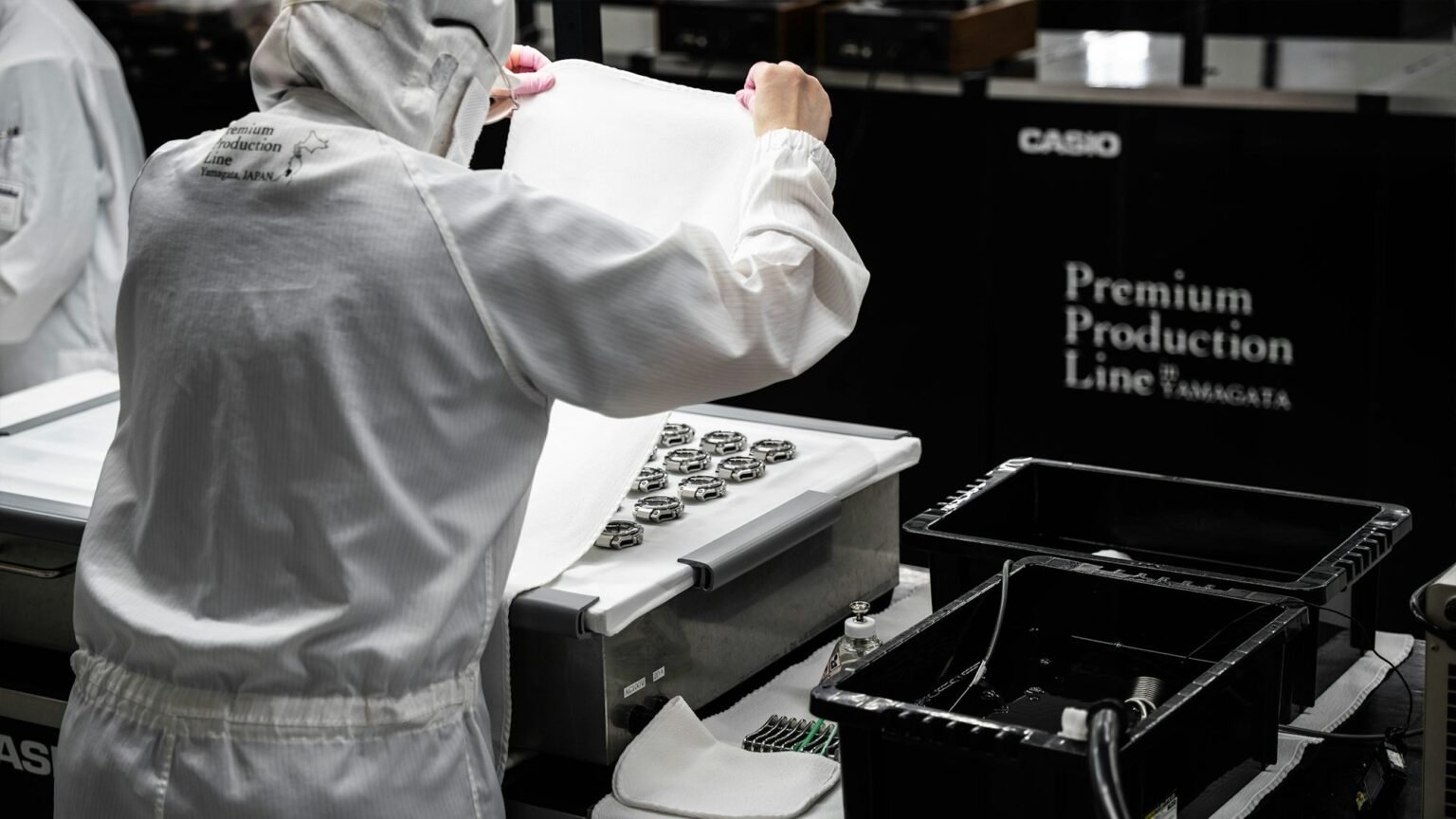
Perhaps the most important part of this facility for a G-Shock nerd is the brand’s Premium Production Line, which handles the assembly and final inspection of all high-end Casio and G-Shock watches. I’ve been quite vocal about my love for the brand’s MR-G G-Shock line, a collection of high-end G-Shocks that offer a hand-finished, intricately built twist on the classic, mass-produced formula. These MR-Gs are assembled by hand and checked here at the Premium Production Line, along with Casio’s flagship Oceanus watches, and a few other models in the brand like MT-Gs and Gravity Masters.


I knew going into this visit that the Premium Production Line would employ a highly skilled team to produce the products leaving the line, but I didn’t know there was such an extensive certification system. Casio’s qualification system has five tiers, with “Meister” as the highest, and it’s determined through yearly examinations. A Gold Medal or higher qualifies you for the Premium Production Line.
Every day and every hour is different on this line, as production dictates. Though I hoped to catch a glimpse of the assembly process, the team focused on inspecting already-cased Gravitymaster watches during the brief time I was there. It’s less visually interesting than seeing this stuff put together, but I did find it interesting to see watches that retail for under a thousand dollars here inspected so rigorously by a room full of humans.

Made in Japan
Casio straddles an interesting line when it comes to the definition of watchmaking, given that the company is still, at heart, an electronics manufacturer. No one on staff has the title of “watchmaker,” nor are there any balance wheels or pallet forks to be seen. And yet, the brand is producing some of the most iconic watches out there.

What Casio has done with this segment, especially after Kikuo Ibe invented the G-Shock in the 80s, is infiltrate popular culture and mass adoption on a scale that feels unrivaled. This also means Casio watches and G-Shocks make up the largest part of the brand’s business today—not a total shock, given how much most of the public thinks about the watches versus calculators or digital pianos these days. And while a majority of the millions of Casio watches produced each year are made overseas, Yamagata Casio represents the crown jewel of their operation. After all, even within the unique and passionate cult of G-Shock, anything with a caseback branded “Made in Japan” has its own distinct following.

After a few quick hours in Yamagata, I found myself back at the Higashine train station, walking again past the giant advertisements for cherries, picking up a box of Yamagata Cherry-flavored Pocky for me to devour during the week, and promptly boarding the Shinkansen heading to Tokyo. A visit to Yamagata meant a checkmark on my horological bucket list, and I’m glad a typhoon did not derail those plans.
Stay tuned for more on TanTan’s visit to Casio, coming soon.