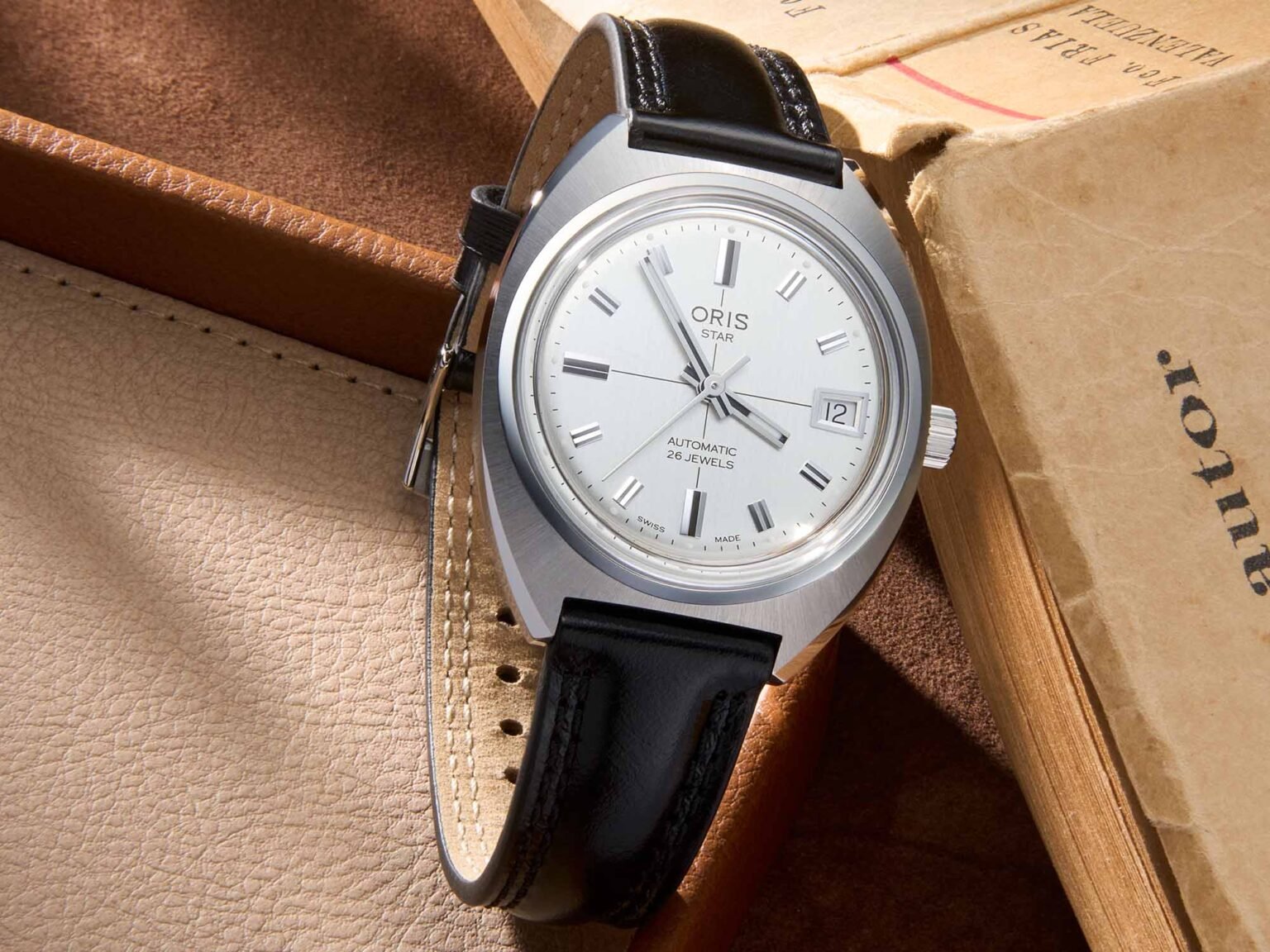

Launched onto the scene at this year’s Watches & Wonders, the Oris Star Edition brought back one of the most significant designs in the brand’s repertoire in a modern re-edition that captures the spirit and ethos of the mid-century model that inspired it. Down below, we’re breaking down everything you need to know about the return of this classic to the brand’s contemporary catalog, from key details, some historical deep-dive goodness, and what’s been updated to get the design up to speed with today’s watchmaking standards.
[toc-section heading=”The Independent Spirit of Hölstein”]
If you’ve spent any time in the luxury watch world, you know how much value heritage brings to a brand’s reputation and collectability. Often, a brand’s history is tied to its independence, and Oris is a great example of that. Based in the small Swiss village of Hölstein since 1904, Oris is still one of the few truly independent brands in the Jura Mountains. You might know Oris for its Hölstein Editions, its focus on sustainability, or even the time it featured a Muppet character on a dial. In this article, however, we’ll explore the return of a legendary watch: the Oris Star Edition, which once captured the spirit of its time and now comes back with renewed purpose.

Unveiled at Watches and Wonders 2026, the Oris Star Edition is a direct portal back to 1966 — the year the brand finally broke the chains of a legal cartel that had stifled its creativity for decades. To label this timepiece a simple retro revival would be a disservice; it is, in truth, a nod to Oris’s unyielding devotion to independence and a chapter of its long history worth revisiting.
[toc-section heading=”From the Swiss Watch Statute to the Star”]
To truly appreciate the Oris Star Edition, it pays to understand the legal war that preceded it. Imagine being a world-class chef but being legally prohibited from using a stove; you were only allowed to use a microwave because a law from the 1930s said so. That was Oris’s reality for 30 years. In 1934, the Swiss government introduced the Swiss Watch Statute — a draconian, anti-competitive law designed to protect established movement manufacturers by preventing others from introducing new technologies without government permission. What this did was essentially freeze the industry in time, favoring those who already held the keys to the kingdom.

For Oris, this meant it was legally restricted to using “pin-lever” escapements, a much simpler technology than the “Swiss lever” escapements used by its competitors. Oris became so masterful at pin-lever movements that it actually passed chronometer tests with them, which is the horological equivalent of winning a Formula 1 race in a modified family hatchback. But the marque wanted more. The Hölstein watchmaker (factory pictured above) wanted to prove it could compete at the highest mechanical level without being handcuffed by the Swiss government.
A young lawyer, Dr Rolf Portmann, felt the same. Understanding the restrictions around this, Portmann was tasked with a mission to take on the “Swiss Watch Cartel” in 1956 and get the statute overturned. It wasn’t an easy fight. He faced the government in the courts and the press for a full decade, arguing that the law was stifling the very soul of Swiss innovation. In 1965, he finally won, and the law was scrapped. Oris was finally free. The very first watch the brand released to celebrate this hard-won freedom was the 1966 Oris Star (vintage advertisement below). It featured the brand’s first in-house Swiss lever escapement, marking the dawn of a new era of excellence.

Dr Portmann’s influence didn’t end with that legal victory. In 1982, amidst the devastating Quartz Crisis that saw many legendary brands disappear or be swallowed by conglomerates, he and Ulrich W. Herzog staged a management buyout to ensure Oris remained independent. Today, in his nineties, he serves as Honorary Chairman. So, every time you see that “Red Rotor” in a modern Oris, you’re looking at the legacy of a man who saved the very concept of independent Swiss watchmaking. As the guardian of Hölstein, the Oris Star Edition is his trophy.
[toc-section heading=”Oris Star Edition Case”]
When you first hold the new Star Edition, the case is what immediately grabs your attention. Measuring 35mm, barrel-shaped, in stainless steel, it perfectly captures the “Space Age” optimism of the mid-1960s. It’s no secret that 42mm “dinner plate” cases became the order of the day from the 1990s onwards, and although 35mm might sound small on paper, its lug-to-lug distance of 41.5mm balances proportions rather perfectly on the wrist, beautifully centering it without any awkward overhang, even on more slender wrists.

The case also showcases some really neat finishing. You have a pronounced vertical satin-brushing on the top of the case that contrasts markedly with the wide, mirror-polished bevels, catching the light in a way that feels expensive and considered. Clearly, the profile of the Star Edition was sculpted by designers who understood the architectural trends of 1966. Then, there’s the crystal. Oris made a brave choice here by opting for a domed plexiglass (acrylic) crystal. Yes, it can scratch more easily than sapphire, but it provides a warm, vintage distortion that sapphire simply can’t replicate. This material selection is a deliberate commitment to the spirit of the original 1966 release, with its rounded edges creating a unique “halo” effect around the dial. To top it off, you have a screw-down crown and a screwed caseback engraved with the vintage Oris shield, along with a 50-meter water resistance rating.
[toc-section heading=”Oris Star Edition Dial”]
The dial of the Orient Star Edition is a faithful re-creation of the 1966 original, featuring a subtle “crosshair” design in the center. The silver surface has a sunray-brushed finish that gives it a dynamic range of tones depending on how the light hits it. The dial’s appearance is remarkably fluid. Depending on how the light catches it, the surface can shift from a crisp, icy white to a sophisticated, deep, moody gray.

Oris has chosen to apply double-baton markers with high-polished facets, imbuing the dial with a three-dimensional depth. Many collectors will also appreciate the date window at 3 o’clock, which preserves the trapezoidal shape from the original 1966 model. It’s a small restored detail that lets you know that Oris is reaching back to its archives in the most faithful of ways. For legibility, you have square-tipped hour and minute hands and small plots of Super-LumiNova at the base of the hour markers.
Ultimately, by refusing to cut corners on these minute historical nuances, Oris has delivered a dial of immense charm that captures the very essence of 1960s horology, proving that when it comes to a faithful revival, it is the smallest of details that invariably deliver the greatest emotional rewards.
[toc-section heading=”The Movement: A Legacy of Levers”]
Inside the Star Edition beats the Oris Caliber 733. Now, if you’re a movement purist, you might note that this is based on the Sellita SW200-1, rather than sourced in-house from Oris’s high-end, five-day-power-reserve Calibre 400 series. However, there is an irony here that shouldn’t be overlooked. Remember, the original 1966 Star was all about the move from the restricted pin-lever to the modern Swiss lever escapement. Caliber 733 is a modern, reliable evolution of that technology.

Oris has a long and storied history of movement manufacture, having produced over 280 in-house calibers before the Quartz Crisis forced a shift in strategy. In recent years, the maison has returned to its roots with the Caliber 400 series, but the use of Caliber 733 here is a conscious choice. It keeps the watch accessible, retailing at $2,300, while maintaining the everyday reliability that the brand has championed for over a century. It provides a 4Hz frequency (28,800 vibrations per hour) and a 41-hour power reserve. Basically, the Caliber 733 is a workhorse movement in a thoroughbred’s clothing, ensuring that while the watch looks like a vintage heirloom, it performs with the set-it-and-forget-it confidence of a modern tool.
[toc-section heading=”Oris Star Edition Strap”]
To finish the vintage aesthetic, Oris has paired the Star Edition with a simple, elegant black leather strap. It measures 17mm at the lugs, which is slightly unconventional by modern standards (generally, 20mm is the baseline), but it’s perfectly proportional to the watch’s 35mm case. Some might find 17mm a bit narrow at first, but on the wrist, it contributes to the Star Edition’s elegant character, making it feel more like a tailored accessory.

The strap features quick-release spring bars, which is a fantastic modern touch, allowing you to swap it out for a brown suede or perhaps a grey NATO strap if you’re feeling adventurous. Whatever your preference, you can completely change the identity of the watch in seconds using the mechanism. The strap secures with a standard stainless steel pin buckle to match the Star’s barrel-shaped case. By eschewing the modern trend for oversized proportions in favor of this slender, period-correct 17mm width, Oris ensures that the Star Edition sits upon the wrist with the poise and grace of a bespoke suit or the casual elegance of weekend attire.
[toc-section heading=”Why the Star Edition is the Thinking Collector’s Choice”]
The Oris Star Edition is a mechanical revival with an interesting story to tell. It captures a moment in time when a small company in Hölstein took on the giants of the Swiss government and won its freedom. Its 35mm barrel case, crosshair dial, and plexiglass crystal all contribute to a heritage release done correctly.

It goes without saying that the Oris Star will undoubtedly appeal to the vintage enthusiast, as well as the intellectual collector who buys a watch for the story it tells at a dinner party, rather than for the price tag it carries. If you appreciate independence and prefer a watch with soul — moreover, if you’re especially attracted to the history of Oris and its evolution during the 1960s — the Star Edition is calling your name. Oris may well be signaling the dawn of an entirely new era for this collection, and it’s certainly a joy to see such a storied name return to center stage.
For more information, visit the brand’s website here.