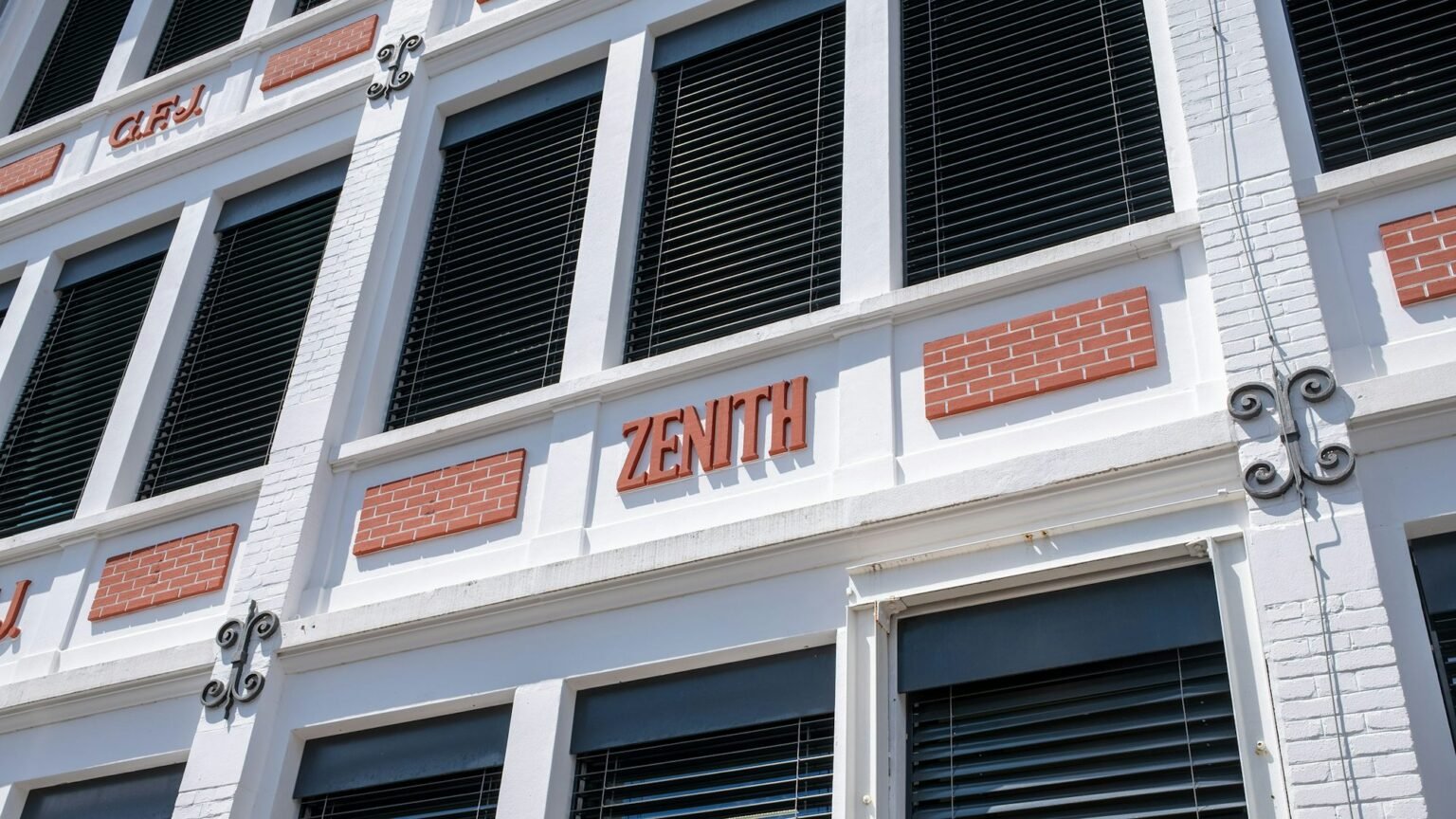


Zenith, the storied Swiss brand founded more than a century ago and known for its El Primero high-beat chronograph movement, will undergo major restructuring, forcing the LVMH-owned company to significantly reduce its workforce and scale back production and distribution, with plans to reposition the marque as a high-horology, low-volume watchmaker.
The Zenith overhaul follows years of financial losses by the brand, founded by Georges Favre-Jacot in Le Locle, Switzerland, in 1865. Chief Executive Officer Benoit De Clerck addressed employees at the company’s headquarters this week, announcing the restructuring and warning that the company could eliminate as many as 100 jobs, or about half the workforce at the manufacture. To complete the reorganization and reposition the brand by 2029, the company may also eliminate another 100 positions, including the watch brand’s entire international team.

A Zenith watchmaker.
Management and executives are now in a formal “consultation process” with employees over the next three weeks to negotiate the terms of the restructuring and job cuts. Unia, the Swiss employees’ trade union representing workers at the manufacturer, will meet with employees next week and join management in the consultation process, according to people familiar with the matter who spoke on condition of anonymity because they were not permitted to comment publicly.
“We confirm that a staff consultation process was initiated today [Thursday] concerning a proposed strategic repositioning of the Maison,” Zenith management said in a prepared statement.
“Out of respect for this process and for the employees with whom discussions are being held, we will refrain from providing any further information until the consultation process has been concluded,” the company spokesperson added.

A Zenith stamping tool.
Zenith’s struggles represent the latest and potentially largest restructuring to hit the Swiss watch industry in recent years as the sector grapples with a strong Swiss franc, U.S. import tariffs, and shifts in demand from traditional strong markets including China and the Middle East.
Zenith has racked up financial losses in recent years as demand for its watches, priced in the mid-tier range of CHF 7,000 to about CHF 12,000, has suffered as customers and brands move to higher-priced timepieces produced in lower volumes. Zenith has significant production capacity at its Le Locle facilities that is underutilized due to the downturn in demand.

A recent model Zenith Defy.
Photo credit: Tim Vaux
While Zenith has found some success supplying movements, including its El Primero caliber, to other LVMH brands such as Tiffany, Hublot, and Bulgari, inter-group supply orders haven’t been sufficient. The company will continue supplying movements to other LVMH brands amid the restructuring but is expected to cease production of many core catalog models, including the Chronomaster, Defy, and Pilot lines.
The company plans to focus on haute horology product lines, similar to its GPHJ award-winning GFJ models, so named for the initials of the brand founder.

Swiss newspaper Le Temps reported on Zenith’s restructuring on Thursday. The newspaper obtained a transcript of CEO Benoit De Clerck’s address to employees and quoted the executive explaining the challenges faced by Zenith and much of the Swiss watch industry.
“All of us in our segment, which is described as mid-range, are going through a very difficult period. You have seen it in recent months, with the many announcements by our competitors, including right here in Le Locle a few days ago with Montblanc. The strong franc, US tariffs, and the decline of key markets such as the Middle East and Asia: this is not a passing patch of turbulence; the market has changed for the long term. Zenith is not immune to this situation. Yet our house has real strengths to offer: our history, our expertise, our exceptional calibers,” De Clerck is reported to have said.
“All of us in our segment, which is described as mid-range, are going through a very difficult period…The strong franc, US tariffs, the decline of key markets such as the Middle East and Asia: this is not a passing patch of turbulence, it is a market that has changed for the long term.”
Zenith CEO Benoit De Clerck
In addition to its production of calibers for other brands, Zenith’s significant after-sales operations and services will continue to function, according to people close to the company. The brand has long prided itself on its ability to service and repair almost any watch or clock from its more than 100 years of production. Zenith stocks more than 1 million components at its Le Locle facilities to repair and refurbish vintage models.

Zenith stocks more than 1 million components for after sales repair and service in Le Locle.
Zenith’s corporate history had long been volatile before it was acquired by LVMH in 1999. For much of the 1970s, the U.S.-based Zenith Radio Corporation of Chicago owned the brand and ordered the Swiss watchmaker to shift movement production entirely to electronic quartz movements and halt production of mechanical calibers. However, the company’s enterprising chief movement engineer Charles Vermot defied those orders and hid stamps, plans, and components for the El Primero in a secret section of attic space at the Le Locle manufacture. When major volume brands, including Ebel and Rolex, needed a reliable chronograph movement for updated or new models, Zenith supplied them with the El Primero, a move that saved the company at the time.

A Zenith movement baseplate.
Looming Zenith job cuts and restructuring plans follow staff reductions at several other Swiss watch brands, including IWC, Montblanc, Chopard and Breitling, as reported by local and international media. Component makers supplying the industry are also suffering, with major brands such as Audemars Piguet, Rolex, Patek Philippe and Richemont investing in or acquiring suppliers to keep them operational.
While the Swiss watch industry exports watches at record values of around CHF 25 billion annually, volumes have nearly halved over the past decade, squeezing entry-level and mid-tierwatch brands such as Zenith.
“Zenith is also held back by more structural difficulties that no longer allow it to turn these strengths into lasting performance,” De Clerck told employees this week, according to Le Temps.
“These difficulties: a position in a highly competitive segment against houses with considerable marketing power compared with ours, and an industrial and commercial structure sized for far more than we sell, which weighs heavily on our costs,” the CEO added.
The consultation with Zenith employees and union representatives will run until November 12. De Clerck said no company, including Zenith, can lose money indefinitely, and that by implementing a profound change to its business model with a move to high-end timepieces, Zenith is “choosing recovery.”
The restructuring at Zenith follows other executive changes at LVMH brands, with some senior managers overseeing the Daniel Roth and Gérald Genta brands departing, as well as a CEO change at TAG Heuer and the decision to bring in former AP CEO François-Henri Bennahmias as a consultant at Hublot, which has also suffered a downturn in sales.