
[toc-section heading=”The Soul of Schramberg”]
Holding a Junghans watch in real life for the first time can be an unusual experience, especially if you’ve spent many years wearing hefty steel sports watches. These German timepieces feel light and clean, dominated by smooth convex crystals and dial surfaces that seem to stretch to the very edge of the metal. Junghans watches remain an insider’s choice, a knowing nod across the room between enthusiasts who appreciate genuine design history.

Of course, when exploring the market for like-minded watchmakers, a comparison between Junghans and brands like Nomos Glashütte is inevitable. Both lean heavily into minimalist design language, and both appeal to the thinking collector, but they’re entirely different beasts in practice. Junghans operates out of the Black Forest and relies on a brilliant, historically grounded formula: outsourcing reliable Swiss engines from ETA, Sellita, and Dubois-Dépraz, then wrapping them in some of the most authentic mid-century case designs available today.
[toc-section heading=”History: From Wooden Clocks to the Munich Olympics”]
Erhard Junghans started the company back in 1861, initially making wooden components for traditional Black Forest clocks. But it was his son, Arthur Junghans, heavily influenced by the industrial mass-production techniques he’d observed during his time in the United States, who steered the firm into true modernization by 1903, employing over 3,000 people and churning out millions of timepieces a year. The sheer scale of its setup was staggering, and its terraced factory buildings, built right into the steep slopes of the Black Forest valleys, still stand as architectural wonders today.

Throughout the 20th century, Junghans evolved from a mass producer of clocks into a serious player in precision wristwatches. By the 1950s, it was producing its own fully in-house movements, like the legendary J88 manual-wind chronograph caliber. The newly formed German Bundeswehr famously adopted this movement for its military pilots. The turning point, however, came in 1956. That was the year Junghans brought in Max Bill (below), a Swiss architect, painter, sculptor, and product designer. He was tasked with designing a simple kitchen clock. Having studied at the Bauhaus in Dessau under heavyweights like Wassily Kandinsky and Paul Klee, Bill brought a functionalist philosophy to the table. The kitchen clock featured perfectly balanced typography and a teardrop-shaped timer, which eventually led to a dedicated line of wristwatches in 1961, cementing Junghans’ reputation as a leader in Bauhaus design for the next 60 years.

The brand kept innovating on the tech side, too, providing the official timing gear for the 1972 Munich Olympic Games and introducing colorful, highly legible digital instruments. The watchmaker even pioneered the world’s first radio-controlled wristwatch, the Mega One, in 1990. Today, Junghans is operating as an independent entity once again, having survived the Quartz Crisis and various corporate shakeups to focus entirely on heritage and quality.
[toc-section heading=”Key Collections: The Pillars of the Brand”]
If you’re considering your first Junghans watch, you won’t be short on options. The modern Junghans catalog is neatly split into a few core mechanical pillars. Each collection speaks to a completely different era of the company’s history, yet all four share that unmistakably German design language.
The Max Bill Collection

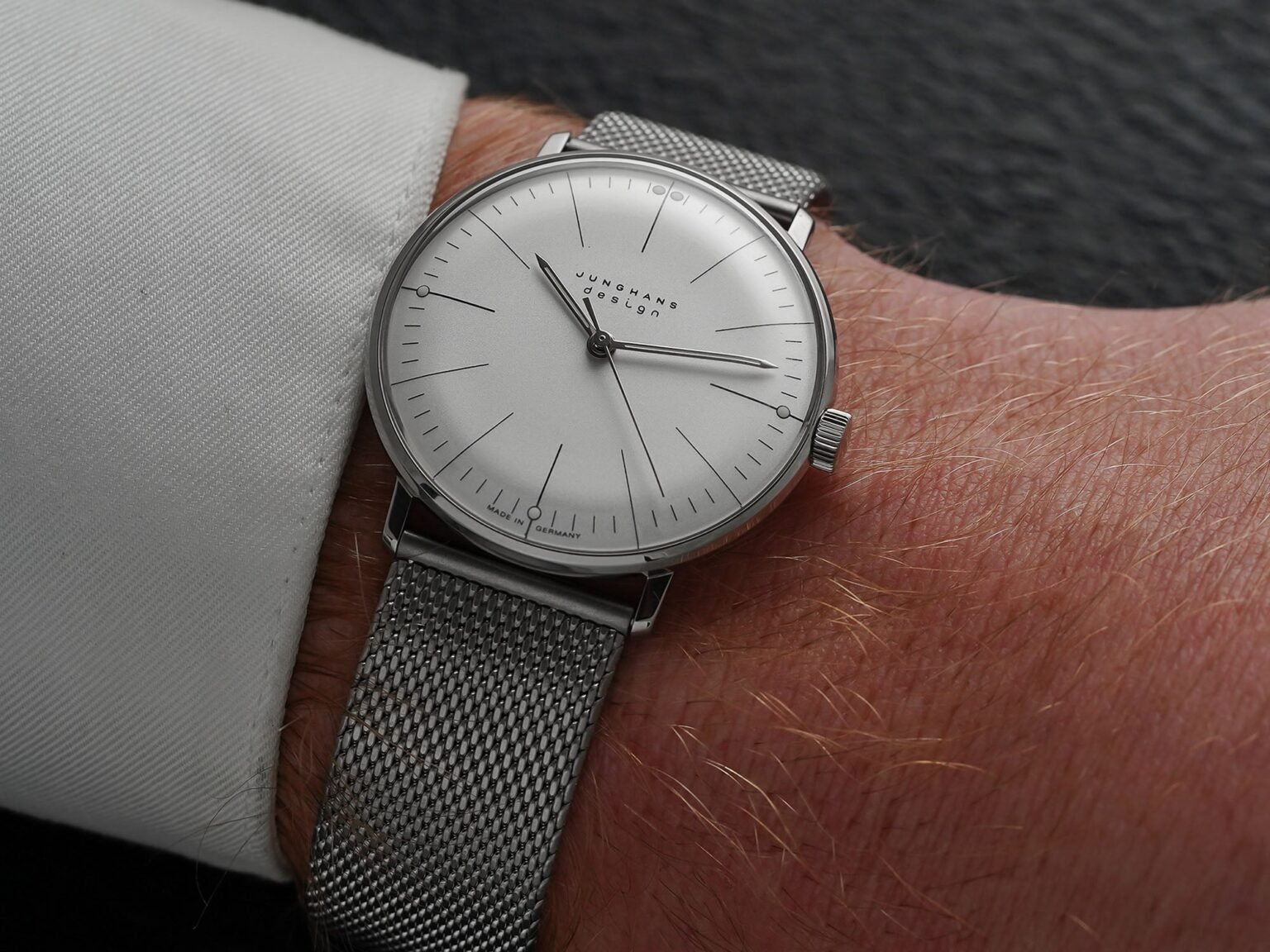
If you asked a hundred watch enthusiasts to name a Junghans design, 99 would say the Max Bill. This is the brand’s cornerstone, highlighting one of the 20th century’s most important industrial designs. What strikes you immediately about the Max Bill in the metal is its minimalism. The watch is all dial. The bezel is virtually non-existent, serving only as a razor-thin steel frame to hold a domed crystal in place. That convex crystal, traditionally made of plexiglass coated with a scratch-resistant Sicralan layer, beautifully distorts the dial’s extreme outer edge, giving the watch a warm, vintage character. Junghans does, however, offer sapphire versions now for the pragmatists among us.

Max Bill designed the font specifically for these watches. Each dial’s number “4” features a custom-designed, closed-top Arabic numeral that watch enthusiasts often note resembles an upside-down chair. The hands are simple, needle-like batons that reach exactly to the minute track. Whether you opt for the 34mm hand-wound version, the 38mm automatic, or the Chronoscope chronograph variant, the proportions are all well-considered. The Max Bill is frequently presented on a supple calfskin leather strap, but also on an ultra-fine Milanese mesh steel bracelet that drapes over the wrist like metallic fabric and elevates the entire package into something that feels incredibly premium.

Mechanically, these watches run on J800 series calibers, essentially modified ETA 2824s or Sellita SW200s. From a watchmaker’s perspective, this is a brilliant choice, because they’re easy to service and they keep the price point highly accessible.
The Meister Collection

While the Max Bill line gets the lion’s share of mainstream attention, the Meister collection is where Junghans celebrates traditional watchmaking. The Meister, or Master, series traces its roots back to the 1930s when it represented the brand’s respectable in-house capabilities.

The cases share the same visually thin design language as the Max Bill, achieved with sharply curved, bowl-like case backs that sink into the wrist and domed dials that arch up to meet the crystal. This creates an optical effect that makes the watch appear mere millimeters thick in profile. The Meister dials are also typically finished with a subtle sunray brush, giving them a dynamic quality under the light.

The standout in this family is the Meister Chronoscope, featuring deeply recessed, bowl-shaped subdials on a beautifully classical bicompax or tricompax layout. Driven by the J880.1 caliber, which uses the legendary Valjoux 7750 as its base, this elegant, dressy chronograph balances mechanical accuracy with mid-century formality. The dauphine hands, with their razor-sharp profiles and tiny slivers of luminous material, give the Meister a decidedly mature personality.
The Meister Pilot Collection

For those who find the Max Bill and Meister a little too refined for daily wear, Junghans offers a completely different, albeit more aggressive flavor with the Meister Pilot. This collection is a direct descendant of the J88 chronographs issued to the German Bundeswehr in the 1950s, boasting a distinct tool-watch edge.
The defining characteristic of the Meister Pilot is the bi-directional rotating bezel, which features 12 deeply scalloped, concave notches, creating a dodecagonal shape that’s easy to grip, even when wearing heavy leather flying gloves. These watches are rugged, functional instruments with oval chronograph pushers and long shafts, a brilliant design quirk that’s also historically accurate.

Inside, the watch is the J880.4, which relies on a reliable ETA or Sellita base paired with a robust Dubois-Dépraz chronograph module. The bicompax layout on the matte dial is wonderfully balanced and framed by a 43.3mm case with a convex caseback and steeply downward-curving lugs. The pilot-style strap in black and navy blue calf leather, with rivet detailing and a DLC-coated buckle, completes the vintage aviation aesthetic, giving the watch both physical presence and rugged capability.
[toc-section heading=”Conclusions”]

Whether you’re captivated by the strict Bauhaus logic of the Max Bill, the traditional elegance of the Meister, or the rugged military history of the Meister Pilot, you’re buying into a German brand that stands for substance and purity when you invest in a Junghans watch. This brand offers some of the most strikingly simple yet compelling designs in the mid-tier bracket, with proven movements that, if properly maintained by a good watchmaker, will quite literally outlive us all. It’s a brand that every serious watch enthusiast should make the effort to experience in the metal at least once in their collecting journey. You can learn more about the brand at junghans.de