

Happy Friday again, Ballers, and congrats to whoever snagged the Omega 2998-4 on Goodwill earlier this week. I’m fighting multiple aspects of my nature—as a midwesterner and a dad—to avoid making lame jokes about the heat, but fingers crossed, the fever’s breaking, and it’ll return to average temperatures sometime soon for all of us.
Scorekeeping last week’s picks, the Hamilton sold for $4,300, the Speedmaster Soyuz for €18,000, and the Universal Genève Rattrapante for GBP 4,250 . The Goldpfiel Vianney Halter sold, but the auction house hasn’t listed the price online and hasn’t responded to my email, so we’ll all have to live with the mystery.
Strays
I mentioned Always Sunny last week, and now this week there’s this exquisite Movado Ermeto with a caseback dedication—Dennis from Mac—that feels too good not to include. I figured it’d be fun to stir the pot last week and argue the Hamilton Model 21 as the Most Important American Watch in history. For whatever it’s worth, the runner-up would’ve been the Bulova Accutron, and the purest expression of that watch is the Spaceview, of which there’s a nice (though non-running) version available here, which auction lot also includes a Spaceman watch (also not working), and the Spaceman, for what it’s worth, deserves more oddball attention.

Photo courtesy of Seuyco.
Here’s an almost comically reserved but gorgeous Grand Seiko SBGW235, and, in the same auction, here’s what sure seems to be a great example of an IWC ‘Sterile Dial’ Mk XII. I know folks who refuse to buy vintage militaria simply because of how often such stuff’s messed with and/or is inauthentic, and while I’m certainly no expert, these two A. Lange & Söhne’s B-uhrs are worth further examination. Finally, here’s an Omega Calypso just because they’re cool watches and should be pointed out more often, and here’s another extraordinary Thomas Engel pocket watch that someone with more resources than I should purchase posthaste.
A Million Valjoux 72 a.k.a. A “Poor Man’s Enicar”
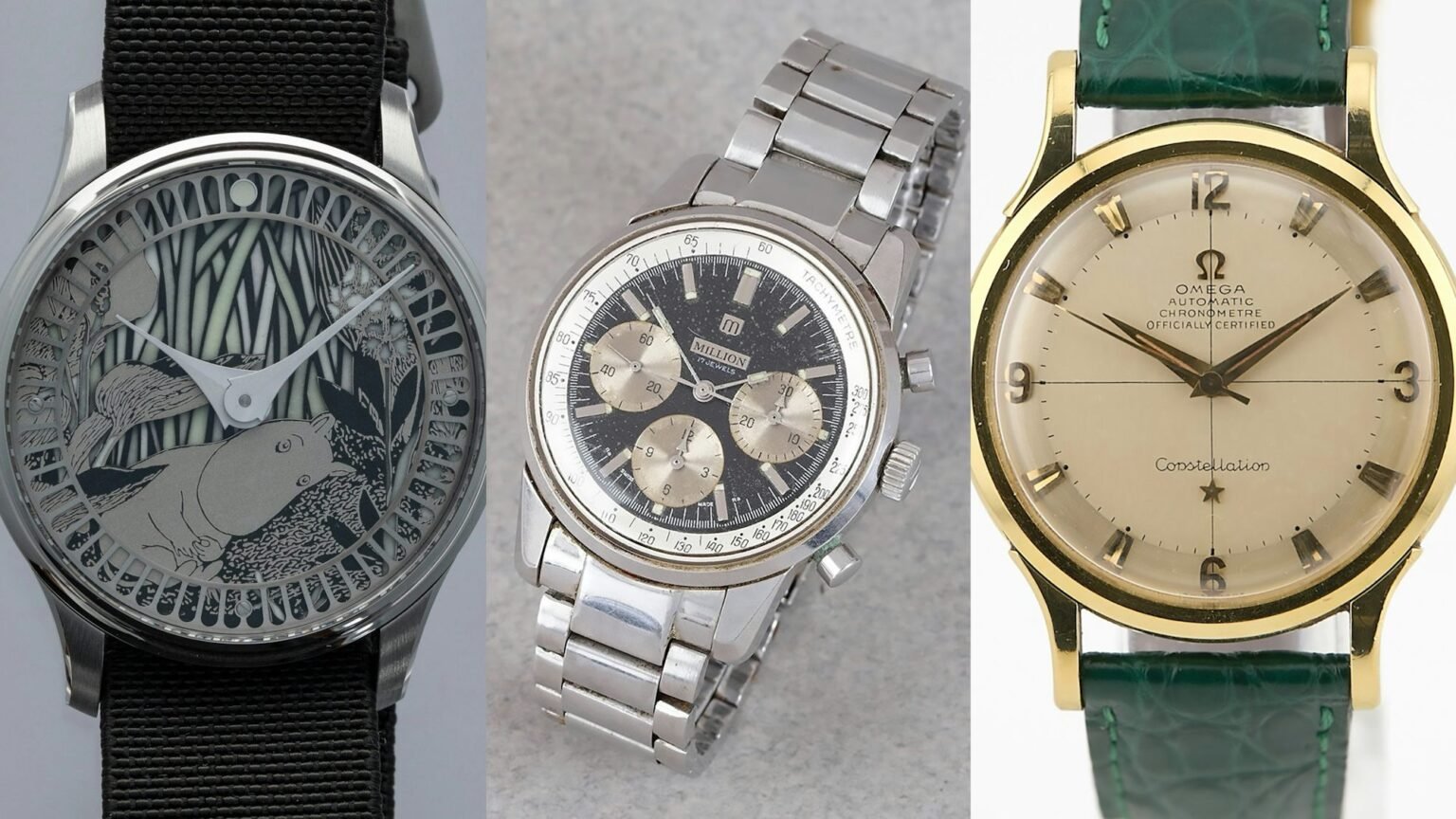
I fell hard early on for “Poor Man’s Heuers,” of which there are plenty. I love and have nothing against Heuers, but I’m also a 100% Kirkland guy, and if I can get something that’s almost identical to the name-brand thing but with different branding, sign me up. Which brings us to this Million chronograph, a model that falls under the less-fraught category name “Sherpa Graph Cousins.” As the name and pictures make clear, this is very close to an Enicar Sherpa Graph with a different name. While the dial has some spotting, the watch overall still presents well enough (depending, obviously, on your tolerance for imperfections).

Photo courtesy Time Studio Watches.
What I still find sort of charmingly fascinating about the Poor Man’s Heuers versus the Sherpa Graph Cousins (SGC) is that, generally, the rebranded Heuers we find come from well-known brands. Not so the SGCs: I know I’ve seen other Million-branded watches, but they don’t come up much. Ditto Desotots and Schild (two other SGCs I’ve owned): you can find other watches by those brands, but, as brands, they didn’t have near the establishment or reach of the Heuer off-brands.

Photo courtesy Time Studio Watches.
While the dial’s a bit of a downer on this example, everything else is pretty excellent. I don’t remember seeing another Million-badged bracelet, which is cool in and of itself, and the recognizable 40mm case with those beveled lugs looks excellent (obviously the thing’s not been cleaned up for the auction). With a bid (at the time of writing this) up to £900, this watch will be sold on July 12th in Sheffield.
An 18k Omega Constellation ref. 2648
My apologies, Baller, for including another 18k Omega Constellation. I could not help myself. The Omega Constellation line was launched with the reference 2648, with a bumper movement, in 1952, meaning this particular cross-haired example is from the original year of one of the most significant watch models ever made.

Constellations are tricky simply because of their diversity: plenty of folks swear the best iterations are pie-pan dog-leg models (167.005 for no date, 168.005 for date), and there’s a contingent who swears by the 2852, but those two merely scratch the surface of what’s available in Connie world (for way more info about Constellations than you could begin to digest in a month, dive into Desmond Guilfoyle’s invaluable website). Among vintage Omega Constellations, there are so many configurations—case shape, case material, dial, and hand differences—that the field feels nearly endless.

The example on offer this week—auctioning on July 4th, in France—is worth noting because of the Three Cs standard regarding looking at watches: condition, condition, condition. A handy metric by which to adjudicate gold watches is to check the caseback, and the Observatory emblem on this one is in almost freakishly excellent condition. From the front, you can see the clearly articulated lugs and the decagonal crown. Yes, there’s evidence of wear, but you could go a long, long time without finding another 70+ year-old solid gold watch in such good shape.

Take my comments on the dial with whatever requisite salt you believe’s necessary, but, to my eye, the thing looks original and in excellent shape. While I’m not an expert, I’ve seen many of these, and everything seems to check out here. To be clear, reference 2648 Connie dials are widely debated and deliberated over. Still, I say it’s original, and I’d be bidding on it were I in the market for a gold Connie.
Again, this goes to auction tomorrow, so if you’ve got time before whatever barbecue and/or firework activities you have planned, this thing is worth watching (and if the Omega’s not quite your jam, there’s also a lovely gold Universal Genève time-only watch in the same auction).
A Sarpaneva Moomin
I am not Finnish, and do not know the Moomin books at all, but in the six years since these Sarpaneva x Moomin models were released, when one’s popped up on whatever feed I’m plugged into, I’ve never once, not ever, seen one and immediately looked away, bored. While I wouldn’t argue that’s a perfectly useful metric for caring about a watch, it’s a hell of a start.


Released in 2020 for the 75th anniversary of the Moomin books, this watch was a limited edition of 75, was priced at €5,000, and sold out in a day. While the nicely finished case has a lot going for it, and while the Soprod A10 movement’s a totally acceptable workhorse, you’re into this watch (or not) based almost exclusively on the three-layer dial.
This is one of those cases where the specifics—that each of the three dial plates is cut by lasers, that the lume’s applied to the reeds at random, meaning each dial’s different—only matter if the whole thing ends up singing as a coherent whole by the end, and, again, it sure does to me. If you click on the Loupe This listing and go to the 13th picture, you’ll see the lume activated, and the image itself should serve as something of a Shibboleth. Does it thrill you to see such lume? If so, proceed. If not, pass. The bid is up to $7,000 at the time of writing, and the watch sells on the 7th.
A Vacheron Constantin 4111
First, the Artcurial auction coming up on the 6th is stuffed to the gills with great watches, including a phenomenal Jaquet Droz “Twelve Cities,” an unworn Vacheron 222 featuring the emblem of Saudi Arabia, and a quartet of Journes—a platinum Octa Perpetual, a titanium Elégante, a platinum Centigraphe Souverain, and a platinum Octa Divine.

However, the standout is this Vacheron Constantin 4111 chronograph from 1940. This is one of those watches about which it feels almost silly to say much. If you have eyes, you can determine nearly everything critical regarding assessing the watch. Is it beautiful? It is indeed (with the caveat of beauty’s supposed subjectivity). I find it hard to believe, but more than one source notes that only three of these watches were ever made; again, that seems impossible, but I read it on the internet, so obviously it’s true.


Regardless of the inherent rarity, I’d note from the jump that I do not know what Artcurial means by saying the dial has been ‘cleaned.’ The estimate—€50,000-80,000—seems low for what one’d expect a flawless, entirely correct example to sell for. I suppose there’s some comfort to be taken from the fact that it comes with an extract from Vacheron Constantin’s archives, and that the watch is being auctioned on behalf of a descendant of the original owner, but past that, you’ll have to take some things on faith. And if you (like me) are priced out of a solid-gold 86-year-old piece of high horology but still hanker for a non-circular-cased chronograph, here’s an Eterna that’s fairly worn but (imo) still has a decent bit of charm.