

Given that May 1st is celebrated as International Workers Day, it seems almost compulsory to reward yourself with a little mid-day Mayday watch ogling, right? Congrats, Baller, you’ve done it again. Happy Friday.
Scorekeeping last week’s picks: the Certina Argonaut chrono went for £1,620, the Vacheron Constantin 6394 for £7,400, the IWC Mark XII for £2,400, and the Cartier Coussin for CHF 42,000.
Strays
Everyone’s encouraged to take a closer look at this, described as an “18k Vintage Vacheron Constantin Geneve Quartz Watch,” and let’s take a moment to collectively register the fact that, in the pictures, the second hand has clearly moved, so either a) the battery’s still got some life in it after all (impressive!), or b) maybe it’s not quartz. Mr. Hoffman wrote earlier this week about the Patek 5322G, “[a] chiming alarm in a mechanical watch today is a purely romantic complication that recalls an earlier era.” While he presumably wasn’t specifically referencing the LeCoultre Memovox, it’s certainly what springs to mind when I think of the alarm watches from an earlier era, and if you’ve made it this far in life without one, here’s a pricey way to address that lack.

Photo courtesy Precious Collections.
Yes, the dial is imperfect, but look, if you’re going to scare the bejesus out of yourself with an old mechanical alarm that sounds like a tattoo machine suddenly buzzing to life on your wrist, don’t you owe it to yourself to do so with lots of gold? Finally, if you’ve wondered if there are more ‘disco volante’ models out there, do not fear: here’s a Juvenia on offer from Apex watches that looks just lovely.
A Breitling ref. 765CP “Raquel Welch”
I feared Breitling when I started getting into watches. I’m old enough now that maybe I wouldn’t be as embarrassed, but if, 15 years ago, I’d worn a Navitimer and someone’d asked how to use the bezel, I’d’ve blanched and sputtered before admitting that I probably shouldn’t’ve even been wearing the thing, given my lack of sophistication.

Photo courtesy Kraft Auction Service.
Fortunately, this Breitling 765CP obviates the whole mess of needing to know how to actually use a watch’s most salient complication. The first time a Breitling 765 shows up in a catalog is in 1944, and while the earliest examples have their charm, the look of the watch changed significantly with the addition of an external rotating bezel in 1952/53. At the same time, the minute totalizer for the Venus 178 movement powering the model was changed from a 30-minute counter to a 15-minute counter. And, of course, the early models also offered a digital minute totalizer at three: it looks precisely like a date window but was, in fact, a minute counter.

Photo courtesy Kraft Auction Service.

Photo courtesy Kraft Auction Service.

Photo courtesy Kraft Auction Service.
The example on offer is from after 1965, when Breitling introduced the 765 CP, or Co-Pilot, with a black-anodized (instead of aluminum) bezel. Made for only two years, the 765 CP is big at 41.5mm, with 22mm lugs, and, because of its size, many of them got pretty beat up, which makes the one coming up for auction on the 3rd so great. It’s got a great, seemingly-unpolished case, the caseback etching is clear, and the dial and hands look wonderful. Bid up to $1,000 at the time of writing, I imagine this one’ll be fairly contested by bidders.
A Patek Philippe ref. 1593 “Hour Glass”
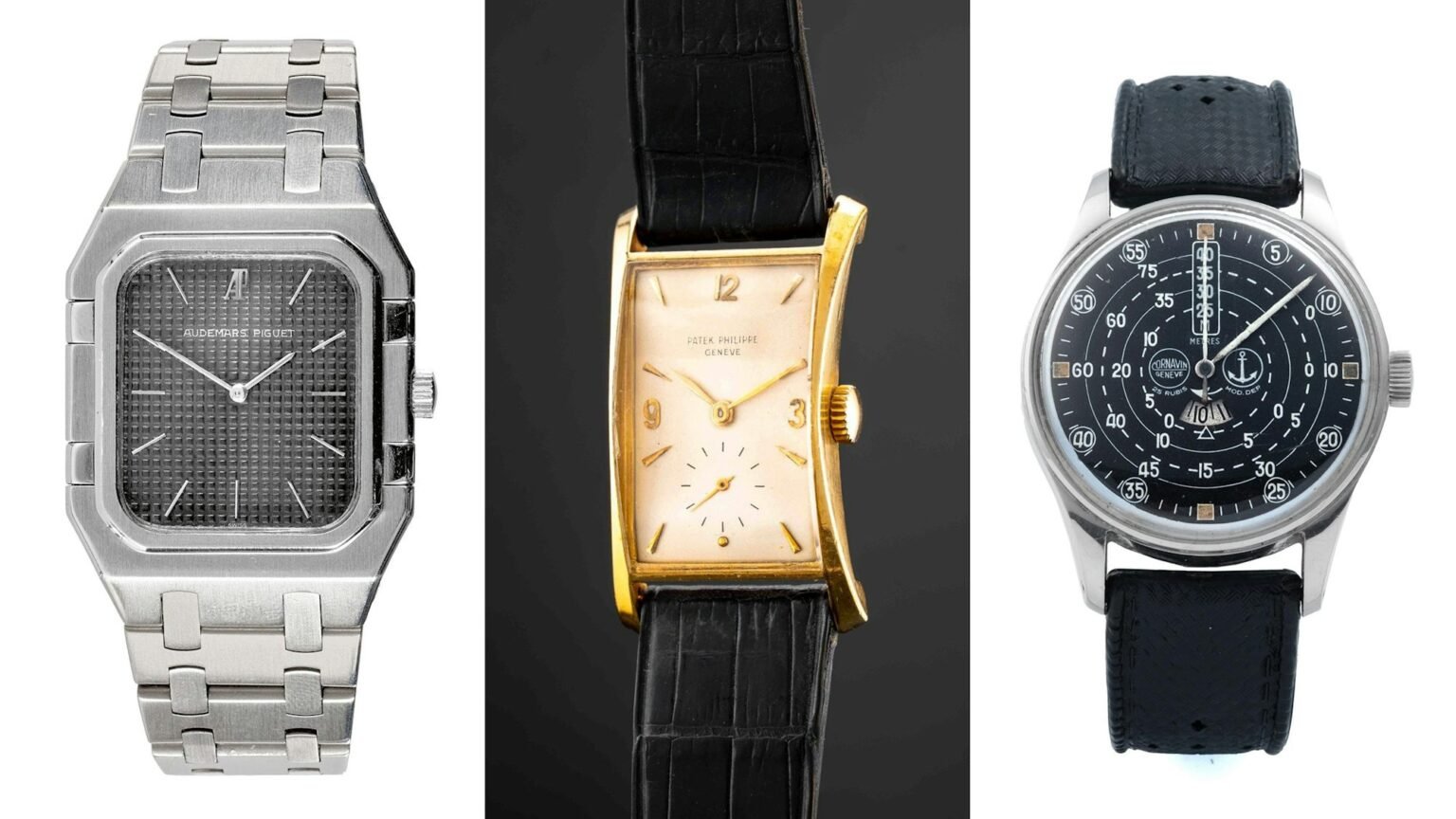
This watch would d be worth a look even if Michael B. Jordan hadn’t worn a platinum version of the model to the Golden Globes this year, and even if Antiquorum didn’t have a similar example on offer (albeit with a service dial, as Mark noted in his roundup). In production from 1944 till 1967, Patek made approximately 500 examples of the 1593 in yellow gold (i.e., just a few more than 20 per year), and like most Pateks from that time period, it both a) packs horological heft and b) seems almost whimsical.

Photo courtesy of Osenat Fontainebleau

Photo courtesy of Osenat Fontainebleau

Photo courtesy of Osenat Fontainebleau
This example dates to 1950 and features the caliber 9-90, which at least some people consider an icon. Of course, the watch is fairly small—22mm wide by 32mm long—but it’d seem blasphemous to complain too much when the end result is so elegant. Look at the side view of the thing!

Photo courtesy of Osenat Fontainebleau
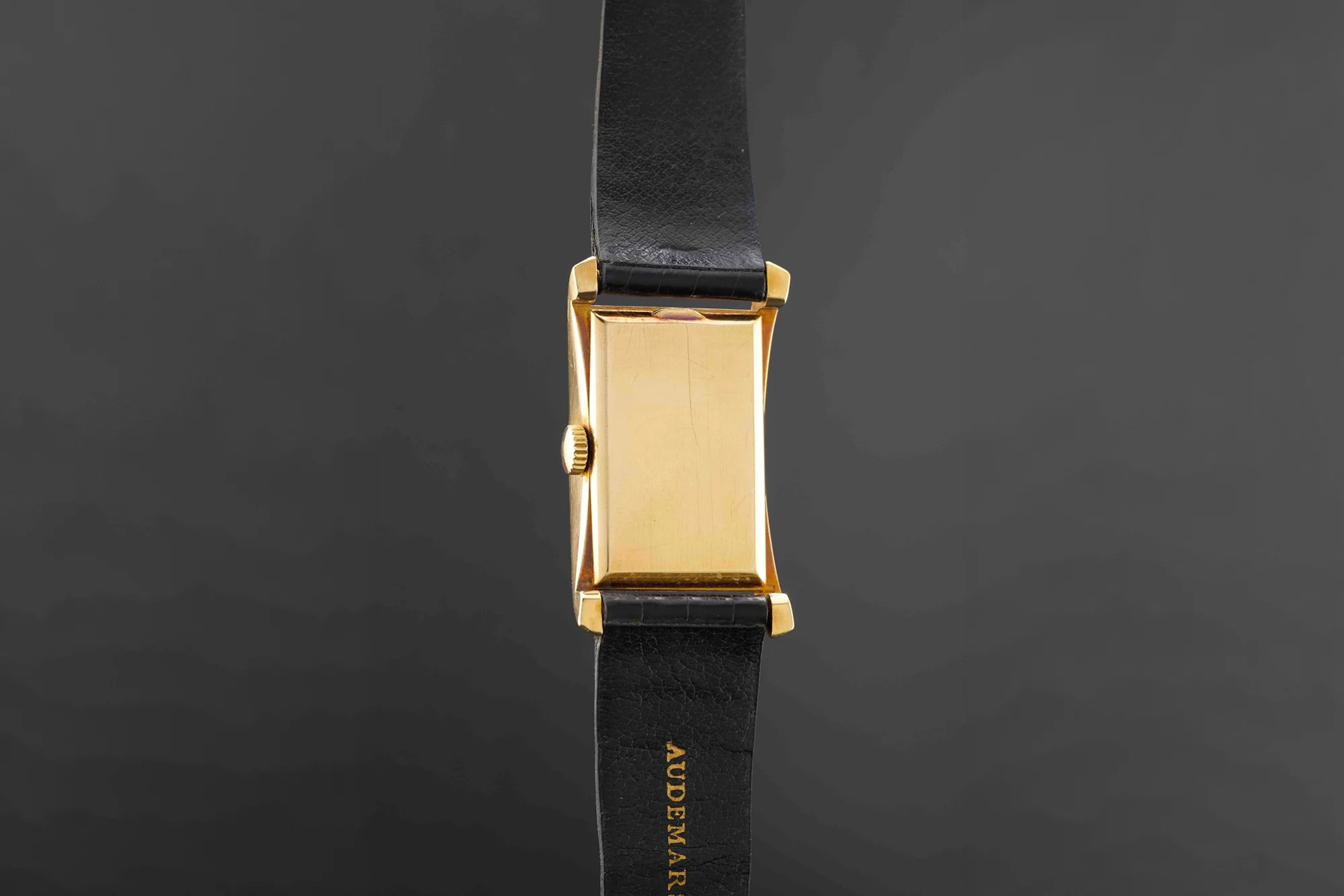
Photo courtesy of Osenat Fontainebleau
True, this is probably the least go-anywhere-do-anything watch imaginable, and the estimate—€14,000-18,000—makes clear it’ll likely stay out of reach to most of us mere mortals. And yet it’s just so, so pretty—the austere dial with those numerals, the leaf hands, the seemingly unpolished case. Here’s one of those times where beauty is an end in and of itself. The auction commences on the 6th of May.
A Cornavin Diver
A watch like this Cornavin diver, reference P 810, is tricky. It forces me to confront the fact that there actually are some watches that are too specific a tool watch for me to cosplay with. Obviously, this is subjective, but, for instance, my enjoyment of a vintage Memosail has nothing whatsoever to do with the fact that I have never sailed in a regatta and likely never will. Ditto, many other sorts of complications.

And then there’s the P 810, which resolutely scratches a whole host of itches I have re: things in general—it’s a little strange-looking and is less known (than other divers). And while I’m sure I’d be more than happy to wear one, it’s inconceivable I’d ever use its chief function as intended, i.e., setting the minute hand to 12 as I start a dive, and then checking the placement of the minute hand at dive’s end and decompressing as directed to ensure I don’t end up like Washington Roebling.
This Cornavin is among the 672 lots in Antiquorum’s Geneva auction. Dating to the 1960s, it’s huge—42mm wide, 14mm thick, 22mm lug-width—and, yes, the hands have been relumed. Also, yes, you’ll have to get used to registering the hour on this watch by looking at the aperture just beneath the hand-stack. If you’re more therapeutically balanced than I and feel less freighted by any object’s originally intended purpose, the auction starts on the 9th.
An Audemars Piguet Royal Oak Square ref. 6005
Royal Oaks are so omnipresent and such a significant through-line in modern watchmaking, it’s almost comic (there are, according to Audemars Piguet itself, “no less than 500 variations”). In the upcoming Geneva auctions, there are nine Royal Oaks in the Phillips catalog, nine at Christie’s, and ten at Sotheby’s. What’s most striking about the line is how recognizable it is throughout its many iterations: over the years, Royal Oaks have sported just about every complication imaginable, and yet, at least of the ones I’ve seen, they’re all recognizable, carrying just enough of the original silhouette to make the lineage.
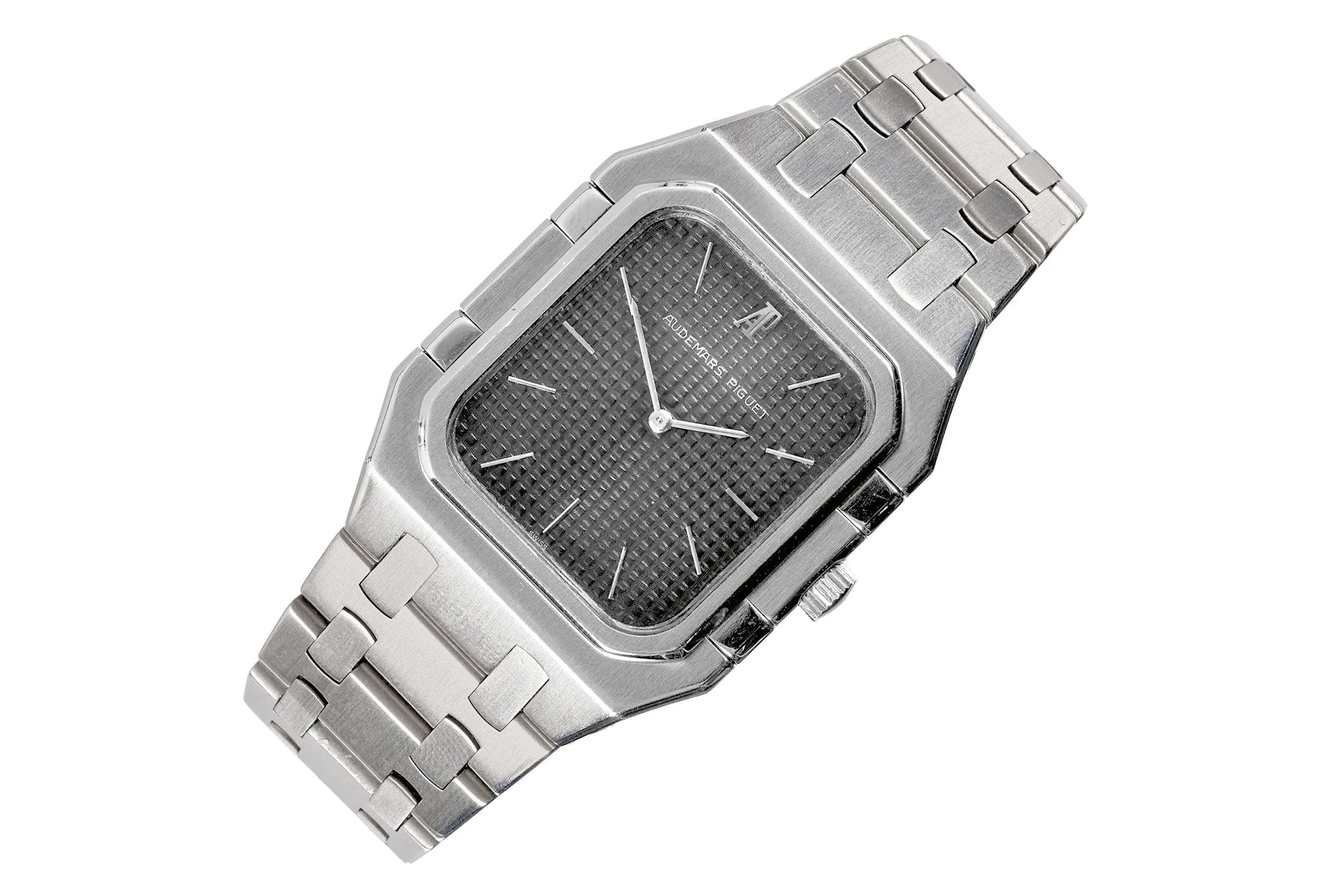
Photo courtesy Dobiaschofsky Auktionen AG.
All of which serves as a bit of a setup, as this Audemars Piguet 6005 does not immediately register as a Royal Oak (if anything, it looks more like a Vacheron Constantin 222). Sure, it’s got that recognizable tapisserie dial, and the stick hands, but still. Yet a Royal Oak it is. Here’s what Audemars Piguet themselves have to say regarding the context of the model (emphasis mine):
Launched in 1972, the Royal Oak went through several major phases between 1976 and 1982 that turned it into a collection. During its first four years of history, Model 5402 was the only option, available in steel only and adorned with the same dial. But in 1976, the birth of the first ladies’ Royal Oak 8638 paved the way for a dedicated collection. The following year witnessed a major spurt with the addition of gold versions, followed by other sizes and movements. From then on and in barely five years (1977–1981), 27 new models were created.
It’s that last bit that thrills me most about this watch. It’s easy to forget—not just in watches, but in any field—how what seems obvious now wasn’t at all obvious, often in the very recent past. While this square Royal Oak may seem comically out of place or like a misfire from here, 40+ years after its release, it’s a wonderful reminder of how few things find their footing immediately.

Photo courtesy Dobiaschofsky Auktionen AG.
Dating to 1980, this quartz weirdo is (obviously) one of the 27 new models referenced above, and its charm stems from the fact that Audemars Piguet was still trying to figure out exactly what a Royal Oak was. How far could a watch be pushed and stretched and still retain its essential Royal Oakness? Obviously, everyone gets to decide for themselves the answer to that specific question, but the watch on offer is a fascinating attempt at an answer.
On the smaller side, at 28.5mm wide by 30mm long, this particular example seems in generally good condition, with the dial, hands, and case all presenting well. The watch already has an opening bid of 6,000 CHF, and will be auctioned on the 6th of May. If this Royal Oak is just a little too far afield for your tastes, there’s also, in another auction, this Royal Oak 25645BA, a recognized classic for all sorts of obvious and good reasons.