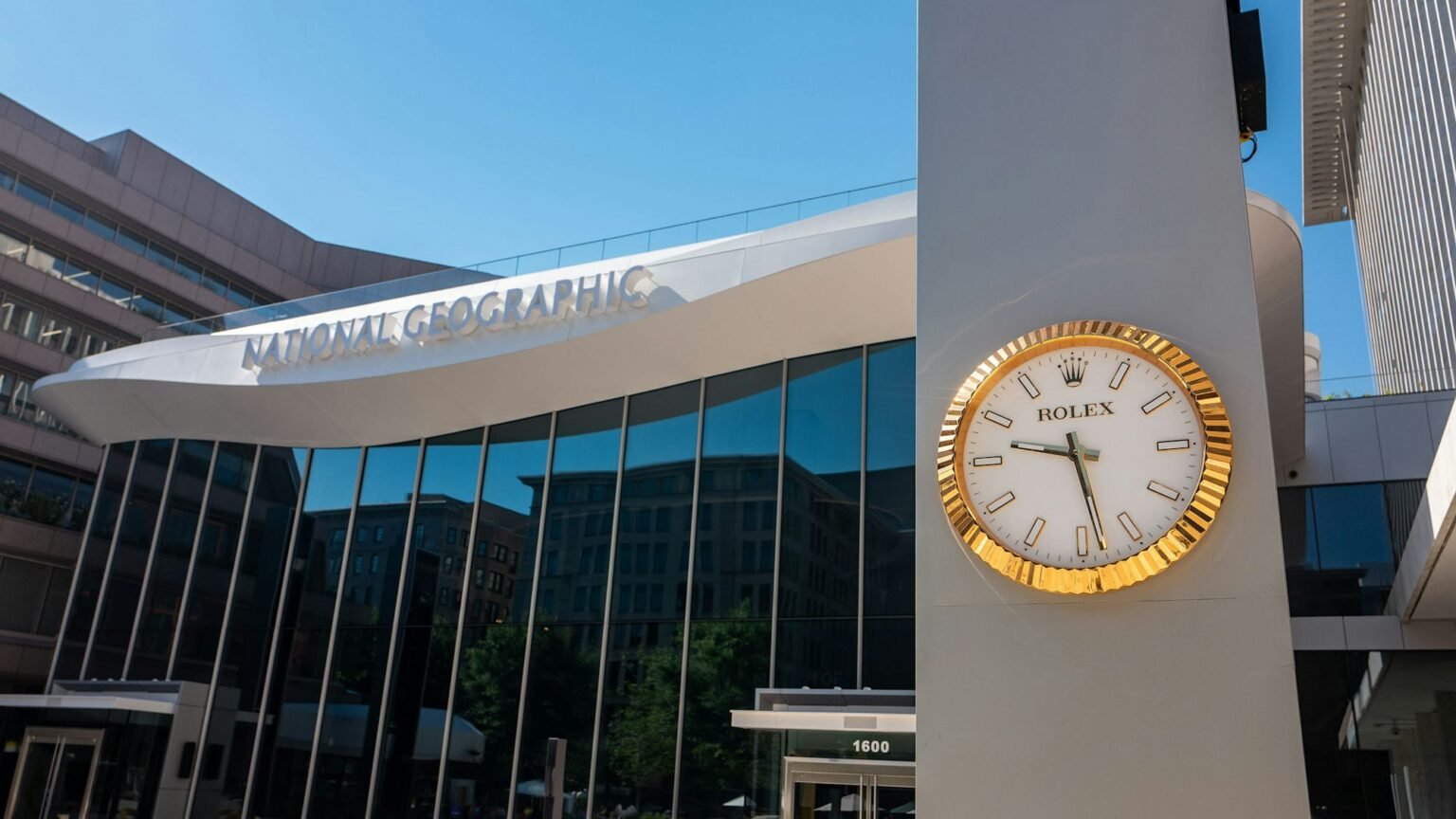


It was about halfway through James Cameron’s speech on the Rolex Landing at the new National Geographic Museum of Exploration in Washington, D.C., that I glanced up. There, suspended above my head, was a familiar yellow object. To the uninitiated (and less nerdy), it might look like an alien spaceship from a low-budget sci-fi film. But I knew what it was immediately: Jacques Cousteau’s soucoupe, the diving saucer from his 1964 documentary, “World Without Sun.”

As I listened to Cameron go on about his descent to Challenger Deep, I looked around at all these incredible objects—there was the bathysphere that William Beebe climbed into and descended to over 3,000 feet in 1934. Down the hall, the Maruti Suzuki 4×4 used by Sandesh Kadur to track wildlife in India, its tires still muddy.
A dugout canoe, once upended by a hippo, used by Steve Boyes while searching for the source of the Zambezi. A Chinese terra cotta warrior. And a one-atmosphere JIM suit like the one in which Dr. Sylvia Earle walked 1,000 feet deep on the ocean floor. For a student of exploration history like me, this was nothing short of nirvana.


Rolex has been a supporting partner to the National Geographic Society since 1954. Those were halcyon days for exploration and the introduction of Rolex’s most legendary tool watches—the Explorer, the Submariner, and the GMT-Master. The names Rolex and National Geographic have been intertwined ever since, and I, for one, recall seeing those great print ads in the yellow-bordered magazine throughout my own childhood, dreaming of my own adventures. The partnership between Rolex and Nat Geo is now over 70 years old, and with the new museum, it is entering a new chapter.

A plaque on the wall of the Museum of Exploration lists the donors who contributed to the construction of this incredible destination and its exhibits. There, at the top, is Rolex, and a staggering number: $100,000,000. If the preview I got last week was any indication, it was money well spent. National Geographic had a museum on the campus of its headquarters in Washington, D.C., but it was much more modest in scale.


The new museum, four years in the making, is over 100,000 square feet of exhibit space and artifacts from the Society’s history of supporting exploration and its familiar magazine. Aside from the hundreds of exploration ephemera, there are photo galleries and interactive exhibits, many of which will rotate over time. Joel Sartore’s Photo Ark: Animals of Earth is particularly poignant, an immersive and interactive space displaying still and moving pictures the photographer has made in his attempt to photograph as many species as he can before they become extinct. So far, he’s up to 17,000 and counting.

For Rolex’s generosity, it gets an entire floor named after it. The Rolex Landing occupies the second level of the museum and consists mostly of objects from expeditions around the world and from across decades. Aside from those I listed above, there is a lion tracking collar, film cameras used by Nat Geo photographers, and a gondola that ascended, suspended from a balloon, to over 72,000 feet into the stratosphere in 1935 (interestingly, the same year as Beebe’s record-setting ocean descent). The name of the gondola? Explorer II. Coincidence, I’m sure. Prescient, definitely.

What is lacking, with one exception, is watches. You’d think a floor of an exploration museum named after Rolex would have vitrines of famous watches worn by explorers. But the only watch to be found is a Deepsea Challenge, the deep-diver built for and named after James Cameron’s submersible and its descent to the deepest point on Earth. In one respect, it was refreshing not to find the Rolex Landing turned into a watch showroom, but as someone who loves the watches of exploration, I did hope for a few more examples.

The author’s own 14060M Submariner.
I only had a few hours to visit the new Museum of Exploration, in addition to two days attending the National Geographic Explorers Festival, but I wanted to linger. I could spend a full day, maybe two, wandering the halls, studying the galleries of iconic photos, playing with the interactive exhibits, and soaking in the lore of so many amazing explorers. I guess that will require a future expedition.
The Museum of Exploration opens to the public on June 26th, and you can find more information here.