

In terms of analog intricacy and an unyielding enthusiasm for the vintage and enduring, watches and the automotive realm are a natural A-to-B: it should come as no surprise that the Venn diagram of watch nerds and automotive nerds is eerily close to a circle.
Yet, there’s more to the world of branded cross-promotion than, say, TAG Heuer and Porsche. Some of the most off-the-beaten-path collaborations are worthy of deep dives, and the six examples highlighted here (including many from Heuer!) are collectible and worthy of appreciation by those who know. Because there’s only so much that can be represented by Steve McQueen, in that white racing suit, giving the British equivalent of the middle finger. Thankfully, the world of mechanical fascination runs so much deeper than that.
IWC Mark XII x Saab

“Born from Jets” was the advertising slogan of the now-defunct Saab for the last 20 or so years of its life, and while there was a distinct difference between Saab AG the defense contractor and the General Motors-owned division, it made for some really, really cool television ads. IWC, who built its reputation on pilot’s watches, lent its flagship Mark Series to a Saab tie-in in 1997: if you put down the deposit for a limited-edition 900 Mellow Yellow Cabrio, you were awarded one of these Mark XIIs, each one customized with a yellow leather strap and “Saab Automatic” on the dial instead of the usual “Mark XII Automatic.” Today, if you can find one, they go for $4-6,000, or the equivalent of half a dozen Saab convertibles.
Seiko 7A28 Honda Racing Team

Both Seiko and Honda attained new levels of success in the 1980s: Seiko introduced the world’s first analog chronograph powered by quartz, the lavishly constructed 7A28, and Honda began its partnership with Ayrton Senna, which in 1988 would net Senna his first of three Driver’s Championships and McLaren-Honda 15 out of 16 victories. That same year, Seiko transformed one of the 7A28’s dizzying number of variations to commemorate Honda’s ascendance on the world stage. The Honda Racing Team version features a gray and black color scheme, its contrasting subdials featuring hands styled to look like driver’s gauges, surrounded by a minimalist tachymeter scale. “Honda” is prominently featured up top, while “F-1 Grand Prix” is engraved on the overhanging top and bottom lugs: the Seiko word and logo appear nowhere, as if its designers knew when to let Honda have its moment. True to the late-Eighties aesthetic, this 7A28 previews the rounded “jellybean” styling that would infiltrate the watch world throughout the next decade—and so while it’s a polarizing time capsule of a design, its provenance and rarity would endure until the end of its production in 1992, well after Senna earned his other two Driver’s titles.
Citizen 8110A Walter Wolf Racing

Image via Plus9Time
Less successful but far more flamboyant was Walter Wolf Racing, whose eponymous Canadian business fielded a team in the 1977-1979 Grand Prix seasons to varying degrees of success. With Jody Scheckter, the team won the first race it ever entered, the 1977 Argentinean Grand Prix, as well as the prestigious Monaco and homefield Canadian Grand Prixes. To honor Walter Wolf Racing—and its roster of legendary drivers including Bobby Rahal, James Hunt, and Keke Rosberg—Citizen produced a line of watches with the team’s bold red W logo against black minimalist faces. Arguably the most interesting of the bunch is the Walter Wolf 8110, one of Citizen’s crowning chronographs with an automatic flyback movement, this time rendered in titanium and with an unusual compass bezel. Walter Wolf Racing fizzled out after 1979 (the team having been sold to Emerson Fittipaldi) but the brand lived on through a line of period-cool accessories, and a rare line of ultra-powerful, 500-horsepower Lamborghini Countaches, each handbuilt and tuned by factory engineer Gian Paolo Dallara himself.
Buler Bertone Stratos LED

When Bertone unveiled the dramatic Lancia Stratos Zero at the Turin Motor Show in 1970, the copper-colored wedge reshaped car design for the next two decades: angular, sharp-edged lines were now the sign of the future. And only a watch with a novel LED digital display could be worthy enough to match. Bertone selected Buler Watches, a middling brand originally founded in 1945 in the shadow of the Jura Mountains, to engineer the module and wrap it in a series of prototypes, complete with angular cases (some made from ABS plastic), integrated bracelets, and exposed screws as a reflection of the mid-1970s Gerald Genta look. These watches all featured the Stratos logo, a futuristic angular type later resurrected by enterprising graphic designers, on the bottom of the dial along with the Bertone text and symbol, one that can be found from the 1968 Alfa Romeo Carabo concept to the Volvo 780.
Buler never made as big of an impact in the watch world as Bertone did in its realm. Not even the promise of an LED revolution, one embraced by Buler as well as Pulsar, Hamilton, and Omega, could buoy the brand, fading away in the aftermath of quartz dominance.
Heuer Audi Sport Chronograph
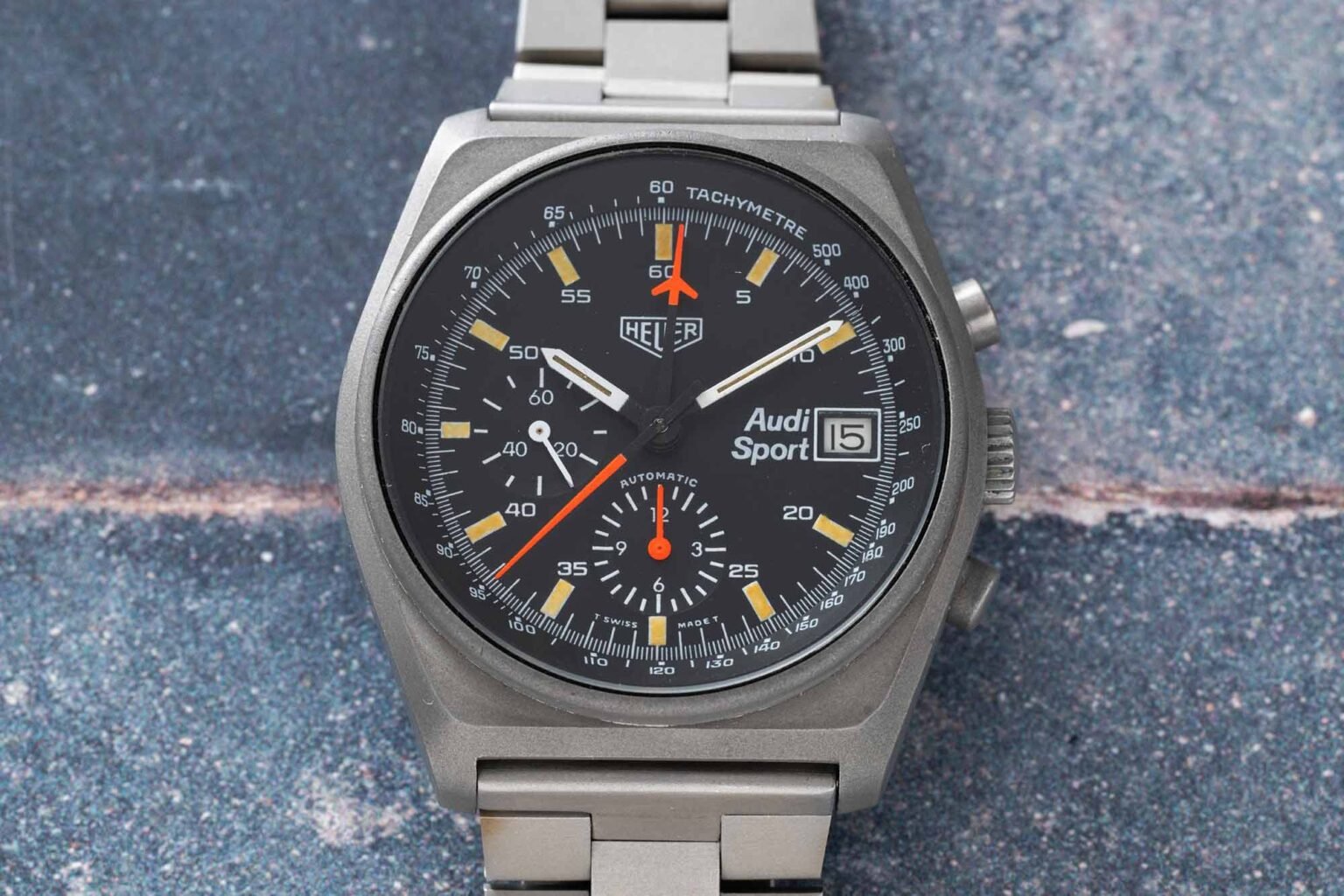
In the early 1980s, no team was more dominant than Audi and its Quattro Sport, whose domineering four-wheel drive system was a revelation. To commemorate Audi’s early Group B victories, Heuer produced less than 300 examples of a motorsports watch that honors a motorsports team. But it’s not the Heuer watch you’re thinking of, and it’s likely not the team, either.

Image via Analog/Shift
Behind the Heuer Audi Sport was the venerable Lemania 5100 movement, the basis for a slew of PVD-coated chronographs: the Porsche Design Orfina that adorned Tom Cruise’s wrist in Top Gun, Sinn’s early chronographs that launched the brand, and Tutima’s Reference 798, the latter having been adopted by so many European air forces that it became known as the “NATO watch.” Many of these rare chronos went to British retailer Preston’s, exclusive owners of the Quattro’s equally exclusive homologation version, and team members of Audi Sport. Such as Hannu Mikkola, seven-time winner of the grueling Rally of 1000 Lakes in his native Finland, as well as the 1982 Driver’s Championship.
Heuer Chronosplit Ferrari

The connection between Heuer and 1970s racing is familiar to anyone who’s had that one image of Steve McQueen drilled into their brain. But unlike, say, a Monaco, the fully-digital Chronosplit wearing the Prancing Horse logo is an inspired choice: a product of the post-quartz crisis, a split-seconds chronograph with two quartz movements that allowed wearers to time two different events simultaneously. Heuer’s newly-created Mikrotechnic division was going all in on high-precision digital timing, and with accuracy down to 1/100th of a second, the Chronosplit was its flagship watch. Heuer awarded the Ferrari-branded Chronosplit to just a handful of VIPs—about 200, by some estimates. One owned by Phil Hill, the first American winner of a Grand Prix in 1961 while driving for Ferrari, was sold by Sotheby’s in 2024. That same year as the Chronosplit, Nikki Lauda won the Italian Grand Prix for Ferrari, and Heuer introduced the Monza the next year in celebration, and the connection became immortalized.
Banner image via Analog/Shift
The post Six of the Most Obscure Watch and Car Tie-Ins You’ve Likely Never Heard Of appeared first on Worn & Wound.