
The IWC Ingenieur collection has been a mainstay of the brand’s portfolio since the mid-1950s, but it hasn’t always looked the same, nor even targeted the same niche consumer base, as it evolved over the decades. This sets the Ingenieur apart from other longtime IWC families, like the Pilots, which have always embraced a military-aviation aesthetic despite the many proliferations and offshoots from the WWII-era original, and the Portugiesers, which never really strayed far from their dress-chronometer-for-the-wrist theme. Recently, after a revamp that brought the model back to its austere 1950s aesthetic, the Ingenieur has returned to the DNA of its most famous iteration from the 1970s while also reaching for new modern heights in terms of materials and complications. Here is what you should know about the IWC Ingenieur, from its very utilitarian origins to its contemporary role as a sport-luxury leader.
[toc-section heading=”Science Project: The First Ingenieurs (1955 – 1976)”]

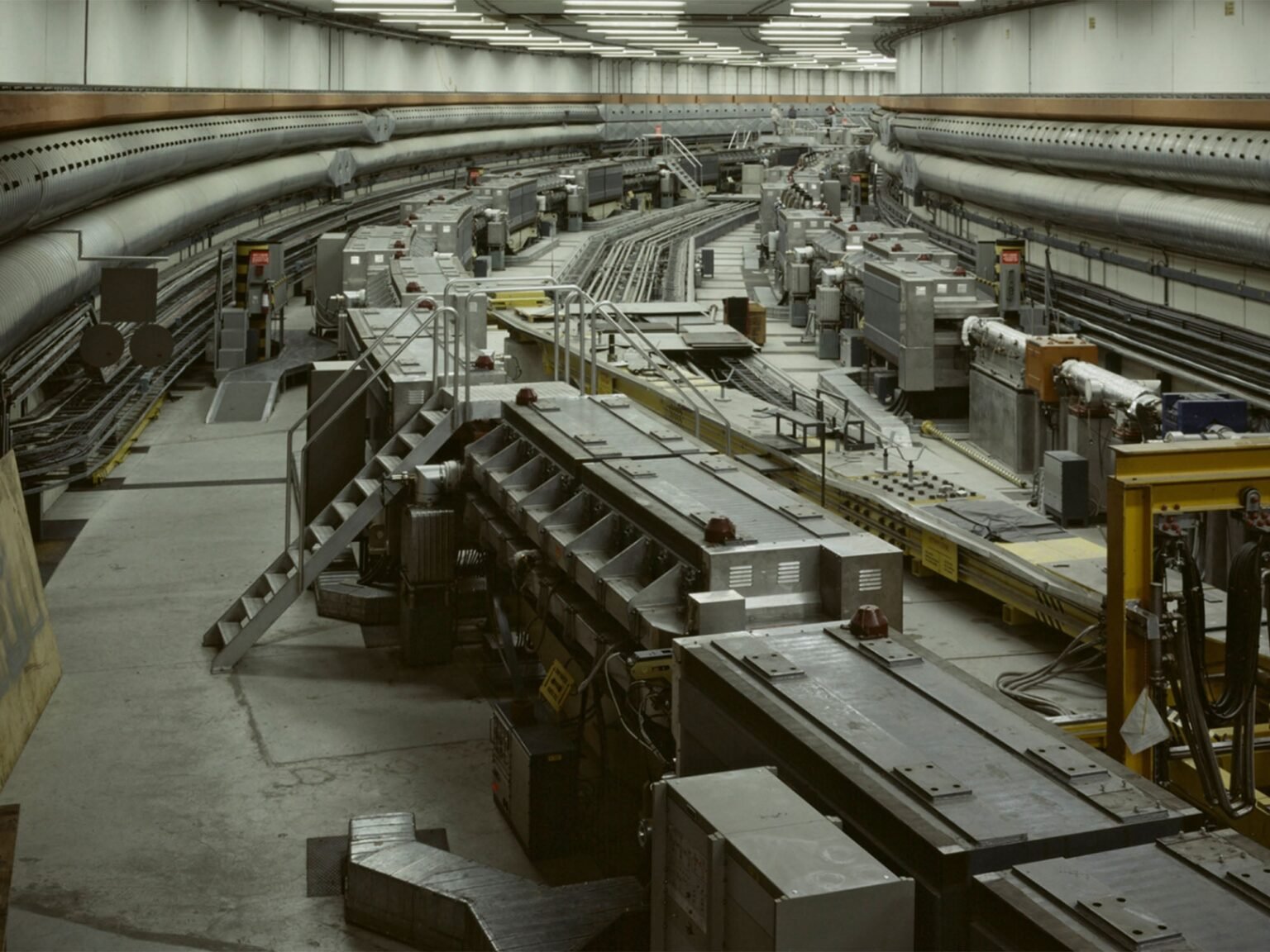
The story of the Ingenieur begins in the 1950s, an era in which everyday technology had advanced to a degree that many professionals in scientific fields, like engineers, technicians, and even doctors, were exposed to strong magnetic fields on a regular basis, often daily. Magnetic fields, of course, are the arch-enemy of a watch’s ability to run reliably and accurately, as they can adversely affect the tiny metal parts in a traditional mechanical movement like the wheels, gears, and hairspring. Accordingly, a handful of watchmakers took on the challenge of making a wristwatch that could run reliably while resisting the effects of magnetism, aiming them at customers in the fields listed above (like the scientists working at Switzerland’s CERN labs, above) and anyone else exposed to such atmospheric effects. Rolex released its Milgauss (named for its 1,000 gauss or “mille gauss” magnetic resistance) in 1956, and Omega followed up with its Railmaster in 1957.

Ahead of both of these, however, was a watch conceived by Schaffhausen-based International Watch Company (IWC) and released in 1955 — the IWC Ingenieur, whose name literally means “Engineer” in French. The first IWC Ingenieur, Ref. 666 (above, via Sotheby’s), had a 36.5mm-diameter steel case, with a screw-down caseback, a 100-meter water resistance, and its signature technical feature, a soft-iron “Faraday cage” inside the case that shielded the movement from magnetic fields to 1,000 Gauss. IWC had, in fact, been using some form of this technology since the 1940s, in the pilots’ watches it supplied to military units. The movement inside was IWC’s Caliber 825, equipped with the proprietary Pellaton winding system that IWC movements still use today. The watch’s dial was fairly unremarkable from a design standpoint, but was available with or without a date display (Ref. 666A or 666AD, respectively).

The second generation of the Ingenieur began with Ref. 886, released in 1967. Inside that model was an upgraded movement, Caliber 854/8541, now with a stop-seconds function for more precise setting, an eccentric regulator to fine-tune the length of the balance spring, and an overall reduction in thickness and diameter. For nearly 10 years, this version of the Ingenieur was the standard — aesthetically, very similar to the 1955 original, but gradually expanding into different dial colors and increasing in diameter (to 37mm) and water resistance (to 120 meters, in steel).
[toc-section heading=”Enter Genta: The Ingenieur SL “Jumbo” Era (1976- 1984″]

The everyday magnetic fields that spurred the creation of watches like the Ingenieur were still around, and likely proliferating, by the end of the 1960s (and they’re even more prevalent today), but tastes in watches were changing. Accordingly, in the late ‘60s and early ‘70s, IWC was already on a quest to produce a newer, bolder version of the Ingenieur that would be even more robust with a built-in shock protection system. After several underwhelming attempts, the brand reached out to legendary watch designer Gérald Genta (above), creator of two of the decade’s most daring watch designs, for the Audemars Piguet Royal Oak and Patek Philippe Nautilus.

Genta’s design gave birth to the now-famous and very collectible Ingenieur SL Ref. 1832 (above) in 1976, housing the automatic Caliber 8541, a watch that resisted magnetism to an astounding-for-the-time 80,000 A/m. The Ingenieur was defined by its screw-on bezel with visible screws and its integrated H-link bracelet. The “SL” stood for either “Steel Line,” referring to the series of tough watches that included the reworked Ingenieur, or for “Safety and Longevity,” depending on which historical account you find most credible. The case measured 40mm wide and 12.5mm thick, and the dial featured baton-shaped hands and hour markers, a date window, and a lightning-bolt-inspired “Ingenieur logo.
If the “L” in the Ingenieur SL did indeed signify “longevity,’ however, it might have been a bit overstated, at least in terms of the original model’s presence in the market. The model was not only uncommonly large in an era when watches were traditionally smaller; it was also very expensive for a steel watch. These and other factors relating to the Quartz Crisis ensured that the Ingenieur SL with an automatic movement was discontinued around 1984. IWC continued to make some Ingenieur models with smaller, slimmer cases and quartz movements throughout the ‘80s, subtly tweaking the Genta dial details along the way.
[toc-section heading=”Return of the Ingenieur: From Magnetism to Motorsport (1985 – 2023)”]

Photo: Sotheby’s
Unlike several other long-tenured watch models from heritage Swiss watch brands, the Ingenieur never really went away during the quartz-dominated decades, though it’s fair to say that the versions IWC put out in the late ‘80s and into the ‘90s struggled for relevance. The “Skinny Ingenieur” models of the ‘80s slimmed down the case diameter to 34mm and contained ETA-based automatic movements, and the Officially Certified Chronometer versions that followed in 1993 used outsourced Jaeger-LeCoultre movements. The first Ingenieur Perpetual Calendars, incorporating the groundbreaking module that IWC’s Kurt Klaus had pioneered several years earlier in the Da Vinci model, arrived in the late ‘80s and early ‘90s.

With the Quartz Crisis ebbing and the luxury mechanical watch making a major comeback, the Ingenieur introduced another bold revamp in 2005. The case was substantially larger, at 42.5mm, and the movement was now an in-house automatic, the IWC Caliber 80110. IWC also launched chronograph and feminine-targeted “midsize” versions in this seminal year, which also marked the beginning of IWC’s relationship with Mercedes-AMG, which would have a profound impact on the designs of the Ingenieur series in the subsequent years — starting with the “Big Ingenieur” series in 2007, which projected the era’s dominant “bigger is better” ethos with its hulking 45.5mm case; “bigger” could also describe the week-long power reserve of the movements, IWC’s in-house Caliber 51113. The Genta-esque DNA of the collection remained dominant, albeit with hints of automotive-inspired design language courtesy of the AMG partnership.

A “Vintage 1955” reissue into the collection in 2008 was a harbinger for another major facelift in 2017, which brought the Ingenieur back to its pre-Genta, pre-”Jumbo” early days, bringing the case dimensions back to 40mm and housing a Sellita-based automatic movement. Notably, this generation of the Ingenieur dispensed not only with hallmarks like the sunken-screw bezel and the lightning-bolt Ingenieur logo on the dial, but also with the antimagnetic, soft-iron inner case that had long defined the series.
[toc-section heading=”Lightning Strikes Twice: The Modern Collection (2023 – Now)”]
IWC Ingenieur Automatic 40

The Ingenieur’s most recent update (above) came in 2023, when IWC reworked the model to pay homage to Genta’s classic design, with a new emphasis on ergonomics and a thoroughly modern and high-tech movement. The round bezel sports the five visible, functional polygonal screws that defined the ‘70s original, while the soft-iron dial features an attractive, grid-like textured pattern, a structural design that balances the smooth curves of the case. The dial’s grid is made up of small lines offset by 90 degrees to each other, and is stamped into the soft iron blank before it is galvanized. The hour markers and hands are luminescent and add additional depth and legibility to the watch’s face. Inside each case, behind a period-appropriate solid steel caseback to ensure its protection from magnetic fields, is IWC’s in-house Caliber 3211, an automatic movement with a hacking seconds function and an improved barrel construction that enables a lengthy power reserve of 120 hours, or five days.

The IWC Ingenieur Automatic 40 was initially available in three steel versions, with dial options in black, silver, and aqua blue, and one in sandblasted titanium with a handsome gray dial. (IWC, as aficionados may know, is one of the pioneers of using titanium in the watch industry.) A model with a case and bracelet made of 18k rose gold, and a black dial with gold appliques and gold-plated hands, followed, along with a steel version with a dark blue dial. All measuring 40mm in diameter, with a 47.5mm lug width, the cases measure a relatively slender 10.8mm in thickness, making them just as wearable or even more so than the models from the 1970s, after years of IWC going bigger and bolder with the Ingenieur family.
IWC Ingenieur Automatic 35

A trio of Ingenieurs at a more understated 35mm diameter joined the expanding family in 2025 — one in rose gold with a matching golden dial (Ref. IW324903), the other two in stainless steel, with a silver (Ref. IW324901) or black dial (Ref. IW324906). Like their 40mm siblings, these watches feature an ergonomic case design with satin-finished and polished surfaces, round bezels with five functional screws, grid-pattern dials, and integrated H-link bracelets. IWC outfits the smaller Ingenieur Automatics with the self-winding Caliber 47110, which stores a 42-hour power supply and whose high-end decorative finishes — i.e., circular graining, Geneva stripes, and gold-plated oscillating weight — are visible through clear sapphire caseback windows. IWC added a crowd-pleasing blue dial to the 35mm subfamily in 2026.
IWC Ingenieur Automatic 42

Also in 2025, IWC introduced a new material and an additional size into the revived Ingenieur collection with the launch of the first full-ceramic models. The Ref. IW338903 was the first, with both its 42mm case and its integrated bracelet constructed of black zirconium oxide ceramic. The black dial features the same grid pattern as the 40mm models, and the IWC manufacture Caliber 82110 beats inside behind a sapphire caseback, storing just half the power reserve (60 hours) of the Caliber 32111 inside the steel, gold, and titanium models but incorporating ceramic parts and a host of decorations. One year later, IWC added its first Ingenieur in full colored ceramic, the forest-green Ref. IW338902, at the same dimensions and specs (42mm in diameter, 11.5mm thick, 100 meters of water resistance), with the same self-winding movement. With these models, IWC continues to flex its considerable muscles as a leading innovator in the watch industry for colored ceramics, an expertise that carries over from the brand’s Pilot’s Watch Top Gun series.
IWC Ingenieur Perpetual Calendar 41

IWC rounded out a big year for the Ingenieur in 2025 with the Perpetual Calendar 41 in stainless steel (Ref. IW344903). It marked the first timepiece in IWC’s repertoire that combined a Gérald Genta design with the legendary Kurt Klaus-developed perpetual calendar function, appropriately marking 40 years since the latter’s origin. The 41mm case and integrated H-link bracelet both feature meticulous combinations of brushed and polished finishing, and the dial (in blue or, in the recently released titanium-cased edition above, gray) sports the modern Ingenieur’s characteristic grid texture, here with three recessed, sunray-finished subdials for the calendar indications and ultra-precise moon-phase, the latter boasting an intricate azurage finish. The IWC manufacture 82600 beating inside the case offers a 60-hour power reserve, an array of ceramic parts including the rotor bearing for the automatic winding, and an overall user-friendly architecture in which all of the calendar displays (date at 3 o’clock, month and moon-phase at 6 o’clock, leap-year at 9 o’clock) can be easily advanced by turning the crown.
IWC Ingenieur Tourbillon 41

IWC unveiled the latest high-horology, high-luxury interpretation of the Ingenieur at Watches & Wonders Geneva 2026: the Ingenieur Tourbillon 41 (Ref. IW345901) with a case and bracelet made from 18k rose gold. On this model, limited to 100 pieces, the visible screws in the bezel are forged in IWC’s proprietary Armor Gold, an alloy boasting a higher degree of hardness than other precious metals, and the grid-pattern dial is executed in dark olive green, providing a stark and attractive contrast with the golden case and dial details. The flying tourbillon, which is suspended from gold-plated bridges and rotates on its axis once per minute, is on full display in a large aperture at 6 o’clock. The tourbillon mechanism is extremely lightweight despite its complex construction consisting of 56 individual parts and thanks to an integrated stop device, it can be halted on demand for accurate resetting of the movement. IWC’s Caliber 82905 delivers an impressive power reserve of 80 hours and incorporates vital components of its Pellaton winding system made of virtually wear-free ceramic. The rotor is adorned with a solid-gold medallion bearing IWC’s longtime motto: “Probus Scafusia,” or “solid craftsmanship from Schaffhausen.”