
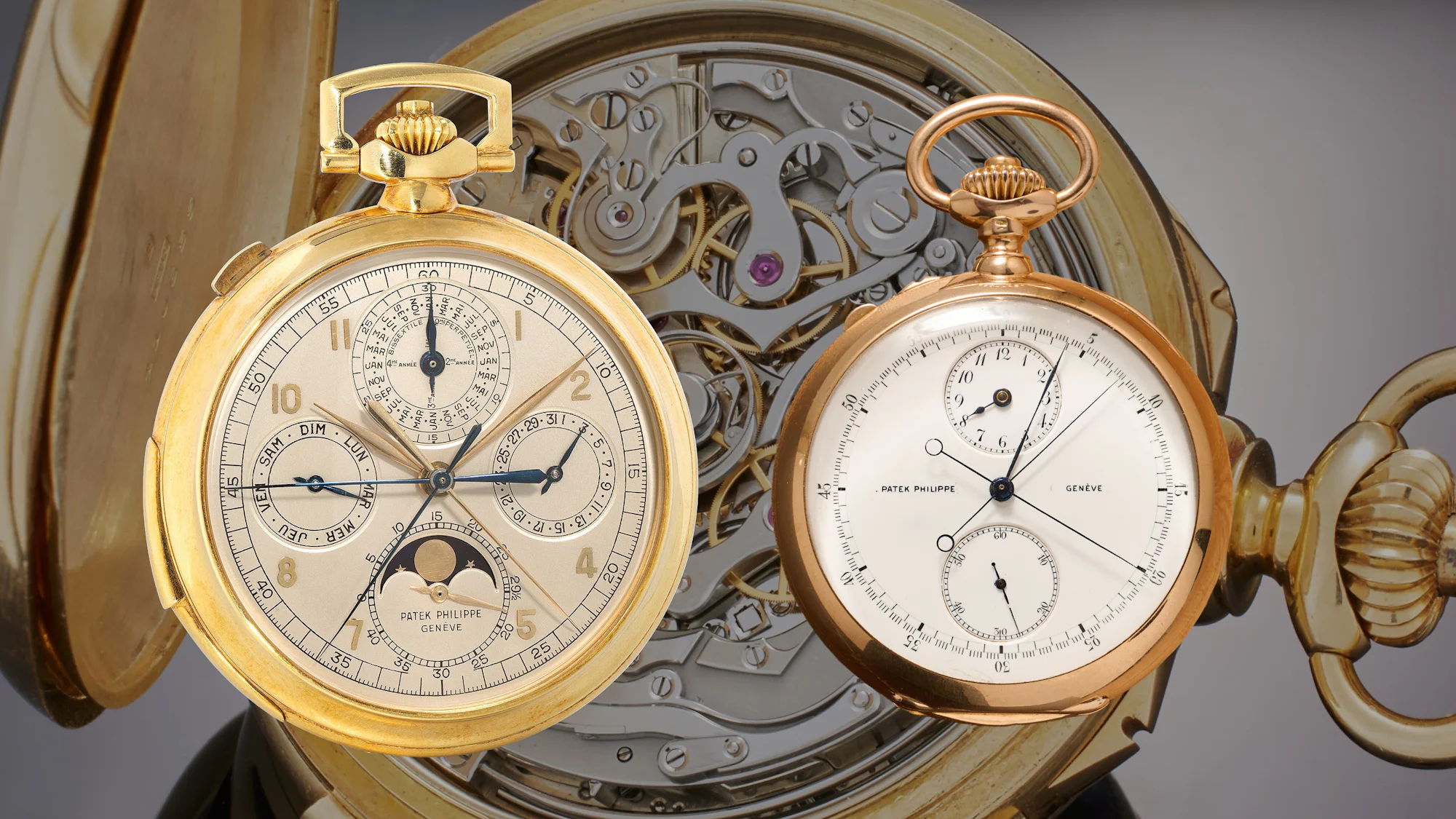
- Understanding Patek’s History of Split-Seconds Pocket Watches (1878 to 1970s) and the Importance of Victorin Piguet
- Combining the Rattrapante with Other Mechanisms
- John Motley Morehead III Split-Seconds Double-Movement Pocket Watch
- Suzanne Rohr Miniature-Painted ref. 864 (on a C.H. Meylan Ébauche)
- John Motley Morehead III Carrillon Minute Repeating American Calendar Double-Chronograph
- Unique Patek Philippe ref. 767 “Double Split”
- The Years Following Victorin Piguet
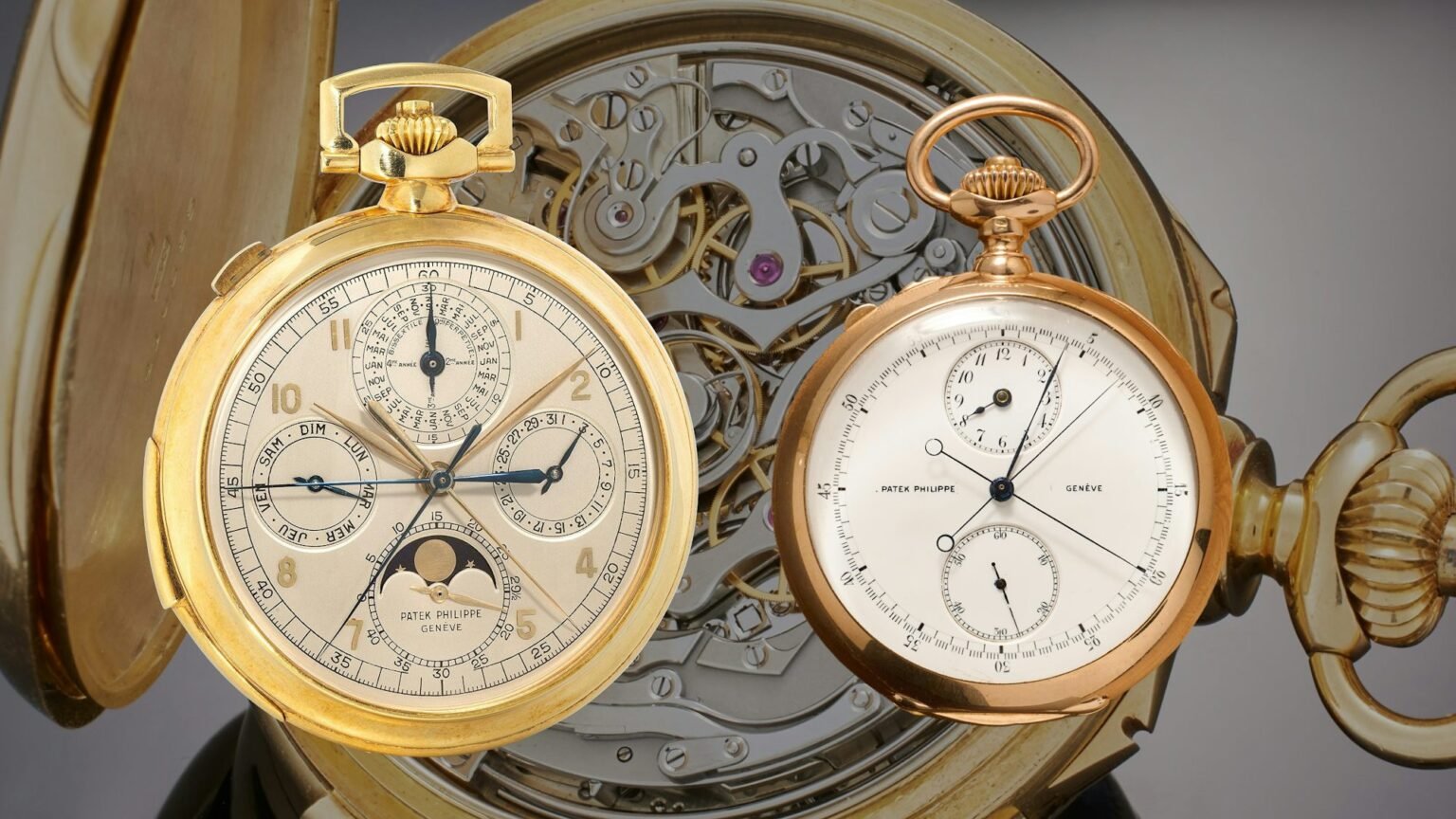
Just last week, we published a Reference Points video on the Patek Philippe split-seconds wristwatch. The complication itself—a.k.a. the rattrapante—is incredibly important in the brand’s history, forming the backbone for some of its greatest and most coveted watches of all time. However, you can’t talk about the history of the split without understanding Patek’s pocket watches. It’s a story that eventually led to one of the brand’s most meaningful relationships with a supplier that helped it grow into a powerhouse, a relationship that would last over a century.
Instead of going deep in the weeds on pocket watches in our main Reference Points, we’re spinning it off into this secondary article—an addendum of sorts—for those who want a bit more background. The story won’t be exhaustive; Patek continued to make split-second pocket watches long after they began making the same complication in wristwatch form, and some such watches deserve (and have had) their own standalone stories. There are also many different versions because Patek, at the time, didn’t make things in batches the way they would starting in the 1930s. You could probably write 20,000 words on these pocket watches, but rather than go that deep, here’s an overview of Patek’s split-seconds pocket watches, with a focus on Victorin Piguet’s movements.
Understanding Patek’s History of Split-Seconds Pocket Watches (1878 to 1970s) and the Importance of Victorin Piguet
If you read the first part of our story, you’ll know that the split-seconds and functional chronograph mechanisms were developed separately. While others had created early concepts that functioned as simple stopwatches, almost all had functional limitations. It wasn’t until 1844 that Adolphe Nicole created a cam-actuated zero-reset mechanism that allowed a timing device to be reset and restarted with nothing more than a button. In 1862, that was put into a functioning chronograph pocket watch for the first time. By the 1870s, that was combined with Joseph Winnerl’s invention of the “catch up” mechanism (rattraper in French) for two-hand counting of two different intervals.

An example of an early Patek Philippe ébauche chronograph, with added calendar (date) complication, from circa 1870. Within a short period, Patek would stop making their own base movements (and with that decision, the architecture would become far more elegant). Photo courtesy Bonhams.

Victorin Émile Piguet.
It was only about eight years after the first Nicole/Piguet chronograph that the first Patek Philippe watches with the function appeared on the market. Despite the first few watches apparently being based on Patek Philippe ébauches, by the 1880s, the brand was being supplied in large quantities by the brothers Victorin Émile Piguet and William-Alfred Piguet, who were already making their mark as experts in the complication, and basically every other complication as well.
Victorin Piguet, born in 1850 in Le Chenit, taught at the watchmaking school in La Vallée de Joux in the 1870s before running a complications-focused educational workshop in Geneva, starting in 1880. That year, he officially founded the firm Victorin Piguet et Frères (recorded as Piguet Frères in Patek’s archives) with his youngest brother, William-Alfred. In fact, the two had already been delivering movements to Patek Philippe in the years prior, but apparently decided to put a more formal business on the books. While being in Geneva obviously made it easier to connect with Patek and other clients, Victorin’s time in the city did not last long. By 1883, he had returned to the Valley, where he had closer access to suppliers, and he could maintain his workshop in Le Solliat-sur-Le Sentier.
In the late 1880s (at least by 1888), Victorin parted ways with William-Alfred (who later founded the company Piguet, Guillaume & Cie, Sentier et Genève), and oversaw the shop alone until 1895, when he teamed up with his other younger brother Julien Henri Piguet to create Victorin Piguet et Cie. Such shifts in the valley’s company landscape were common in the 20th and early 21st century, even if it surely was messy with family involved. But, as with any good artist, there are touches of the maker’s style and approach to technical challenges that make them instantly recognizable to any collector or historian.

The ref. 541 perpetual calendar minute repeater, made with an 11″’ Victorin Piguet ébauche. The movement was made in 1930 but not cased until 1939. Photo courtesy Patek Philippe.
The importance of Victorin Piguet is so great that it’s the only name specifically mentioned in the introduction to the chronograph section of Patek Philippe’s museum catalog. Chronographs weren’t their only expertise, however. Victorin Piguet (and, at various times, his brothers) would create everything from the brand’s first sweep-seconds pocket watch to the module for the caliber 27 SC in the reference 570.
They made the brand’s first minute-repeating wristwatch, the first perpetual-calendar minute-repeating wristwatch (possibly for Patek Philippe or, around the same time, for James Shultz in the United States), the first perpetual-calendar minute-repeating chronograph wristwatch (for James Shultz), and a host of other industry-changing developments. Victorin Piguet’s impact was so big that in 1980, Patek Philippe president Henri Stern was a key guest at the company’s 100th-anniversary celebrations, as the brand still employed the remaining three watchmakers at the workshop to construct grand complications.

A Patek Philippe split-second chronograph with what could be considered a more common version of the early 18”’ Victorin Piguet ébauche. Photo courtesy Christie’s.
The first rattrapante in the Patek museum is from Piguet Fréres and featured an 18”’ ébauche (a size that would become one of the most frequently used over the years) with running seconds at 6 o’clock and the time in a subdial at 12 o’clock. The next few used a 19”’ movement of similar design in different orientations (hunter or open-faced cases). The earliest date that I’ve seen on a Patek Philippe split is 1878, though it’s very possible there are other earlier ones. But there was far from any “standard” design that Patek seemed to prefer. Instead, they drew from a variety of suppliers, each with their own creative approaches, adding an extra layer of finishing—from capping the column wheels and polishing the levers to chamfering the bridges—that is quite impressive.

A Patek Philippe & Co. split-seconds pocket watch, movement no. 65’023, with a 19”’ Piguet Fréres ébauche made from 1881-1882 and delivered to Philadelphia retailer Bailey, Banks, & Biddle. The watch—one of less than ten known with a similar design—features an unusual offset center post for a smaller time-telling subdial. Photo courtesy Patek Philippe.
The earliest example in the Patek museum catalog dates to 1879 and was delivered to Tiffany & Co., New York, in 1881, making it one of the earliest fully functioning zero-resetting split-second chronographs to be made commercially available. These early watches featured a design that’s a bit unusual today, with a subdial for hours and minutes, with only the rattrapante hands on the center post. Then, according to Patek Philippe, in 1886, the brand made three watches (numbered 66’088 to 099) with more traditional regulator-style layouts, featuring a central minute hand and hours on a subdial. Similar designs are known without the split (just plain chronograph). Apparently, they made more than just those; we have another one in our Reference Points (from around 1885).

A Patek Philippe & Co. split-seconds wristwatch, movement no. 66’1xx with a 19”’ Piguet Frères ébauche, from 1885.


Piguet Fréres’ early approach was actually pretty creative, with a concept that would appear in watches from Henchoz Fréres to Rexhep Rexhepi’s recent Chronograph Flyback. The balance is, as it almost always is, at the edge of the watch, but by moving either the counters or the center post away from the actual center of the watch, you can flatten the movement substantially. The same concept can be found with the A. Lange & Söhne Datograph and 1815 or the 5170, with its slightly off-center subdials.
Based on examples from the Patek Museum, Patek Philippe & Co. would go on to use at least seven different ébauche suppliers for rattrapantes. That number rises to at least 14 when you count simple chronographs or chronographs with complications. Curiously, Patek made far more pocket watches with both rattrapante and minute repeater mechanisms together (an estimated more than 900, with about 160 known) than watches with only split-second mechanisms. Only about 200 of the latter are thought to have been made, but they vary wildly in design (both inside and out). Three of the less common ones are below.

A Patek Philippe & Co. minute-repeating split-seconds pocket watch, movement no. 90’455, with a 19”’ Victorin Piguet & Cie ébauche made from 1891-1892. The watch belonged to (and was engraved on the caseback for) Jack Daniel, creator of Jack Daniel’s whiskey. Photo courtesy Patek Philippe.

A Patek Philippe & Cie. split-seconds pocket watch, movement no. 80’072, with a 19”’ Z.F. ébauche made in 1887 and retailed by Cady & Olmsted in Kansas City, Missouri. The very fine and sweeping restrictor springs are unusual, but the real curiosity is the name of the ébauche supplier. No research has been able to determine the name, but it is likely Z___ Fréres. Photo courtesy Patek Philippe.

A Patek Philippe & Cie. split-seconds pocket watch, movement no. 415’150. The watch, with a 30-minute counter, was made with a 17”’ LeCoultre & Cie ébauche made in 1927-1929 and retailed by Gübelin. By the 1920s, Patek had started to shift away from Victorin Piguet’s work and onto other makers (unless leftover movements were found). Photo courtesy Patek Philippe.

A Patek Philippe & Co. for Tiffany & Co. split-second minute-repeating pocket watch from 1900 based on a 16”’ Victorin Piguet ébauche. This design was common starting in the early 1890s in 16, 17, and 18”’ sizes. Photo courtesy Antiquorum.
Below is the list of the names associated with examples of solely rattrapante pocket watches found in the Patek Philippe museum. Keep in mind that Piguet Frères and Victorin Piguet were essentially the same lineage:
- Piguet Frères
- Z.F. (One example noted in 1887)
- Charles Piguet (one of four examples with central minute counters)
- Victorin Piguet & Cie. (the use of the name in Patek’s collection was first recorded on a split-second chronograph in 1892, continuing into the 1910s, and found again starting in 1942)
- L.E. Piguet
- LeCoultre
- Valjoux (using the caliber 13”’130 R, which was found in the wristwatches ref. 1436, 1563, and unique 2512, and also made its way into a few pocket watches)
- William Alfred Piguet

A 17”’ Victorin Piguet-based central-counter split-second chronograph, made by Patek Philippe for Tiffany & Co. in 1891. Photo courtesy Antiquorum.

A 17”’ Victorin Piguet-based central-counter split-second chronograph, made by Patek Philippe for the American market in 1884. Photo courtesy Antiquorum.
There are some truly exceptional Patek Philippe watches from over the years that went beyond the basic rattrapante and didn’t necessarily add another major complication. A great example is the four central-counter split-second pocket watches based on Piguet Fréres, Victorin Piguet, or Charles Piguet ébauche designs. These were pretty intense technical feats at the time because applying five hands to a single central post stack required impressive micromechanics for the time (and is not frequently done to this day). Unfortunately, in the early 2000’s, the Patek Philippe museum went on a massive buying spree, and, in this case, purchased every single example.

A very unusual William-Alfred Piguet-based split-second Patek Philippe pocket watch with foudroyante, which sold at Antiquorum in 2022 for CHF 57,500. The movement uses two barrels with differential gears and bidirectional winding, inspired by the designs of Sylvain Mairet and Louis-Elisée Piguet. Photo courtesy Antiquorum.


One fun bit of trivia: as much as his older brother Victorin dominated Patek’s order sheets, the youngest Piguet brother got his own revenge of sorts. Among the technically impressive rattrapante variants in the Patek museum (including central-counter versions by Charles Piguet and Victorin Piguet), William-Alfred Piguet made three split-second chronographs with either a 30-minute register (two known examples) or a 60-minute register (the latter sold to the Prince of Siam).
That said, his brother Victorin made a fourth. Big brothers always have to upstage the little one, I guess. One of two-train split-seconds, with a unique movement construction likely by William-Alfred Piguet, recently sold at Sotheby’s earlier in 2026. It just goes to show that there are still watches to be found. I recently discovered what is possibly only the third known 17”’ extra-thin split, with an unknown ébauche. Another central-counting chronograph (non-split) recently appeared at auction.
Combining the Rattrapante with Other Mechanisms
Of course, in our Reference Points, we mostly focused on watches with only a split-seconds function, but, as with wristwatches, Patek commonly combined that complication with others. While the combination of split-second and minute repeaters only appeared on a Patek wristwatch in 2023, it was about 140 years after the brand did the same in a pocket watch. And, as previously mentioned, combining a rattrapante with a minute repeater was almost five times as common as a rattrapante alone at the time. While there are many great grand complication pocket watches (and other multi-complication watches), here are a few of my personal favorites.
John Motley Morehead III Split-Seconds Double-Movement Pocket Watch

Photo courtesy Sotheby’s.
One of the most surprising horological discoveries of the last few years was that of two previously unknown watches made by Patek for John Motley Morehead III, a chemist who helped found Union Carbide. An early American industrialist and person with wide-ranging interests in astronomy and science, Morehead had a number of unique Pateks in his collection. There is even correspondence in which he had written to Patek to express his appreciation for having so many special pieces (while still inquiring about getting more).

Photo courtesy Sotheby’s.
This previously unknown watch featured two Victorin Piguet movements, stacked and yet connected to function via the crown, with six hands mounted on the same axis for two sets of time-telling hands and the split-seconds function. Our friends at SJX have a great breakdown of the watch’s technical achievements, which sold in 2025 for $3,710,000. It’s one of the great feats of early 20th-Century watchmaking, even if it seems less complicated than a perpetual calendar or minute repeater. Even stacking six hands on one post is a technical achievement, and the only Patek watch known to have it.
Suzanne Rohr Miniature-Painted ref. 864 (on a C.H. Meylan Ébauche)

A personal favorite of mine is this watch from Patek Philippe, probably commissioned by the Sultan of Oman or a dignitary of the country sometime in 1964, that was sold ten years later. That assumption is based on Suzanne Rohr’s enamel painting of a mosque near the College at Wattayah in the Sultanate of Oman, though the government was overthrown in 1970, which likely accounts for the time between the painting’s creation and the watch’s sale. The watch is claimed as a technical achievement of Patek Philippe, using a 16”’ caliber, which was the smallest they ever used, combining perpetual calendar, minute repeater, and split-second—at least in the post-war period. But that’s because the watch is actually based on an ébauche from Charles-Henri Meylan, probably made around 1910, that was not used for half a century. The watch is now in a private collection.
John Motley Morehead III Carrillon Minute Repeating American Calendar Double-Chronograph

Photo courtesy Antiquorum.
Leave it to John Motley Morehead III to show up on this list twice. This is an incredibly complicated watch, with a minute repeater on three gongs and an inline (American) perpetual calendar. The main focus here is actually the double chronograph. There’s an example of such a function (without any other complications) in the Patek Philippe museum, based on a Victorin Piguet ébauche, as is this watch. Essentially, the double chronograph functions somewhat differently from a split-second, in that you can run both chronograph functions either at the same time (like a split-second function) or independently of each other and then reset both to zero at the same time. The watch is now in the Patek Philippe museum.
Unique Patek Philippe ref. 767 “Double Split”

Arguably the most complicated on the list here, the Patek ref. 767, based on a Victorin Piguet ébauche and made in the 1950s, is already an iconic watch among pocket watch collectors at the highest echelon. One example, however, stands out as the only one known to have a double-split mechanism. Unlike a simple split-second watch or even Lange’s Double- or Triple-Split watches, this watch can track three elapsed times with a gold split-seconds hand, a short blue independent chronograph hand, and a long blue sweeping seconds hand. I’d like to once again encourage people to read the SJX story on this watch. The watch sold for $1.3 million at Phillips Hong Kong in May, 2024, which, looking at the market now, is an incredibly reasonable price all things considered.
The Years Following Victorin Piguet
The final pocket watches worth mentioning are probably more eye-catching than the average late-19th- and early-20th-century examples. It’s pretty remarkable to see how quickly Patek adapted its aesthetics to market demands. As you can see with watches like the ref. 767 above, things started to feel far more modern in the 1940s and 1950s. But as stock of old Victorin Piguet movements dried up or got allocated to bigger, more profitable projects, Patek made use of the Valjoux 23-based caliber 13-130 R that was still on hand but not used in its ref. 1436 wristwatch.

A Patek Philippe reference 840 with a caliber 13-130 movement. Photo courtesy Sotheby’s
There are a lot of great caliber 13-130 pocket watches out there, the vast majority of them simple chronographs. But they’re some of my personal favorites, especially when it comes to the steel examples of the ref. 840, like the black-dialed example that sold at Sotheby’s earlier this year for CHF 70,400. Most examples of the ref. 685, 755, or 840 are simple chronographs, but every once in a while, you might find gold. That includes the following watch from the Patek Philippe museum, engraved “Best Wishes to Tom Smith from the Rices, Dec. 25 ’48”. Who was Tom Smith? The trainer of the legendary horse Seabiscuit. Horse racing, it turns out, seems to be a good way to get yourself a split-second Patek.
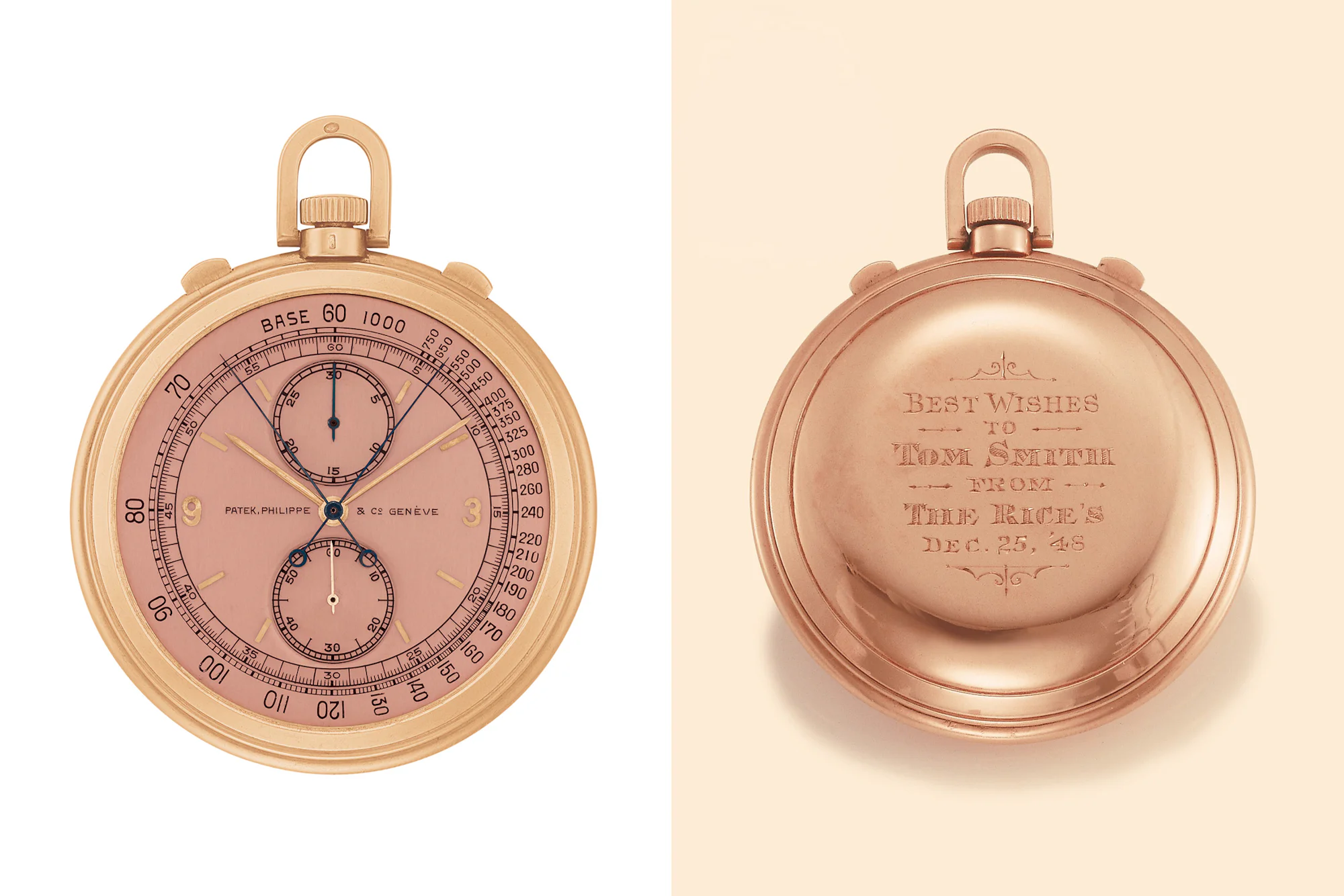
A Patek ref. 685 formerly belonging to Tom Smith, the trainer for Seabiscuit. Photos courtesy Patek Philippe (left) and Antiquorum.
For more on Patek Philippe split-second watches, watch and read our Reference Points article.