

One of the brands we don’t talk about all that often here is Arnold & Son. It’s a brand that offers an interesting heritage story—Swiss watchmaking with English roots, as the brand proudly headlines on its website in homage to eighteenth-century watchmaker John Arnold. It sits within the Citizen Group as one of the brand’s prestige properties, along with Angelus, and both are led by Pascal Béchu. Many people may be surprised to find out that the Citizen Group’s portfolio extends quite a bit out of Japan, with other familiar names like Bulova, Frederique Constant, Alpina, and La-Joux Perret as key properties, but Arnold & Son stands out mostly due to its price point and complicated high horology offerings.


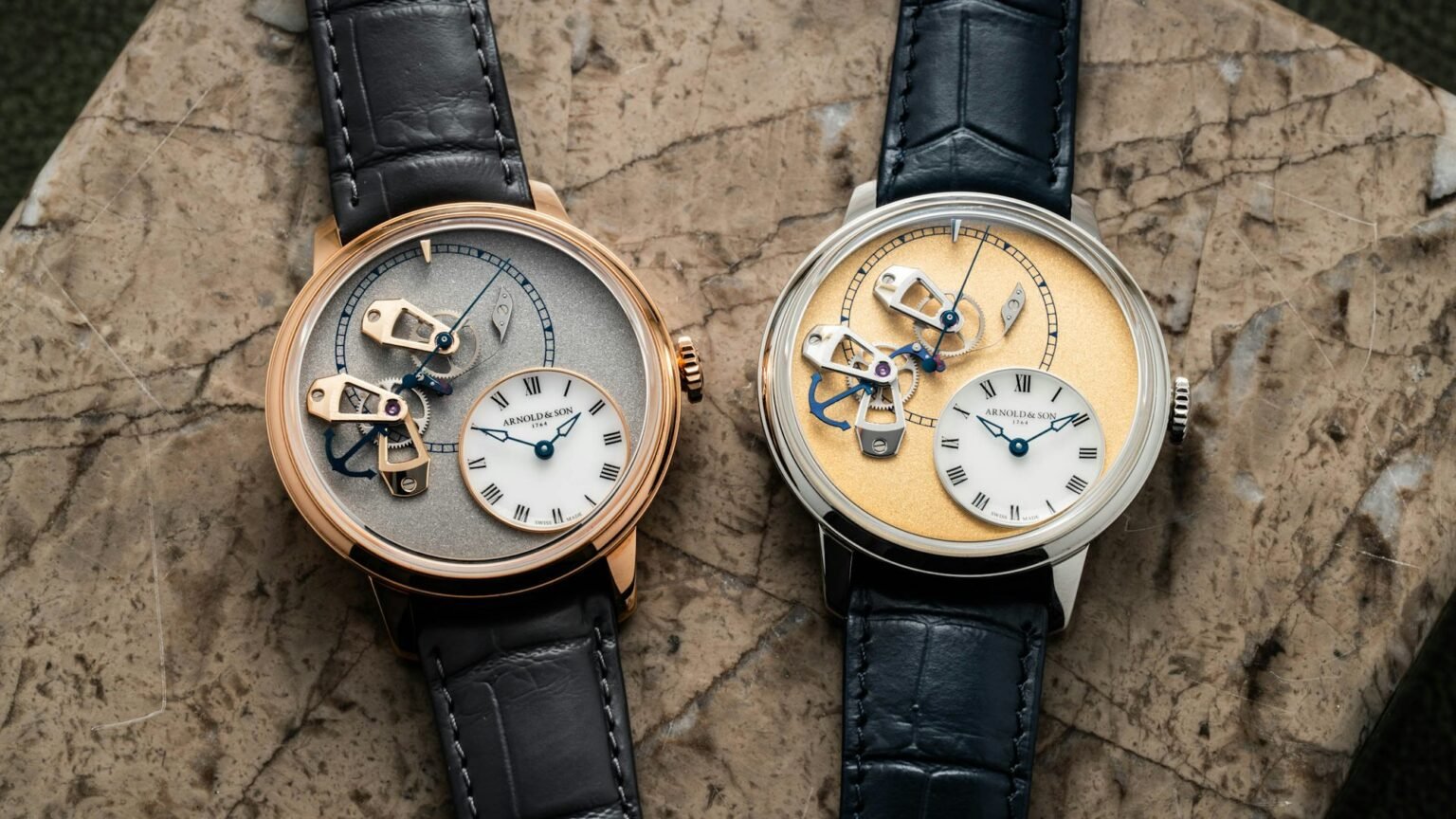
A little over two weeks ago, in time for WatchTime NY, Arnold & Son introduced a new update to the brand’s DSTB models—the new DSTB Stop-Seconds limited editions in Cliff Grey and Kingsand. Both are limited to 18 pieces each. On the surface, they might look just like new dial and metal combinations for the pre-existing DSTB (Dial-Side True Beat) references, but these new editions get a pretty major upgrade—hacking functionality for the deadbeat seconds. Hacking seconds might not seem like an update worthy of celebration, but for a watch that puts so much emphasis on the seconds hand, it is a welcome sight.

The deadbeat (or true-seconds) complication is, unsurprisingly, the focus of the architecture here, thanks to the mechanism of the complication isolated from the rest of the caliber. As such, a few bridges, gears, and the release mechanism are on full display on the dial, taking the constantly beating caliber and translating it into pulses that move the oversized seconds hand forward once per second. The composition of the dial is very asymmetrical, with the deadbeat seconds mechanism taking up much of the area between nine and twelve o’clock, and an oversized railroad seconds track printed on the dial in blue.
What does feel rather on the nose is the lever of the deadbeat seconds mechanism, shaped like the anchor of the Arnold & Son logo, itself an homage to John Arnold’s marine chronometers. Though well-executed in blued steel, the anchor itself feels a bit too graphical for what is otherwise a really elegant dial. That said, the overall structure of the dial-side mechanism is beautifully finished and feels grand in its exaggerated presence, and I love that the ticking seconds hand is the focal point of the entire design.

The subtly concave white opal subdial.
Near five o’clock sits the offset subdial for the hours and minutes. It’s crafted out of white opal, which is a delightfully subtle touch to the overall design. The dial sits slightly raised from the rest of the main dial surface, but then offers an interesting play in dimensionality, as this subdial is actually concave and its center sinks back down closer to the base level of the main dial. The gentle slope is most reflected in the printed Roman numerals as they curve to the edge of that dial. Past editions of the DTSB featured a flat version of this white opal subdial. If there’s one thing to wish for, especially given the watch’s emphasis on chronometry, it’s minute markings on this subdial.
The base metallic dials are rendered in a grained texture and colored through a PVD coating. The red gold model gets a light grey treatment, while the platinum edition gets a pale gold base as a warm contrast. They are, for lack of a better term, quite sparkly, especially in direct light, yet legibility remains completely unaffected.
Both models are powered by the in-house automatic A&S6303 caliber, which offers the deadbeat seconds complication in addition to hacking seconds, and a power reserve of 55 hours. The finishing is classic and attractive, with radial Côtes de Genève on the bridges and a good mix of anglage, blued screws, and different brushing techniques. The rotor is quite nice, with a guilloché decoration and the brand’s anchor logo once again. It’s all set in a 42mm case, either in that 5N red gold or platinum, with a case height of 12.95mm and a water resistance of 30 meters.


On the wrist, the DTSB Stop-Seconds continues to wear large, as have all of the previous versions. Given the dial of the DTSB, this isn’t necessarily a bad thing, as all of the elements from the deadbeat seconds mechanism to the main time subdial fill out the front of the watch in a very intentional manner. A big part of it is certainly visual proportions, as the expansive dial and thin bezels paired together on the DSTB seem to make the watch wear larger than it is. It’s an execution very much in line with the rest of the watches from Arnold & Son, as most of the brand’s complicated models tend to come in a larger case size.
Though I’ll often wish for smaller cases, and I reserve hope for a downsized design given the movement diameter of 36.2mm, I don’t see the large sizing as a con here—the watch is meant to be a showcase for a rather dramatic jumping seconds complication, and it does it incredibly well here.

Overall, these two new DSTB Stop-Seconds models feel like a very lovely evolution in this specific line. The red gold edition is priced at $58,700, while the platinum one is $72,500, both marking a rather small relative markup (a little over a thousand dollars) over the outgoing versions in their respective case metals despite the two rather large improvements of stop-seconds and a concave stone subdial. For the collector who wants a well-finished, unique interpretation of a high-end deadbeat seconds watch, these are certainly now more compelling than ever.
For more, visit Arnold & Son.