

It’s been a big year for Tudor. The brand is in the midst of a major anniversary celebration, with 2026 marking 100 years since Hans Wilsdorf filed the first paperwork that eventually led to Tudor’s creation. Appropriately, that anniversary has been the dominant story this year, and it was reflected in their major novelty for Watches & Wonders 2026: the Tudor Monarch.
That watch was, I think, largely a successful launch for the brand, and the supporting releases, though subtle, were meaningful and (in some cases) necessary. Still, for those of us who find ourselves generally drawn to Tudor’s more utilitarian offerings, it was easy to feel a little overlooked coming out of Watches & Wonders.

That changed last week with the launch of the new Northflag. The new watch is an update on the North Flag from 2015, and is aimed squarely at those looking for a compelling everyday adventure and exploration–ready watch. It does that, but it also brings the same maturity that has begun to permeate the Tudor lineup. But more on that in a minute, because before we talk about the Northflag, I want to talk about the North Flag (I know, vaguely confusing), and to do that, I need to talk about anniversaries.
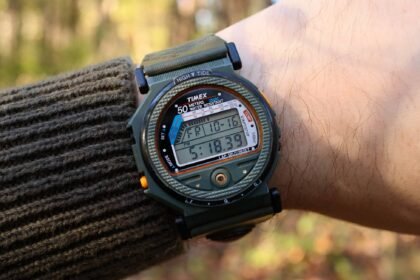
The Tudor North Flag
I’m on record in several places as having my doubts about whether this was really the year for Tudor to mark the 100-year milestone. An even cursory look at Tudor’s history quickly reveals that, while the Tudor wordmark may have been trademarked in 1926, and while early watches bearing the name ‘Tudor’ were produced under license as far back as the early ’30s, Montres Tudor S.A. (the entity we all mean when we say ‘Tudor’) wasn’t founded until 1946. So while I’m skeptical of celebrating Tudor’s 100th birthday this year — I do still think there are Tudor milestones worth celebrating in 2026.

The Tudor Northflag alongside its predecessors, the North Flag and the Ranger II.
After all, it’s now been 17 years since Tudor reorganized into the company it is today, 16 years since they launched the Tudor Heritage Chrono, 14 years since the introduction of the Pelagos and Black Bay, 13 years since Tudor relaunched in the United States, and now 11 years since the introduction of the original North Flag.
Now, I admit, these milestones don’t have the same satisfying roundness as “100 years” does, but they do still tell a story. Namely, today’s Tudor is not the scrappy little brother it was 15 years ago. Instead of being a nascent experiment with relatively low stakes, Tudor is now well established, well regarded, and their product offering in 2026 has matured dramatically. And the original North Flag played a significant part in that evolution.

Before the North Flag or the Northflag, there was the Ranger II
When that watch came out in 2015, it was not only unlike anything else Tudor had offered, but it also marked a fundamental shift in approach for a brand that had only ever done things one way. What do I mean by that? Well, the North Flag was the first Tudor watch with an in-house movement. And I don’t mean the first modern Tudor with an in-house movement — the MT5621 was the first Tudor in-house movement, period, and it made its debut in the North Flag.
It was a momentous shift, and one that’s probably hard to wrap your head around if you only got into watches in the last few years, in an era where Tudor is well known for its manufacture movements. In fact, it was such a big story back in 2015 that I remember much of the coverage focusing tightly on the impact and potential of the MT5621, rather than the watch itself. If you don’t believe me, go back to Ben’s original introducing post for the North Flag in 2015 and look at the header image.

The MT5621 and subsequent in-house and manufacture movements started showing up in other Tudor watches relatively quickly, and the North Flag never quite caught on in the same way as some of its siblings, like the Pelagos or Black Bay. So it wasn’t much of a surprise when, after six years without any updates or new variants, Tudor quietly discontinued the North Flag.
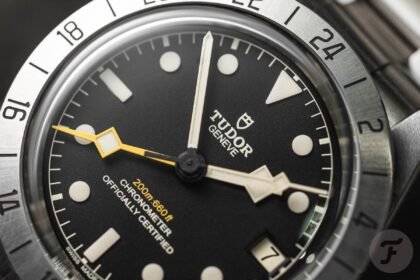
That said, it was a bummer, because the original North Flag was an awesome watch, and it has a definite—and passionate—fan base. The quirky rotating-disc power reserve indicator, black ceramic bezel ring, yellow accents, and Ranger II–inspired integrated bracelet design all gave the North Flag a distinct flavor, and if you liked the taste, you probably loved the North Flag (I know I did).
The All-New, All-Different Tudor Northflag
Which brings us to the Northflag. The new one. The one with no space in its name (I’d have loved to have been a fly on the wall for that meeting). To say that I expected this watch would be an overstatement, but to say it blindsided me also wouldn’t be totally fair. I’ve had several conversations with people over the last year about what it might look like if Tudor relaunched the Northflag, and I’m happy to say I wasn’t too far off the mark.


One of the big things that has long held me back from being a North Flag owner was the power reserve indicator. While I think the North Flag’s power reserve indicator was about as well implemented as I’ve seen, and that it made a ton of sense to really emphasize the movement you were getting in that original watch, it’s just not a complication I generally care for. To me, Power reserve indicators always feel redundant in automatic watches, and if I’m going to have an indicator anywhere, I prefer it to be on the movement or caseback.
A GMT is, to me at least, a much more sensible addition to this watch. It’s also (I’d imagine) easier to market as a value add, especially to off-the-street customers who care less about the movements in their watches than some Hodinkee readers might. Besides, a GMT is a romantic complication that tells a story, if not of past adventure or excitement, then at least of the aspiration and promise of travel. Here, the GMT comes courtesy of the Tudor MT5652-U movement, a METAS and COSC-certified flyer GMT. It’s a serious movement that has more than proven itself in recent years.

The new Northflag also has an improved fit. While the headline dimension has remained unchanged — its 316L stainless steel case still measures 40mm across — the whole case has been refined. And, by that, I largely mean trimmed up and slimmed down. That’s not to say it’s slim or wildly compact, but at 12.7mm thick and 48.8mm lug-to-lug (as compared to 13.3mm thick and 50mm lug-to-lug), the watch wears noticeably sleeker and more comfortably, at least on my 7.5″ wrist.
Of course, my wrist isn’t the whole story, and I should say that Tim and TanTan (who both have wrists around 6.5″) each found the watch to be a little too expansive and did not find it to sit nearly as comfortably as I did. All this is to say that I’d really recommend seeing this watch in person before buying, because — like with most integrated bracelet watches — wrist size and shape will come into play here more than you might expect. That said, this is largely a moot point, at least until the Northflag starts popping up on the secondary market, because the new watch is an in-store exclusive for Tudor, so if you’re interested, you’ll have to make the trek to see it in person before you buy.

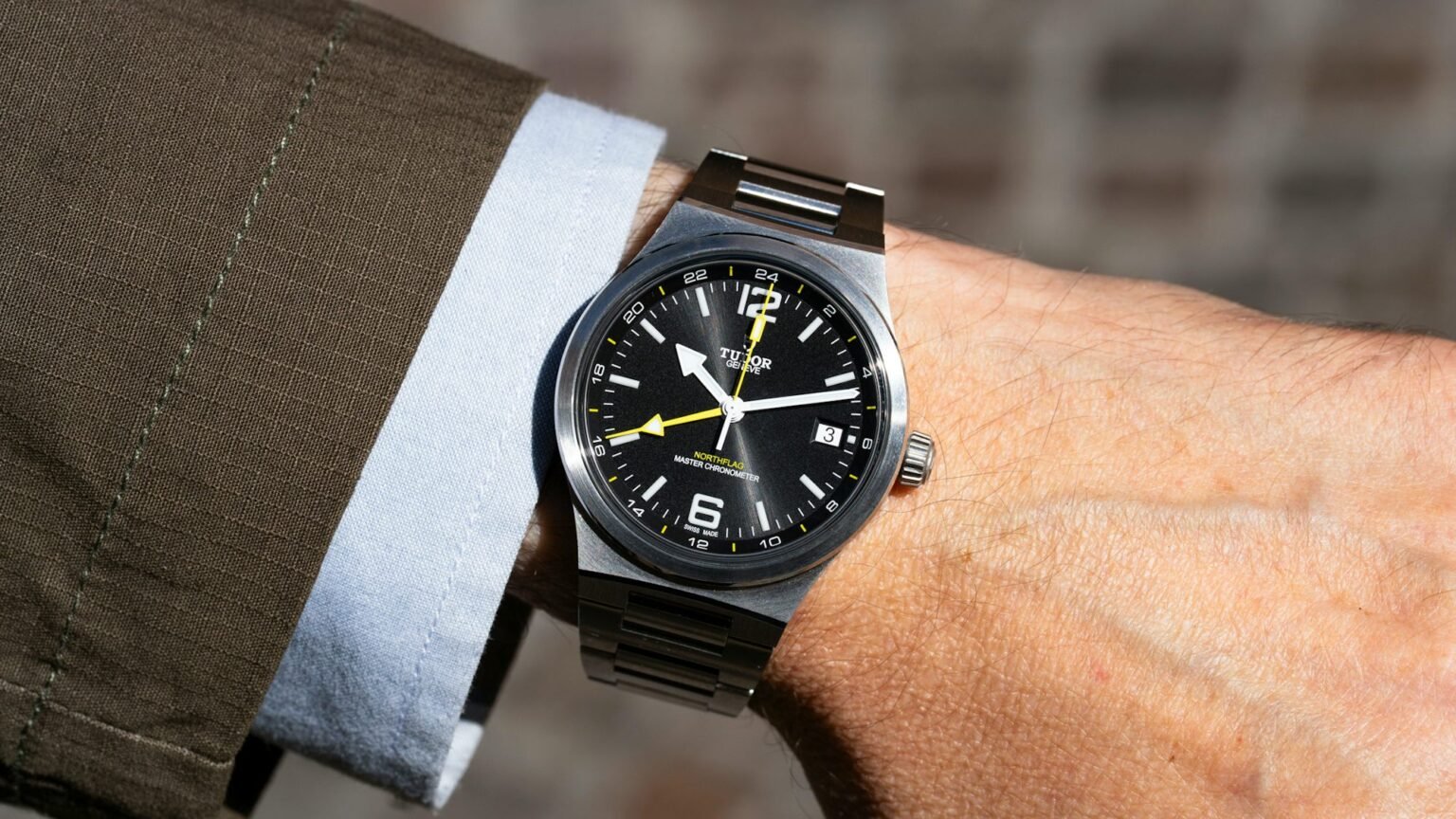
Obviously, the clearest visual adjustment between the new Northflag and the old North Flag is the omission of the power reserve indicator and the inclusion of a fourth GMT hand and a corresponding 24-hour bezel. Beyond the new case and movement (and its associated functionality), Tudor has also used this moment to introduce a smattering of other updates to the Northflag. These are mostly small adjustments, but when you stack them up, they start to get impactful.
A sunburst black dial brings a more classically ‘luxury’ look to the watch, and the raised luminous markers and numerals help to differentiate this watch from the previous generation while also subtly making the whole package feel more contemporary. One of my favorite changes here is the switch of the seconds hand from the Ranger-styled seconds hand used on the North Flag to one that is much closer in its design to that of the Ranger II, which helped inspire the line.

It’s a very small change that might not jump out to most, but I think it really helps keep the seconds hand and the GMT hand — which are both bright yellow and about the same length — distinct. There’s a valid argument to be made here that the two hands maybe should have been different colors, but I’m largely appreciative of the extra yellow on the watch, and the hands are visually different enough that I’m not really bothered by it.
One more obvious change is that Tudor has done away entirely with the black ceramic bezel ring that was such a defining visual hallmark of the original watch. If you’ve only ever seen the original North Flag in photos online, I’m not sure you’ll appreciate just how much character that feature brought to the original North Flag, but its loss here is notable, although I’m sure also welcome for many.

This bracelet features a similar H-Link design to the original North Flag, updated with the many quality-of-life improvements Tudor has introduced over the last decade and now includes here. Most important is T-Fit, Tudor’s on-the-fly adjustment system, introduced five years ago and now part of a decent chunk of Tudor’s catalog. It’s nice to have it here.
Some visual details remain consistent, though. While the markers are now monobloc luminous ceramic, they keep the same Explorer-like typeface as on the earlier version of the watch. The Ranger II handset remains, as does the tapered crown, which is unique among Tudor watches and one of my favorite details on both the North Flag and the Northflag.


Altogether, I think the new watch is quite handsome. In person, and on wrist, it feels like a Northflag, just one that’s grown up a little over the last decade. Put another way, the original North Flag made a tremendous amount of sense in its own context, but it was maybe a bit too brutish to cross over into polite society. This new Northflag is ready to come in from the cold, sit by the fire, have a whiskey, and reminisce.
Competition
Finding competition for the Northflag was a bit of an odd challenge, because when I really stop to think about it, the biggest competition for this watch comes from inside the house. While I’m not sure anyone is cross-shopping this watch with the Pelagos FXD GMT (with which this watch shares its movement), I can see a very real scenario in which people cross-shop this watch with the Black Bay 58 GMT, or, and this seems more likely, the Black Bay Pro — and I don’t know that the BB Pro comes out of that matchup looking all too pretty.

Image, James Stacey

Image, James Stacey

Image, James Stacey
Sure, the Black Bay Pro is less expensive — it can be had on a strap for $4,725; the Northflag is available in only one spec priced at $5,525 — but to save that money, you’re giving up METAS certification, picking up nearly 2mm of thickness, and possibly passing on a bracelet. I also just think there’s something to be said for the Northflag’s unapologetically ‘Tudor’ identity and design. No one is going to look at you wearing this watch and think, “Oh, he couldn’t afford an Explorer II.”
Outside Tudor, it gets slightly harder to find good comps. The Breitling Chronomat GMT offers a similar feature set and a vaguely similar look in a comparably sized package to the Northflag, but it also costs nearly $7,000 in most versions and — as far as I can tell — is, at the moment, largely only available in configurations tied to either NFL teams, Rugby squads, or specific athletes, which might not speak to many. Plus, they’re very shiny.

Image, Mark Kauzlarich
Over at Oris, the Propilot X Calibre 400 comes in starting at $4800 dollars and scratches a lot of the same itch as this one does, at least for me, but for some reason, Oris has yet to put a GMT into that case shape, so, again, it doesn’t quite match up (although if Oris ever makes that watch, I will be the first in line to see it).

Image, James Stacey
Lastly, I think it’s hard to talk about any modern Tudor release without at least mentioning Longines. We’ve talked a lot about the frankly incredible job Longines has done in the sub-$5,000 range over the last few years. They’ve released a bunch of great watches aimed straight at Tudor’s audience, and I don’t think it takes much to see it’s working for them. That said, while I love Longines’s GMT offerings, I don’t think there’s one that really scratches the same itch as the Northflag, so chalk this up as an uncontested win in the Tudor column.
Overall Thoughts
Okay, I really like this watch, at least in principle. I was bummed when Tudor discontinued the North Flag rather than update it, and the introduction of the Northflag feels like the brand righting a small wrong. Still, I’m happy it’s back, and I think Tudor has managed to make a watch that will appeal to far more people than the previous generation.


That said, I’m not sure this is quite the watch it could have been. For one thing, it’s hard not to wonder what this watch could have been in titanium. I’ve already seen comments to that effect on our site and others, and it’s a real question. Aside from absolutely anything else, a titanium Northflag would have felt more singular in the Tudor lineup. At the very least, it would have felt less like a direct competitor to the Black Bay Pro.
I do also wish the new Northflag was a bit… weirder. Don’t get me wrong, it’s all the things I’ve said it is here — it’s more mature, more refined, and probably objectively better — but I think if you were a real fan of the original, this one can’t help but feel like a bit of a compromise, although I concede probably a necessary one.

For more, visit Tudor’s Website.