

“The first two days, almost nobody came to see us. We were very anxious,” Carlo Crocco, the founder of Hublot, tells us, casting his mind back to Baselworld in 1980, when he stood in a booth with a single window displaying a single gold-cased watch on a black rubber strap. “On the third day, we realised that everyone was speaking about us, because it was really something different from all the other watches.”

We are sitting together in Milan on the eve of the Classic Fusion Tributo launch, which Hublot presents as a return to that very first design. After spending time with it in the metal, I would argue the most interesting thing about it is how firmly it refuses to be a reissue. At a time when brands can reproduce their back catalogues down to a 3D-scanned dial, Hublot has presented an evolved expression of its first watch, combining it with a design language that’s taken shape over four decades.
That decision makes more sense when you consider where Hublot stands today and why this watch is arriving now. Since Julien Tornare took over as CEO in late 2024, the brand has been working through a deliberate reset, investing in its Nyon campus and its movement strategy and reworking the Big Bang twice this year, with Tornare signaling early on that a Classic Fusion built around the Italian elegance of its founder would follow.


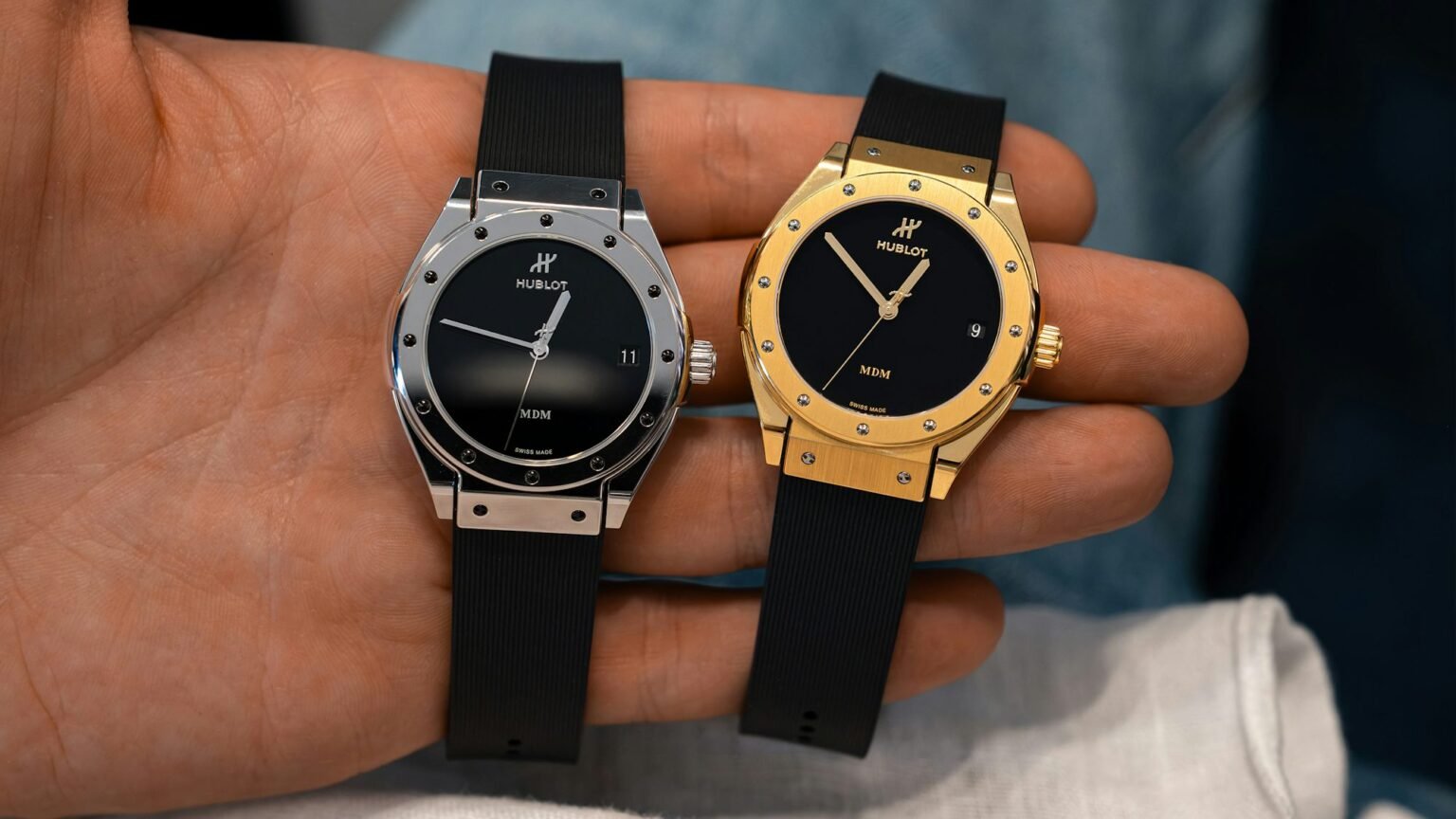
The two things Crocco focused on for the Tributo, the twelve screws and the black rubber strap, are precisely what make it read as the original at a glance. The detail I kept coming back to on the wrist, though, was the case, where the evolution is most striking. It has grown from 36mm to 38mm, and in the metal it feels bolder and more commanding than those two millimetres suggest, thanks to a layered, stepped construction that gives real depth and shadow. Yet at 9.5mm thick it wears as a complete, almost compact package, well short of Big Bang territory. It sits, dare I say, perfectly on my 7-inch wrist, helped by shorter, downturned lugs that give it that all-important wrist-hugging quality. What surprised me most is that, despite the added presence, the design has been distilled further to the essence of the MDM. The bezel screws are pushed forward as a focal point, the ears on the case flanks are retained, and metal around the lugs is left exposed to show how everything fits together.

In the flesh, the two references have noticeably different personalities, though both follow the same evolutionary logic rather than replication. On the yellow gold reference, everything feels familiar to modern-day Hublot codes, with a striking yellow gold case, a deeply contrasting matte black dial closer in spirit to 1980, and a restrained design that makes the Tributo case’s impressive lines feel positively brazen on the wrist. In softer light, the yellow gold reads muted, but in bright light, the metal’s modernity and impact are impossible to ignore. Sure, it’s a loud watch, but that’s no bad thing, because arguably it’s exactly what a return of the original disruptive MDM should be.
Then comes the white gold, which Hublot pitches as its black-tie option, with black-plated screws and a polished black onyx dial that, in person, has a depth and gloss the original’s matte black never had, making it a more formal and understated choice and, for me, the one that offers the most versatility, with a high-polish finish that looks consistent in any light, which is to say pretty perfect. Reading this, it’s probably no surprise that I’d take the white gold any day of the week, which, coming from someone who’s hunted yellow gold watches almost exclusively for the past two years, says a lot about how well the Tributo is done in white gold. For me, it comes down to contrast: the Tributo’s whole theme is the juxtaposition of rubber and gold, old and new, bright white and deep black, and that contrast, both figuratively and literally, lands best on a white gold watch.
On both, the date window remains at three o’clock exactly where Crocco placed it, but now color-matched to the dial so that it all but disappears, the MDM signature returns at six o’clock as a direct nod to the name under which Crocco first showed the watch, and the hands are larger and more highly polished than the original, bringing surprising life to a dial with almost nothing else on it.


However, arguably the biggest change sits behind the caseback. The original ran on quartz, a choice Crocco made because he “was really fixed on the aesthetic,” though he is candid about it now. “Personally, I was wrong,” he says, and the Tributo puts that right with Hublot’s automatic HUB1711, a Zenith-based calibre beating at 4Hz with a 60-hour power reserve behind an open-worked “H” rotor in 22k gold or black tungsten. The decision to use the HUB1711 instead of one of Hublot’s Sellita-derived calibres is not just the correct one but a tangible benefit for the watch, its owners and the perception of the brand as a whole, bringing a longer power reserve than the roughly 42 hours of the Sellita-based HUB1110 and a pedigree that the Tributo’s price demands. While there will always be an audience asking more of Hublot in this department, for the type of watch it has created here, one whose appeal lies in its form and its lineage, the HUB1711 is a great match.
What makes the Tributo interesting within the Hublot lineup is how far it sits from the watches most people picture when they hear the name. You, and I’ll admit, I don’t necessarily first think of the Classic Fusion when Hublot comes to mind, because the Big Bang, the collaborations with Usain Bolt and Novak Djokovic, the sapphire cases, and the skeleton dials are the Hublot many of us know. The wider Classic Fusion family has long been the brand’s more restrained line, spanning a broad range of sizes and materials on a modern case, and, to give the brand credit, it has looked back to 1980. First with three limited 45mm reissues for its 40th anniversary in 2020, and then with the Classic Fusion Original in 2023.

The Tributo returns to the original’s proportions and details with more intent than anything that came before it, or, frankly, anything you’ll find in the Classic Fusion line itself. Try on a Classic Fusion today, and you’ll find they’re quite hefty things, with thick lugs, broad cases, and a thick bezel. While they’re very considered at any size, their form leans toward the bulky side. After wearing both Tributo editions, I can (happily) share that the model doesn’t suffer the same fate.
Spending some time with these new releases, I’m reminded of a familiar but fitting analogy. If say you were to park a Porsche 964 from the early 1990s next to a 911 from today, almost every panel and component would be different, yet nobody would mistake either for anything other than a 911. That is far harder to achieve than simply copying the past, because it asks the designer to understand which lines define a watch and which simply belong to the year it was made. Sadry Keiser, Hublot’s Chief Product Officer and the man responsible for shaping the Tributo alongside Crocco, explained it to me by imagining the original MDM pressed into sand, where “everything you see is the minimum that you need to keep,” and anything else belongs to its moment, whether that is 1980 or 2026. “Our challenge was being sure that we understood those lines,” he says, and having handled the result, I can say that level of consideration is refreshingly felt.
Priced at $30,900, the Tributo sits in a fiercely competitive bracket of serious gold dress-sports watches. Hublot’s own 38mm Classic Fusion in King Gold costs $21,100 and it features the modern case and Sellita-based HUB1110 calibre, so the premium for the Tributo buys a great deal of rethinking. Beyond Hublot, gold on rubber climbs quickly: Piaget’s rose gold Polo Date is $37,700, Parmigiani’s rose gold Tonda PF Sport Automatic is around $46,000, and Vacheron Constantin’s pink gold Overseas 4520V is $71,500, albeit with a gold bracelet. Even Patek Philippe’s steel Aquanaut retails at around $27,000. Each of these brings its own calibre, finishing, and pedigree to the table, but set against that company, a solid gold watch with a Zenith-based calibre from one of the most respected movement makers in the LVMH family, with a genuine claim to having started the whole gold-and-rubber conversation, looks far less like a punchy price and far more like a fair one.

I’ll be honest, I’ve struggled to find something I dislike about these new additions from Hublot, and with so many watches released almost every day, the criteria for what would actually make it onto my wrist get tougher, but the Tributo in white gold would make that list. I could sit here and say I’d like it without a date, but the date is a key part of the original’s design, and I could say I wish it were just a little bit smaller and a little closer to the original, but in reality, it wears incredibly well. The only real sticking point for many will be the price, particularly in a market that has grown more sensitive to pricing than at any point in recent memory, and those who see the Tributo simply as a smaller, simpler Classic Fusion may struggle to justify close to $10,000 over the King Gold, though that scrutiny is no bad thing when Hublot has shown such self-aware and proactive consideration throughout, from studying the original lines to bringing Crocco in on the journey.
To me, the Tributo is a watch that exists for two quite different people: the collector who has always admired aspects of the Hublot story but never found a modern watch that expressed it, and the newcomer to the brand who wants something with a tangible legacy and a design that will still make sense in the next 46 years. Both, in their own way, are reacting, whether they know it or not, to that same idea Crocco revealed at Basel in 1980, and it says a great deal about the care behind the Tributo that the idea still lands as clearly today as it did then.