

If there was just one watch in the slew of new Rolex releases at Watches and Wonders this year that cried out for an in-person experience, it was the new Rolex Day-Date 40 in Jubilee Gold. This was, after all, the first new gold alloy unveiled by the Crown in more than two decades. Not since the debut of Everose Gold way back in 2005 have we had a new gold Rolex alloy.

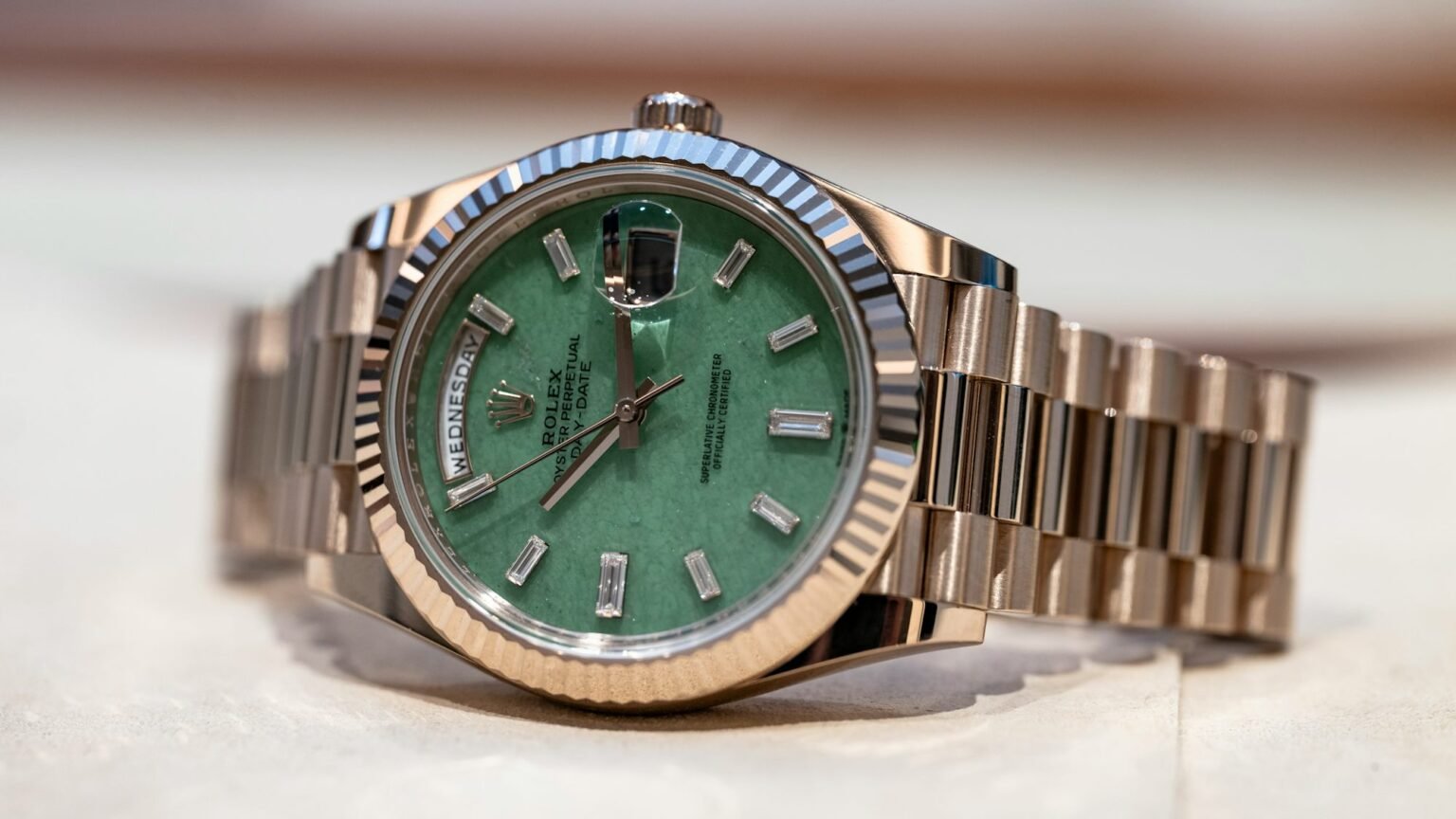
Jubilee Gold is definitely different, unexpected, and unique. In the (precious) metal, the effect is surprisingly restrained, even muted. In some lighting, it reads almost like faded yellow gold; in others, it takes on a cooler, slightly silvery character. Rolex seems to be chasing a different emotional register here — less overt luxury, more quiet confidence.
Instead of the bold warmth of yellow gold or the coppery glow of Everose, Jubilee Gold is intentionally subtle. The case and bracelet contours still glint when they catch the light, but seemingly a bit less so than with its other gold alloys. Rolex describes the tone as a blend of yellow, grey, and pink, and on the wrist, it behaves much like that description suggests: shifting between warm and cool depending on the light.

It almost seems as if the new Day‑Date in Jubilee Gold wears a little differently on the wrist than a typical gold Rolex. Yellow gold Day-Dates demand your attention, catching your eye immediately and drawing you in visually. But a Day-Date, in Jubilee Gold, suggests more than it demands. Its glow sits somewhere between yellow gold, Everose, and even a slightly warm white gold, depending on the light. In bright sunlight, I expect it to be more golden, while indoors in artificial light, it can skew cooler and almost champagne-toned.
And while the 36-mm Day-Date is usually considered the more democratic choice when it comes to wrist wearability, the 40mm case continues to be one of Rolex’s quiet successes. Even with a full gold case and bracelet, the toned-down hues of Jubilee Gold just might make the biggest-sized Day-Date 40 appear to wear even better.

If the case material is the intellectual highlight, the dial is where Rolex gets a little more expressive. The Day-Date pairs its new metal with a light green aventurine dial — a natural stone whose quartz structure produces subtle flecks and shimmering texture across the surface and a color somewhere between jade and light emerald greens. The dial is framed by ten baguette-cut diamond hour markers, leaving space only for the day and date apertures. The result is visually rich without feeling overloaded. A balance Rolex has perfected over decades of gemstone dials.
To be sure, aventurine stone dials are tricky — they can either feel magical or overly decorative. Here, the pale green tone and the stone’s soft sparkle actually work well with the restrained color of Jubilee Gold. The baguette diamond markers add visual rhythm without dominating the dial.
There’s also a quiet symbolic note here: green has long been associated with Rolex, and the stone dial arrives during the centenary celebrations of the Oyster case, the waterproof case architecture first introduced in 1926.


In practice, the watch reads less like a flashy gem-set Day-Date and more like a quietly luxurious dress-sport hybrid. That’s a surprising place for the Day-Date to land, and it’s part of what makes this version compelling. This Day-Date 40 in Jubilee Gold is an “off-catalog” release, meaning it’s not part of the standard Rolex retail lineup and will likely be produced in extremely limited numbers. That makes it less of a typical product launch and more of a material showcase, a way for Rolex to introduce Jubilee Gold before potentially expanding the alloy into other models down the road.
The price sits at around $62,700, squarely within the modern Day-Date range with an upgraded dial but with the added intrigue of a new metal that collectors haven’t seen before. From a distance, this might look like a simple dial-and-metal variation on the Day-Date. But in the context of Rolex, where material change moves slowly and carefully, Jubilee Gold is a genuinely meaningful development. It also signals something interesting about where Rolex design might be heading: toward more nuanced precious metals rather than louder ones.
If Everose was Rolex’s answer to rose gold, Jubilee Gold feels like an answer to the question: “What does understated gold look like in the back half of the 2020s?”

The Day-Date has always been Rolex’s purest expression of status. But the traditional yellow-gold version carries a bit of cultural baggage — the “president watch,” the boardroom watch, a timepiece that wants to be noticed. This Jubilee Gold version feels aimed at a different type of collector. It’s for someone who already understands the Day-Date’s place in the hierarchy of watches but doesn’t necessarily want the loudest version. The more nuanced alloy and the unusual dial feel almost like a nod to insiders — people who have owned multiple Rolex watches and want something that looks familiar but also slightly different.
Rolex almost never introduces a new precious metal. When it does — as it did with Everose in the mid-2000s — that alloy tends to become a permanent part of the brand’s design language. Jubilee Gold could follow the same path. At the moment, it feels like a test case to introduce the metal in the brand’s flagship model, pair it with an expressive dial, and see how collectors respond. If the reception is strong, it’s not hard to imagine the alloy eventually appearing across other high-end references. But even if it remains relatively niche, there’s something refreshing about this watch.

The Day-Date is one of the most conservative icons in watchmaking. And yet here it is, nearly seventy years after its debut, still finding ways to evolve — not through radical design changes, but through the smallest details: a new metal, a new dial, a slightly different way of wearing gold. For a watch that’s built its reputation on permanence, that kind of subtle innovation is exactly the point.
For most of modern watchmaking history, gold meant yellow, white, or rose. But over the last decade, several high-end brands have started developing proprietary gold alloys designed to create distinct color signatures and improved material stability. In that context, Rolex’s Jubilee Gold fits into a broader, though still relatively small, category of experimental precious metals.

One of the most visible examples comes from Omega with Moonshine Gold, introduced in 2019. The alloy was developed to produce a paler, more subtle yellow gold tone while also improving resistance to fading over time. Compared with traditional yellow gold, Moonshine Gold has a slightly cooler hue with a faint champagne character. Then there’s Sand Gold, developed by Hublot and unveiled in recent years on pieces such as the Hublot Big Bang Unico Sand Gold. Sand Gold pushes the concept further, blending tones between rose gold and yellow gold to produce a beige-like metallic color that sits almost halfway between the two traditional shades. The idea is similar: create something that reads softer and more contemporary than classic yellow gold.
What makes Jubilee Gold compelling is how closely it aligns with this broader movement towards proprietary alloys while still feeling very much like a unique Rolex idea.
For more, visit Rolex online.