

In the horological sphere, we associate the 1970s with the quartz crisis, but there was a more significant threat facing the world at large: an energy crisis. Oil consumption was reaching an all-time high with widespread international travel and car ownership becoming more prevalent and mainstream. Simultaneously, domestic oil production was dwindling in many countries, increasing pressure on imports. The situation reached a crisis when OPEC (the Organization of Petroleum Exporting Countries) imposed an oil embargo in 1973. So, getting back to watches – you’re probably wondering, what’s the connection?
Like the United States, Japan was one of the countries impacted by this energy crisis. In response, Citizen Watch Company established an internal initiative to work toward developing a more sustainable and eco-friendly power source for its timepieces. In short order, the brand looked toward solar cell technology and had developed its own light-powered prototype by 1974. Two years later in 1976, we saw the world’s first light-powered analog watch, the Crystron Solar Cell. This technology would later come to be called Eco-Drive and celebrates its 50th anniversary in 2026.

You’ve probably already read about the flagship anniversary Eco-Drive model covered by our own Zach Kazan at its launch earlier this year, but this spring, in peak cherry blossom season, Citizen opened the doors of its manufacture for the first time in years to pull back the curtain on just how the technology works. Here, I visited two of the 17 factories in the brand’s expansive network spread across Japan. One was, of course, the movement factory where Eco-Drive calibers are produced. The other was the dial factory, which may, at first, seem less relevant but nevertheless holistic. However, the dial is really the secret weapon of Eco-Drive.

Dipping our toes back into some important historical context, we look briefly at the evolution of the solar cell technology that is at the core of Eco-Drive. The earliest evidence of the photovoltaic effect or the phenomenon of converting light energy into electricity traces all the way back to the early 1800s, with the first solar cell eventually being produced by the end of that century. Albert Einstein later published a paper on the topic in the early 1900s, which laid the groundwork for solar cell technology to make significant strides over the next several decades. By 1964, NASA had launched the first spacecraft powered by a solar PV array, a linked collection of solar panels designed to capture sunlight and convert it into usable electricity. One of the primary goals throughout this first century of advancing solar cells was optimizing efficiency for consistent, stable, maximum power generation. As you might guess, when it comes to the micromechanics of watchmaking, Citizen had some different objectives in mind when miniaturizing solar cell technology to power its timepieces.
“With Eco-Drive, our aim has been to reduce the use of energy and save power,” explains Yoshihisa Yajima, Brand Manager at Citizen. “What makes this technology different when used in an object like a watch, is it must not just be functional – it must be beautiful,” he clarifies. “This is all about how the dial – the main focal point of the watch – can bring in the power, light power, to drive the watch. The less energy needed, the more creative license you have with different dial expressions.”

This brings us back to the unsung hero of Eco-Drive: the dial. At the base of Mount Fuji sits the Kawaguchiko Factory, responsible for bringing Citizen’s Eco-Drive dials to life. Here, I was not only able to walk through the factory lines where more than a dozen steps are executed by a combination of machine and handwork to carefully construct the dials, but also able to speak to two of the brand’s leading dial engineers with roughly three decades of combined experience.


Shinji Sato has been with Citizen for nearly 20 years and oversees the development of all of the brand’s dials, including those optimized for Eco-Drive. “One of the biggest challenges I’ve experienced in my career with Citizen was developing a range of colors in the resin palettes for our Eco-Drive dials,” Sato shares. “They must serve a very specific purpose of allowing the light to pass through to the solar cell while still being visually pleasing. We have always had the technology to mix paints together and create any color we wanted to execute for a dial,” he continues, “and then we developed our resin dials for Eco-Drive, which are 100% recycled polycarbonate. This material helps us to achieve efficient energy conversion, allowing our Eco-Drive watches to maintain a high power-reserve even in low-light conditions,” explains Sato, “but combining the two was difficult – previously, we could not achieve the same range of colors in the resin material without compromising the transparency needed.”
The solution was developing a new mixing process that allows Citizen to designate the light permeability for a given dye. This required the creation of new machinery – a practice the brand has upheld since its early days when it began creating its own components in-house. No matter what shade, this resin layer is crucial to the functionality of Eco-Drive watches, and perfecting its composition has given way to specialty dials within the Eco-Drive line, like the washi paper dials introduced in 2017 and more recently the Fujifilm dials that debuted in 2023.

According to Daisuke Yamakage (another dial engineer who has specifically overseen the integration of the washi paper dials), this material has expanded creative potential and a new range of style variations for eco-drive just like the advancement of color iterations in the resin palettes. “Washi paper is a material that feels like it has opened up endless possibilities for our artisans,” Yamakage describes. “The delicate texture is practical – perfect for light to pass through – and it gives us the potential to experiment with different dying techniques and colors.”
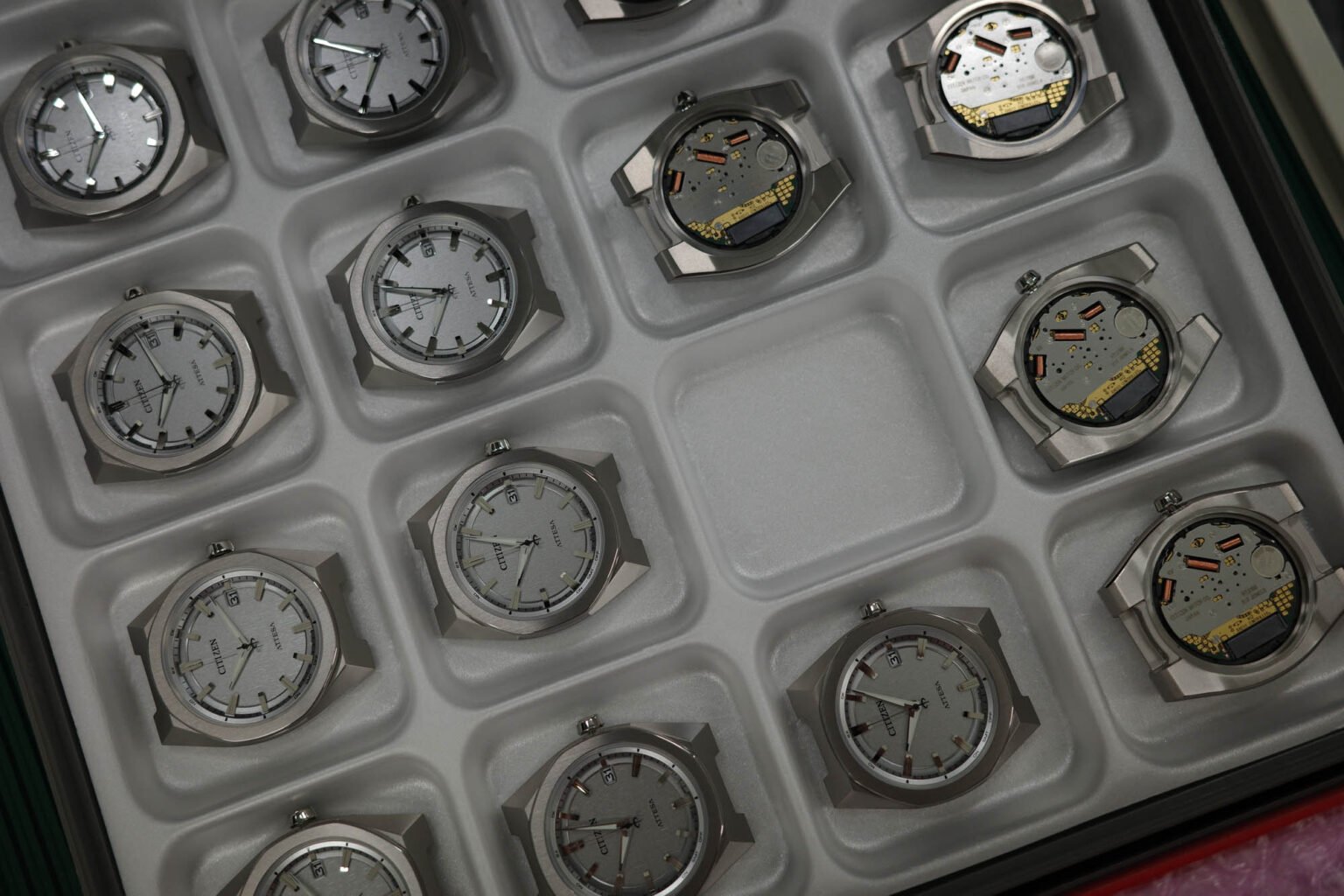
Moving beneath the surface, we make our way to the eco-drive movement itself, produced from the ground up at the Saku Factory in Nagano, Japan. Eco-Drive technology is not just about environmental impact and low energy consumption. It is still about creating watches with superior accuracy. “In the early days of Eco-Drive, we were able to achieve accuracy of around +/- three seconds,” recalls Shoichiro Morita, a leading movement engineer at Citizen. “By 2019, we had improved that accuracy to +/- one second, and one day, we aim to improve it further to just +/- half a second, but there are a number of factors that weigh into this,” he explains. “It is not only about refining our Eco-Drive technology but also about considering daily elements that have an impact, like temperature and moisture. It is not just achieving this accuracy once but putting the watch through tests to simulate years of wear and maintaining that accuracy over the passage of time.”
Beyond the dial and the solar cell beneath that charges the quartz battery is an intricate system that actually powers the watch. Two of the three sections making up the Saku Factory are devoted to this portion of Eco-Drive: circuits and coils followed by the final movement assembly. The key to refining and optimizing these circuits and coils is reducing the power consumption. Here, an integrated circuit (IC) manages the energy flow between the solar cell, quartz battery, and the motor that powers the watch. The key component that drives the motor is an expertly engineered electromagnetic coil whose thickness measures mere fractions of a human hair and whose magnetic field drives the movement of the watch hands.


This entire self-driven eco-system (pun intended or perhaps just a perfect double-meaning of Eco-Drive) results in timepieces that not only boast extreme accuracy but also require no winding, charging, or battery replacement to maintain constant operation as long as there is light. In many ways, the trajectory of Eco-Drive – from its inception and through every step of its evolution – has been incredibly practical and strategic. A problem was identified, a goal was set, the initial mission was achieved, and through other micro-challenges, the technology has been propelled forward, refined, and improved. This in and of itself feels reflective of Japanese culture and its reverence toward methodical order and precision.

However, there’s a poetic element to eco-drive as well that’s equally reflective of Japanese culture and embodied by some of the brand’s lesser-known slogans like, “whenever you are with the light, you can move forward through time.” These metaphors of light and time hold a deeper weight about growth and resilience as we walk through the world and remind us that watches are far more than just functional objects. We don’t just collect them because they tell the time – we collect them because they symbolize something for us about the meaning of time. Citizen