

Continuing Doxa’s focus on its core late-60s aesthetic, the brand recently unveiled the T.Graph II, the latest iteration of its core dive chronograph. Reborn but largely faithful to the original (and indeed to some more recent T.Graph forays), the new T.Graph II ports the Sub 300’s classic look into a burly yet entirely wearable automatic chronograph that comes in Doxa’s classic trio of colors, along with the surprise inclusion of a blue “Caribbean” execution. With a flagship price tag, it’s a model that has previously been hard to source and often even more expensive, so the question becomes: is the new T.Graph II the dive-ready Doxa chronograph we’ve been waiting for?

Don’t fret, we’ll get to all that and more. But first, a quick history lesson to bring us all loosely up to speed on the T.Graph, as it’s a model with a cult following but was previously never made in any considerable quantity.
T.Graphs Past
To keep things as basic as possible (because Jason Heaton has written extensively about, and dived with, vintage T.Graphs – here with a Searambler, and here with a Sharkhunter), the new Sub 200 T.Graph II is based on a low-production design from 1969 called the Sub 200 T.Graph. While there is some contention over production numbers, it is believed that ~300 of each of the original colorways (Sharkhunter, Searambler, and Professional) were produced. Again, I recommend both of Jason’s stories, even if only so you can see how absolutely gorgeous a vintage Sub 200 T.Graph Searambler really is.

Moving on, we didn’t get the next full-fat take on the Sub 200 T.Graph until 2019, when Doxa celebrated the model’s 50th with a 13-piece LE in solid gold (at $70,000, still so wild) and then followed up that set with a 300-piece limited edition later in 2019 that was offered only in the orange “Professional” colorway. You can read our original Introducing story for that model here (also written by Jason), but if you don’t click the link, it’s worth noting that the watch was 43mm x 15.15mm x 45.5mm, used a manually wound NOS Valjoux 7734, and had a price tag of $4,900 (in 2019).

That’s the history of the T.Graph until June of 2026. As I said, while limited in production, the T.Graph has a cult following, and any revival, limited or otherwise, is going to be mired in the gooey nerdery at the core of any Doxa enthusiast.
Jump to today, and you’ll find the new Sub 200 T.Graph II as the most recent and first non-limited addition to the modern T.Graph family. It’s worth noting that this move (from an in-demand LE to a largely similar catalog model) is not without precedent. In 2017 (and under previous management), Doxa released a limited-edition trio of Sub 300s to mark the 50th anniversary of the brand’s beloved 1967 model. I have the 50th Searambler model on my wrist as I type this, and can recall when, in 2020, Doxa launched a non-limited spec for the Sub 300 for ~$2500. Much to the chagrin of owners of the 2017 limited-edition models. Never bothered me much, but welcome to watches, I suppose.
T.Graphs Present
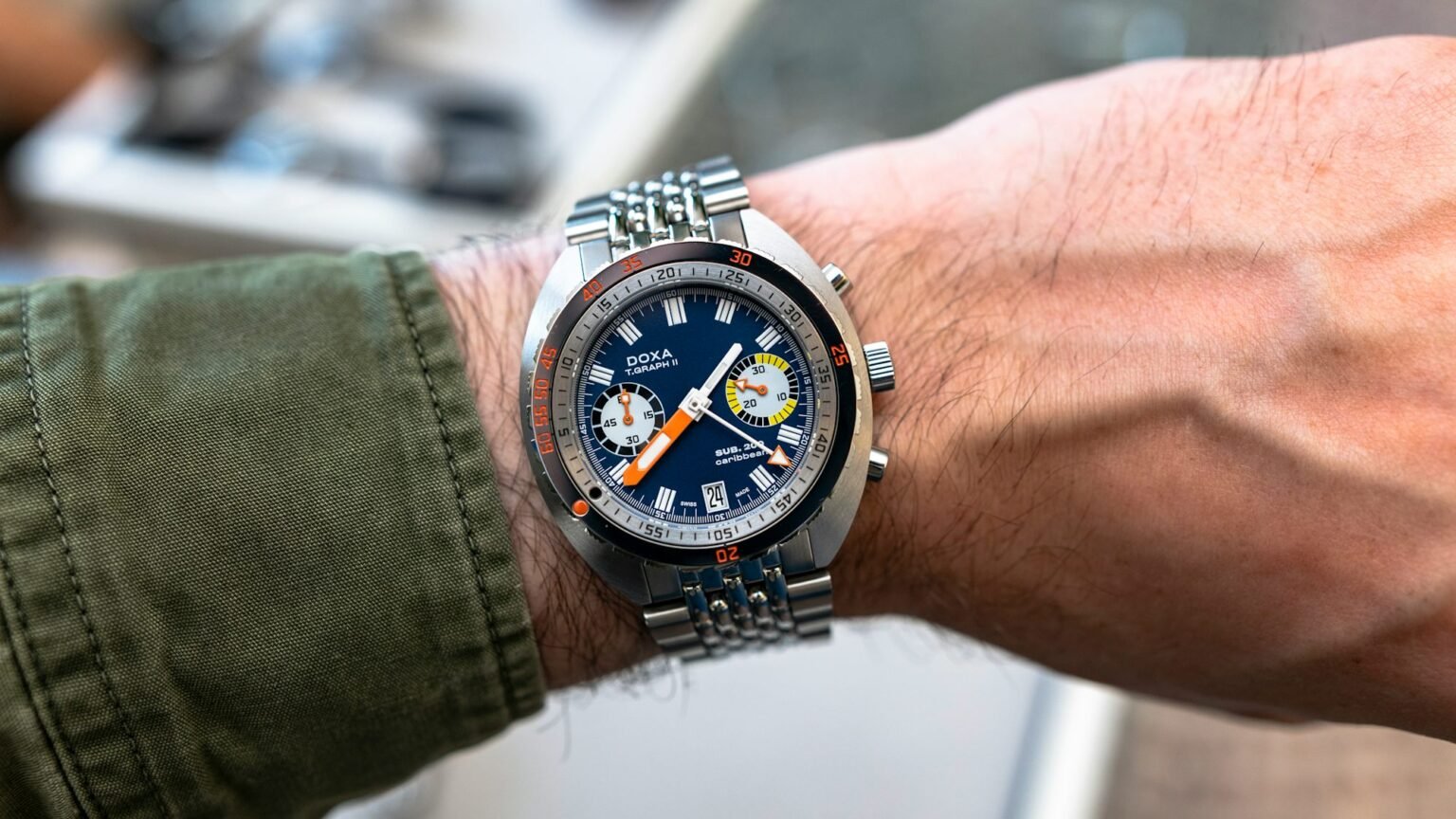
Now that we’re up to speed, let’s take a look at what we get for a T.Graph–sorry, T.Graph II–in 2026. There are four standard colorways offered from launch. If this is your start in the Doxa world, you’ll soon learn that the brand uses aquatic-themed names for its dial colors, so for the T.Graph II, we get Professional (orange), Sharkhunter (black), Searambler (silver), and Caribbean (blue). As TanTan covered in his recent intro story, the new T. Graph II is 42mm wide, 14.6mm thick, and 44.5mm lug-to-lug, marking a reduction in size that pays dividends in terms of wearability.

While a bit smaller than the 1969 examples, the dial design has been largely maintained, with a successful port of the Sub 300 look that is augmented by a pair of subdials and a date window at 6 PM. In the image below, you can see a 1969 Sub 200 T.Graph Searambler (left) next to a modern T.Graph II example. Note the preservation of some fun details, like the block lume marker on the running seconds hand in the 9 o’clock subdial, the arrow design for the chronograph minutes hands, and the 3 o’clock subdial (which shares the very cool black/yellow color scheme).
Keen eyes will also notice that the distinctive Doxa “no-deco” dual-scale bezel is shown in meters for the 2026 model (the only option), whereas the original 1969 spec could be had in either meters or feet depending on the owner’s (diver’s) locale and wishes.


Speaking of diving, for those planning to take the new T.Graph II underwater, the water resistance is 200 meters, and the crown screws down, but it’s worth noting that the pushers cannot be operated underwater. Confirmed by Doxa, this is a notable element as the bezel is perfectly useful as a bottom-timer backup for a diver’s computer, but the 30-minute total measure of the chronograph feels like it would be useful for inter-dive timing (time to cover a piece of a wreck or to get to the other side of the reef, for example). Is it a big deal for most people planning to buy a new T.Graph II? Probably not, but neither is having 200 meters of water resistance (but we’d all be commenting if it were 50 meters).
From an aesthetic standpoint, as a Doxa fan, I absolutely love the way the T.Graph has always looked, so naturally I like the T.Graph II, and I appreciate that they didn’t mess with the core qualities of the original design. In person, and perhaps unsurprisingly, I vastly preferred the Caribbean and the Searambler. The Pro is simply too orange for me (I’ll reconsider when I retire to a sandy beach someday), and the Sharkhunter feels a bit muted due to the use of a white minute hand. While certainly accurate to the original, I do feel like an orange hand would have worked quite well.


But due to the orange minute hand and the yellow present in the chronograph minutes register, the colorway winner for my cash would be the Caribbean. The blue is warm, the orange looks great, and the yellow fits in nicely.
Moving on from colors, when I tried on the new T.Graph II, I found it to wear beautifully. Comparing its sizing to my Sub 300, the T.Graph II’s case is half a millimeter smaller, nearly a millimeter shorter lug-to-lug, and about 1mm thicker, despite packing a chronograph. I’ve said it before, too many times to count at this point, but few watches wear like a Doxa, and, just as I’ve experienced with my Sub 300, the T.Graph II’s uncommon proportions make it wear far better than the width might suggest.

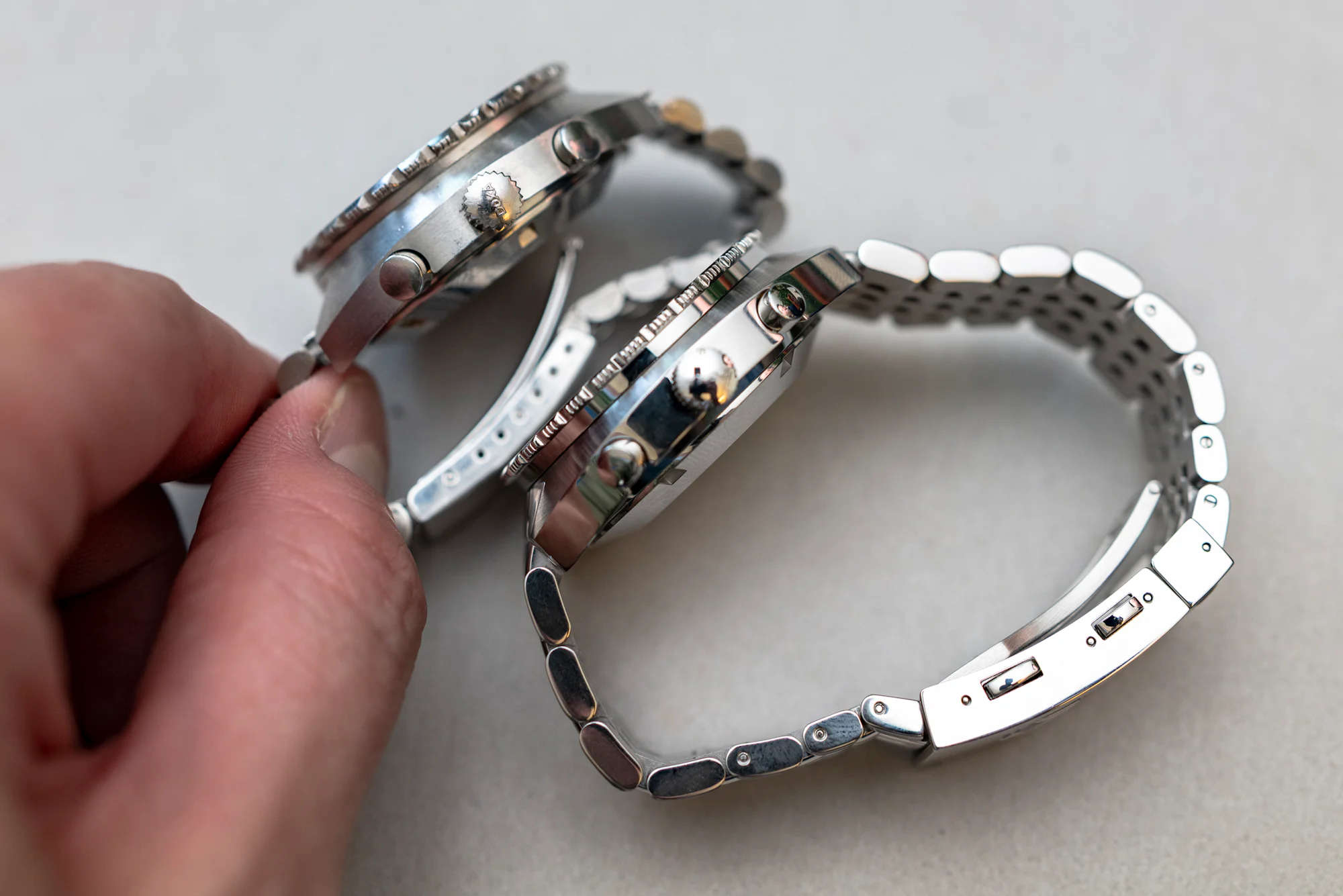
While I’d likely swap in an Isofrane or some other vintage-effect rubber strap, both the Doxa FKM strap and full steel bracelet were nicely matched for the medium weight of the T.Graph II. As always, given the small premium Doxa charges for the bracelet (which includes a ratcheting micro-adjustment in the clasp), that is what I’d choose, even if I was unlikely to wear such a watch on the bracelet (my Sub 300 lives on a NATO or a cheap sharkmesh mesh from eBay).

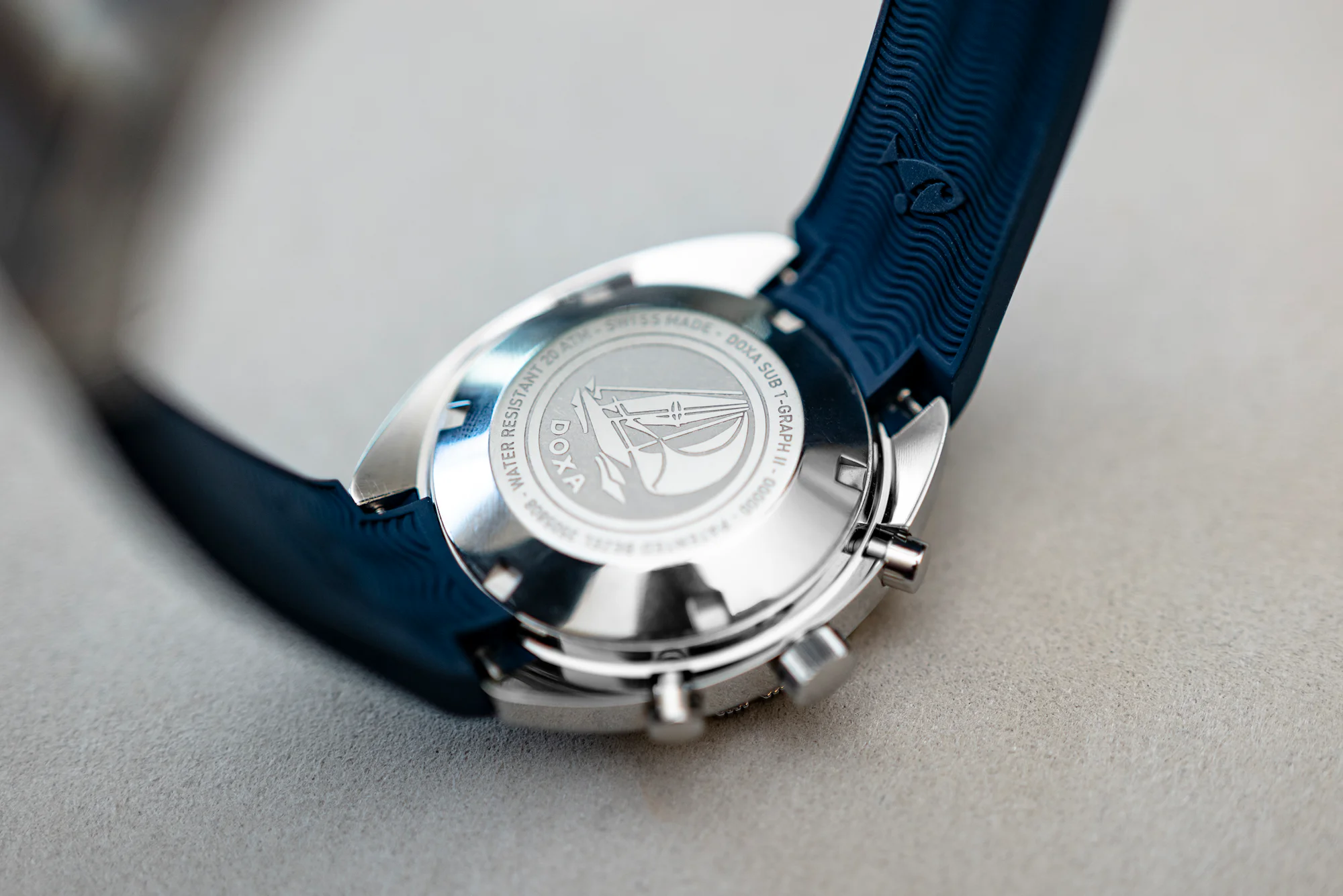

Inside, Doxa has fitted a Sellita SW510, a Swiss-made automatic chronograph movement that is based on the same architecture as the ETA 7753. The SW510 has a cam-operated chronograph, a rate of 4 Hz, and a power reserve of 56 hours. Like the ETA versions of the movement (which Sellita produced in the past), these are not overly complicated nor overly expensive, with the benefits being lower costs when it comes to service and a reputation for being largely reliable and straightforward.
That said, while not without comparison (more on that in a moment), the SW510 is a movement that is used in a wide range of watches, many of which cost less than this Doxa. While I would argue that too much importance is placed on the movement used at a given price point (and too little on the long-term costs of more expensive movements), the immediate online feedback for the new T.Graph II was at least in part tied to the combination of a $4,000+ price point and the use of the Sellita movement.

T.Graph Competition
Which I suppose brings us to a good bridge to look at the competition for the T.Graph, both in terms of price point and dive-chronographs. For simplicity, keep in mind that the Doxa is a $4,250 41.5mm steel vintage-inspired dive-chronograph with a 30-minute automatic chronograph movement sourced from Sellita (SW 510) and 200 meters of water resistance.

- Aquastar Deepstar Chronograph 39mm (above/center, $2,900 on a bracelet). This is a 39 x 17 x 49mm (thickness domed includes crystal) steel dive chronograph with a 30-minute max measure and 200m of water resistance. The movement in use is an automatic from La Joux Perret with a column wheel and 55 hours of power reserve.
- Olech and Wajs Astrochron (above/left, ~$3,900 on a bracelet). This is a steel, 12-hour chronograph, with 500m of water resistance that measures 39.5mm x 16.8mm x 49.5mm. The movement is a Valjoux 7753 with a 54-hour power reserve.
- Sinn 613 St (above/right, $3,570 on a bracelet). A steel, 60-min chronograph that is good to 500m and measures 41.5mm x 15mm x 47.5mm. The movement in use is a Sellita SW515.

- Oris Divers Sixty-Five Chronograph (lower/center, $4,700 on a bracelet). This is a dive-style chronograph good for 100 meters of water resistance that measures 40mm x 15.4mm x 48mm. The movement in use is a Sellita SW500 with 62 hours of power reserve.
- Nivada Grenchen Chronomaster Broad Arrow (lower/left, $2,285 on a bracelet). This is a steel dive-style chronograph that measures 38mm x 14.55mm x 46.5mm and is good to 100 meters. Available in multiple sizes and with more than one movement, the base option uses a manually-wound Landeron 70 movement with a power reserve of 46 hours.
- Vulcain Skindiver Chronograph (lower/right, $3,310 on a bracelet). This is a steel 30-minute dive chronograph that measures 39.7 x 13 x 47mm (excluding the domed crystal) and has 200m of water resistance. The movement used here is the automatic ETA 7753 base with 42 hours of power reserve.

Looking at that spread, the Doxa sits toward the premium side of the range for the movement in use, but it’s still well within range with direct vintage-inspired offerings on either side from Oris slightly above and Ollech & Wajs below. Keep in mind that the 7753 is a precursor to the Sellita 500/510, and both use a largely similar architecture (despite being made by two different companies).
If the Doxa is simply one on a list of options in the vintage-inspired category, the O&W offers a lot, as you get a 12-hour register and 500m WR, albeit in a considerably thicker case. The Aquastar and the Vulcain offer a lot for your cash as well, in the range of $3,000. I had a 39mm Aquastar, and it wore well but was also fairly thick. I’m certainly not one to argue with the snappy feel of a column wheel. Would recommend for sure if you like the dimensions.
Finally, Nivada Grenchen offers the value play with a litany of models in the Chronomaster collection, spanning 38-41mm, automatic and hand-wound, and a wide range of colors. Pricing starts under $2,000 for the Landeron-powered options and tops out at $5,000 if you want a Valjoux 23-powered option.


If we’re talking about my own money, I am really not at all uncomfortable with the T.Graph premium here, and it’s almost certainly where I’d spend my money on the above options, though I would give credit to the Vulcain for its great looks and the Sinn, especially the GMT-equipped 613 St UTC version.
Factoring for my personal appreciation for the Doxa aesthetic, the appeal of the T.Graph as a model, and – perhaps most crucially – the wearable dimensions, the T.Graph II manages to stand out among a solid pack of options delineated above. Did I miss any great contenders? Let me know in the comments.
Final Thoughts

So, with a bit of history, a bit of time on-wrist, and a bit of competitive context, where do we land on my original question? Is the new T.Graph II the dive-ready Doxa chronograph we’ve been waiting for? While not a value play within the brand’s lineup (though not as expensive as the LE before it), I think the new T.Graph II nails the brief while also serving as a proper flagship for Doxa’s colorful and always quirky lineup of dive watches. Though I certainly can’t say that I need another Doxa diver at this point in my life, the T.Graph II feels special, and it’s something I’d love to own and take diving someday soon. But help me out – Searambler or Caribbean?