

- Tell us a little bit about yourself and how you first got into diving.
- When did you move from recreational diving toward the more technical side?
- How much time have you actually spent underwater?
- What’s been your most memorable dive?
- What about your most challenging or treacherous dive?
- You got into watches and diving around the same time. How did those two passions build on each other?
- Having actually used dive watches for their intended purpose, what separates a genuinely good dive watch from something that just looks the part?
- You recently took the Certina DS Super PH2000M underwater for the first time. Tell us about the dive.
- What was your immediate impression of the Certina?
- The watch has a pretty distinctive, almost geometric bezel. How did that work underwater?
- Why do divers and gear guys enjoy having overbuilt tools?
- You dove with three of the colorways. Did one stand out?
- How did the Certina compare with your previous experiences with dive watches?
- Is there a type of diving where you think the Certina is particularly suited?
For Chris Sohl—or simply Sohl, as most folks know him—watches and diving have always been intertwined. He got into both around the same time in 2015, discovering that each offered the same combination of history, adventure, technical detail, and, perhaps most importantly, an endless rabbit hole to explore. Nearly a decade later, he’s a technical diver, devoted dive-watch enthusiast, and self-described “Nerd Shepherd,” bringing people together around the things they love.
In this edition of Enthusiast Spotlight, we caught up with Sohl to talk about his path into technical diving, the watches he trusts underwater, his most memorable dives, and why sometimes the best tool is the one that’s wildly overqualified for the job. Finally, we got Sohl’s first impressions of Certina’s new DS Super PH2000M, deep-water dive watch.
Tell us a little bit about yourself and how you first got into diving.
I’m a landlocked, scuba diving family man in Louisville, Kentucky, and a real big nerd about a lot of things. I find great joy in bringing people together over shared passions, especially watches and diving, and organizing the pursuit. I recently coined the label “Nerd Shepherd,” which I think captures what I’ve been up to for the past several years pretty well, from administering The Grey NATO podcast’s TGN Crew Slack, to organizing dives with friends across the watch enthusiast community.
I got into watches and diving separately by chance, just months apart back in 2015, not suspecting how well they’d intertwine. For watches, I couldn’t take my eyes off the watch on Hugh Laurie’s wrist while watching House M.D. reruns, so I googled it (a Hamilton Khaki King, which would become my first mechanical watch). For diving, I simply walked into my local dive shop out of pure curiosity for what lay inside. The owner asked me if I was a scuba diver. I said no. Then he asked me if I wanted to be, and the rest is history.
I’ve had an insatiable drive for learning and experiencing both things ever since, and for the stories that tie them together. But the people I’ve met have been the real reward as we’ve forged real, lasting friendships—the kind that maybe starts with social media, but ends up with road trips, AirBnbs, genuine adventures and lasting memories—that’s what motivates me.
When did you move from recreational diving toward the more technical side?
When I started diving I saw pretty quickly the incredible breadth of learning that can open up to someone new in the sport, academically and in applied skills. And it can take a long time, depending on your geography and your schedule, to acquire the experience and grow in a good way.
I started on the normal learning path: open water, advanced open water, nitrox, rescue diver, and so on, about a new cert every year. But right from the start I adopted a technical mindset for my recreational diving, because for me, that rigor and attention to detail is what makes it fun. Focusing on things like redundant gear (“two is one and one is none”), clear hand signals, detailed planning and logging gave me the satisfaction of executing the thing with excellence, rather than just being along for the ride.
In 2025, my dive buddy Tim and I completed our AN/DP (baseline tech diving) certifications on the USS Oriskany, a sunken aircraft carrier off of Pensacola, FL, which began my journey as a technical diver more formally. So I’m still just beginning this new learning arc.
How much time have you actually spent underwater?
I can tell you exactly, though not off the top of my head. I mentioned logging, which is a vital discipline taught to us from the beginning. I use a logging app called MacDive that is a data lover’s dream. It gives my total bottom time as 155 hours, over about 250 dives. Not that much in the grand scheme of things, but it would be fun to know how many land-based hours have gone into supporting those 155 hours underwater (it’s a lot)!
What’s been your most memorable dive?
My family has spent every summer at the Jersey Shore since 1969. So as I became a diver it was important to me to one day dive in that place, where I grew up staring at the surf wondering what was out there. It’s a less common scuba destination, and it has a unique diving culture. The North Atlantic is dark, cold, and turbid. But it has real shipwrecks—tangible history, nautical disasters, tragedies that have occurred, artifacts from which are waiting to be unearthed.
It so happened I was able to fulfill that goal as my very first dive out of open-water certification, on the wreck of the Almirante (aka the Flour Wreck to the locals). Like many wrecks, she’s literally no longer ship-shape. Having been blown up and wire-dragged as a navigational hazard multiple times, she is a jumble of steel plating and boilers 65 feet deep, a few miles off of Atlantic City. But the exact site wasn’t the point. Being able to face that deep, very dark, and cold (53º F) water—with a patient divemaster to guide the newbie– was the culmination of so much preparation, daydreaming, and pushing past boundaries and fear. Near the end of the dive, my guide plunged a hand into the silt and drew out a bunch of one-by-one-inch mosaic tiles and handed me one. I still have it.
That dive taught me that genuine adventure was available to everybody if you just look for it, and it was such a meaningful start to this journey. It also taught me one other important lesson: seasickness is no joke, but it goes away when you jump in!
What about your most challenging or treacherous dive?
The one that comes to mind started out as an easy dive in warm, clear water with a good friend as my buddy. I was getting low on air, so it was time for us to deploy a DSMB (an inflatable underwater buoy attached to a spool of line) to the surface and then ascend slowly on that line.
The first problem was that I spent most of that dive stressing myself out feeling accountable for my friend, who was much less experienced, and diving at the edge of his training. I’d already lost him briefly a couple times in the poor visibility, and I knew he had never used a DSMB before, so it felt extra important to stay together so he could get back to the surface safely and not, you know, be swept out to sea forever. Second, because of that background stress, I was breathing harder than normal and paying less attention to my air supply than I should, so that when I finally noticed I was low, I was further stressed to find little to no safety buffer left. Third, shooting a DSMB well takes practice, and I had struggled with it before, and now I had to nail it with the clock ticking. And then finally, as I’m digging the spool out of my pocket… I notice my buddy is gone. Of all the times to disappear! Now my heart is pounding and I’m breathing heavily, making everything worse. I spin in circles, but I can’t see him. With no choice but to start my own safe ascent, panic begins to gnaw at me. Out of breath and tank pressure visibly dropping, I utterly fumble through deploying the buoy, but I pull it off. Then, as I watch it rise, I see him. He had watched this entire scene unfold, floating serenely five feet directly above my head. He gave me a little wave. I forced my breathing back in check while we made a controlled ascent (including safety stop), in the end surfacing with an uncomfortably low, but not empty, tank.
Good divers like to share these kinds of stories because of the obvious lessons we pick up from dives that go a little (or a lot) sideways. But the bigger lesson is that the danger underwater really isn’t the shark, the wreck, the cave, or really even running out of air. It’s the panic that turns 3 or 4 little things into one big emergency because you’re no longer able to deal with them calmly and rationally. That dive was the closest brush I’ve had with panic. And it’s funny because just telling the story out loud, it’s clear nobody was in actual danger on that dive from any single one of those things. But in allowing them to stack up on me while not paying attention, I had put myself in a situation that could have spiraled further into something a lot worse.
You got into watches and diving around the same time. How did those two passions build on each other?
Just days before I took that first giant stride into the Atlantic, I finished reading Shadow Divers by Robert Kurson for the first time. A must-read for divers, it’s an incredible true story that also took place off the NJ coast back in the 90s, amongst an elite community of wreck divers whose fingerprints I could suddenly see all around me. I think the act of tying my personal history together with their tale sort of permanently lit up the power of storytelling for me. I wasn’t just doing something fun and exciting—I found myself participating in the underwater adventure writ large! And the more I learned about real diving legends while adding my own small episodes, the more I saw dive watches specifically as a portal to and from that world. Because it’s that exact spirit of participating in the big underwater story that has sustained and grown dive watches long past their obsolescence as true tools. And I love that this applies to everybody who wears one, while calling many to join in.
Having actually used dive watches for their intended purpose, what separates a genuinely good dive watch from something that just looks the part?
To address the elephant in the room, people are often quick to point out that “real divers don’t wear watches, they wear dive computers.” In the sense that pairing a dive watch with a “no-deco-limit” dive table has been fully replaced by the dive computer, that is true. But I’m here to say that for real-world use cases, especially in technical diving, I genuinely appreciate having a mechanical backup bottom timer. Because unlike in recreational diving, in technical diving you don’t just cut loose until you hit 700 psi then ascend. Instead, you pre-plan every depth to which you will go, and every gas you will breathe there, down to the minute of elapsed “run-time” (with contingencies) and then you follow that plan to a tee. And if a watch is really well designed, I personally find it much more pleasant to use than the digital readouts on my dive computers.
I’ve found that a mechanical watch with a sweep seconds hand (so you never get that split-second impression that it’s stopped running), shallow depth of dial, grippable and fully-graduated bezel, and good lume is all you need to slow down your dive and make elapsed time tracking a pleasure.
You recently took the Certina DS Super PH2000M underwater for the first time. Tell us about the dive.
Quarry diving is a sort of quirky reality for us landlocked divers. We do it to train and build experience as we’re a long way from the coast. Such places are usually custom-outfit to cater to divers, sinking all kinds of cool things to explore underwater. Our target, Gilboa Quarry, was up in northwest Ohio, right in the middle of nowhere like all good dive quarries. It was our first time there and it won’t be the last.
They’ve sunk a Sikorsky helicopter, a couple of school buses, a private jet, and plenty more. They’ve got massive culverts, and even a bubble dome anchored to the bottom that’s filled with air so you can swim up inside it and look around (remember to keep your regulator in, kids!). In most quarries we tend to encounter schools of bluegill that try to bite your earlobes off, but at this quarry there are schools of largemouth bass and rainbow trout—big five-plus-pounders—keeping the freshwater piranha population in check.
I brought an underwater scooter or “Diver Propulsion Vehicle (DPV)” with me, which you can see in the photos. You just hang on and let it tow you. They can be a fun toy (like this one) or a powerful tool for exploration, depending on what kind of diving you’re up to. We had a great time overall that was made much sweeter by bringing the families along to play in the water, snorkel, and watch dad dive. Awesome memories.
What was your immediate impression of the Certina?
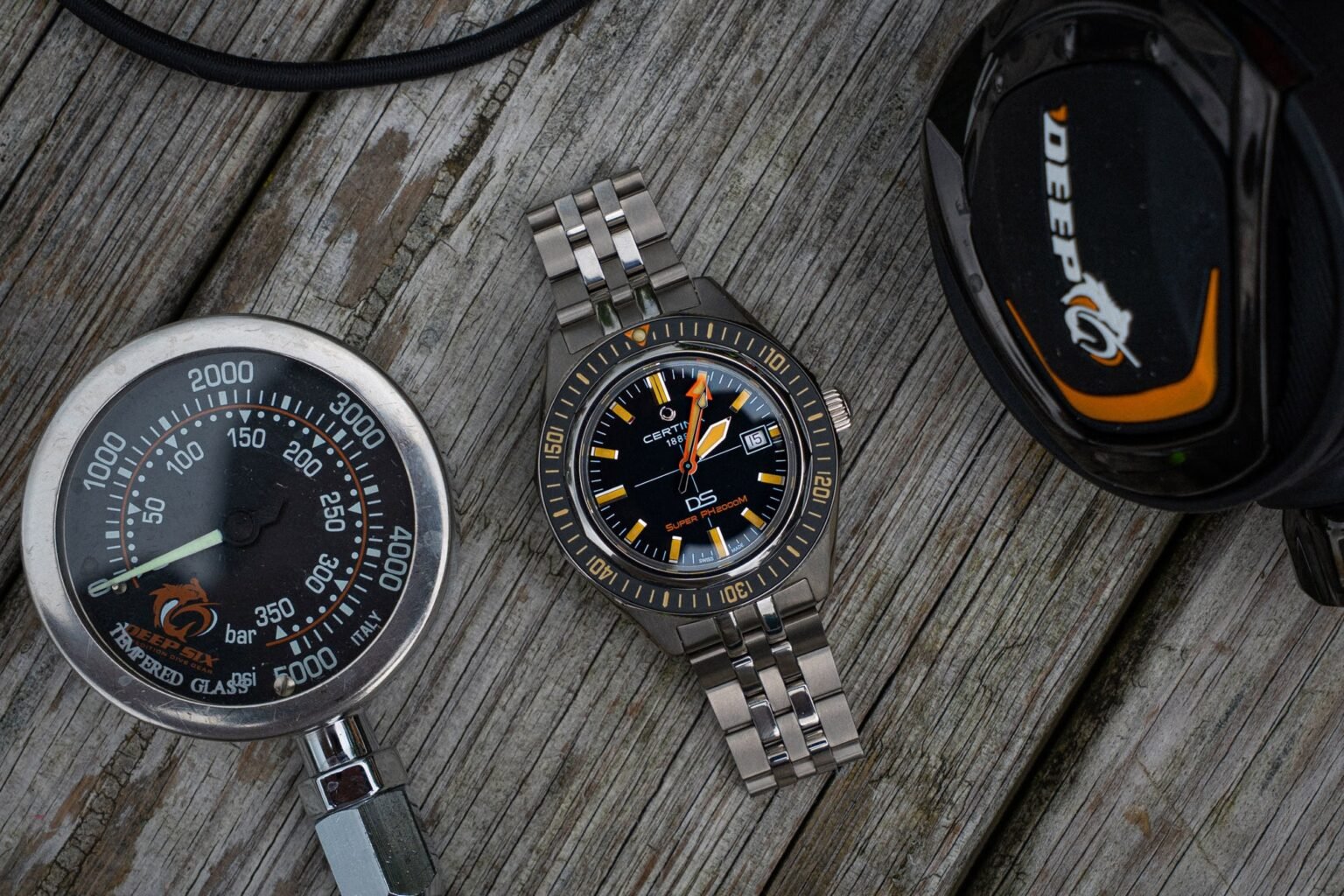
How light it was in titanium. It’s not a small watch, but wow, it struck me as absolutely wearable at that size because of the material. Legibility was solid, too, and I thought the push-to-turn bezel was a nice, purposeful touch. It’s very feature-packed. Obviously super water resistant. 2,000 meters is a hilarious depth that I cannot begin to wrap my head around. The quick-release bracelets made strap-swapping easy, a really nice addition that more brands ought to offer.
The watch has a pretty distinctive, almost geometric bezel. How did that work underwater?
Very grippy. It’s coin-edge and decagonal, so that makes it really easy to grab. And since it’s push-to-turn, you’re already applying a good bit of force in the right direction. It just—it’s very straightforward. Some bezel mechanisms are too cute by half. They try to make it too fiddly and it just doesn’t work well. I think Certina made this work well.
Why do divers and gear guys enjoy having overbuilt tools?
I think it goes back to that grand underwater story. We know these watches have an exciting purpose. So what would it be like if we sort of stretched that purpose? How can we grow that capability, even if only in our hearts and minds? Where else could it take us? It’s just like asking what’s around the next corner.
2,000 meters is over a mile. Even the commercial “Sat Rat” Lords of the Abyss can’t dive half that deep, and the world record for a human on scuba with a death wish is about 330 meters (1,000 ft). But our imaginations can go there even if we can’t. I think that’s probably what it comes down to. People like to rain on parades and say, “Well, you’ll never use that,” or “It’s silly,” or “It’s not needed,” but the point of the overbuiltness isn’t necessarily to physically go where you can only go with a submersible. The point is to enjoy the what-if of it all, while also resting in the confidence that it can handle whatever.
You dove with three of the colorways. Did one stand out?
Yes, we had three: the yellow, the white dial, and the black dial with vintage lume. I picked out the yellow because it was super visible against the black dry suit and just seemed very purposeful and usable in its bright color.
We weren’t concerned about visibility or color change at extended depth because we didn’t plan to go particularly deep. There’s more to see in the quarry that’s exciting in the shallows, particularly those fish, for me. But just the ability to glance at the watch and zero right in on it was nice. And you can really see in photos: man, that is a bright yellow dial in that field of black drysuit.
How did the Certina compare with your previous experiences with dive watches?
I think Certina does a good job of conveying value in an overbuilt, fit for purpose diver. But I also like this watch because it appeals to everybody at first sight. When they see a big, chunky dive watch made out of titanium, they’re like, “Whoa, this thing is awesome. It has a turtle on the back. How cool is that?”
I’m like, “Yeah. You know what? It is cool.” We get really wrapped up sometimes in parsing every stat and trying to compare watches, but it’s much more about the spirit of the thing. In its overbuiltness and lightweight titanium execution, I just think it’s a cool and fun watch. And that’s all a dive watch needs to be.
Is there a type of diving where you think the Certina is particularly suited?
I think it’s an all-rounder. It does have a fully graduated bezel, so that’s helpful if you wanted to take it on a tech dive. It’s a tank, so you never have to worry about it in terms of durability. But it also has the spirit of enjoyment of a recreational-style dive baked into it, especially with bright colors like teal and yellow. It’s fun. And you can wear it out of the water, too. It’s not like it’s going to be so big or heavy that you’re going to want to take it off when you get out (like most dive computers).
You’ve built a community around watches and diving. How would you describe it?
S.H.I.P.S. or the “Subaquatic Historical Interest and Preservation Society” is the name of our tight group of dive buddies. I like to say we’re nautical nerds of grace and goodwill. The name itself is an inside reference to the classic debate between different dive cultures around shipwreck artifact salvage. In Jersey in particular, where I trace my spiritual roots, diving is largely about exploring the tangible history of maritime disasters rife in those waters, and preserving it by salvaging artifacts from them. Start with a mosaic tile, maybe next find a pewter stein. After a decade or two of hunting, perhaps recover the Wreck Diver’s holy grail of an intact brass porthole. For true rarified air (especially these days), set your sights on fine china from deep within the Andrea Doria, the “Everest of wreck dives.” I could go on.
These artifacts are taken out of the water, lovingly restored, and put on the mantle. Or if the diver is prolific enough, in a museum alongside the genuine and singular historical research they’ve done on the ship, her crew, and her passengers on her final voyage. For a lot of people outside this culture, that sounds akin to disturbing something sacred. And a diver in the Great Lakes might be quick to agree, where shipwrecks are all legally protected sites in governed waters. When we dive the Mystery Wreck in Lake Michigan, for instance, we see her ship’s wheel standing proud, and deadeyes and bottles scattered in the silt. She is preserved by the cold, fresh water itself. But if that wreck was in the Northeast, it would have been picked clean decades ago, preserved piece by piece in homes, dive shops, restaurants, and local museums before the stormy, salty Atlantic could destroy it, all that history forever lost to time and corrosion.
So it’s a fun debate to have, as two sides of the same coin, and because we span those various cultures ourselves in the group. But underwater history is so much richer than just shipwreck salvage, and we embrace all of it, from Cousteau to Sealab to commercial diving to covert ops. Because we all believe in the grand underwater story, and we all love to obsess over the watches that bring us there and back.
The post Enthusiast Spotlight: Chris Sohl Dives Into the Soul of the All-New Certina DS Super PH2000M appeared first on Worn & Wound.