

Two months ago, I spent a Friday lunch eating a sandwich called the Crazy Poulet at Notos Bar Restaurant in Le Sentier with Mark Schmid, who is a sort of jack-of-all-trades in the marketing and communications department at Audemars Piguet. Schmid has quickly become someone I’d consider a friend, whom I appreciate for our candid conversations, his willingness (and frequency) to correct my confusion between l’accent aigu and l’accent grave in articles, and, more recently, his gastronomic suggestions. I’m sure this story will require a few more corrections from Mark, for which I apologize (mostly to him) in advance, but I wanted to share a recent experience that illustrates why I love Switzerland’s Vallée de Joux, past and present.

Le Sentier, pictured back in 2022 on the author’s first trip to Switzerland. The town, now home to the headquarters of Jaeger-LeCoultre, was the hometown of Samuel-Olivier Meylan, the first watchmaker in the valley who began crafting timepieces around 1743 and set the stage for what is arguably the most important geographic location in watchmaking.
“People ask me what I’d want to do if I didn’t work at Hodinkee,” I said. “Sometimes I say that I wish I could be the head of the tourism bureau for the Vallée de Joux.”
“Well, maybe you could be our advocate in New York,” he said. “But if you came back here on a Thursday night at 4 o’clock, this place would be full. You’d hear watchmakers talking about all the things they were up to at AP, JLC, Blancpain, Breguet… You would learn a lot. You’d just have to learn French.”

It was around 1:00 pm on a Friday, a day I didn’t yet realize would turn into a 15-hour marathon in the Vallée de Joux. After visiting the historic headquarters of Audemars Piguet—playing with a few Royal Oak pocket watches, some of the then-new and divisive Royal Pops, one of four Union Glashutte grand complications, seeing the restoration workshop, the new Atelier des Établisseurs workshop, and visiting the workshop where they make the RD#4 “Universelle” (all of which warrant a future story)—we toured around Le Brassus.

A selection of Audemars Piguet and associated pocket watches. The grand complication is technically a Union Glashütte watch with a Vallée de Joux origin. All these watches are a part of the AP Museum.

Someone had to do it.

A replica of “Sapy,” the mammoth of Le Brassus that died on this spot 16,000 years ago. Its remains were discovered in May 1969 in the Praz-Rodet gravel pit near Le Brassus and are now a crown jewel of the paleontology collection at the Naturéum (Palais de Rumine) in Lausanne. Audemars Piguet is working to help move the renovation of the nearby park forward.
During our meanderings, Mark pointed out a very unexpected recreation of a Woolly Mammoth unearthed in the town, now in what is a small park. Next was an after-hours visit to the new “Arc,” where Audemars Piguet has expanded its manufacturing facilities (but no photos were allowed, and nothing was happening at 5 pm on a Friday). And this all came on the tail end of an already busy week, during which I visited Philippe Dufour the previous morning and saw the opening of a museum exhibition at the local watchmaking museum—Espace Horloger—based on one of the first articles I ever wrote for Hodinkee. Busy, but no better way to be in my favorite place.
Where The Love Began
I first visited “The Valley of Complications” back in 2022. It was my first time in Switzerland, and it would yield what are probably two of my proudest stories. One was on the largely forgotten watchmaker Charles-Henri Meylan, a story that brought me back to the valley again this trip. The other was in Hölstein, the city that Oris built, where I wandered the countryside further north of the valley, befriending a man tending to his sheep and making one of my favorite portraits of Oris’ chairman, Ulrich Herzog.

An unpublished photo from that 2022, with Le Sentier in the background.

Erhard Wyss, a farmer, feeds his sheep in a building in the middle of St. Pantaleon, Switzerland, near the Orisbach. Not in the valley, but it was the first time I tried to photograph someone in Switzerland without speaking the same language.

Ulrich W. Herzog, Chairman of Oris SA, walks in a field near the Orisbach, or Oris Brook, that divides the border between Solothurn and Basel-Landschaft Cantons in Switzerland. Not in the valley, but a formative photo for me.
Switzerland, and the Vallée de Joux in particular, has a romantic, almost hypnotic quality that feels like an unchanging time capsule of beauty, nature, and tradition. Everywhere I looked, the signs had names that wove their way into horological lore. Rochat, Golay, Piguet, Meylan, LeCoultre, Aubert, Audemars, Guignard.
And the landscape was infectious. More three-dimensional than my home vistas in Wisconsin, but still with beautiful landscapes and cows wandering along the roadside. It was my home, just transported somewhere else and magnified. I was afraid I’d never come back, so I was up and down and awake until late, photographing the beauty. I even have a photo from that first trip hanging above my bed. To quote James Earl Jones in Field of Dreams, “It reminds us of all that once was good, and it could be again.”

A photo looking toward the Dent de Vaulion, from that first trip, which now hangs over my bed.

A view of farm houses in the front and both Vacheron and La Pierrette buildings in the back, at the southwest edge of the valley.

Cranes over the skyline, where you can see construction was ongoing in Le Brassus on my first visit in 2022.

And yet the landscape seems so timeless.
A Return (For The Sixth Time) And An Exhibition A Century In The Making
But change comes for every land. Every growing brand is a driver here, and I saw the signs on that first trip in 2022. There were the cranes for the “Arc” AP was building and the ones at CHH Microtechnique SA, which is a part of the Swatch Group and is right down the road. This growth is obviously contentious for some, but there are undeniable economic benefits in some respects. Not so much in others, as many workers drive in from France and take their money right back there.
Even on my sixth (or so) visit to the valley, I could see how much the valley changes year over year. It does seem more bustling at times. There’s the new fancy Hôtel des Horlogers that has supplanted the Hôtel Bellevue Le Rocheray as a go-to (if you can afford it). The latter is where I stayed on my first trip, though the food there is still really very good.

“Le Bras,” which gives the town its name. It was slightly diverted at one point, but Audemars Piguet is putting it back in place.

The entrance to AP’s new facility.

The view from the roof, back toward town.

The hotel where I first stayed is a great option for people on a budget.

The watch was loaned to me by Moser on that first trip. Georges-Henri Meylan, the chairman of the holding company for Moser and Haulance, was my tour guide for the trip. I have to say, the breakfast at Le Rocheray was quite good.
Audemars Piguet is expanding while working to improve the landscape where it can. Manufacture des Forges and the Arc Manufacture in Le Brassus are powered by a fossil-fuel-free, remote wood-fired heating plant. This central plant, alongside wood pellet furnaces at their Manufacture des Saignoles in Le Locle, sustainably heats both the factories and over 100 neighboring homes, while the company replants all the trees it harvests. While some people still argue about the wind turbines that are starting to mar the scenic vistas of mountains in the distance (which are not AP’s doing), AP is finishing its work on dismantling its old factory and returning “Le Bras”—the stream that gives the town its name—to its original meandering path.

L’Orbe River, which feeds into the Lac de Joux.

The sign I saw in 2022 wasn’t there in 2026. At the time, I thought it was funny, the implication that alongside sponsoring or carrying on relationships with people like Serena Williams or LeBron James, AP was also technically a sponsor, of sorts, of the local waterski club.

The valley is full of nature hikes, and I hope to be in better health to do those hikes again someday.

Logged trees in 2022. The Audefmars Piguet Foundation for Trees has supported more than 180 environmental protection projects in around 60 countries. They even put a tree on the dial of a Royal Oak to support the foundation.
Then there’s the immovable human history—the people, the families, the names—which brought me here in the first place and brought me back again that warm Thursday evening in May. I was invited back by the Espace Horloger, the brand-agnostic and yet universally supported museum in Le Sentier, just down the road from Breguet’s factories and close to Jaeger-LeCoultre. Actually, they’re surrounded by horology and the echoes of it basically everywhere you look, and while they don’t focus on one brand, they are supported by donations from brands and private individuals.

Le Sentier back in 2022. The JLC headquarters is at the left.

Georges-Henri Meylan at his summer cottage on the lake, looking at Charles-Henri Meylan. The two, separated by around 100 years, are somehow very distantly related. That’s the story of the valley. Tight families, tied together by geography.

Then there’s the plumbers, Meylan & Zooler. Another branch of the Meylan tree and important in a different way.
It was over a year of work to get to this point (and four years after the original stories), but there it was: a new exhibition I helped curate and for which I wrote most of the text: “Charles Henri-Meylan: From the Vallée de Joux to the American Dream.” If you’re so inclined, the exhibition is open until September 20, and it is only a 45-minute drive from Geneva. I was shocked and pleasantly surprised by the turnout, and, surprisingly, even the local newspaper and public TV station attended.


The far wall is painted Tiffany blue to honor the work C.H. Meylan did for the company.

Angela Benza (second from left) and Tania Cotting (right), who guided me through curating my first exhibition, and Jean-Daniel Bodenmann (center), the president of the museum.


Georges-Henri Meylan looking at the exhibition.

The turnout was great.

And we even had a chance to snack and talk a bit.
I was invited by the team at Espace Horloger—Angela Benza and Tania Cotting, who guided me in curating my first exhibition— by Jean-Daniel Bodenmann, the president of the museum, and Georges-Henri Meylan. I had gotten to know Georges-Henri as his obsession with Charles-Henri Meylan fueled my studies, and my studies fueled his obsession (just ask his sons Ed and Bertrand Meylan, who run H. Moser and Hautlence).

Mark Schmid and Sebastien Chaulmontet, who attended to support me.

Sebastien Chaulmontet, who I consider one of the greatest experts on historical chronographs (and modern designs).

He was looking at an early Henri-Alfred Lugrin-patented double-dial Waltham chronograph movement.
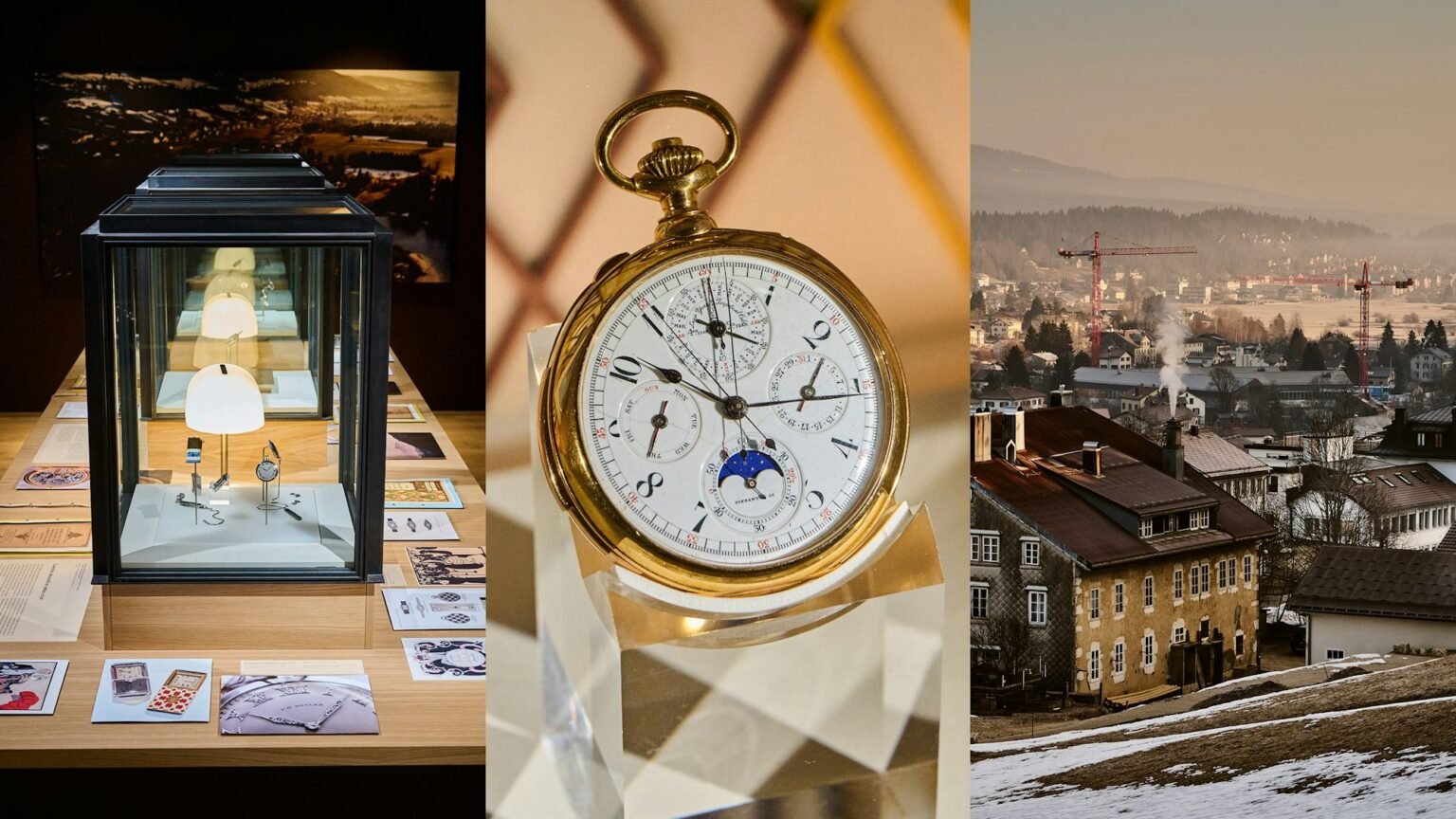
It was amazing to see a written work come to life in such a way. There was the family tree that traced the valley’s first watchmaker, Samuel-Olivier Meylan, in 1743, to Charles-Henri Meylan. There were scenes that showed C.H. Meylan’s impact in the United States, including at Tiffany & Co. and other watchmakers.
I brought my own examples of Waltham complications, including a newly acquired five-minute repeater gifted to a California Senator who had lost his eyesight in the early 20th Century. My grandfather’s name was displayed on his Waltham chronograph, which I found for sale at an antique mall after his death. There was my text, translated into French, explaining Meylan’s impact, and then the watches he made under his own name and for brands like Audemars Piguet, proudly on display.

A grand complication movement by C.H. Meylan for Audemars Piguet, which was delivered to Tiffany & Co. The movement is signed Audemars Piguet, but the number doesn’t correlate to anything in the brand’s archives. Instead, the four-digit number matches a batch of identical C.H. Meylan movements known to and documented by a collector and watchmaker, Yang Shiming, in China.
What moved me the most was seeing my friends explore the space and the work the team and I had done. I wasn’t sure if it would come together at all, and I hadn’t seen pictures of the space, so walking in was its own discovery. But I also discovered the Vallée in a whole new way on that trip. I started to allow myself to imagine what life could be like there for me. Not the dream, but the reality. I saw the same names in a different way. They weren’t the ghosts of families who failed to continue their forefather’s watchmaking history, but the ones who exist to make watchmaking possible by making life possible in the valley.


At the event, I gave a short speech. My hope was to remind people to stop and appreciate the history they have around them. The buildings they drive by every day, the watches exported all around the world, and the things that make life in the valley possible all exist because of the people who worked here in the centuries before. It could have been their parents, their grandparents, ortheir great-grandparents. They may not have names on the side of buildings anymore, but they deserve to be remembered.
I finished up the day over dinner with Sebastien Chaulmontet and watchmaker David Candaux at Hôtel Restaurant du Marchairuz, watching the two eat fondue as I, a Wisconsinite with an ironic lactose intolerance, had some steak. As we talked about historical watchmaking, I reflected on how my view of the valley had shifted to something beyond just watches. On this trip, I became appreciative of the Thursday morning farmers market, Golay Fleurs, the dry cleaner, and the plumbers Meylan and Zooler. All of it might seem incidental to watchmaking, but these are things that keep life here moving forward and often vibrant. With the exhibition opening over, I’ll skip ahead to later that next afternoon, where this story started.
A Friday Taste of Life in the Valley
My afternoon the next day at Audemars Piguet was as interesting as it always is, if quiet, with a lot of the company off ahead of a holiday weekend. The first time I visited the AP museum (as a ticket-buying civilian), I was fascinated by the watchmaking on full display in the center of the museum. I was also shocked to see Olivier Audemars and Jasmine Audemars (board members) touring the room. This time, Mark Schmid took me through, where I could see the master watchmakers building the Code 11.59 RD#4, with people working on final construction and testing two at a time.

The Grand Complication Workshop.


Code 11.59 RD#4

Filing an angle on a piece

The dial-side calendar display.

A cool look at the under-dial.
The new Atelier des Établisseurs workshop was quiet as well. There, I spoke with some of the team and saw one of their Galets pebble-inspired watches in progress, along with some of the materials that make up its intricate shape. I’m hoping to return to see the product and maybe explore their suppliers’ workshops, which make up the backbone of the project. In fact, the manager of the workshop was chosen specifically because he has an encyclopedic memory of and an uncanny ability to manage those sometimes temperamental supply chains.

The original AP workshop and headquarters are seen at the right, with the large, tightly-spaced windows that signal a watchmaking workshop.
It’s a return to the old way of doing things, before everyone loudly (and often wrongly) proclaimed that “in-house is better.” No one wants to say that they’re not the best at something, but once you’re an educated buyer, that in-house starts to ring false. Not every brand can employ the best enamelists, stone cutters, engravers, etc. So someone is lying if everyone says it. Instead, with the Atelier, Audemars Piguet has gone back to what brands used to do: tapping the people who know how to do great work and focusing on the things they do do best. This is how it was done in C.H. Meylan’s days as well. This is how Audemars Piguet made La Grosse Pièce, and part of why the brand found it important to buy back. It’s the history of a system that has built the Vallée de Joux and kept it alive all these years.

The new Atelier des Établisseurs workshop, inside the brand’s historic and original headquarters building.

The movement for the new Galets with some of the inspiration and the stones used for the bracelet.


Afterward, we visited the restoration workshop, where they have basically every piece of information at their fingertips to understand and then restore any watch that comes through their doors. As we stood there, we talked about the history and how much had been forgotten.
“The people who know the answers are right there,” said Mark Schmid, pointing across the valley to the northwest slope. I could see a cemetery. Apparently, after some time, the bodies are removed for new ones to be buried, he told me. “They just can’t answer. I remember riding my bike past there years ago, and the stone for C.H. Meylan was there, stacked with a bunch of others that were being replaced. I didn’t know how important he was. I’m not sure what I would have done with it, but now I feel like I should have saved it.”

The restoration workshop

A pocket watch that had been sent in for restoration.

An example of how the brand tests different Geneva stripes before they perform them on restored movements.

Old boxes for movements and parts in the restoration department.

The Dent de Vaulion, viewed from the roof of AP’s new Arc, where we’d end up shortly.
We went to the Arc, where we had promised no pictures (though I grabbed a few of the view from the rooftop). Most of the action was just the cleaning staff, tidying up after a busy Friday, and the watchmakers had gone by 5 o’clock, but it’s worth a return visit.
It was as we arrived back at my car that Mark remembered I had never visited the Dent de Vaulion, the mountain with a ridge that stands proud, overlooking the valley. I had tried once, on that first trip, but the road was blocked by snow. Instead, this time, there was green grass, and the sound of cow bells ringing as they wandered their summer mountain pastures. Mark and I got out of the car, and I grabbed my cane. At the time, I was fresh off my fourth back surgery in a year and a half (one that sidelined me from Watches and Wonders), and heading into a fifth in August. Unsurprisingly, my body wasn’t ready for a hike. We made it as far as I could, Mark close by to stop me from any falls, and then turned back to the car and headed to dinner.


A view of the Lac de Joux.
Over rösti (basically a hash brown dish, mine covered with the Swiss tomme cheese, bacon, and egg), Mark and I continued to talk about the beauty of the valley, and while I grabbed the check (after much haggling with him over who gets to pay), I heard the word “vaches” between him and the waiter. “Cows?” I asked. The night before, David Candaux warned me that sometimes, during these late-spring months, you can get stuck for hours behind dozens of cows being moved from the winter pastures in the valley to the summer pastures in the mountains. “Do we have to go around the back side of the valley to avoid them?” “No,” said Mark, “I thought we’d go find them.”

A quick cellphone snap of a necessary part of sitting outside with a beer: someone else’s dog to play with.

My delicious rösti. Now I’m hungry again.
As we hopped in the car, the sun was setting (late, as it does in Switzerland, around 9:15 pm that day), and Mark guided me to the northeast end of the Lac de Joux. Maybe two dozen people were standing by the side of the road, sipping wine and eating cheese served off a folding table by the Hôtel et Restaurant de la Truite and again by Hôtel Restaurant du Cygne. Mark asked me to stop, and he asked the revelers if the cows had come past. They had; this was just social hour now, after all the entertainment had meandered on. He directed me up some back roads nearer to the border with France.

People grabbing drinks out of the back of a pickup and blocking the dirt road so cows don’t take a wrong turn.

The last of the sun setting in the background.

The first of the cows, coming up the road.
We stopped and walked with a small crowd to gather at an intersection, waiting for la désalpe procession, the moving of cows from the winter valley grazing to the mountain summer pastures. It’s a walk that, for some farms, can take over eight hours. We waited, watching cows and horses graze on a ridge, backlit by the fading sun and growing moonlight. “You’ll hear them before I do,” said Mark. But what I heard first was the old tractor with the hand-painted sign reading “Familie Vonlaufen,” a farming family from Vallorbe. I didn’t have a flash, so I leaned into the place’s feeling and set my camera for a long exposure. Then the herd came, the family and friends wearing traditional costumes suisses, the cows with their loud, giant ceremonial Treicheln bells ringing as they paraded to the mountains.
As I understand it, the best milk producers, or the “heads” of the herd, were the ones decorated with giant floral wreaths and crowns, and somehow they looked proud of it. At the rear, the laziest, oldest, youngest, or even most distracted cows ventured into the ditches to graze or tried to escape into the pastures, but were urged onward by the last farmers, with a tractor and trailer picking up those too tired to go on.


Nearer to 11:30, Mark and I were in the car back to Le Brassus so he could pick up his bike and ride home, like he does most days. I was exhausted, but in reality, I don’t know that I’ve ever felt I understood Switzerland more. The CNC machines that you see on tours of every factory can strip a bit of magic from the idea that what we’re seeing is art. The real art is what’s lived in places like this.

The Dent de Vaulion in 2022.
The following weekend, the town of L’Abbaye would be celebrating its 900th birthday. Cake, celebrations, even a DJ for a little town that, at the time, had no idea it would become a part of something bigger. If Audemars Piguet, Breguet, Blancpain, and the rest are the “winners” because their legacy lived on when C.H. Meylan’s didn’t, that minimizes his impact. It also minimizes the impact of every person who makes the Vallée so special, watchmaker or not, and why I’ve fallen so deeply in love with the place and the people who call it home.
The exhibition, “Charles Henri-Meylan: From the Vallée de Joux to the American Dream,” is on display until September 20, 2026, at the Espace Horloger in Le Sentier. More information (and hours). can be found at the museum’s website.