

Happy Friday, friends, and congrats on tackling another week. The days are now growing shorter (if you’re north of the equator), and if you, like me, live in a state where fireworks are legal, best of luck for what will presumably be a very loud and long week. But before all that, let’s take a moment and enjoy some watches.
Scorekeeping last week’s picks, the Dugena and Mulco chronographs don’t sell till the 27th, but the Rolex 6241 sold for 2,000,000 CHF, the Patek 5960 for 34,000 CHF, the Excelsior Park Monte Carlo passed, the Longines for TKTK (emailed, price not updated), and the Tavannes for TKTK (sells 6/25).
Strays

For all the Movado heads, this pocket watch looks spectacular, and if that doesn’t ring your cherries, here’s a gold-plated dual-time that’s almost intimidatingly beautiful. My urge to recommend no-name skin divers will apparently never abate, and this week’s pick is this Altitude that looks fantastic and is unlikely to sell for more than a few hundred dollars. Speaking of excellent divers, here’s a Lip Nautic Ski, and, sure, it’s a quartz watch from the 1970s, so (some) headaches await (though the watch is currently running, according to the listing), but I’m lately unable to shake an intense fondness for these latter Piquerez super compressor cases with their huge bezel and recessed crowns. Lastly, this Ebel is perfect; please buy it, someone, so I can stop thinking and debating if I should pursue the thing.
Before getting into the main watches, I’d like to note that despite my best efforts, I seem doomed to pick watches I’d like to feature from dealers who sell before I have the chance to write them up. This week it was this Patek 6000 from Bulang and Sons, which lasted like 72 hours before going on hold (as of Wednesday), and last week it was this Patek 5212A from Wind Vintage which sold in two days. I’m trying, I promise.
Hamilton Model 21 Marine Chronometer

The Hamilton Model 21 Marine Chronometer is the most important American watch ever made. Let that be the takeaway if nothing else regarding this particular watch.
Quick history: war breaks out in Europe in 1939, and the United States quickly realizes its supply of marine chronometers will be direly impacted, which is no big deal if you have satellites, but, again, it’s 1939. The US Naval Observatory sends letters to eight American watchmaking companies, requesting one of them start making marine chronometers, which is both a totally valid and a truly wild request: then as now, lots of critical horological components came from Europe, and asking American companies to immediately develop mechanical capacity they’d till then not needed to develop is just staggering to consider. Hamilton eventually won the contract, and by November of 1942, began providing the U.S. military with the marine chronometers that were essential for every ship (Here’s a good write-up of the significance of the watch, and here’s a fascinating article about the guy who made the watch’s detents). As you’d suspect, given that the watch is a marine chronometer, it keeps excellent time when serviced and maintained, averaging less than a second loss a day.

All of which history either hits you or it doesn’t. Railroad timepieces are also extraordinary and historically significant, and, generally, they elicit yawns from many watch folks. But I’d encourage you to stifle your yawn on this watch. I have, in fact, been hoping for just such an example since starting Bring a Loupe, and am thrilled Jones and Horan are offering one to cover. The example under consideration is as good as they come: clean dial, full inner and outer mahogany boxes, an extraordinarily great-looking movement that is still running.
For those who don’t know their marine chronometers, these watches generally came in gimbaled boxes, so that the watch was allowed to move as the ship pitched and rolled, the dial always pointing up (so as to maximize accuracy: the watch needn’t be dialed into various positions if it’s always in a box, dial-up). You’re literally buying a piece of American history here: the circled N on the dial denotes that the watch was made for the Naval Observatory, meaning it was intended for use on an American warship.
This watch will go to auction on July 2nd, and, unless something truly wild transpires, it will sell for under $2,000. This is bonkers to me; I’m happy, as someone who loves these models, that they’re still reasonable, but also, two thousand dollars. For the model that kept better time than almost literally any other watch made till then, and which was on every single naval vessel used by the United States 80 years ago? It’s hard to even know what more you could horologically hope for.
Vianney Halter Goldpfeil Jump Hour with Moon Phase

We’re all in our own little curated algorithmic worlds on social media, so perhaps you did not spend the last couple of weeks seeing a burst of pictures of various Vianney Halter Antiquas. A few sold at various places, including a pink-gold model at Phillips’ New York auction for $584,200. Your guess is as good as anyone’s about what that result means for the broader Halter and/or Antiqua market, though it’s worth noting that Phillips sold a yellow-gold Antiqua in 2024 for 203,200 CHF and a white-gold example in 2015 for $64,500. Take that information as you wish.
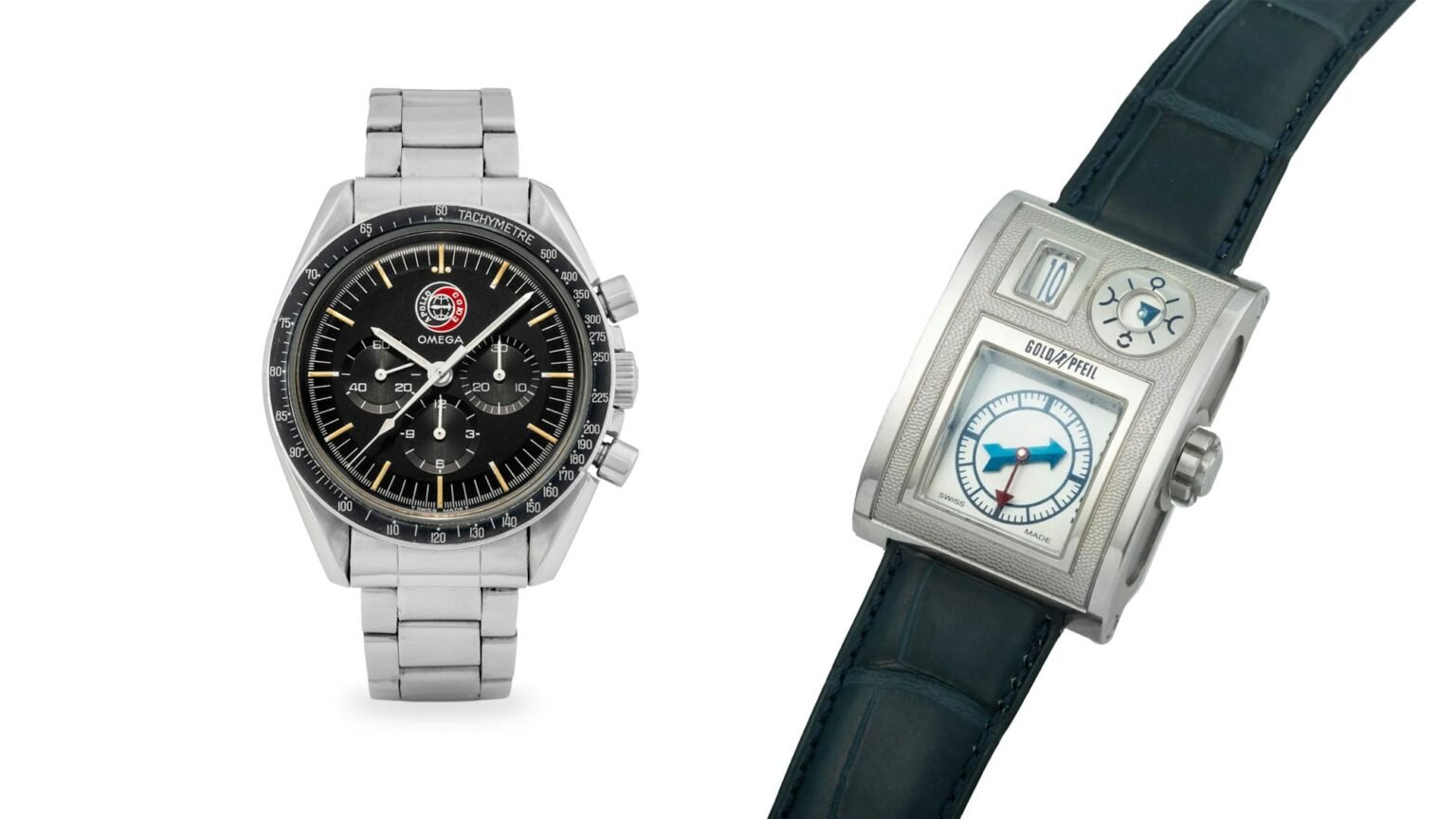
Halter needs no introduction—his two most well-known models have to be the Antiqua and the Opus 3—and while his work is easiest to slot into a sort of steampunk aesthetic. Or, as Phillips writes of him, “he is a mélange of inventor, mad scientist and time traveler!” If you spend more than a few minutes looking at this Goldpfeil Jump Hour with moon phase, the watch recognizably becomes a Halter, despite the Goldpfeil logo and the lack of obvious steampunk attributes.

Released in 2002 in an edition of 108 pieces, the Goldpfeil Vianney Halter (GPVH) is the sort of refined oddball you’d expect. The hours are displayed in the top-left aperture, with a moon phase to the right, and the main dial of the watch features the minutes (big blue hand) and seconds. Cased in white gold, it’s hard not to look at the GPVH as a precursor sibling to 2007’s Trio or, arguably, as an even stranger relative of the Opus 3, which was released only a year later.
The example on offer—auctioning on the 28th—looks to be in excellent shape. Aside from a slight bit of what appears to be aging discoloration at the bottom left of the rectangular minutes/seconds dial, there’s nothing of note on any of the dials or hands, and the watch retains its large and strange (and supposedly range-finder-inspired) crown and original leather strap. The front of the case has been hand-hammered (supposedly by Halter himself), and aside from minor scuffs from wear, it looks great. These models seem to have remained fairly within reach, unlike their Antiqua brethren, so presumably the €15,000-25,000 estimate will hold.
Speedmaster Soyuz
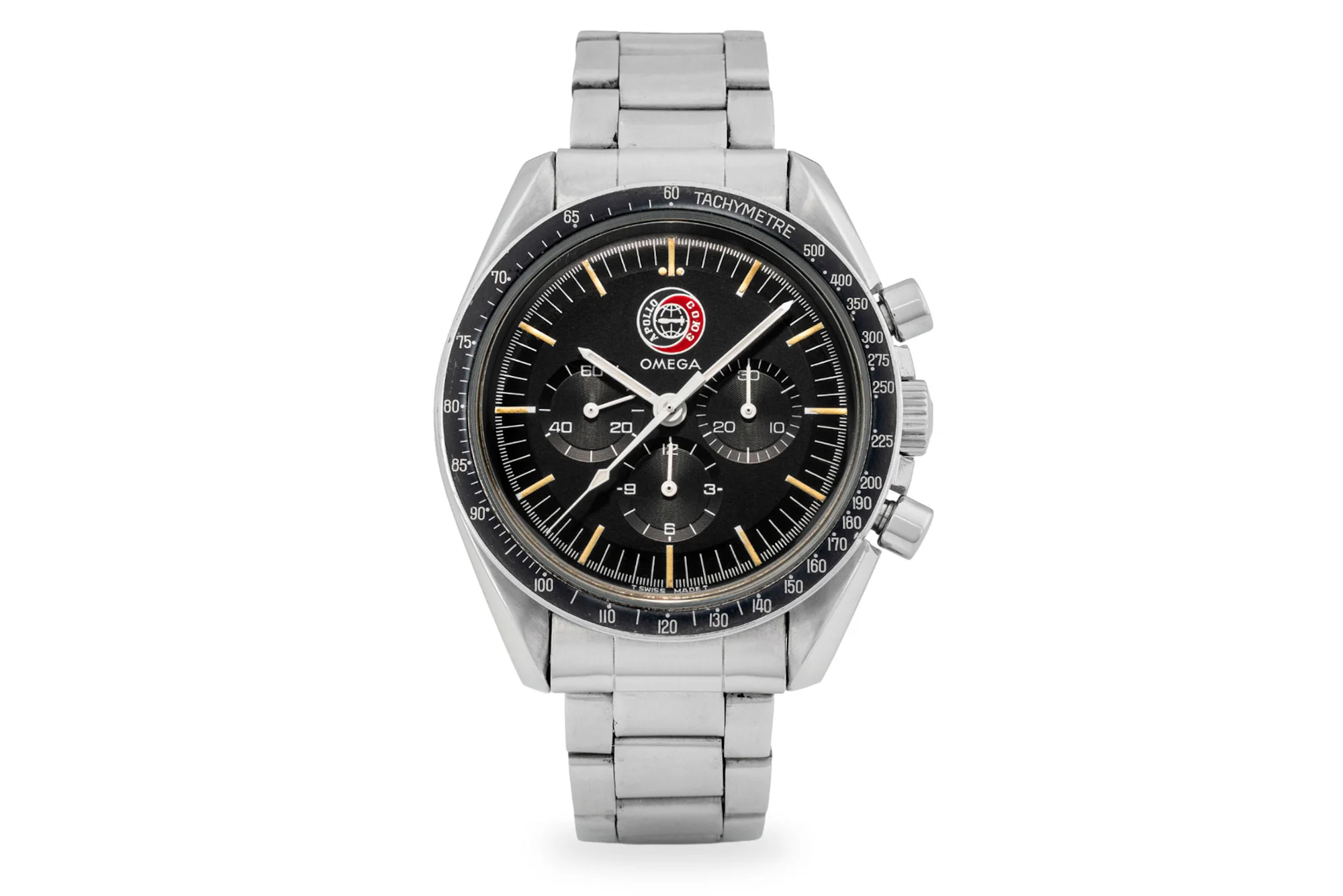
Hoo boy, Baller. Welcome to the game. In July of 1975, the two great Cold War powers, the U.S. and the U.S.S.R., shot some dudes into space (those are the technical terms) for the Apollo-Soyuz Test Project, in which Soviet and American astronauts docked their orbiters and conducted tests and experiments. Please don’t let the placid language there detract from the profundity of the act: two armed-to-the-teeth countries with absolutely no affection for each other still managed an extraordinary feat of engineering and diplomacy. It’s pretty remarkable, truly.

In the aftermath of the successful mission, Omega made what’s now known as the Soyuz Speedmaster, and that is about the last concrete and provable thing I can claim here about the model. That meme of Charlie from It’s Always Sunny, smoking a cigarette with the red thread connecting everything? Dig into the Soyuz, and you’ll end up in similar straits.
For starters, the Soyuz model at the Omega museum had and may still have the wrong hands: they’re recognizably MkII Speedy hands instead of the correct standard Speedy Pro hands. To make matters worse, the Soyuz is essentially identical to the standard 145.022 you could have bought in 1976, except that the pusher caps were 10% larger (5.5mm instead of 5mm) and the midcase was modified for them. It feels almost cruel that Omega bothered to make a physical change to the watch that was so minute that it all but guaranteed future frustrations, debates, and skirmishes. And I very much do mean skirmishes: this Omega Forums thread dedicated to the Soyuz is 16 pages long, and as if that wasn’t enough, William from Speedmaster101 also has a thread on Omega Forums that attempts to collect data on all extant models.

The model is *extremely* popular with collectors, and is also a minefield. How ordnance-packed is said minefield? Christie’s sold example number 100 in November of 2025 for 25,400 CHF, while Phillips sold number 76 in May of 2022 for 113,400 CHF, and that price delta has everything to do with the murkiness of the model’s provenance and the aforementioned debates/skirmishes.
Which brings us to this watch, selling on June 30th. First, it seems to lack the 5.5mm pushers you’d expect, but it does come with its original box. Second, the watch was originally sold at Antiquorum’s Omegamania sale in 2007, which seems like a vote of confidence in the watch. However, if you click on that Omega Forums thread, this specific watch is addressed, given that it has a movement far outside the range of accepted Soyuz models.

So: this one’s trickily difficult, and you should proceed with extreme caution. The likelihood of landing on a totally correct and excellent Soyuz for anything less than a sum approaching six figures seems nil, and this example brings its own set of questions, but the model comes up so infrequently and inspires such intense fervor that it’d be silly not to note it.
Universal Genève Master Tech Rattrapante
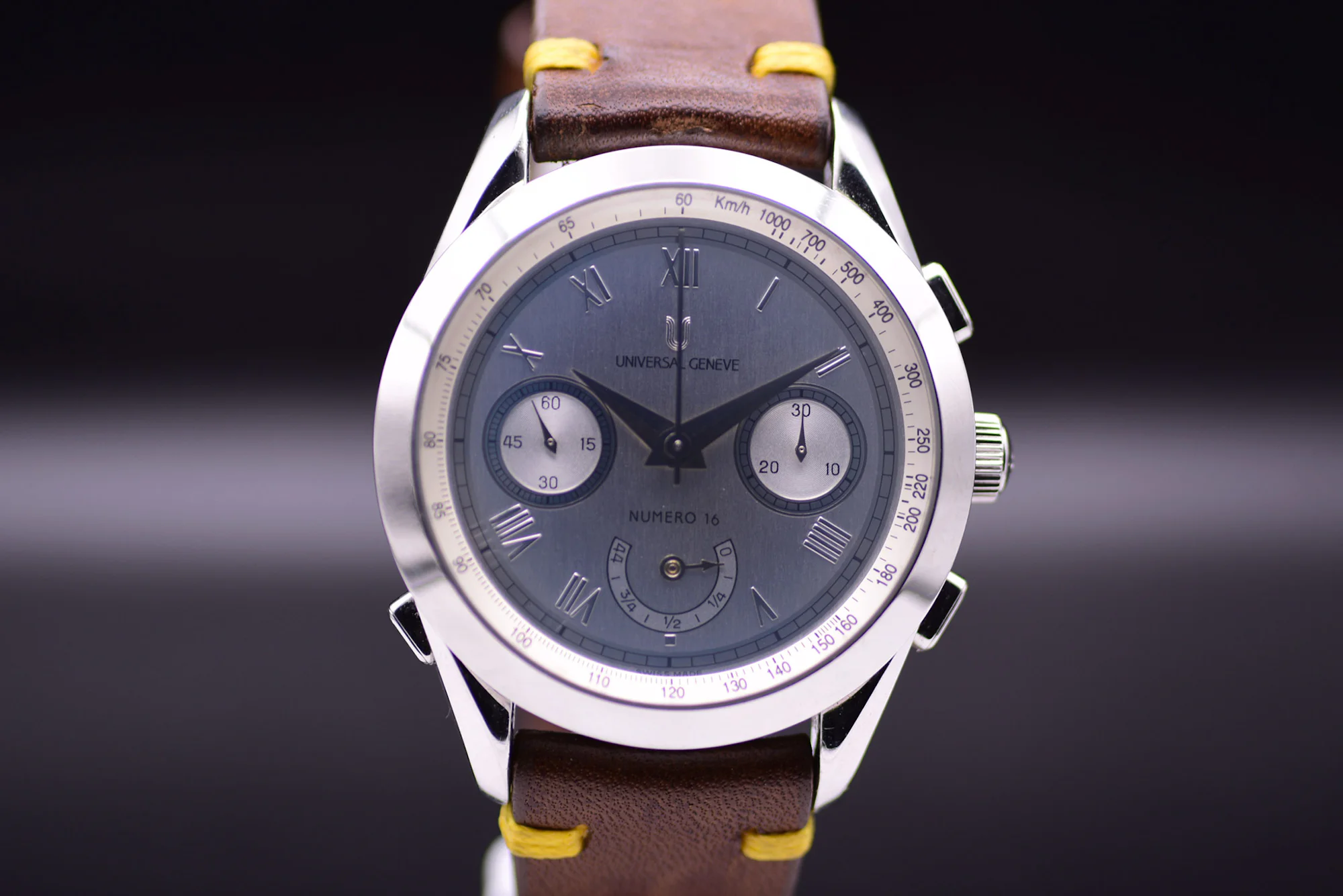
Let’s close things out on a bit of under-the-radar neovintage charm. This Universal Genève Rattrapante from the mid-90s is one of 500 of this model released, according to the listing, to “commemorate the historic Swiss manufacturer’s mastery of complex horological complications.” As for reasons for launching a limited edition, they’re pretty thin, but the watch more than makes up for it with its features.
There’s a power reserve at six, subdials at 3 and 9, and of course, the split-second chronograph right there stops the primary handstack. The movement, the manual-wind Universal Genève 88, is pretty recognizable as being part of the ETA 77XX family, though it’s also been extensively modified.

The watch clocks in at 39mm but is almost 15mm thick, which, given the movement architecture and the space needed for split-seconds hands, isn’t that surprising. Still, this example looks to be in great shape, and with no bids yet on a 1,600 GBP minimum, it’s worth considering.