Welcome to August’s end, everyone. I never know how to start these things—there’s too much variety in most of our days, meaning that, short of borderline universal cultural experiences, it’s hard to know what we’d all even know about. That said, I’d like to offer quick thanks: I’ve now lucked into writing Bring A Loupe for six months, and it’s just tremendous fun, soup to nuts. Thanks for reading, and I look forward to working as hard as I can to not bore you for as long as I’m allowed.
Also, boo to Dolly Parton’s and Tim Curry’s passing. Terrible plot twist.
Scorekeeping last week’s picks, the Hublot Orlinski’s on hold, the Seiko Sportura sold for €1,350, the Breitling Tabarly for €760, and the Yema Tomahawk for £800.
Strays
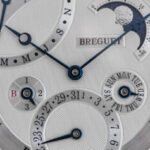
I have failed to highlight fun skin divers over the last couple of weeks, so let me ameliorate that lack with this Dupont and this LIP. They share identical all-steel skin diver cases; the differences in their bezels are awfully minor, and the Dupont’s got a bracelet, so maybe that’s enough of a needle-mover. This Breguet Chronoscope pocketwatch in platinum’s not in perfect condition—the dial’s got a few spots—but it is also incredibly gorgeous, the design is fantastic, and Monaco Legend Group sold a silver version in 2023 for €16,000, so plan accordingly. I could be wrong, but it looks like this ultra-thin solid gold quartz Jaeger was made by other brands as well, among them Bulova (who called their version a Phantom) and Microma (apparently Intel’s watch brand, and the first company to use continuous-display LCD screens).

Photo courtesy of Wind Vintage.
If it’s the same dimensions as the Bulova (which sure looks to be the case), it clocks in at a whopping 1.86mm thin, and apparently includes a chronograph, too. Here’s a great Girard Perregaux included for no reason other than that it looks great, and, finally, here’s what I have to presume to be a Rolex Day-Date reference 1807 with John Bull finishing. I spent several days in a head-scratching fugue about this watch. A standard bark finish (objectively the best finishing on a vintage yellow-gold President) would be limited to the center links on the bracelet, and the bark finish on this one not only covers the entire bracelet but the case, too, sides and all. Into my confusion came riding Loupe This, who is right now offering this great steel Datejust, which then led to this 18038 from Wind Vintage (sold), both of which have listings that offer plenty of details about John Bull and finishes like these. I remain unsure if the 1807 is an actual John Bull, but it also seems improbable that it’s anything else.
Hamilton Cross Country
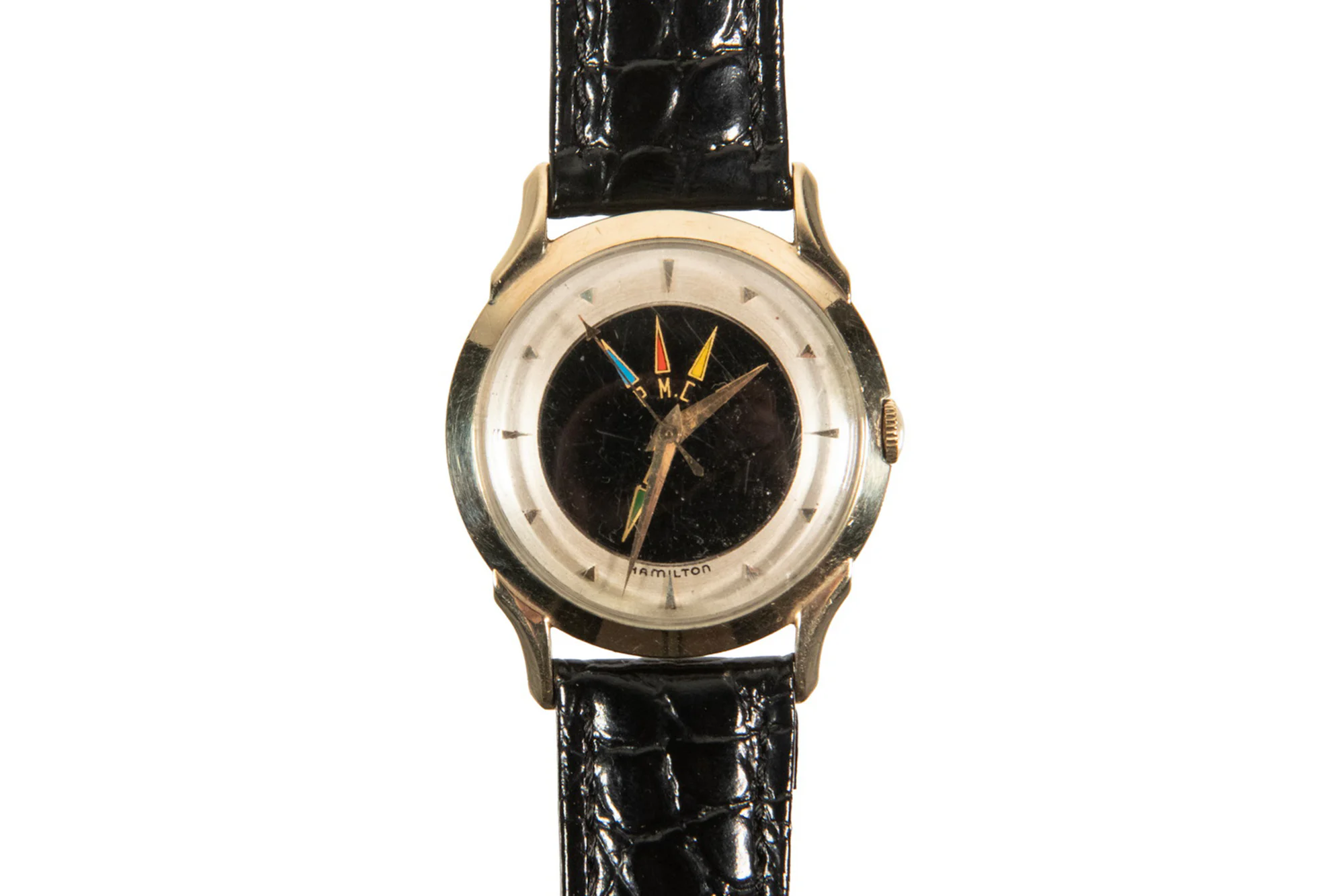
Photo courtesy of Invaluable.
Released in 1956, a year after Rolex’s 6542, the Cross Country is Hamilton’s play at something like a GMT watch. To be clear, it’s not quite a GMT, in that there’s no bezel to track a second time zone, nor is there an independently adjustable hour hand, caller, flyer, or otherwise.
What the watch offers, instead, is a sort of direct-read GMT functionality, at least for those in the States. The thing about the Cross Country is that, along with the hour, minute, and seconds hands, the black part of the dial also rotates—and rotates identically with the hour hand. The blue triangle has a P beneath it, designating it as Pacific time; the red one’s got an M for Mountain, etc. Yes, the green triangle marked G is Greenwich Mean Time.
On this example—bid to $250 at the time of writing, and going up for auction on the 30th—the watch has been set to Eastern Time, meaning you can’t see the bright white triangle on the dial marked E, because the hour hand covers it, as the watch has been set to the Eastern time zone. I very much mean set, too. Whoever buys this watch—if they want the watch’s pseudo-GMT set to a different time—will have to remove the hands and literally reset the hour hand for wherever they live.

Photo courtesy of Invaluable.
I’ll put on my heretic hat for a moment to note that I find the functionality of complications a weak selling point. Most of the folks I know who wear watches do so simply because they like the watch, for whatever reason, and because it’s wearable in most circumstances they face. In my own case, I love moonphase watches, and while I set the moonphase to accurately reflect what’s in the sky when I wear one, I have literally never consulted my watch to determine the moon’s phase. Not once. This is all to say that the actual utility of the watch’s complexity is, in all likelihood, negligible, despite the fact that it’s also real fun.
Regardless of your feelings regarding the utility of having a quick way to confirm what time it is in various parts of the United States, the Hamilton Cross Country is beautiful and represents an interesting method for addressing what was, then, a going concern for more folks (not for nothing, 1956 also saw Eisenhower establish the interstate system). This example is in good condition, with the gold-plated case showing well, and the dial remaining remarkably clean (I’d put money on this looking very good after a crystal polish). It is, of course, small—34mm without what seems to be the original crown—and if you’re the sort who’d rather own a Cross Country with a red-tipped seconds hand (which some models came with), this one’s not for you. Again, this sells on the 30th, with an estimate of $800-1,000.
Heuer Titanium Quartz
I promise, Baller, that I’ve almost completely worked this strange infatuation with truly weirdo quartz watches out of my system. What you’re looking at is a watch I can’t remember seeing before, one from the very last moments before Heuer was purchased by TAG. Introduced in 1983, this beauty is reference 825.213, and I remain stumped as to whether I find this watch inherently transfixing or if its seduction is mostly because it’s so strange and against the grain.

Photo courtesy of Invaluable.
This Heuer’s cousin was the Omega Seamaster Polaris, which either was or was not designed by Genta. The Omega was launched in 1982, and when, a year later, Heuer introduced this watch, you can almost feel the cultural currents that pushed both watches separately into existence, can’t you? Titanium! Quartz! Gold accents! You’d hardly even need a development meeting. Neither Omega nor Heuer were doing well as the decade began, and whatever else these watches were, they were born of desperation, which likely has quite a bit to do with how strange and futuristic they (attempt to) look. The Heuer, for its part, has an all-of-the-above relationship regarding shapes, with its circular dial, octagonal bezel, tonneau case, and rectangular date window.

Photo courtesy of Invaluable.
Not many of these models are kicking around anymore, which makes this one—bid to $95 AUD at the time of writing—all the more pleasing, given that it is, all things considered, in not terrible physical shape. You’d expect some scuffs after 40 years, but the watch overall looks presentable. It seems safe to assume that’s the original, Heuer-signed bracelet, given the rarity of titanium-with-gold-inlay bracelets, and the dial and hands look excellent (that font for Titanium is reason enough to salivate for the thing). The watch isn’t listed as working, so assume a service in your calculation for how much you want to bid. The auction’s on the 30th, in Perth, Australia.
Movado Super Sub Sea

Photo courtesy of Invaluable.
There’s something freeing about leaning into something you might otherwise resist or recoil from. Rain, for instance. If you, sans umbrella, are attempting to stay dry in showery weather—hustling from doorway to doorway, pretending you can bend or break the laws of physics—there’s something relieving about finally letting go and allowing yourself to be drenched.
This Movado—reference 206-705-502—is one horological equivalent of such leaning in. Less unsubtle than anti-subtle, the thing’s not only a beast at 40.5mm, but that orange inner bezel is a hit of nitrous on the already revving panda dial engine, and the huge lumed hands and lollipop chrono seconds hand are almost just exclamation marks.

Photo courtesy of Invaluable.

Photo courtesy of Invaluable.
If you know your Movado, you can probably guess this watch’s general era based on the fact that it’s got a twin. This watch is from when the Mondia-Zenith-Movado conglomerate meant designs could be all but identical aside from the name on the dial. This meant sharing a case, dial, and, critically, the Zenith cal 146 HP, a manual-winding column-wheel integrated chronograph movement. Also, the bracelet was the same on each: a Gay Frères ladder bracelet.

Photo courtesy of Invaluable.
This particular watch is in very, very good shape; many of these Movado Super Sub Seas, along with their Zenith counterparts, show up pretty heavily used, so finding one that didn’t look like it was once used in a pinch to pound nails or pry off a bike tire is a treat. The bad parts are minor—the original signed crown’s been replaced and, at least on my monitor, a little schmutz seems present on the hour totalizer at 6. Past that, I’m seeing nothing that’d dissuade me from chasing this were I in the market for an unforgettably and unignorably loud and classic chronograph. Bid up to $1,100 at the time of writing, this sells on the first of September.
A Pair of Breitling Top Time Pandas
The Breitling 810.
Photo courtesy of Invaluable.

The Breitling 815.
Photo courtesy of Invaluable.
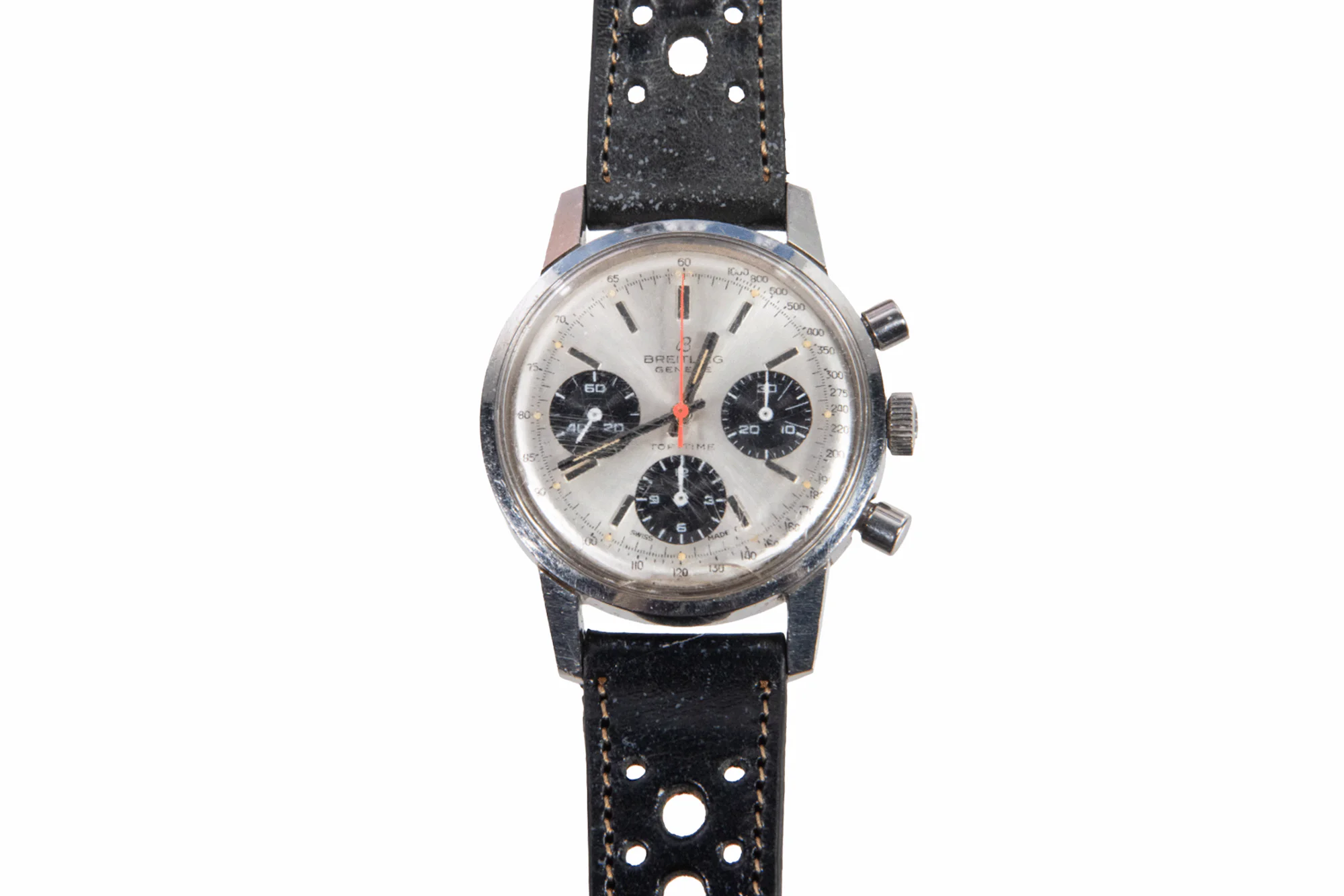
Breitling introduced the Top Time line in 1964, and the watches were “Designed for the young, speed-obsessed generation of its era” and featured “sporty personality.” The problem with vintage sports chronographs is that we can’t really see them anymore. In the same way, it’s hard to get a present-day teenager to appreciate why Catcher in the Rye was so culture-shifting, given that a present-day teenager lives in a world where it’s completely normal to write so directly and clearly about whatever taboo topic they wish, most of us have probably become so accustomed to fairly large panda-dialed chronographs that it’s hard to remember when they were novel.
Both of these Breitling Top Times are from the early 70s, and they’re nearly identical aside from a) their reference number and (therefore) b) the movement inside each. First, and located in the States, is this Breitling 810. Splashy orange chrono seconds hand? Check. Nicely aged lume plots? Indeed. Very scuffed crystal? Absolutely. This one’s powered by the Venus 178, so if you’re hankering for a legendary movement famously used in Breitling’s best-known watch, this one’s for you.
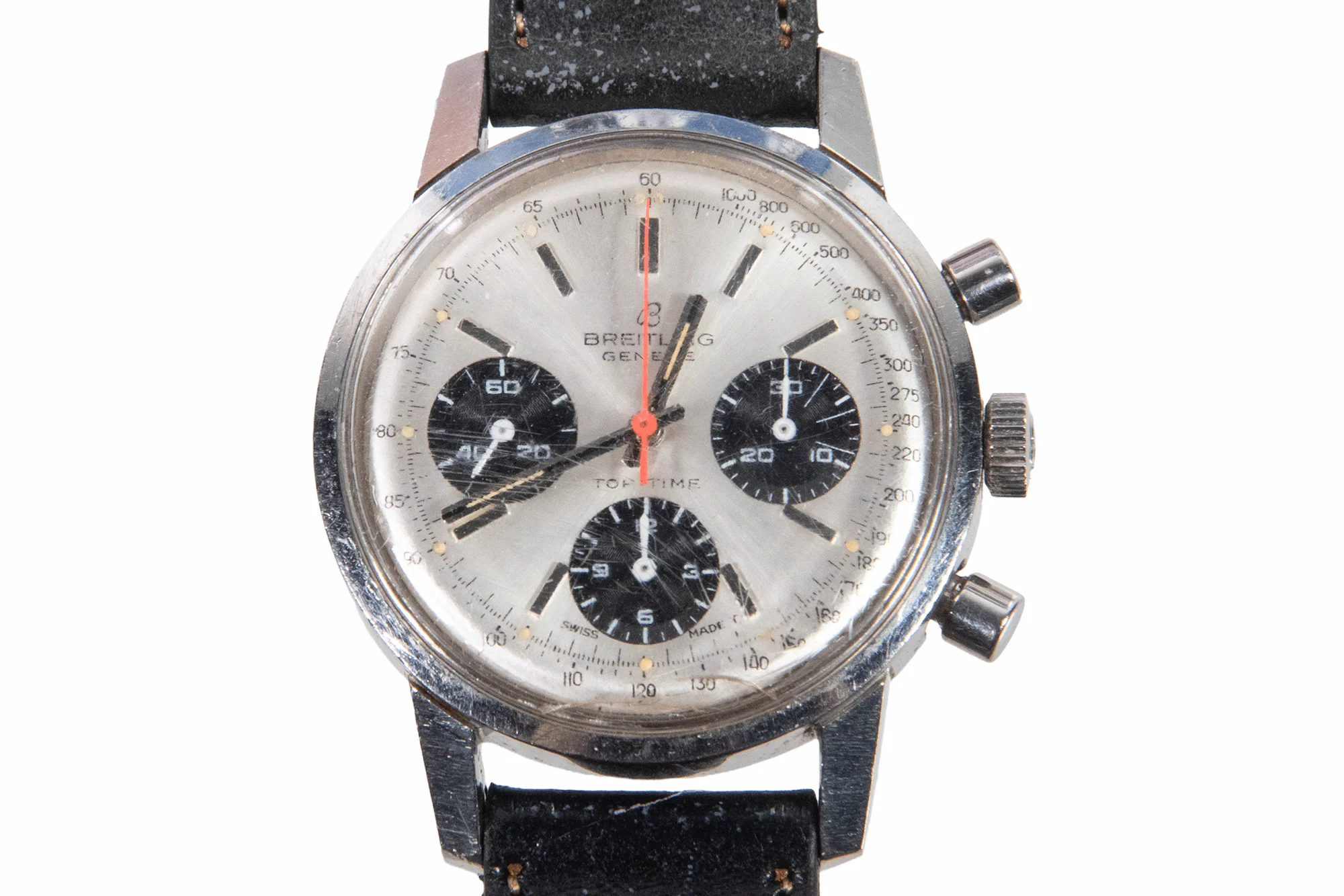
Photo courtesy of Invaluable.

Photo courtesy of Invaluable.
If you’d like to tone it down and/or would prefer to buy in Europe, this Breitling 815 has got you covered. It’s powered by a Valjoux 7736 and features a more muted, unpainted central chrono seconds hand and a dial free of any Top Time badging. You still get the nicely aged lume plots (and slightly different hands), and this one presents a little cleaner, with a crystal that looks not to have been used to test an unlabeled sandpaper’s grit. The dials on each are subtly different, too, with the 815’s subdials a shiny gray compared to the more matte black ones on the 810.

Photo courtesy of Invaluable.
These watches, obviously, have more in common than not: identical 38mm steel cases; both still have their signed crowns; both feature snap-on casebacks. I see no evidence either watch has in any way been messed with—the cases on each are sharp, the dials and hands look correct, and, aside from more wear on the 810’s caseback, they seem to be in great shape overall. The 810 has been bid up to $1800 at the time of writing and sells on the 30th, and the 815 has no bids yet on its opening price of €2,600, and it sells on September 5th.
Baume & Mercier “Hommage à Pierre Soulages”

Photo courtesy of Interencheres.
In the ongoing interest in including watches that are fascinating collabs with artists, here’s a first-iteration Baume & Mercier “Hommage à Pierre Soulages.” This watch was released in 2022 in an edition of 102, sold for $5,850, and, as far as collaborations go, is fairly interesting (at least the technical details of how they made the dial look like that is). I didn’t see this watch when it was released, though it must have done well enough, given that there’s a second limited edition now available, in 328 pieces, with almost identical styling save for a different dial (and a different Soulages painting as reference).

Photo courtesy of Interencheres.
This watch is a bog-standard Hampton from Baume & Mercier, in a 31mm wide case and powered by an ETA 2892. The case, instead of the usual steel, is DLC-coated, but the reason this watch hits, if it does, is that dial. You need to know nothing about Pierre Soulages to appreciate the watch—the dial’s dramatic, textural, and dynamic, and the pops of gold on the dial, and especially the hands, are excellent and unexpected. You’ll likely not be all that shocked to learn that not only did Soulages work primarily in black (enough so that he termed his own work Outrenoir, meaning ‘beyond black’) but said of his work “My instrument is not black, but the light reflected from the black.”
Unsurprisingly, given that the watch is four years old, this watch is a full set, including the original box and papers, a book on Soulanges art, and a VIP card granting free access to the Musée Soulanges in Rodez for life. The watch goes up for auction on the 30th in France, with an estimate of €9,000-10,000.
Angelus Pulsations Medical Monopusher

Photo courtesy of Shuck the Oyster.
Let’s finish off with another monopusher. A decade ago I was the underbidder on a Paul Portinoux version of this watch, and spent the intervening years hoping they’d stay underknown and that I’d eventually get one. Messina Lab and Angelus scuttled that likelihood by introducing a modern version in 2023, and now the originals are even more scarce and more expensive.
Which makes it so rad that Shuck The Oyster had two available of these: a Paul Portinoux (which has already sold), and this Angelus one, which remains available. The example on offer’s fantastic—clean case, excellent hands and dial (with a bit of yellow fade on the dial to the left of the center post)—and while I’ve never worn one of these watches, I’ve got to presume the watch wears wonderfully at 37.5mm. I also presume this watch would ironically be dangerous to my health, because instead of checking for traffic as I crossed streets, I’d be staring at the dial.
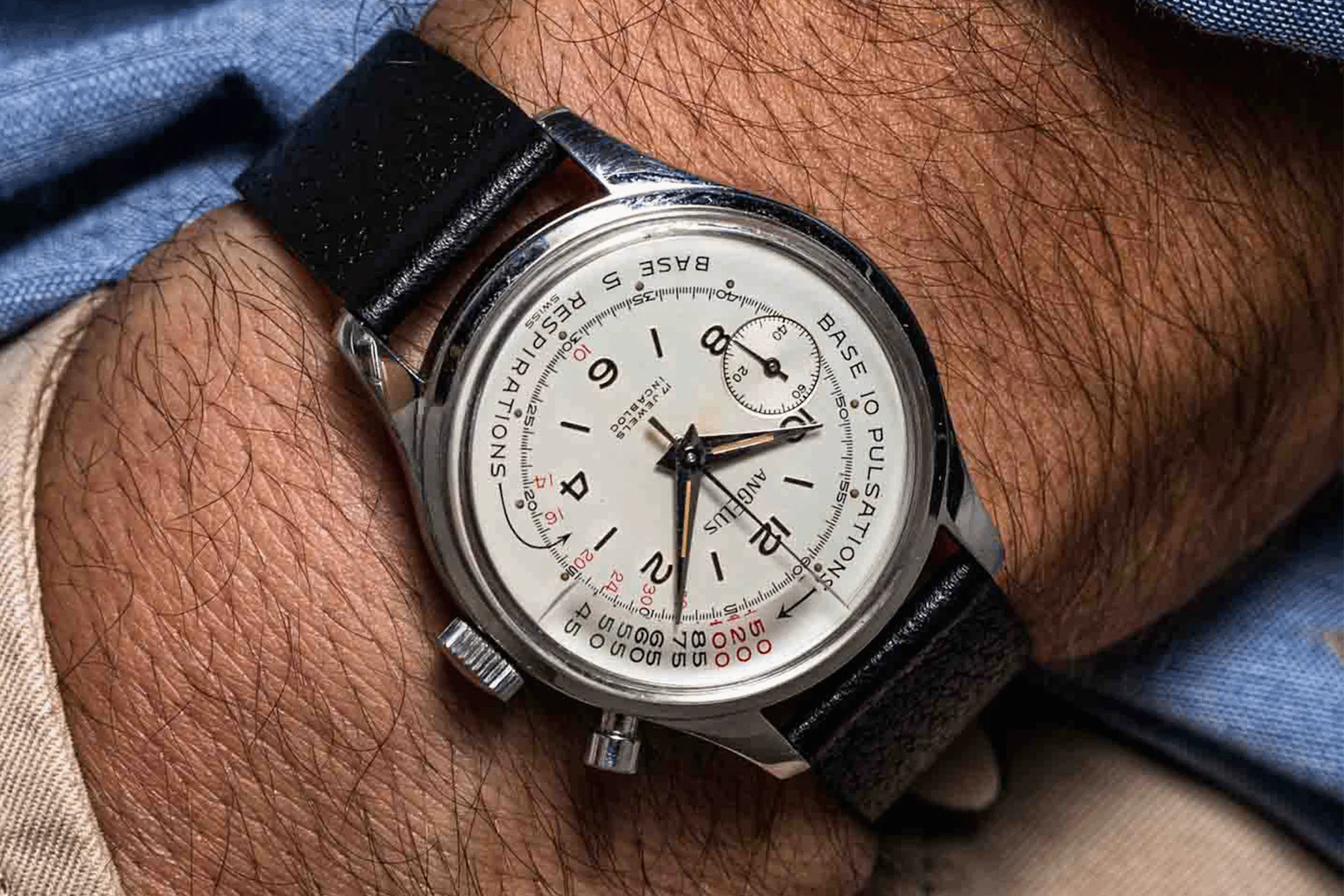
Photo courtesy of Shuck the Oyster.
While I maintain my conviction regarding the general disutility of complications, I seem unable to look at the dial of this one without feeling a sudden urge to count my breaths. Nifty as an adjective seems to have fallen out of favor, but that dial is 100% nifty, specifically because of that curved arrow, so sweet and helpful and somehow playful on an otherwise just-business dial.
Plus, there is, of course, the original magnifier crystal, which enlarges the numbers on the pulsations scale, helpfully color-coded to let you know the degrees of cardiac intensity. The watch is mind-blowing for only including the useful bits: the pulsations run from 150 to 45, while the respirations scale only from 40 to 10. Sure, if you’re some zen master, maybe you’d like a dial to include a respiration scale that goes all the way to 1 breath a minute or pulsations scale that bottoms out at 30, but for the rest of us, the dial offers most of what anyone’d need most of the time. Note, too, that this chronograph only functions medically: there’s no minute totalizer.

Photo courtesy of Shuck the Oyster.

Photo courtesy of Shuck the Oyster.
Again, these do not come up all that often (in any of their variations—Angelus, Paul Portinoux, Vernal), and this one checks all the boxes, plus it’s been recently serviced. For the record, too, yes, an unsigned modified Valjoux 22 is correct on the Angelus-branded models. Shuck the Oyster’s offering this watch for €13,900.