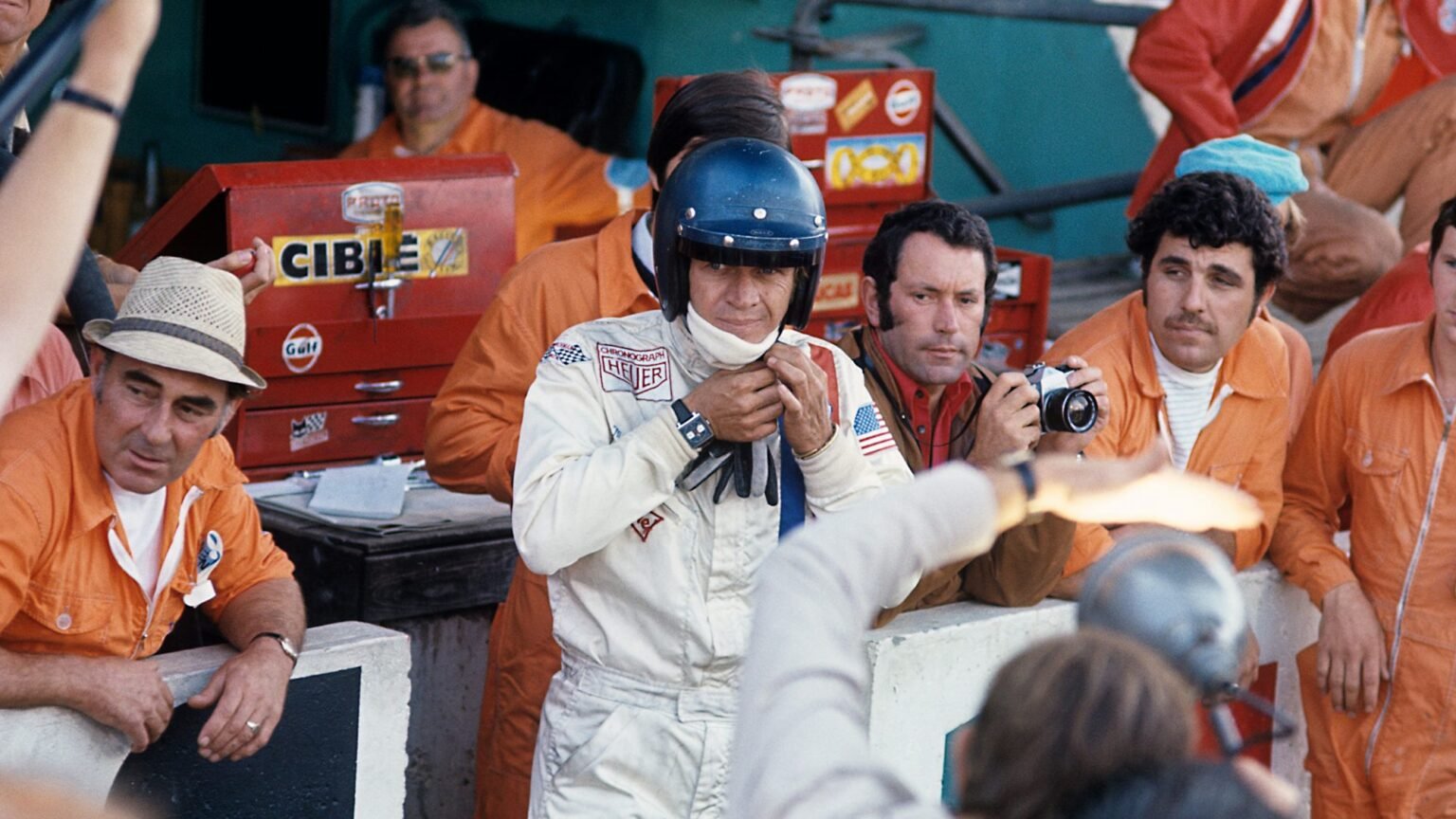


When lot 71 hammers at Sotheby’s New York Auction this weekend, it will punctuate a story that was started nearly sixty years ago in France—the lot number surely a nod to the year Le Mans debuted, 1971. The story of Steve McQueen and the film has been well told over the past half century, immortalizing a man and bolstering two industries in the process. It’s essentially canon at this point, yet the story was never complete—until now. A cache of documents from the film’s property master, held onto for decades after production closed, has finally set the record straight. And the last watch is coming up for sale this weekend.

The Heuer Reference 1133B Monaco Screenworn by Steve McQueen in Le Mans, Circa 1969, up for auction at Sotheby’s this weekend. Photo courtesy of Sotheby’s.
The 1960s were a formative decade for Heuer. The Autavia launched in 1962, the Carrera in 1963, and the Monaco in 1969—the latter completing a trio of Heuer chronographs all released that year with the Calibre 11, a movement developed jointly by Heuer and Breitling, built around a Buren micro-rotor with a Dubois-Depraz chronograph module layered on top, creating the first commercially available automatic Swiss-made chronograph.
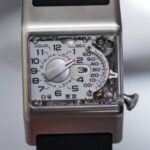
The Autavia and Carrera received redesigned cases for the occasion. The Monaco was something else entirely: a completely new watch, built around a patented square case sourced from EPSA, creating the world’s first water-resistant square chronograph. With its angular form, iridescent blue dial, crown positioned at 9 o’clock, and an NSA bracelet that looked almost integrated—it certainly stood out amongst contemporaries at the time. Initially, that outlier quality worked against it. The Monaco played third fiddle to the Autavia and the Carrera within the Heuer lineup, and it also differed significantly from its competitors in the automatic chronograph race—the Zenith El Primero A386 and the Seiko 6139, both released the same year.

Stanley Kubrick on the set of A Clockwork Orange wearing a Monaco. Photo via Getty Images.
It took time, but of course, eventually the pendulum swung back, and the Monaco became more in favor when some of the leading artists at the time across many disciplines, including Oscar Peterson, Sammy Davis Jr., and Stanley Kubrick, were seen wearing one. Then came Steve McQueen, and the rest is, well, you know.

Photo courtesy of Sotheby’s.
In parallel with what was happening in watchmaking, another race was playing out on the big screen. In 1966, John Frankenheimer produced Grand Prix with James Garner, a film about Formula 1 that pointed directly at what McQueen wanted to do with Le Mans—a film about the 24-hour race that had long obsessed him.
When production began in earnest in 1970, property master Don Nunley laid out a table of watches for McQueen to choose from: Rolex, Longines, Omega, and others before ultimately picking the Monaco, which, as it turns out, was a watch he’d never heard of. Jo Siffert—the Swiss F1 driver, Heuer ambassador, and one of two racing drivers hired to coach McQueen on the Porsche 917—had a Heuer logo already on his racing kit. And thus, following in his coach’s footsteps, McQueen chose to also go with the Heuer. And that’s when the Monaco became the Monaco.
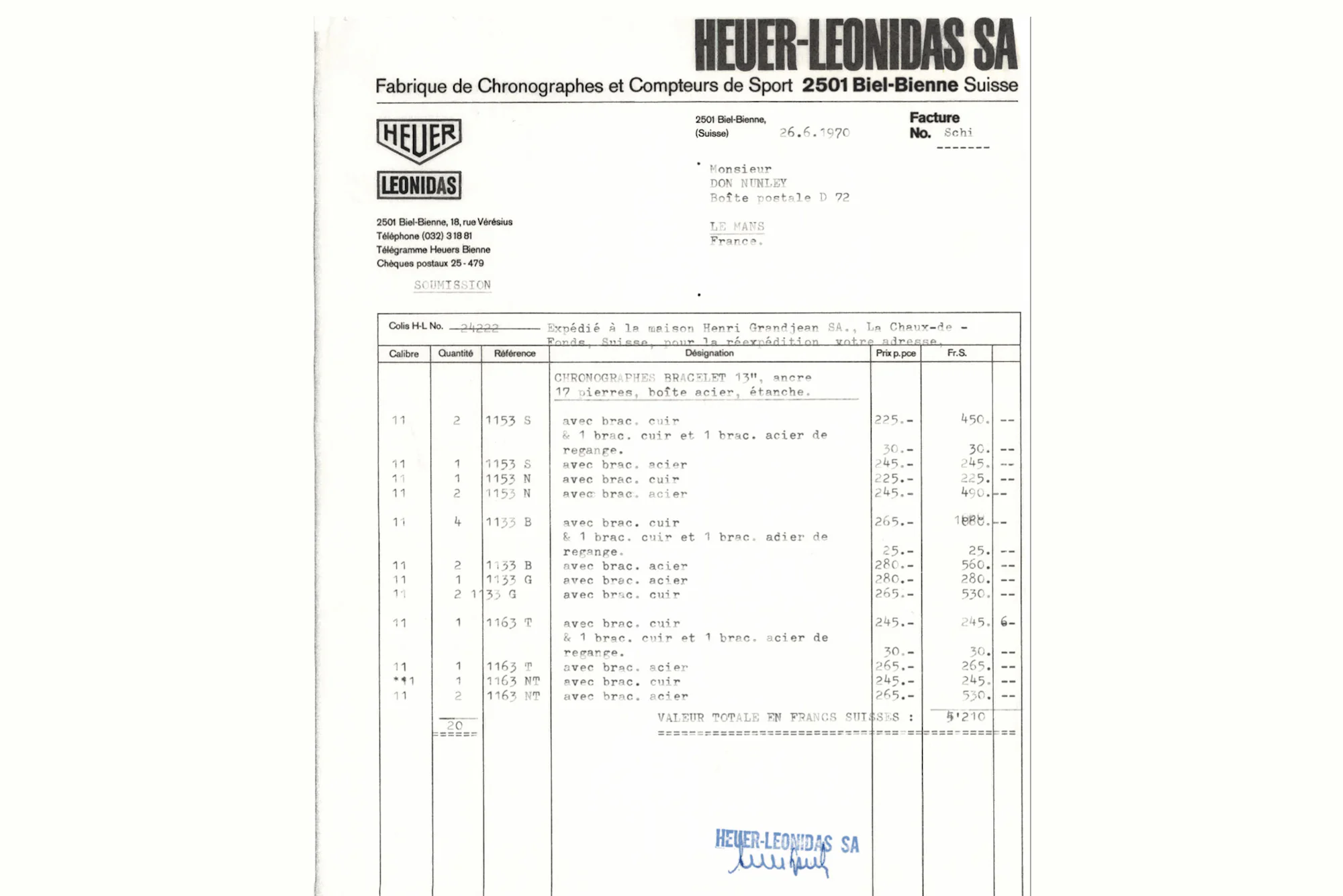
Notice the six 1133B watches located in the middle of the invoice. Image courtesy of Sotheby’s.
Fast forward to modern day, where a paper trail was forming piece by piece that TAG Heuer Heritage Director Nicholas Biebuyck spent years reconstructing. Previous tellings of this story relied on secondary sources—interviews, memoirs, oral history. What Biebuyck has assembled here is primary documentation. The dispatch note (essentially an invoice) from June 26, 1970, details 20 automatic chronograph wristwatches sent to the film’s set—among them, nine Monaco references, six with blue dials and three with grey dials. Heuer employee Gerd-Rüdiger Lang drove them across the French border in his own car; Jack Heuer, anticipating customs complications, had instructed him simply not to declare them. Lang was stopped, fined, and arrived on set regardless.

The notarized provenance letter from Nunley. Image courtesy of Sotheby’s.

When filming wrapped, Jack Heuer told Nunley to give the watches away as gifts—a decision that would later cause friction when McQueen, furious to find his image informally attached to the brand, discovered what had happened. Nunley defused it by telling McQueen the crew had bought the watches at reduced prices, and token checks for $30, $50, and $70 trickled back to Bienne in the following days. Of those six blue-dial watches, provenance has been established for all but one—the watch Haig Altounian sold through Phillips in December 2020, whose case number has never been disclosed, leaving one entry in the record unconfirmed.

Photo courtesy of Sotheby’s.
The documentation now accounts for seven blue-dial Monaco reference 1133B watches with traceable provenance to production, with case numbers clustering tightly in the 159,000–160,000 range—consistent with production in early 1970, when Heuer transitioned to the matte blue dial now synonymous with McQueen. The watch at Sotheby’s this weekend, case 159’381, is the one Nunley kept after filming wrapped and later sold to a private collector — and by his own account, the one “worn by Steve McQueen most often throughout the movie and on the set.” His notarized affidavit accompanies it. The watch is, as Biebuyck describes it, evidently lived-in—worn, scratched, and comes with “a huge whack”, which we can only hope comes from “The King Of Cool” changing gears or something of the like, from one of his many laps in the 917.

Photo courtesy of Sotheby’s.
It’s the last of Nunley’s watches to come to market, and thus, leaves us to assume that it’s one of his most favored. What also sets this example apart from others that have surfaced is the documentation behind it—a notarized provenance letter from Nunley himself, correspondence between Nunley and Jack Heuer, and primary source records that allow Biebuyck to build a precise chronology of where the watch has been since filming wrapped.
“The watch is significant, the design is significant, the technology of the Calibre 11 is significant,” Biebuyck said. “But when you pour on the rocket fuel that is the romance of Steve McQueen and the movie Le Mans, you start to understand what provenance can add as a layer on top of a watch that’s already special.”

Photo courtesy of Sotheby’s.
The last Monaco with Le Mans provenance sold at Sotheby’s in December 2024 for around $1.4 million. This one carries an estimate of $500,000–$1,000,000, but with the level of documentation that accompanies it—and Nunley’s own notarized attestation that this was the watch McQueen wore most throughout filming—expect it to go higher. Layer on top of that the current moment for Formula 1—the sport is at a cultural peak, on the heels of a fabulous Monaco Grand Prix just last weekend, and with TAG Heuer back as the official timekeeper of F1—and the conditions could be right for a result north of 2024.