

Just last week, I visited the workshop of Petermann-Bédat in Renes. I had a morning to kill on the way to Lausanne for a project, and instead of sleeping off some jetlag, I decided to do something productive. And, actually, something that makes me happy. Spending time with Gaël Petermann and Florian Bédat is always a pleasure. I put a lot of stock in the personalities of independent watchmakers, and I think it’s fair to consider them artists you want to support, not just for the art but also for how you connect with them. Far from a buyer, I still seem to operate on a similar wavelength to the two. But the added bonus is that I finally got to see their new reference 1826, which was launched for The Hour Glass in Japan, and boy, was it a stunner.
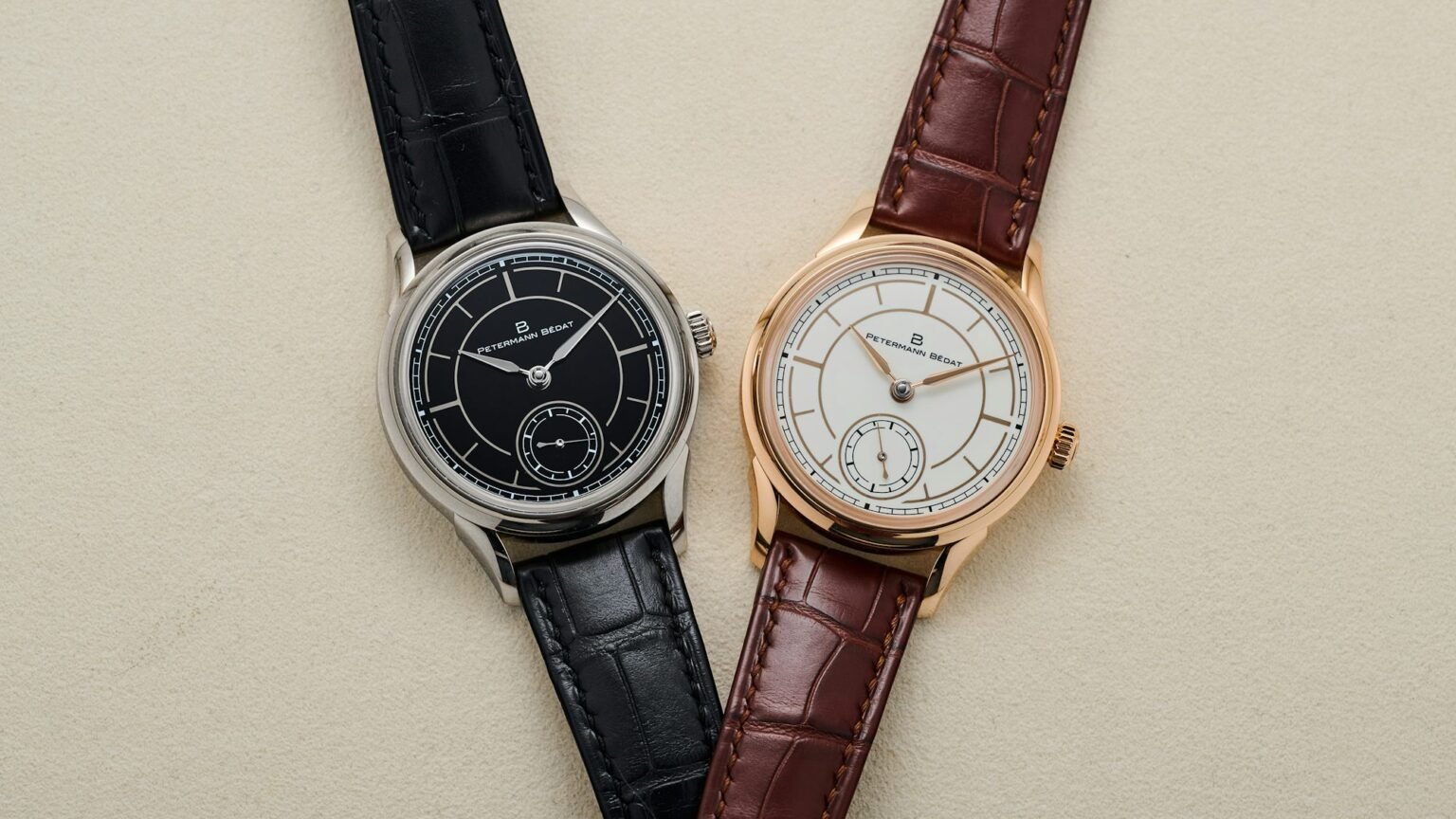
No, the name isn’t a typo. While the larger (and relatively recently released) ref. 1825 from 2025 featured a 38mm case; the watchmakers have been able to downsize the two new versions to 36mm, made in white and rose gold. Actually, they made the original caliber with a 36mm case in mind, but, to paraphrase, they didn’t feel the market was ready. Turns out that it was maybe not the best for the global stage, but perfect for one market in particular. The difference is pretty dramatic in person. But so is this recent generation of watches in general.


Petermann-Bédat’s business arch has been a yo-yo from a simple-looking but technically complex deadbeat watch (shown above) that launched the brand, then an incredibly complex split-second wristwatch to follow, and now their simplest watch yet. Going from something as complicated as a split (a deadbeat itself is no simple watch either) to a more refined three-hand watch is a challenge of opposites.
Their first two watches showed their technicality in subtle ways, but the dials telegraphed it a bit with a semi-open sector approach. If you give yourself more constraints, you are increasingly challenged by the fact that the three-hand independent watch has become ubiquitous. My simple question is, “Does it work on its own merit?” I’d say that the 1825 and now 1826 do, but as a slow burn and in a subtle way.

Every time I visit a workshop for the first time, I always get this feeling of, “Oh, wow! It does exist.” Of course, that seems obvious. The watches have to come from somewhere. But it’s a little more real when you can see people sitting at the bench, doing their work. Petermann-Bédat source parts from outside suppliers—you won’t see CNC or electro-erosion machines in their Renes space.
The team was a bit of a skeleton crew when I visited, coming off a holiday weekend. But even the founders have their own benches, where they had been assembling the last of their split-second chronographs and working on the new time-only watches when I arrived. One of the side projects Gaël Petermann showed me involved building a new machine for Geneva stripes, using cheaper parts from China. Old machines can cost tens of thousands. This new one could be less than CHF 3,000, and Petermann plans to publish directions online so anyone can build one.


An old machine for Geneva stripes.

The new machine.
The original 1825 was a compelling watch for people who like classic design. There’s been a recent wave of independent watchmakers making time-only watches, which is no surprise, as it allows them to reach the broadest audience in both taste and price point. But while some focus on open dials that show off a variety of finishing techniques (often nearly every one they can think to cram in), the ones that seem most promising are the more traditional.
That previous watch, at 38mm by 10.15mm, fits really well on the wrist. Sitting at over 10mm might sound a bit inelegant, but it’s still within the range for a nice dress watch. Now at 36mm with the same thickness, you can see that the difference is slight on the wrist, but even for a tall person with a 7.25″ wrist, it fits quite well.

One version of the new 36mm 1826.

The other 1826 in white gold.

The original 1825, for comparison.
The original 1825 sector dial combined something a bit more casual than with dressier techniques, using flinqué and champlevé enamel. The dial, still made by Oliver Vaucher, has been tweaked. The dial plates are in white and rose gold. Black grand feu enamel and white ivory grand feu enamel. The logo, minute, and second track are printed. If you notice any issues with these dials, it’s worth noting they’re prototypes.


A dial like this is nice, but candidly, there are a lot of brands that could do something similar and charge far less than this watch costs. The price, of course, is due to the in-house caliber 233 movement and all the hand-finishing involved in getting it to look this good. There’s a touch of the same kind of vintage perspective that Philippe Dufour drew on when the VZSS movement inspired the Simplicity. Just like the traditional front, the watch uses an 18,000 vph, large, free-sprung balance wheel in the brand’s own design (noticeably different than most you see on the market), with an overcoil hairspring.

Symmetry, or something close to it, is pretty popular with this generation of watchmakers. While this doesn’t exactly do true symmetry, there’s something about the caliber 233 that almost causes a bit of an itch in your brain, drawing your eyes around, from the bell-shaped open-worked bridge to the large jewel for the mainspring barrel. The same could be said for the swan-neck regulator, which is a bit redundant to the free-sprung balance, but a nice touch. Mainplates are made of German silver, and the wheels are in gold. The watch has a 56-hour power reserve.
One of the things the brand is most proud of is the level of finish it provides. It’s obviously quite spectacular, with a lot of time spent on black-polishing nearly every surface that can be polished, and the chamfers are awesome as well. The end cap for the balance cock and bridge for the pallet fork are two large areas of black polish that draw the eye around the movement even more. The only critique I have is that such a high level of finishing is now expected for a watch at this level. That’s why it’s nice that the brand came up with such an interesting design.

The case design has been refined, not just shrunk. The lugs are more finely sloped around the case. On top is a box crystal, rather than a domed one, which changes the appearance from the side but more so from a top-down view by further reducing how big it looks on the wrist.


The best choice for me might still be an 1825 that somehow uses the visual tweaks of the new 1826, but that watch doesn’t exist. This, on the other hand, shows how Petermann-Bédat and The Hour Glass know their market. Simple, time-only wristwatches are popular around the world now, but Japan arguably understood their beauty first. From the Patek ref. 96 to the inclusion of a display caseback later in the ref. 3796 (largely because of the Japanese market) and their early passion for Dufour’s Simplicity, you can tell the lineage that created this watch.

The retail price, CHF 96,000, feels a bit aggressive in a vacuum, but is indicative both of the quality of the work and the small-batch approach that Petermann-Bédat has. With a much smaller team, they have lower overhead, but unlike a lot of watches made with parts often supplied by one company in northern Switzerland, Petermann-Bédat has to juggle smaller batches of supplied parts (which often means a higher price per part), more work for fewer people. And yet, the team produces a very nice product that also helps establish a developing design language for the future.