

The small German town of Glashütte is paradise for watch nerds. Some people don’t quite believe how densely packed the watchmaking is in this little town in Saxony, with the biggest German horological names literally next door to each other. But undoubtedly the most iconic name in Glashütte watchmaking (and German high horology in general) is A. Lange & Söhne, and the manufacturer rarely opens its doors to outsiders to take a closer look at what the brand is up to.

Earlier this year, during the rainy month of July, a few of us on the Hodinkee editorial team hopped over to Glashütte to see what was happening within the secretive walls of the Lange, and to say that the visit was unforgettable is surely the understatement of the century. There’s still lots to come from our visit, but one of the best moments of the few days I spent there was, well, looking at watches—very special watches though, pulled from the Lange archives.
The Designs Behind The Revival

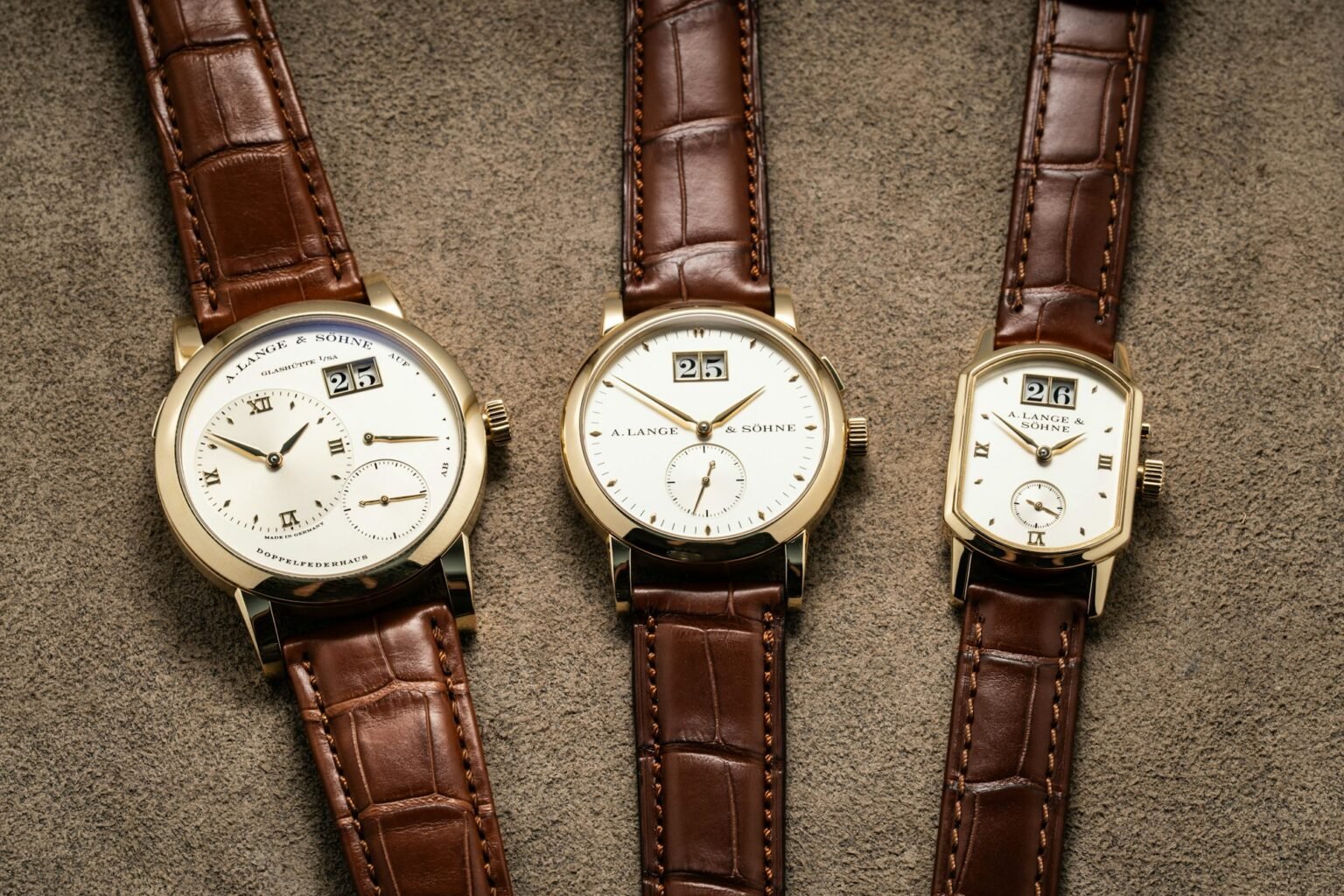
Kicking it off are three of modern A. Lange & Söhne’s inaugural silhouettes in yellow gold, representing the then-new designs unveiled by Günter Blümlein on October 24th, 1994. That day, of course, marked a pivotal moment that not only revived the A. Lange & Söhne name after a long period of dormancy, but also set a new standard for what high-end watchmaking meant in the mid-nineties, especially among its Swiss contemporaries.
The Lange 1 could just be the most iconic model from the brand. It’s the only design in this original collection still made today, with its asymmetrical dial layout, big date, and non-linear power reserve indicator on the right side of the dial. From a collector’s perspective, it’s also wonderful to know that the Lange 1 you’re buying today looks and feels much like what it was when it first shook up the watch industry with that modern dial design more than three decades ago.


The Arkade stands out not only in its distinctively shaped case, but also in its Teutonic (and arguably unisex) interpretation of a women’s watch in 1994. In a compact 29mm by 22mm case, it showcased Lange watchmaking with the shaped caliber L911.
One thing to note, however, is that both the Lange 1 and Arkade here feature exhibition casebacks, which means that these are later references than the originals but largely representative of the very first designs. Those familiar with Lange’s revival will know that these models were all initially delivered with solid casebacks, unlike the ones I photographed here.

The original Saxonia, the simplest in the group and one that puts much of the focus on that oversized big date window, seems to be a fan favorite among many of my Lange-collecting friends. While I didn’t appreciate the split A. Lange & Söhne logo on the dial until recently, I have to admit that Lange’s reassuring build quality, paired with a compact 34mm proportion, has made every one I’ve tried feel spectacular on the wrist.
Just last week, I saw a beautiful blue-dialed Saxonia Big Date at our monthly Hodinkee Happy Hour, and it reminded me how lovely this watch is (I certainly wouldn’t mind a revival today). I also love that this original Saxonia reference is powered by that shaped caliber found in the Arkade. It’s a deep irony, given the typical criticism we give shaped watches when they feature round movements inside. Here, this beautifully classic round watch hides a rectangular movement behind its solid caseback.

You may notice that the Pour Le Mérite Tourbillon, the only remaining reference introduced that day in 1994 and by far the most technical and complicated in the lineup, isn’t in this group. That’s because I saw two of them on this visit, and those two pieces are special enough to warrant their own section. I think you’ll understand why.
Some Epic Handwerkskunst

I’ll confess—I’m obsessed with Lange’s Handwerkskunst line. If you’re not familiar with what this slightly-confusing-to-pronounce series of watches from the brand is, each Handwerkskunst reference pairs a complicated reference from Lange with insane levels of artistic handwork that go far beyond the excellent finishing you’d typically find on any Lange. Production runs are tiny, even by Lange standards, and each reference is totally different from the next. I love it because it’s Lange at its most serious (in craft) and, at times, least serious (in whimsy and flourish). I got to see four separate Handwerkskunst designs that covered a wide range of the diverse artistry in the ongoing series.

If you gave me a blank check and asked me to pick one Handwerkskunst model for myself, I’d choose the 1815 Tourbillon Handwerkskunst ref. 730.048. Introduced in 2015 in a small run of 30 pieces, it took the 1815 Tourbillon released a year earlier and paired it with a tremblage dial produced in-house by Lange’s engravers. Beyond offering the one-minute tourbillon tied to the seconds hand and capped with Lange’s signature diamond endstone, the 1815 Tourbillon is the first watch to feature both hacking and zero-reset functionality. Not only are both impressive to achieve with a tourbillon to this day, but they also make a watch with this complication useful in its chronometry.


The zero-reset lever activated, with the v-shaped hacking spring in position.


Of course, my affinity for this watch comes largely from that gorgeous tremblage dial. I visited Lange’s engraving department during this trip, and while I have much more to share about Lange’s craft, tremblage feels underrated, given its painstaking demands once you see the process in person. In my case, I observed one of the engravers working on a future service dial for the Datograph Handwerkskunst. The seemingly random marks, all done by hand with one of two tools, have to be visually consistent to keep the entire textured surface even in the light. Most nerve-wracking of all is seeing how an engraver has to navigate around all of the raised lines of the numerals, tracks, and text throughout the process. I know I could never.


The two Lange 1 Handwerkskunst models here—one being the Lange 1 Perpetual Calendar Tourbillon Handwerkskunst ref. 720.048 and the other, the Lange 1 Tourbillon Handwerkskunst ref. 704.048—are interesting to me because they represent diametrically opposed dial executions within the same collection. The former fully embodies baroque extravagance, with extensive tremblage and relief-engraved dial sections paired with hand-painted, oversized date discs. The latter is a no-nonsense, stoic expression of a Lange 1 that seemingly hides the amount of work required for Lange’s first in-house grand feu enamel dial thanks to the austere black-and-white look.


The most maximalist expression of Handwerkskunst to this day remains the 1815 Rattrapante Perpetual Calendar. There are so many literal layers to unpack—from the playful starry relief-engraved motif of the dial, set in rich blue enamel, to the hunter caseback with a large engraved medallion and more of that enamel. Sadly, the prototype I saw at HQ didn’t have a movement, so that hunter caseback will remain closed for now. But I’ve been lucky enough to have seen the full watch, movement and all, and it is a thrill. The playfulness of the stars is so unlike Lange, but as a result, feels so Lange. It’s the great Handwerkskunst paradox.
Two References of the Tourbillon Pour le Mérite, as Owned by Walter Lange and Günter Blümlein

Walter Lange’s Tourbillon Pour le Mérite, #1/150
I had to separate the Tourbillon Pour le Mérite from the other three references introduced in 1994 for Lange’s rebirth here, because these weren’t just any old Tourbillon Pour le Mérite pieces the folks at Lange pulled out for us to see. Normally, seeing both the yellow gold and platinum Pour le Mérite variants side by side—and both number 1 in their respective editions at that—would be exciting enough. The watchmaking speaks for itself: the Tourbillon Pour le Mérite is the first-ever wristwatch to combine a tourbillon and a fusée-and-chain mechanism.
While that’s already plenty to be thrilled about, it’s knowing who these watches belonged to that makes this one of the most memorable horological moments I’ve ever experienced. These belonged to the late Walter Lange and Günter Blümlein, the two men instrumental in the revival of A. Lange & Söhne shortly after the fall of the Berlin Wall. With Walter Lange wanting to restore his family legacy shaping Glashütte watchmaking, and Blümlein looking for a new challenge after the momentum he established while working on both IWC and Jaeger-LeCoultre, a revival of the Lange name in German watchmaking was set in motion.

Günter Blümlein’s Pour le Mérite, #1/50

Both watches are completely unrestored, in an effort by the brand to preserve them as they would have been on the wrists of Lange and Blümlein. Walter Lange’s watch was the one in yellow gold, and Blümlein’s was in platinum. What immediately stands out about Lange’s watch is how well-worn it is, not to mention the oxidation on the case.


As we started to absolutely fawn over these pieces, Lange CEO Wilhelm Schmid mentioned that, unsurprisingly, both of these watches will never leave Lange’s headquarters. You might catch a Handwerkskunst piece at an exhibition or a first-generation Lange 1 on the wrist of a collector, but there’s only one place where you will ever be able to see these two pieces in the metal. Holding Walter Lange’s own watch in my (gloved) hand had me quite emotional—that patina could tell a million stories, and I’d dream of listening to each and every single one.