

Writing about the Gagà Laboratorio Aqualab has proved a difficult task. A tutor once told me to keep the structure of any article, report, or document simple: tell them what you’re about to tell them, tell them, then tell them what you’ve told them. As I sit to translate my thoughts onto screen, I struggle with both the introduction and summary parts. The longer I spend with this interesting piece, the more difficult it becomes. Gagà Laboratorio describe this watch as “extend[ing] its vision into the world of diving watches, interpreting this category through its distinctive design culture and its contemporary understanding of luxury lifestyle”, and although it encompasses both the function of a dive watch and the refinement of a luxury timepiece I find it tough to pin down exactly what the Aqualab is.
On a personal level, I either like a watch, or I don’t. I’d either be happy to buy it, or I wouldn’t. Writing about a watch causes me to think more objectively, and evaluating against an archetype is a good way to do that. The fact that I struggle to pigeonhole the Aqualab is a stumbling block. But here goes…

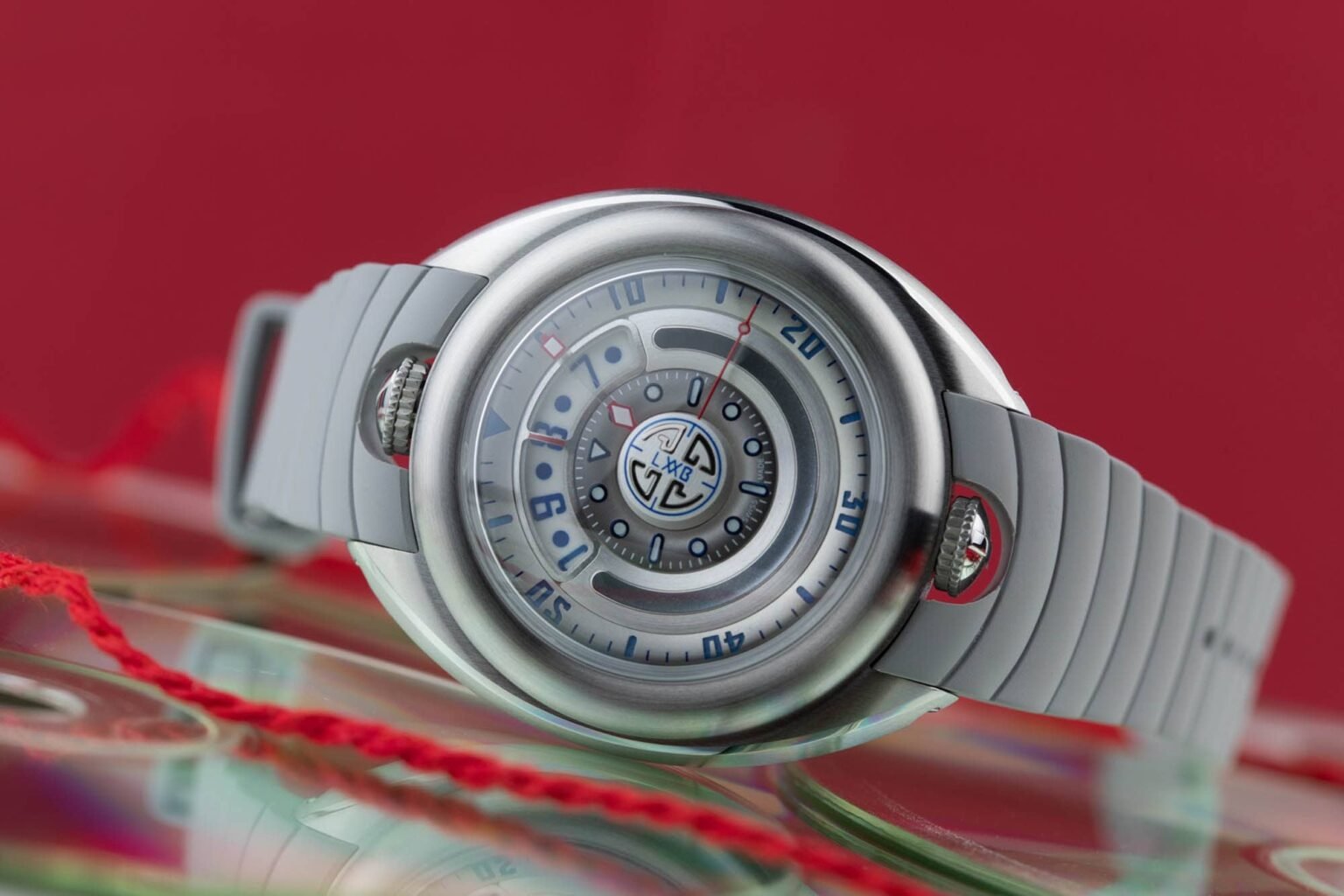
Considering the dial separately from the case, or even the strap, feels a little spurious as the overall design flows strongly throughout. Nonetheless, that’s what I’m going to try to do, starting with the time-telling functions. As you’ll no doubt spot at the very first glance, the Aqualab doesn’t make use of ordinary hands. Hours, minutes, and seconds are all displayed, but all are unconventional to varying degrees. Hours are shown via a rotating disc visible through an aperture in the top half of the dial. The readout, aided by a thin red line, shows the current hour, or which two hours we are currently between.

The minute hand has two parts, both fairly small. The first part is a diamond shape, bordered in red, and sitting above the central gray part of the dial with static markings. There’s another section to the minute hand, connected by a clear portion, which is read against the internal rotating dive bezel. With the bezel aligned and in sync with the standard dial markings, this gives an additional reference point to read the time against. If the bezel has been rotated for measuring elapsed time, the outer part of the minute hand can be read against this second reference point. Even the second hand is a little unconventional. Although not immediately noticeable in photos, the whole of the central decorated cap rotates with the seconds hand.
When reading the time, there’s lots going on. I have found the hour window at the top is often enough – I can tell at a glance if it’s nearly five o’clock for example. However, finding the minute hand for a more accurate measurement is a separate task. The curves, colors and finishes present on the dial push forward the Aqualab’s luxury credentials while slightly inhibiting its function. I hold the same opinion on the beautiful double-domed sapphire crystal, which creates some trippy distortions. This version of the Aqualab is one of three, and is the tamest of the trio. The teal blue ‘Aquamarine’ and black/yellow ‘Anthracite’ colorways have more impactful dials, but having spent two weeks with the silver variant, I think that it offers enough character already.

The case of the Aqualab continues the visual themes seen in the dial and crystal. The soft and annular dial components continue through the large brushed steel fixed bezel, and then to the elliptical main case body. Polished soft bevels flank each side of the case, and echo some of the polished dial embellishments. Perhaps my favorite viewing angle of this watch displays the full 15mm height of the watch from the top of the dome to the slightly downturned lugs, and brings back memories of the 1986 movie Flight of the Navigator. The reverse of the watch features a solid, screw-down case back engraved with the Gagà Laboratorio logo.


Given the 44m diameter, and the thickness mentioned above, it’s no surprise that the Aqualab dominates a 7-inch wrist like mine. With crowns at either end (one sets the time, the other controls the internal rotating bezel), it’s the lug to lug length which may be too big for some. Despite the size and weight, I’ve found the watch very easy to live with on my wrist. The fitted rubber strap is angled steeply down from the lugs, with the overall effect being a continuous curve instead of a protrusion only on top of my wrist. Gagà Laboratorio use HNBR for the strap, which feels similar to FKM rubber but offers better tensile strength and resistance to wear over time. The curved indentations on the strap continue the rounded theme that is shown throughout the watch. Given that the Aqualab is restricted to proprietary strap options, it’s a relief the look and comfort both hit the target.

Powering the Aqualab is the La Joux-Perret caliber G100. This Swiss made automatic movement beats at 28,800bph and offers an impressive 68-hours of power reserve once fully wound. Although the watch can also be wound via the crown at 12, this is slightly awkward due to its position (in relation to the watch, and to the strap). The unidirectional self-winding of the G100 is efficient, although much like Miyota 9-series calibers, the rotor’s free-spinning in the non-winding direction is noticeable. There’s no date display on the Aqualab, and no date-setting position through the crown. The second crown provides free and easy rotation of the internal timing bezel. Unlike the time-setting crown, I’ve had no problems operating while on the wrist – usually by sliding my thumb left or right where the watch meets the strap. Although the crown doesn’t lock into place, I haven’t noticed any unintentional movement throughout the day.

My time with the Aqualab has been split across two different experiences. One comes from the futuristic case lines, flowing further through the crystal and the dial. The case shape also offers remarkable comfort on the wrist. The other experience is of a visually domineering watch filled with eye-catching, but distracting, elements steering it away from being a functional diving tool despite the timing bezel and 200m water resistance. It’s that second part which leads me back to my difficulty in summarising this watch. There’s no doubt that in some ways it is much, much more than a diving watch with an internal bezel, but at the same time it also falls short. For a non-diver such as myself, I could certainly find a place for the Gagà Laboratorio Aqualab in my rotation, but I can understand if it fails to tick too many boxes for others.

The Aqualab is available to purchase directly from the brand’s website, priced at €3,900 CHF plus any import fees.