

When you’ve been using the same camera and lens for literal decades, it can be hard to push yourself creatively and get out of your own habits. Shooting in all conditions becomes muscle memory, and even the trickiest shots can start to feel like just another snap of the shutter. So what is a hobby photographer to do? Well, if you’re me, you use the exposure gauge on the new Nodus Obscura II to challenge your idea of “correct”, and re-learn the act of shooting film in the process.
Let’s rewind a bit, first. Nodus is a Los Angeles-based microbrand established in 2017 who specializes in purpose-built watches. That may seem like a nebulous thing to claim as your hallmark, but it basically comes down to this: all Nodus watches are assembled, regulated, and tested in Los Angeles, and are intended to perform their stated function (or functions) at the highest degree, rather than offering a myriad of complications that could muddy a piece’s “purpose”. Their lineup consists of divers, pilot and sport watches, and GMT units. The star collection, though, is their Design Lab series, where the brand showcases watches designed and built in collaboration with other creators or brands. These watches push Nodus’ aesthetics, and introduce even more hyper-niche categories and use cases. The most innovative of the Design Lab watches is, of course, the Obscura II collaboration with Beers and Cameras.

Image: Nodus
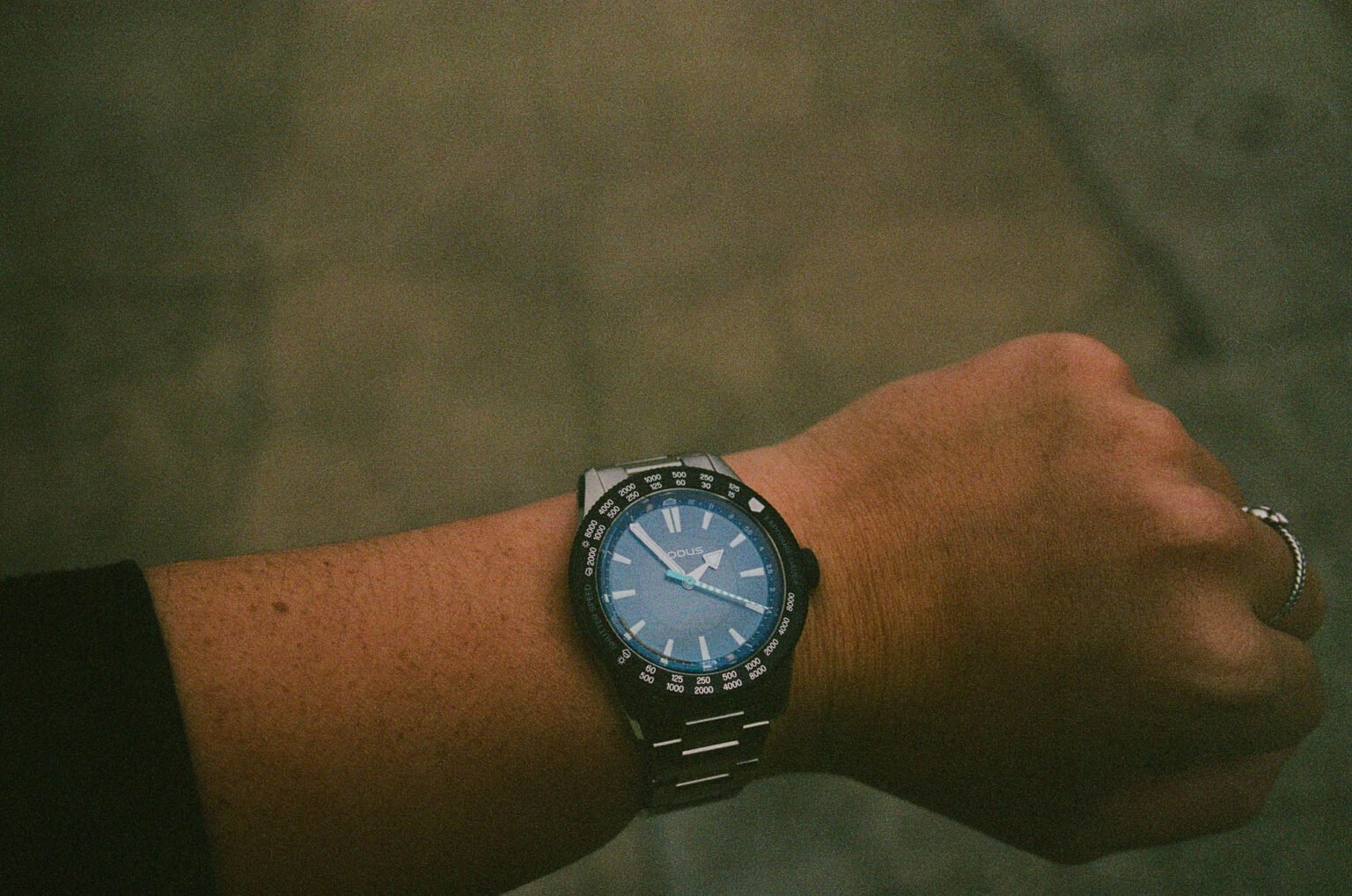
The first Obscura watch introduced Nodus’ patented exposure gauge bezel in 2025, with the Obscura II releasing in 2026 with tweaked specs and aesthetics. The model I received for review is the brushed steel version, which contrasts smartly with the matte black of the exposure gauge bezel. It’s not a small watch by any means, measuring in at 40mm across the bezel in case width and 47mm lug-to-lug, with a chunky 11.7mm in thickness. Still, the dimensions are handsomely dressed up with the 20-16mm tapered steel bracelet, which gives the watch a much dressier feel than its black DLC counterpart.
New for the second interaction of the Obscura is an updated dial design that does away with the Beers and Cameras logo at 6 o’clock, replacing it with minuscule “Obscura” text instead. It makes the watch more subtle for those who aren’t a part of the “worldwide photography meet-up group”, and are purchasing the watch simply for its unique function. Also new is the fume finish of the dial, which gives the black a depth that was missing in the original—very important for darker watches, whose details may be lost in shadow—as well as a grainy texture that Nodus claims is meant to evoke the silver halide crystals of film grain. It’s an effective change, and it certainly gives the Obscura II a more handsome and elevated look over its predecessor. On the technical side, the bezel has been refined to allow for smoother movement and more consistent action, important when adjusting it to compose your shots.

Image: Nodus
That’s where the wholly unique marquee complication of the Obscura II comes in: the exposure gauge bezel, inspired by “Sunny 16” analog exposure meters of yesteryear. Like most analog hobbies in our current age of digital enshittification, film photography has exploded in popularity, and the old Canon AE-1s and Minoltas with beer can lenses are being dug out of attics and put back to work. What has been lost over years of reliance on digital exposure meters and live displays on DLSRs, though, is the art of tweaking camera and lens settings. There’s no option to shoot in RAW with film, and even if you make darkroom adjustments, you can only get so much detail out of a poorly exposed roll. Before later film cameras (like my Canon Eos Rebel from the late 1990s) incorporated easy-read digital light meters into their viewfinders, most photographers made do with separate exposure-metering tools, usually handheld and fiddly devices that required dexterity to juggle at the same time as your camera. Instead of paying another small fortune for an original handheld meter, or opening a web browser while shooting to calculate the “Sunny 16” rule (more on that later), Nodus has taken advantage of another analog tool that can be easily worn out in the field: your wristwatch. It’s a deceptively simple tool that makes a whole lot of sense for a small group of the right people, and while it’s initially daunting to take a leap of faith and trust your watch bezel over your viewfinder when shooting (and taking up valuable frames of that roll of Portra you splurged on), it’s equally creatively rewarding.

So, I set out to test my own skills and perhaps rekindle a little bit of that inspiration juice that I’ve been missing over the last few years. I actually first learned most of my photography basics while shooting film, as I was privileged enough to attend a public high school with a full darkroom and dedicated photography program. While I still consider myself a casual hobby photographer, I did properly study the full gamut of essential skills, like F-stop, ISO, shutter speed, and more. Thankfully, you don’t need even that most basic of framework to use the Obscura II’s exposure bezel; all you need to know is what “speed” (ISO) of film you are shooting, and what lighting conditions you’re in.


Kodak films have long been my favorite, mostly for their naturally warm hues, which help make the foggy San Francisco landscapes and colorful vintage cars that I mostly shoot look a little more vibrant. Before COVID-era film stock price booms, I shot mostly Portra 400, but now mostly lean on the far cheaper and almost as good Gold 200; for my Obscura II test, though, I splurged on my beloved Porta 400. The 400 here refers to the “speed” of the film, or the ISO you need to set your camera at—basically, it’s your camera’s sensitivity to light. Higher numbers mean brighter shots, but also more grain, allowing you to shoot in darker conditions, whereas lower numbers are more ideal for brighter situations and produce darker images to balance that out. Typically, a camera’s ISO setting will be in the 100-200 range for sunny outdoor conditions, 400-800 for overcast days, and 1600 and up for indoor shots or nighttime conditions. It’s only one part of the “exposure triangle”, though, with shutter speed and aperture (F-stop).
If you’re already confused, don’t panic—it’s actually much simpler than it seems. All you need to know to start using the exposure gauge is what ISO your film is. In my case, I am using 400 speed film, so I set the bezel to 400 by rotating it until the white shield icon is even with 6 o’clock, where the 400 speed indicator rests along the minute track. Next, you check your environmental conditions; in my case, since I live in San Francisco, it was a typical August afternoon, meaning overcast and slightly darker than usual at 5pm. Thankfully, Nodus accounts for both overcast and sunny conditions, with two separate rows of shutter speeds around the bezel. Overcast is on the top (or inner) row, indicated by the little cloud icon, so I was focusing on those numbers. The final step is to take another peak at the minute track, where the F-stop markers lie between 12 and 6 o’clock. Check what F-stop you are set to on your camera, and line it up visually with the bezel to see what shutter speed is correct for your settings and conditions.

My first challenge came here, when I realized that my fairly low-spec Canon Eos Rebel with a basic kit lens only accommodates an F-stop down to 4, whereas the Obscura II shows numbers all the way down to 1.4. Different cameras and lenses allow for wider or smaller apertures, so while the Obscura II will help you with your shutter speed, you need to have some basic knowledge of apertures to pick the correct F-stop. The Obscura II includes a decently wide range of F-stops to play with; lower numbers mean a larger aperture, letting in more light, and larger numbers represent a smaller opening, better for bright conditions. I pulled on my ancient knowledge of aperture, and selected a fairly middling and forgiving 5.6, situated at the 2 o’clock position on the minute track, to start. Looking over at the bezel, I saw that this indicated a shutter speed of 8000 for my conditions. I began snapping, taking several photos at the settings denoted by the Nodus, and several with my own eye and the digital light meter built into my camera, for comparison.

What I found while experimenting was that the Nodus exposure gauge consistently produced slightly darker images than I would normally come up with, but that consequently helped the shadows pop a little more, leaving me with slightly higher contrast. Obviously, style is subjective, so whether or not that is more or less to your liking is up to you—what isn’t subjective, though, is that the Obscura II’s simple exposure gauge just works. There was minimal fiddling needed, and even the most novice of film photographers can find easy answers to, “what is ISO or F-stop?” with a simple Google search, meaning the barrier to entry for use as an everyday carry tool is refreshingly low. You can also experiment, purposefully setting your shutter speed higher or lower than the gauge’s recommendation to darken or brighten your image as desired. I did just that over the course of two weeks, snapping photos at several car shows while playing with the gauge to see what it could inspire me to change about my normal shooting routine. And while the results may be only noticeable to me at first glance, the experience made me pay far more attention to my trusty old Canon than I had in over a decade. I’d been so used to my tried-and-true settings—the ones that assured that the photo would come out clear every time, but perhaps not compelling from an artistic standpoint—that I’d forgotten what fun it is to throw your safety net away and start over as a novice.
Aside from the admittedly narrow niche that the exposure gauge bezel offers, the Obscura II is still a handsome and robust watch in its own right. The matte black of the bezel, crown (at 3 o’clock), and dial contrast crisply with the white numerals and markers, while the striped white and light blue seconds hand evokes darkroom exposure test strips. The bezel’s grip is constructed of CuAI5 bronze with black DLC coating, exemplifying the under-the-radar upscale touches that Nodus watches tend to champion. Inside it all is a TMI NH38 caliber movement that promises a decent 41 hours of power reserve, 100 meters of water resistance, and most importantly, a reliable and serviceable core for non-photography-related timekeeping duties. Top it all off with blue anti-reflective coating on the underside of the box sapphire crystal, and you have a watch that takes its aesthetics as seriously as its functions.


My initial test shots were certainly boring from a photography standpoint, but they were incredibly informative for the rest of my time with the Nodus Obscura II, and I will admit that very few watches have grabbed me as quickly as this one has. If you are a professional photographer, the gimmick may seem too simple to justify purchasing a whole watch for, but the novelty of carrying a proper, usable exposure gauge with you everywhere you go is enough for me, and likely for most hobbyists. The Obscura II combines two analog darlings, film photography and horology, and creates something that exceeds at both. I had a blast and felt cool as hell while using it, and if you can deal with wearing a heavier-than-average watch and want to turn your love of photography into a functional conversation piece, the Obscura II may be the watch for you.
The Nodus Obscura II is available on the company’s website, and retails for $650 and $725 for the brushed steel and black DLC options respectively. Nodus