
There’s not much left to say about the Tissot PRX Powermatic 80 that hasn’t already been said. It’s a watch that feels like it’s always been there, even though it was only released by Tissot in 2021, at exactly the right moment in history. With integrated-bracelet designs on the upswing, Tissot brought one to market that was fun, well-designed, and well-priced. It also happened to be based on an original ‘70s Seastar design from the brand. It was an instant hit, and the brand was quick to capitalize on its initial success by fleshing out a full collection, including different sizes, materials, and even movement options, culminating in the PRX Powermatic 80.
[toc-section heading=”History And Context”]


It’s that combination that is the real draw of the PRX, and today, in 2025, it’s only strengthened. The PRX Powermatic 80 remains well priced, starting at under $700, but there is no shortage of other fun, creative options hitting the market from brands big and small, which represent something of a risk to the future of the PRX in all its forms. How Tissot responds to that will be anyone’s guess, but at the moment, the PRX Powermatic 80 has plenty of legs to forge ahead as a leader in its class. In this review, we’ll take a closer look at why.
[toc-section heading=”Case Details”]

Tissot PRX Powermatic 80 40mm Steel (Left) and PRX Powermatic 80 38mm Titanium (Right)
The original PRX was fitted with a quartz movement, keeping the 40mm case to a svelte 10.4mm overall thickness. The shape and size were a big part of its charm, but almost immediately, fans wondered what a reference equipped with an automatic movement might look like, and just as importantly, what kind of case size options it might have in store. When Tissot put its Powermatic 80 movement into the PRX in 2023, it did so in both 40mm and 35mm case size options, notably forgoing what many consider the perfect “in-between” of 37mm or 38mm. In late 2025, the brand finally launched 38mm models positioned in “sweet-spot” sizing that many fans had been rallying for for years. The one main caveat to these three new 38mm options: at the time of writing, they are exclusively in more premium materials (with accompanying price tags to match), like titanium and Damascus steel. Across all sizes, there are some nuances to the dimensions vs. wearing experience, with the shape of the case and bracelet integration making these wear a bit differently than you might expect.


The 35mm case (top) and 40mm case (bottom)
The PRX fills out the wrist slightly more than its dimensions suggest on paper, while at the same time having a relatively short lug-to-lug span. It begins its curvature around the wrist earlier than a traditional case shape, which allows for a larger diameter to feel natural, all while filling in more space in the areas in between. It’s tough to nail down, but in practice, it just works, and I personally find the 35mm variant to be more visually pleasing, even though it feels slightly tankier due to the amount of mass jammed into a smaller footprint.

One thing to note about the case is that there aren’t really any rounded surfaces to be found. Everything is angular in nature, and surfaces come together at crease points rather than flowing organically. The mid-case, when viewed from the side, is a flat section that meets an angled lug at its end. The brushed walls and shoulders are broken only by a rigid, polished chamfer that defines the shape. It’s not quite graceful, but it works exactly as well as it needs to, and represents one of the defining features of the PRX’s unique character.


A couple of other notes about the case worth considering are the lack of any crown guards and the entry point for the bracelet or strap, which recesses into the case. This structure allows for a more natural fit for the bracelet or strap (more on that below) and keeps even the 40mm size tucked neatly into the confines of the wrist. Finally, Tissot offers multiple bezel variations for the PRX Powermatic 80, including a contrasting fluted design that brings its own vibe to the situation.
[toc-section heading=”Dial Variations”]

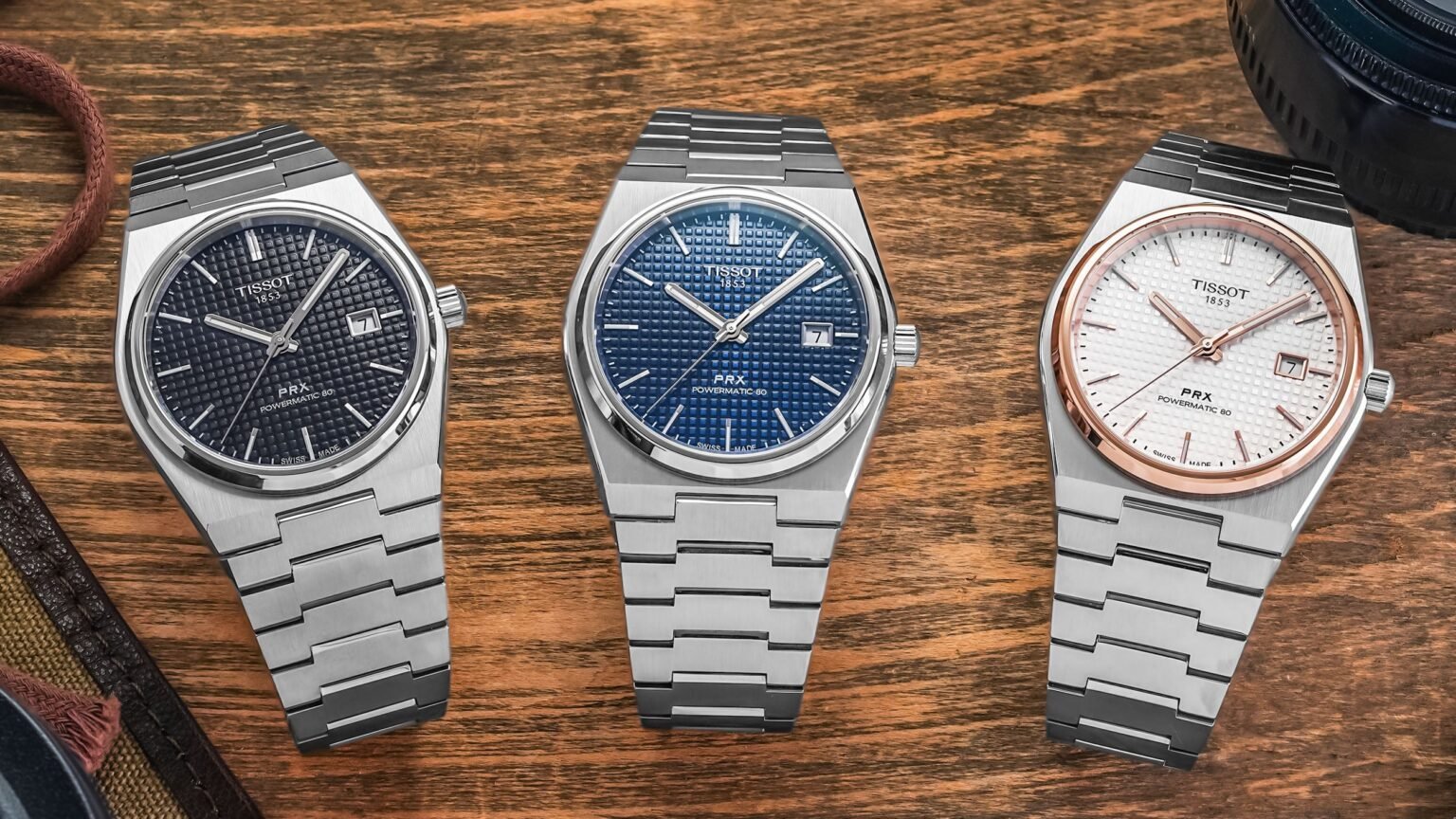
The original PRX launched in three dial colors, each with a subtle finish including a sunray texture and a vertical brush. In an effort to set the Powermatic 80-equipped PRX references apart from their quartz-powered brethren, Tissot introduced these watches with a gridded dial pattern. This pattern has remained consistent throughout a range of dial colors, and while special editions and mixed material references do break from convention, this grid dial has become the Powermatic 80 PRX’s signature look.


Now, the cynic in me would be quick to point out other, more famous watches that employ a similar dial pattern, but in reality, what Tissot has done here does feel unique in its own right, especially at this price point. That said, I personally find the flat dials and vertically brushed dials just as compelling, if not more so in some instances.

As for the dial furniture, things are kept pretty straightforward, with stick hour markers and pencil hands providing a perfectly serviceable level of legibility. There’s not a ton of lume here, no matter your dial choice, but it is there in a pinch. A date aperture at 3 o’clock is present on all PRX models (sans the chronograph variations), except for the recently released UFO Robot Grendizer special edition (which we wrote about here). If I’m being honest, I think this is a design that works well without the date, and I’d love to see Tissot bring more dial options without this complication, particularly with a vertical brush.
 I want to give a special shout-out to the Forged Carbon PRX with the Powermatic 80 movement, which features a unique dial and case made of, well, forged carbon. Each one will be different, and the use of this material brings a distinctly different feel to the design, and it works quite well. More on that particular example right here.
In the case of the newer 38mm PRX Powermatic 80 models, the two titanium models go the more traditional route. Currently, the 38mm titanium is offered in a blue sunray waffle dial option, as well as anthracite with rose-gold-toned details. The Damascus steel model is in a class of its own, carrying on the signature marbling of the material to the dial, and forgoing the waffle dial texture to let the swirling pattern take center stage.

No surprise here to learn that the PRX Powermatic 80 uses the automatic Powermatic 80 movement, which provides, you guessed it, 80 hours of power reserve. It does exactly what it says on the tin. The movement is visible through an exhibition caseback, though it won’t be winning any beauty contests. Tissot is, of course, a Swatch Group brand, and the Powermatic 80 is based on the group’s ETA 2824 architecture (C07 series), which has been expanded to provide more power reserve.
The Powermatic 80 made its debut at the 2012 Baselworld fair, the same year that Tudor introduced the Black Bay, which kind of sucked up all the oxygen in the room that year. But the Powermatic 80 has served an important role for Tissot, and has developed into maturity with a silicon balance spring (available in some models), and what Tissot calls a high-tech escapement, which is laser-regulated from the factory.

While this movement can be had with COSC certification, that’s not a step Tissot has taken with the PRX. In my time with these watches, accuracy has fallen into perfectly acceptable territory (within 10 seconds per day), but that doesn’t seem like a priority here. I could easily see COSC-certified PRX references in the future, and there’s plenty to build on here for Tissot. That said, this movement and its nature all play a role in keeping the price where it needs to be.
[toc-section heading=”Wearability: Bracelet And Strap”]  Okay, let’s talk about the integrated bracelet and integrated-bracelet designs as a whole. This is a trend that has largely been played out, but it’s not dead by a long shot. That is because we’re still getting really good variations on this concept. If you ask me, a good example will always be exactly that, regardless of where it might release in the trend cycle as a whole. We’re spoiled for choice these days, with pretty great options up and down the food chain, and the PRX is most certainly among these.


Tissot does offer rubber and even leather strap options with the PRX, and the watch does use a quick-release system, allowing for swap-outs on the go. This offers a big opportunity to push the PRX into new territory, and I’d love to see Tissot offer a wider variety of strap options for the PRX to take advantage of that quick-release system. This is a fun watch, and it should be available with a range of fun straps.
[toc-section heading=”Final Thoughts”]


The Tissot PRX is a hugely important watch, not just for the brand, but for the industry as a whole. It has brought in a new market of buyers and created new, lifelong enthusiasts as a result. The PRX with the Powermatic 80 shows just how versatile this platform can be, and showcases the brand’s own proprietary tech in the process. Tissot has been quick to flesh out this collection, now with three different sizing options, though the brand has plenty of room to riff and expand upon its newest 38mm offerings. The PRX is a mature watch, but somehow, it still feels like the very beginning.