

At first blush you might look at this watch and say to yourself, “Okay, so that’s a 1908 with a moonphase.” Visually you’re almost there, but it’s more nuanced than that. In fact, the positioning of this watch is one that even this writer didn’t fully appreciate until today’s launch. The 1908 is actually part of the Perpetual family, to which this new Padellone is its newest member. It is an instantaneous, complete annual calendar with a moonphase. It’s a throwback and a novelty all at once, with layers to unpack (and we will be unpacking them).
And if the name “Rolex Perpetual Padellone” rings a bell, there’s a reason. This new model range takes direct inspiration from the reference 8171 “Padellone,” which had a production run from the late 1940s into the 1950s and has become an absolute collector darling over the years.
 What made the Padellone so interesting in its time was how it represented a wholly different watch from what you would expect from Rolex in the era when it came to case size, case shape, and the complication.
And what makes the name Padellone so interesting today is that it was never really the name of the watch yesterday. It was a nickname, and as far as I can tell this is the first instance Rolex has ever brought a nickname into an official naming convention. The origins of that name are a literal translation of the Italian word, which means “Large Frying Pan.” And it was so named by Italian collectors because the 38mm size of the watch for its time was large enough to warrant such a comparison.
The literal meaning of the word has been somewhat lost to time as collectors across the world now refer to the 8171 reference as the Padellone, and Italian words just sound fantastic, so it has stuck as an easier way to reference the watch than the reference number itself. But while we are on the subject of the vintage, let’s take a miniature side-quest back in time.
History Of The Rolex Padellone

Vintage Rolex advertisement (“Padellone” Ref. 8171 on left)
That original Padellone design was punctuated by a complete calendar layout with moonphase complication that spoke to a certain dressier Rolex, a Rolex that had yet to become a full-throated tool watch brand. In fact, when you think about it, that Padellone predates all of the major Rolex Oyster Perpetual models, from the Submariner to the Explorer to the GMT-Master and beyond. In a year when the brand is celebrating 100 years of the Oyster case, that feels significant.

Rolex “Padellone” Ref. 8171 via Phillips
As noted above, it was a short-lived reference but marks a time in the Crown’s history when it went after a certain market segment that spoke to a dressier buyer. Its 38mm case is also unique in that it represented a real departure from the 36mm and below sizing of the time. In fact, the Padellone had a counterpart in the reference 6062 Triple Calendar, which did come in an Oyster Case and was sized in the more conventional 36mm.

Rolex Ref. 6062 Triple Calendar via Phillips
Neither of these models had a long shelf life, but the Padellone stands out for its unique case sizing for the era and for its multitude of visual intrigue, not the least of which is the dial layout and dial texture. Holding one of these vintage models is a real treat, if not for the rarity, then for the execution.
The New Rolex Perpetual Padellone

In many ways, this return of the Padellone speaks to a return to a style of Rolex watchmaking that didn’t disappear per se, but one that receded from the limelight and had only been seen in models like Cellini and, in a more pared-back format, the 1908. So imagine if Rolex had perpetually (sorry, I had to) made watches like the Padellone – what would the intervening years have looked like? Well, that’s hard to say. What we can speak to is what we got today, and that is a watch clothed in history and packed with the pinnacle of Rolex’s watchmaking might on the inside.
Case And Dial

At 39mm, the Perpetual Padellone joins the 1908 with the same case diameter and a few other stylistic cues such as the hands and typography. The 39mm size feels significant in terms of the homage of it all because it’s a case size we don’t really see in Rolex’s lineup today. Sure, there have been a host of watches in that arena in recent history, from the Oyster Perpetual of the late aughts to the now-discontinued Explorer 39mm. But today we see far more 36, 40, 41, 42, and beyond. The 39mm sizing now feels unique, or even left-of-center, just as the 38mm size seemed when the Padellone first hit the scene some nearly 80 years ago.
The watch sits at 12.20mm in height, giving it a proportional look from all angles. It isn’t intended to be an exercise in thinness, nor is it top-heavy in any regard. It manages to balance a certain sportiness with its throwback dressy appearance. That is bolstered by a lug-to-lug of 44.6mm, and the case – like the 1908 – is water-resistant to 50m.
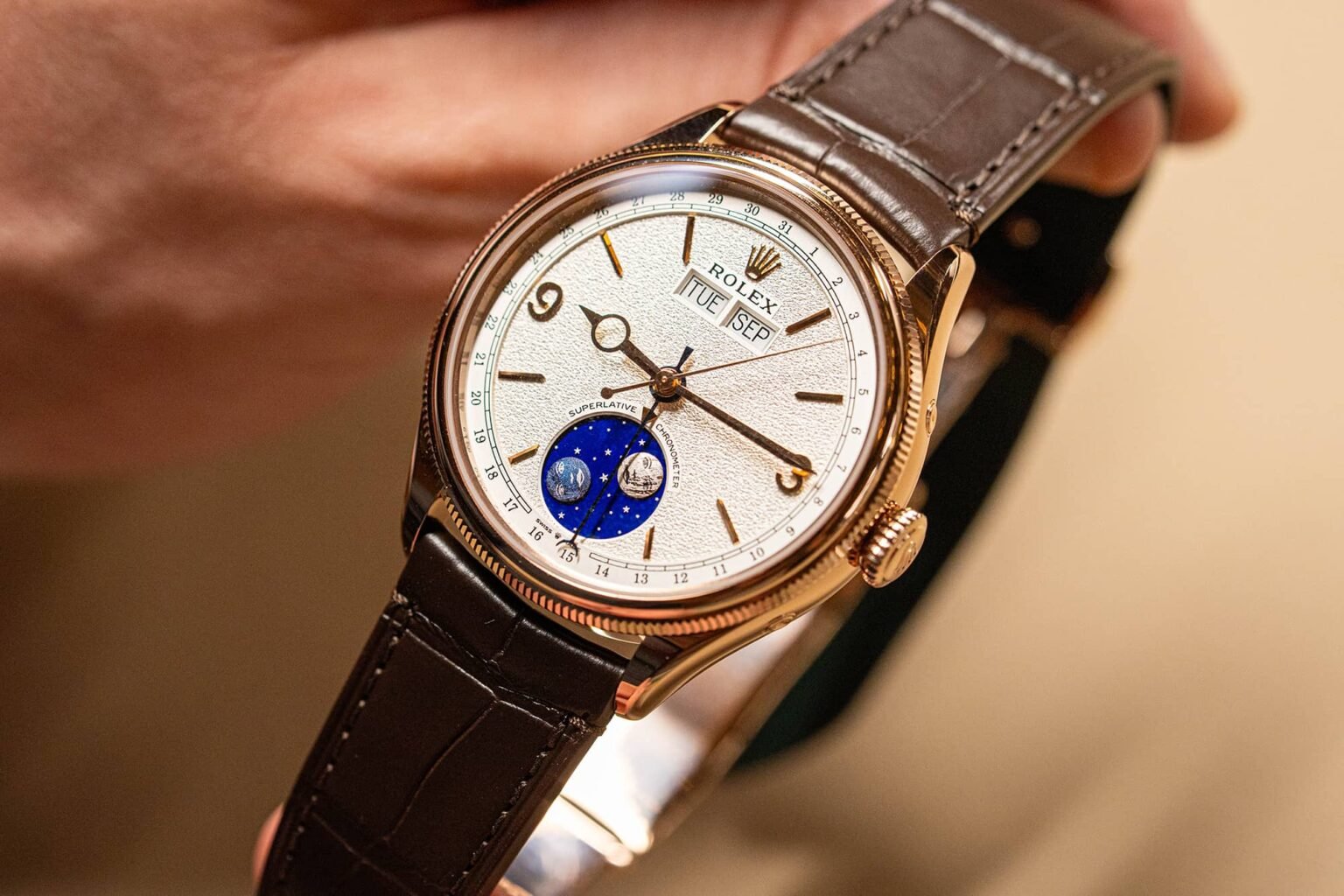
 It also takes inspiration from the textured dial of the vintage models. It has what Rolex refers to as a grained finish, but it is matte in appearance and gives a dimensionality that we just don’t see enough these days where satin and sunray finishes are the norm. But that dial texture is only part of the story. Cut-outs for the month and the day of the week feel like a direct bridge to the past, as does the pointer date for the day. Color me a little bit disappointed that the numerals for those days were not executed in the same hand-written look as the OG Padellone, but the styling of those numerals speaks to a consistency within this Perpetual collection.
Then, of course, is the moonphase. In either metal, the moonphase disc is executed in blue enamel. The full moon is meteorite with a pad-printed face in black, whereas the new moon is also meteorite but with a dark blue PVD coating and a pad-printed face.

Similar to the 1908, we have applied numerals at three and nine (the 1908 also has one at 12, but here that segment of the dial is spoken for) as well as the familiar handset and the Superlative Chronometer text draped around a subsidiary dial.
The Bracelet

I’ve alluded to it, but if the images aren’t clear, the new Padellone comes in two metals: Rolex’s Everose and Platinum, with the brand’s signature Ice Blue dial color, which we’ve also seen used in the 1908.

And the Platinum and Everose variations each come on a leather strap. But that’s not all. There’s a third configuration in Everose that comes on Rolex’s signature Settimo bracelet. We saw that bracelet debut on the 1908 in yellow gold, but this is the first time it is appearing in Everose, and I’ve gotta say, it looks absolutely amazing against the textured, intense white dial. It also contrasts beautifully against the blues of the moonphase.


The naming convention for this bracelet is from the same Italian roots as the name of the watch itself and represents the rows of seven small links that comprise it and make it so comfortable. Unlike the sportier Oyster and Jubilee bracelets, the Settimo exhibits a more jewelry-forward, vintage-leaning approach.
The Movement

In many ways, this is a watch that is all about what’s on the inside just as much as what’s on the outside. In fact, Rolex tipped its hat to its fans, and those who dwell in patent filing databases, when it filed a patent for an instantaneous day and month disc. Online chatter centered around a potential return of the Padellone, though I doubt anyone thought the brand would actually use that name.
I also doubt that anyone thought that Rolex would bring movement technology from the Land Dweller over into the Perpetual collection, but that’s exactly what it did.

The caliber powering the Padellone is the 7190, an instantaneous complete annual calendar movement that only needs adjustment once a year in February, with the aforementioned patented instantaneous calendar change at midnight. As it turns out, that patent has a name: the Haplos system. It is made up of two components coupled to the date mechanism. One of which Rolex calls a carrier finger and the other an annual lever, so that the sequence of 30- and 31-day months is kept in proper sequence.

Tying things back to Land-Dweller, this caliber also utilizes a hi-beat 5 Hz (36,000 VPH) Dynapsule escapement, replacing the conventional sliding interaction with a more efficient rolling transfer of energy. Dynapulse replaces the traditional Swiss-lever architecture with a transmission wheel, two sequential distribution wheels, and an impulse rocker, using lightweight silicon components throughout. Rather than relying primarily on sliding contact, these components are engineered around a rolling interaction, reducing frictional losses and allowing energy to be transferred to the balance more efficiently.
The 7190 also utilizes Rolex’s Syloxi hairspring, its version of silicon designed to minimize the effects of temperature fluctuations and magnetism that can negatively impact a movement’s accuracy. The balance staff follows in the theme of added robustness as it is made of ceramic, improving magnetic resistance and reducing friction at the pivot point.

I noted the curved Superlative Chronometer text earlier in the dial section, and that text is there for a reason: to signify the watch’s COSC bona fides, but Rolex takes it even further than that by testing the watch again once it’s fully cased. It does so across a variety of criteria, from precision to power reserve to water resistance and more. The stated accuracy requirement for the finished watch is −2 to +2 seconds per day.

For years, the norm for Rolex was to conceal its movement behind solid casebacks. In recent years, that has changed, and most notably so on the Land-Dweller, which has the same Dynapulse escapement seen here. The 7190 caliber is viewable through an exhibition caseback and for good reason: It looks very, very good. Standout features include an 18k gold oscillating weight in a skeletonized design, neatly framed jewels recessed in the bridges, and the Rolex Côtes de Genève finish, which is a variation on the traditional Côtes de Genève but with a more distinctive groove between each striped band. The 7190 also offers 66 hours of power reserve, which is quite impressive with the added complication it offers.
Final Thoughts

The large frying pan returns and is now an official moniker; who’d have thought that could happen? Well, if you’re big into patent sleuthing, perhaps you did think it. But also if you’ve been reading the Rolex tea leaves over the years, there have been signs of an ideological shift in design approach that has led us to a moment like this.
First there was the Le Mans Daytona range, an off-catalog launch of chronographs that brought back distinct typographical and design elements from 1960s-era Daytonas of yore. That was followed up just two years ago by the launch of the brand-new model: The Land-Dweller, which revived a 1970s design template via an angular integrated bracelet made famous on watches like the Datejust Oysterquartz.
Even this year, with the launch of the 100 years of the Oyster Case, we saw the brand commemorate the occasion overtly with a special OP model in steel and gold. Needless to say, presidents have been set to look to the past where Rolex typically has its eyes squarely set on the future.
The Land-Dweller and now the Padellone manage to accomplish both things, with realtor design elements on the outside, and cutting-edge mechanical movement technology under the hood. This Padellone launch also makes clear a new distinction in the Rolex catalog: The Perpetual line, which now claims two model families in the 1908 and this new watch.
It feels like a fresh era for a brand that has been so well defined by models like the Datejust, Submariner and Daytona. It will be really exciting to see which directions it chooses to go next with this new movement tech at its disposal. But for now, we can just enjoy the comeback of one of the most loved and coveted Rolex designs of all time. Out of the frying pan and into the Crown.

The new Rolex Perpetual Padellone comes in three iterations: Everose gold on leather strap priced at $59,000, platinum on leather strap priced at $66,200, and Everose gold on matching Settimo bracelet priced at $72,800.
For more information, visit the brand’s website here.