
- The Rolex Perpetual Padellone Specs And Pricing
- A Brief History Of Rolex Calendar Watches, Including The Padellone’s Forefather, the Reference 8171
- A Brief Look At The Technical Innovation Found In The Perpetual Padellone
- Hands-On (by James Stacey)
- Some Thoughts On Competition (by James Stacey)
- In Conclusion (by Mark Kauzlarich)
It’s a watch that has been long-awaited: Rolex has just announced the new Perpetual Padellone—a very classic and technically impressive instantaneous annual calendar with moonphase. The new release comes three years after the launch of the 1908, which replaced the discontinued Cellini collection and introduced the Perpetual line. Now, that new collection goes in a more complicated direction. James Stacey is in Milan for the launch—and even got to see the watch in advance—so read on for a section later in this article featuring his hands-on impressions.

The new 2026 Rolex Perpetual Padellone.
Let’s start with a piece of fun trivia. This is the first Rolex model—to my knowledge—to take its *actual* name from a nickname given by collectors to its historical predecessor. The ref. 8171—which Rolex explicitly cites as the inspiration for the new watch—was nicknamed the Padellone, Italian for “large frying pan,” for its wide 38mm flat case and slightly domed dial. So it’s appropriate that Rolex would return to Milan—arguably the birthplace of vintage watch collecting—to launch a watch that will likely make a lot of vintage lovers happy.

A vintage Rolex ref. 8171 “Padellone.”
Even if you don’t know the history of vintage Rolex or the 8171—which we’ll cover in a minute—a new watch from Rolex (especially one launched off-cycle, so to speak, outside Watches & Wonders) is always a big deal. The only recent similar release was the surprise launch of the white gold Le Mans Daytona at the 100th anniversary of the race, and we all know how people responded to that. Ironically, Rolex decided to launch this watch during the 100th Anniversary of the Rolex Oyster case—named for a design feat of water resistance—and the original Padellone was not water-resistant at all. Of course, Rolex has improved on all that and more.
The Perpetual Padellone immediately evokes the original watch (plus its waterproof successor, the 6062, and also a Cellini design) with a modern touch, but it’s more than that. Inside is a brand-new annual calendar (its second such model), an evolution of the caliber 7135 and Dynapulse escapement launched with the Land-Dweller in 2025. Okay, so I’m realizing there’s a lot more to talk about, so let’s dive in.
The Rolex Perpetual Padellone Specs And Pricing
In a big coup for vintage lovers, the new Perpetual Padellone looks much like its predecessor and measures similarly, with a 39mm by 12.2mm by 45.1mm case in either 18k Everose gold or 950 platinum. That’s only 1mm wider and slightly thinner than the original 8171 from the early 1950s—a watch that was already pretty large for its time at 38mm by around 13mm. As is the standard for the Perpetual collection, the new Padellone is water-resistant to 50 meters.


The new Padellone also has the same number of correctors on the caseband as the original: four, to be operated with an included correction stylus, to set the day, date, month, and moon phase. But the original watch of the 50s was just a “simple” or “complete” triple calendar that required correction, potentially every month. The new one flexes all the technical achievements of the last 70 years as an annual calendar, with day, date, and month changing instantaneously at midnight, and only needing adjustment once a year.


Similarly, the design of the Perpetual Padellone has been subtly reinvented from top to bottom. While the 8171 had a polished bezel, the new Perpetual Padellone follows the cues of the 1908, with a fluted bezel sitting above the midcase, which is accentuated by the slightly convex, curved profile lines that flow into the point of the lugs. Everything on the case, minus the bezel, is polished. The crown is also fluted and has a slight taper, flaring from inside to out. All of this is similar to the Cellini moonphase ref. 50535.


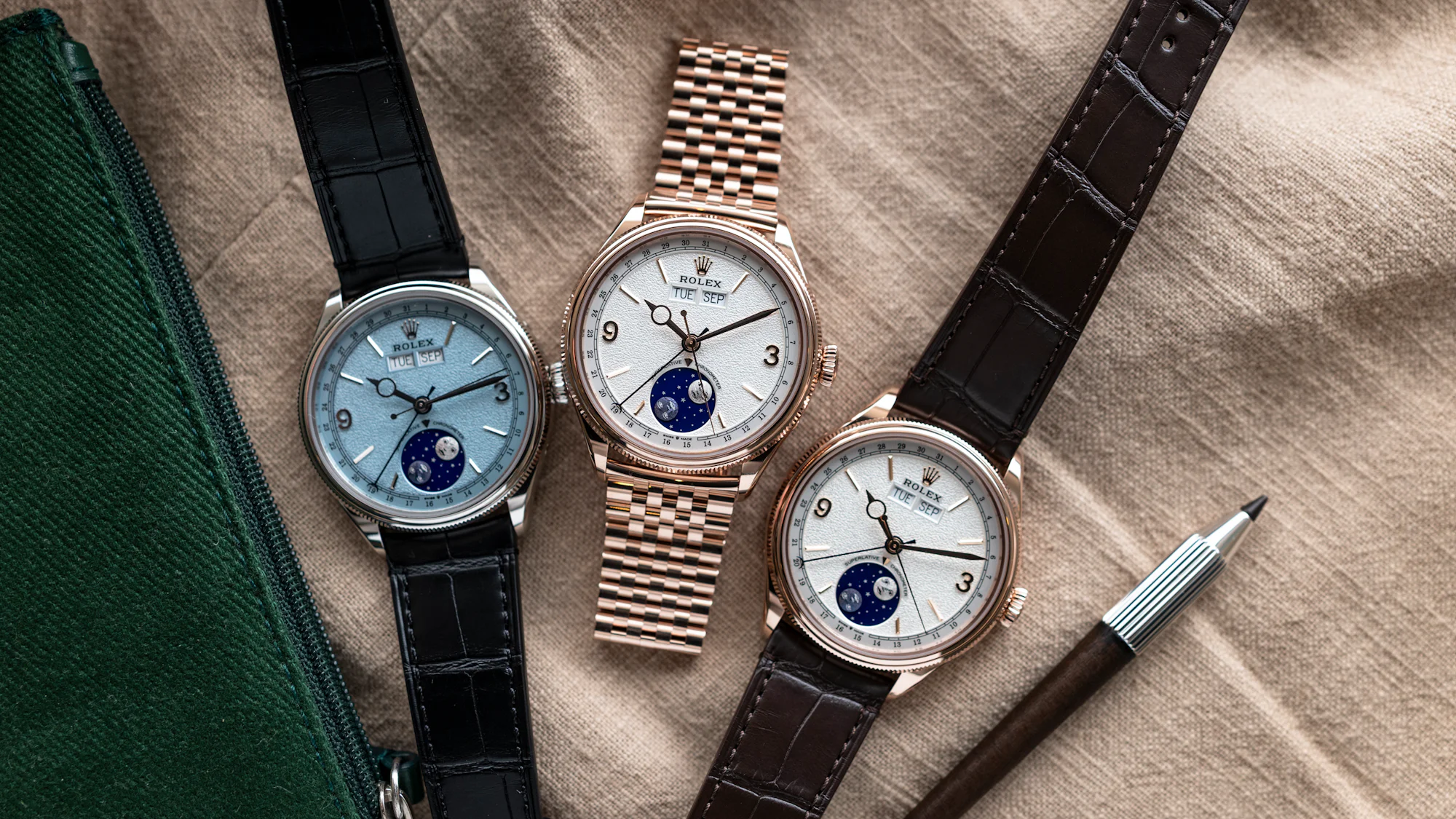
As an annual calendar, the watch displays the day, date, and month, and has a moon phase (which is not required to meet the definition). The day of the week and month are displayed in two apertures below 12 o’clock, while the date is shown with a blue hand tipped with a crescent moon that frames the appropriate number. The moon phase, at 6 o’clock, is done with a fully visible enamel disc (doing away with the half-aperture of the 8171). The full moon and new moon are done in meteorite (the latter treated with dark blue PVD), pad printed with vintage-style faces and stars. The phase of the moon is shown with an arrow index above the aperture (like the aforementioned Cellini). The time (including running seconds) is all displayed via the central post and, like the indices for the hours, is done with hands that match the case material.
Then there’s the movement, which we’ll break down into more technical components shortly. As mentioned, this is an instantaneous annual calendar. At 12 o’clock, the day, date, and month all jump forward at the same time. The moon phase, on the other hand, rotates slowly over the course of the lunar month (29.53 days per rotation). The watch only requires adjustment once per year, on the change between February and March—a defining characteristic and differentiator between annual and perpetual calendars and part of Rolex’s patented “Haplos” system.


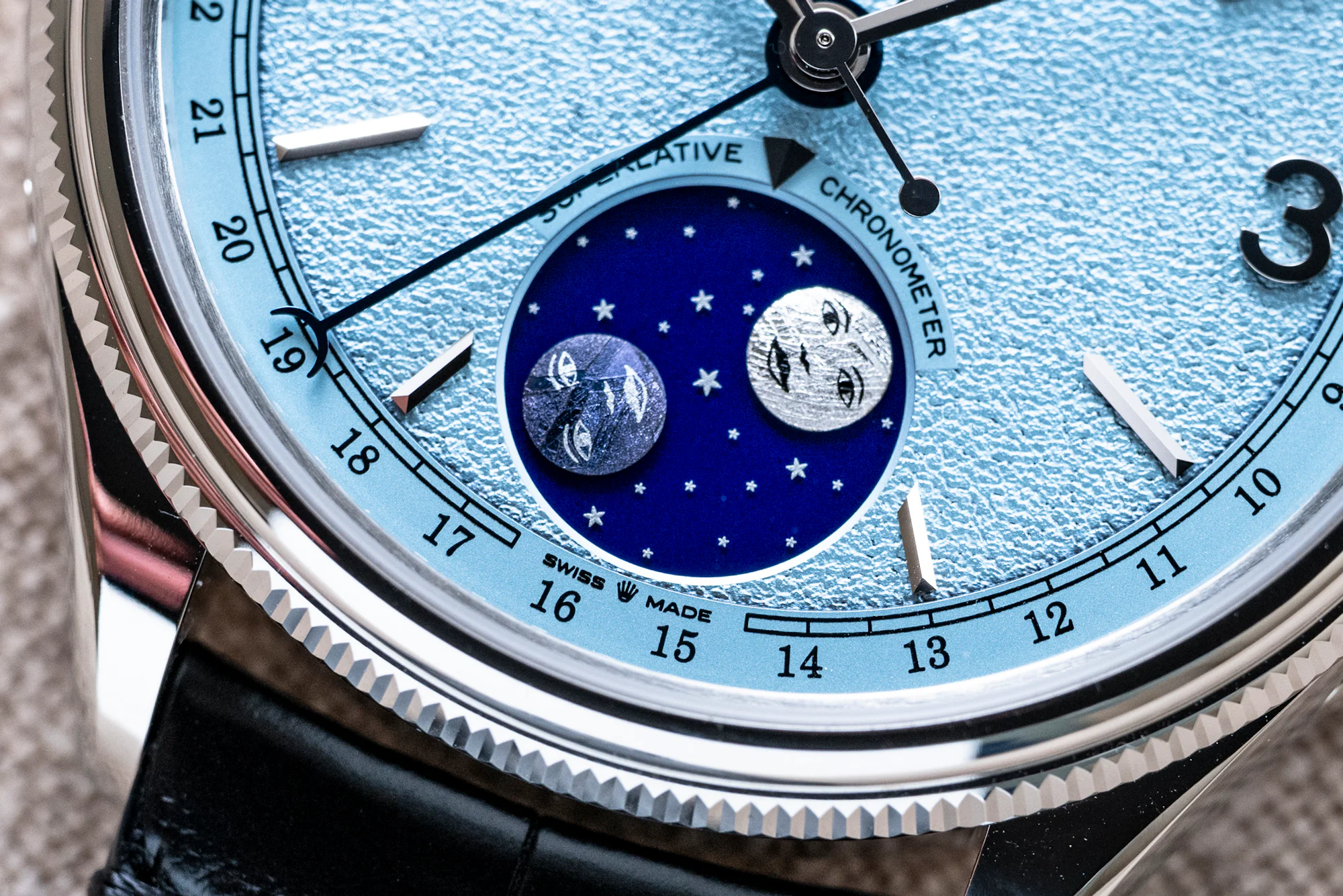
All of this is powered by the new caliber 7190, built on the achievements of the caliber 7135, which we have a technical breakdown of here. The core feature of that watch was the Dyanpulse Escapement, a direct-impulse escapement where power is delivered directly from the escape wheel to the balance, eliminating the friction of traditional escapements and providing a more consistent rate over time.

The Everose models (one on the brand’s Settimo bracelet and the other on an alligator strap) both feature highly grained central dials in an intense white finish, while the platinum model (only available on an alligator strap) features the brand’s signature ice blue dial. The outer edge of the dial (displaying the scale for the date indication) is raised, with a straight 90º (seemingly mirrored) edge down to the center dial. It also has a less intensely grained matte texture, as does any part of the dial that features pad-printing, like the Rolex name over the frame around the window and “Superlative Chronometer.”

Other small details that caught my attention from the pictures are the inclusion of the 3 and 9 o’clock Arabic numerals instead of stick indices as you’d find on the 8171. The apertures for the day, month, and moon phase are chamfered, but while the edge of the windows shares the same texture as the area with the printing, the inside of the windows up top is grained like the dial, which adds contrast.

For those running to your authorized dealers hoping to get in line, keep in mind that the 1908 rolled out very slowly. Both strap versions come with deployant clasps. This time, the retail price will be $59,000 in rose gold on strap, $66,3200 in platinum on strap, and $72,800 in rose gold on the brand’s Everose Settimo bracelet.
A Brief History Of Rolex Calendar Watches, Including The Padellone’s Forefather, the Reference 8171
This is the 30th anniversary of the annual calendar, first released by Patek Philippe back in 1996. While this is only the second annual calendar model from Rolex after the Sky-Dweller, the brand has a long history with calendar-related complications. Rolex started with the Datejust in 1945, a simple foray into telling time on a longer scale, and then, somewhat surprisingly, quickly followed up with Dato-Compax models, starting with the ref. 4767 in 1947.

A vintage 8171 next to the modern Perpetual Padellone ref. 53505.
Most relevant today is the short-lived ref. 8171 Triple Calendar in 1949, which was followed up by the waterproof ref. 6062, both discontinued in 1952 and 1953, respectively. That’s three years before the Rolex Day-Date. The resemblance between the 8171 and 6062 and today’s watch is uncanny, which is entirely the point. But it’s the first time in 73 years that we’ve had all these complications in one Rolex. Ben wrote about the curious history of the ref. 8171 in Hodinkee Magazine vol. 4 (2019), an article which we published online in 2023, a few months after the launch of the 1908. Even back then, the rumors were kicking around that a Padellone-style (or maybe more accurately a 6062-style) part of the lineup was imminent.

A vintage Rolex 8171.
The one other model worth a note is the previously referenced Rolex Cellini moonphase ref. 50535, launched back in 2017. While the Cellini family is gone entirely, some will probably remember that the 50535 was the first Rolex with a moonphase since the discontinuation of the 6062 in 1953, a 64-year absence.

The 8171 was notable for that big, domed dial, which has gone by the wayside for something flatter and dressier. That early triple calendar was most commonly found on a white dial with a small Arabic “12,” triangular hour markers, and square pyramid markers at 3, 6, and 9 o’clock. In Rolex’s press release, they show an example with four-sided stick indices (shown above), with a crown at 12 and a dot at 6. This is pretty reminiscent of third-series Patek ref. 2497s and the 2438-1 models from the same era. It’s also that style of index we see around the Padellone today.

A Rolex ref. 6062 in steel. Photo by Ben Clymer.
But you still get a splash of 6062 styling in the form of a 3 and 9 numeral on the dial, something pretty distinct to that waterproof model. The numerals are the same as those on the 1908. Compared to the vintage models more delicate and larger on the dial, and while they’re less blocky, they maintain a bit of the same feeling, especially with the “open 9.” Funny enough, the numerals on the Land-Dweller feel closer to those on the 6062. Either way, add in the technicality of the annual calendar previously only found in the sporty Sky-Dweller, and you’ve got a Rolex that’s a culmination of over 70 years of the brand’s history.

The Rolex 6062 that sold for $6.2 million at Monaco Legend Auctions in 2025. Photo by Mark Kauzlarich.
There are also a number of dial variations of 8171s and 6062s (many of which we’ve covered here), which opens up a lot of doors for Rolex to iterate over time. Slowly, of course. Rolex isn’t known for doing a ton of changes to a watch within a generation. Instead, there’s a possibility (however small) that we could see off-catalog examples like a black dial version with diamond indices like the fourth- and third-most expensive Rolexes ever sold, the “Bao Dai” 6062 and a recently sold example. I don’t imagine that a “Stelline” dial (with star indices) or stainless-steel versions of the model will ever hit the market, however. That’s just not what the Perpetual collection seems to be for.
A Brief Look At The Technical Innovation Found In The Perpetual Padellone
While there were guesses as far back as 2023 that the model 1908 would eventually become something like this, we got the biggest clue toward an impending annual calendar Padellone in the 2025 Rolex filing with the European Patent Office for exactly such a design.
Patent number EP4632499A1, filed by Rolex SA on August 9, 2025, and published on October 15 of that year, lists the inventors as Valentine Pennestri and Denis Rudaz, and refers to an “instant jump time calendar system.” This is obviously the more elegant approach to a calendar mechanism than the alternative, where the date slowly “drags” and turns over as the hands progress through the day (or more often over the course of a few minutes or hours), but it presents obvious challenges, and fewer brands do it.

We haven’t seen a Rolex movement that looks like this in a long time.
That’s because the other way, the route that Rolex is taking, is to accumulate power over the course of the day, then instantly release that power (usually through a system of intermediate wheels, levers, and programming cams) to move components forward. Therefore, you need a lot more parts, which means a more crowded (and often thicker) movement that requires a lot of power. Rolex apparently made strides in fixing all of these. Here’s an overview. Be prepared to jump around between diagrams a bit.

The Rolex Chronergy, which is very similar to a Swiss lever escapement in a lot of ways, but looks to have just modified geometry of the toothing and the lever itself.
Some guessed this patent would be used on a watch with a Chronergy escapement, Rolex’s design, which is 15% more efficient than a traditional Swiss lever escapement. Instead, Rolex went the extra mile and made this the first complication built on top of the achievements from last year’s Dynapulse escapement, which seems like a big deal for Rolex and its path forward with that innovation. The Dynapulse escapement provides a direct impulse to the balance, which skips the traditional pallet fork (sliding in and out of contact with the escape wheel) and provides an impulse 13-15% more efficient than the Chronergy, making it a total of about 30% better than the lever. But what does that actually mean?
In essence, efficiency is all about reducing friction for better longevity and power delivery—the latter of the two, which is easier to quantify. We know that Rolex’s Superlative Chronometer certification demands accuracy of −2/+2, but last year’s Land-Dweller launched that Dynapulse escapement which changed the game for Rolex. But it was the culmination of years of building their in-house silicon part manufacturing capabilities that set them up for success and continues into this watch.

The Rolex Dynapulse escapement, with parts in silicon (including the intermediary wheel).
While the caliber 7140 in the 1908 used that Chronergy escapement and Syloxi hairspring in silicon, it didn’t take the material to its full potential. The essential parts needed to make the Dynapulse system work are the dual escape wheel gears, one driven by the fourth wheel of the movement and the other driven by the first escape wheel. But the two need to serve a double purpose, as both a gear, meshing with each other, and a toothed wheel with an unusual shape that can impart that impulse to the lever. This results in a very strange design that likely would have been impossible to make in traditional metal, but with Rolex’s use of DRIE (deep reactive-ion etching), was achievable at an industrial scale. The parts are also hollowed out, which increases efficiency, and with a silicon intermediary wheel, the brand avoids any major concerns about magnetism caused by the high beat rate of 5 Hz.
The story of the calendar mechanism is another very involved one, but here are the highlights: Rolex was able to minimize the space needed to build an instantaneous annual calendar display, while eliminating the “danger zones” that other watches have, where you can’t set the date without risking breaking the movement, and making the whole thing more energy-efficient than other calendars. Is that all?

Diagram from EP4632499A1.
Again, this single patent could be another 4,000-word breakdown, but if you look at Figure 1 above, you’ll see the view of the calendar as seen from the dial side, discs and all. The date hand (13) is shown as well from the center post axis (A1), attached to a 31-tooth wheel (1). The diagram in Figure 2 offers a clearer view (viewed from the top down, still). We have the central date wheel with the gear (11), with a lever (12) that can move along the date wheel approximately 7º (or 0.5mm) along a pivot point (12b) and contacts the month cam, which is how the watch “reads” the length of the month.

Diagram from EP4632499A1.
In short, the months wheel (2) has a cam system (22) that rises and falls to match the length of the months. Most of the cam is actually lower sections (22a), but four portions are sloped and raised (22b). Do the count on your fingers — thirty days has September, April, June, and November—or go through a calendar and see the order and frequency, and you can see those are the months with 30 days. The rise, and the month cam in general, interacts with the pin (12b) on the date wheel (1) and is why that lever (12) as a whole has to be able to pivot, to adjust for the change in length of month and to know to advance from 30 to 1. Meanwhile, part (6b) is there to tension the wheel in the opposite direction and stop it from over-rotating from the instantaneous force (which we’ll get to in a minute).

Diagram from EP4632499A1.
You can see how these small levers and cams would need to be incredibly finely miniaturized to allow energy to be imparted (and to withstand torque), but they have to remain flat and compact so as not to add too much thickness. For something like the drive wheel assembly (3) that is only millimeters across, Figure 4 shows the number of parts required (while also ensuring the safety components). It’s also essential for the instantaneous calendar.
Wheel (34) takes the impulse from the gear train (power from the mainspring) and makes a rotation once per day. Above it, nestled inside, is the unidirectional coupling of a cam (33) connected via a “device” to the elastic pawl (36), which further connects the wheel (34) to the wheel (37) above. The way this is done allows the gearing to essentially slip if you wind the watch backward, without reversing the movement (for fear of breaking it). On top of wheel (37), you can see the fingers 31, 32, and 38, which work to advance the date mechanism. A lot of parts in a small space.

Diagram from EP4632499A1.
The instantaneous feature is also easily demonstrated by the drive wheel (3) and how it interacts with wheels (1) and (2), since the movement of the month is less frequent while these two—the date and the day—happen daily. As the drive wheel rotates, so does the finger or pin on top, which contacts the wheel for the date (1) to move it forward (and also move it an extra day during the short months, by contacting the compressed lever [12] mentioned above) while the finger (38) on the side moves the day. But to have the power to do this all in a burst, you need extra energy. That’s where the accumulator (4), essentially a spring, has a long arm that builds up tension on a roller (43) against the cam (33) of that drive wheel assembly (3) over the course of the day, before slipping off the cam precisely at midnight to move everything forward. Now that you know the parts, you can see a lot of them in this image from Rolex.

Courtesy Rolex.
Without breaking apart every annual calendar design on the market, I can’t exactly tell you how novel the solution is, I can just tell you it was novel enough to warrant a patent. It was also effective enough to allow for a watch that is both incredibly efficient, chronometer-certified, has increased durability, and is in a package that is still smaller than much higher-priced competitors. But I’m getting ahead of myself. The main question left is whether, reading the tea leaves, we will see the Dynapulse be the sole basis for similar complications innovation moving forward, or will we have the brand building two platforms—Dynapulse and Chronergy—side by side? Time will tell.
Hands-On (by James Stacey)
By James Stacey
I’ll take the baton from Mark as he’s got you up to speed on the new Padellone, the old Padellone, and some technical evolutions that set them apart. For my part, I’m writing this section from a hotel room in Milan following about an hour spent with the three new versions of the Perpetual Padellone, and I can fill in a few bits of hands-on experience that might not come through in the press release and included brand imagery.

Al three versions of the new Rolex Perpetual Padellone.
As you might expect from the design language and the proportions, the Padellone feels very similar to the preceding 1908. For this much more complicated evolution, the case is thicker but slightly shorter (0.4mm) than the 1908. The case shape, bezel design, display caseback, and general dial aesthetic all connect to the 1908 and the Perpetual collection and, much as it did in yellow gold for the 1908, the Padellone feels right at home on the Everose Settimo bracelet (which, delightfully, happened to be sized to fit my wrist).
The added complication (both literally and figuratively) goes a long way in helping to fill out the negative space on the dial while the moon phase replicated the footprint of the 1908’s small seconds display. With the added date pointer hand and the dual apertures for the day and month tucked under 12 o’clock, the Perpetual Padellone feels nicely balanced and more special than its sibling.

While triple calendar displays are common in the world of traditional watch design, the Padellone adds interest with the Arabic markers for 9 and 3 (previously mentioned by Mark), the railway date track surrounding the dial, and the dial texture itself. For both dial iterations (white and ice-blue), the main central dial base is grained with a strong texture on which the nameplate, date aperture, and moon phase are placed. While it doesn’t jump off the dial like one of the core functions, this finish becomes much more characterful when you experience the watch in person and in different lighting.
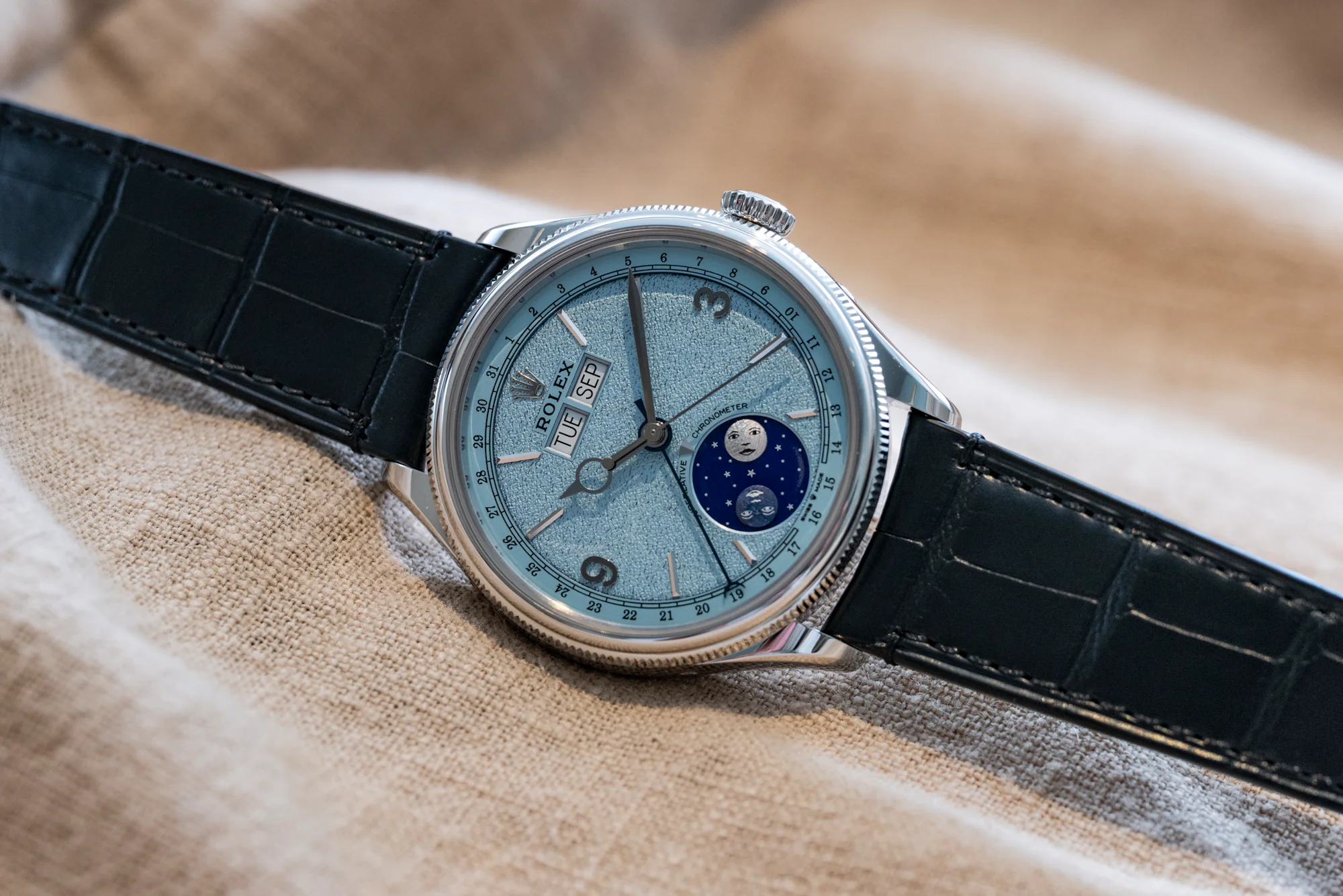
Both dials are bright but entirely matte and avoid drawing focus away from the moon phase display at six. With an enamel base and a pair of always-visible moons rendered in meteorite, both moons feature a face design inspired by the 8171, which was visible through a more traditional dial cutout.


With the watch on wrist, and considering its sizing (again, that’s 39 x 12.2 x 45.1), I’d say that the new Padellone wears a whole lot like the 1908. Basically, that means it wears like a modern larger (but not big) dress watch. The proportions are very dial-forward with the thinner bezel and more wrapped case design. It doesn’t wear like a 36mm Datejust, nor does it wear as large as a 39mm OP (to my eyes and wrist, at least).


As with my experience with the Settimo bracelet launched for the 1908, it is the best way to experience the watch, and the Everose/Settimo execution of the new Padellone feels like how this watch was meant to be worn. The bracelet is smooth, thin, drapes nicely, and matches the mid-century vibe of the Padellone with ease.
While the watch is not incredibly thin, I found it didn’t present any major issues for a cuff, and that, on the bracelet, the case sat flat and naturally on my wrist. On the straps, which were new and should be expected to break in for a better fit, the Perpetual Padallone didn’t sit as nicely but was, predictably, lighter on the wrist.


As a curious fella with some mechanical sympathy, I was interested in trying the four correctors for the date and moon phase functions. There are two on each case side, and clockwise from the top left, the correctors control Day, Month, Moon phase, and Date. Using the included stylus, the process was simple with crisp action, and Rolex assured me that this can be done at any time of the day/month without causing issues for the movement. A good innovation if you’re going to bother making an annual calendar watch. Easy to set, with no worry of doing it wrong and having to send the watch in for service.

All told, it’s a great execution of a modern Rolex calendar watch that evolves the 1908 format by just adding more. I vastly prefer the grained dial finish to the guilloché (or otherwise) of the 1908. All three iterations wore predictably for the size; the Settimo bracelet continues to impress, and after some time (and photography), I think the dials are a highlight of these new Padellone references. If I had any wishes, it would be to see a steel version, which would have been amazing and would have further connected to the lineage of the 8171 (which was offered in steel back in the day).


Some Thoughts On Competition (by James Stacey)
So, Rolex has a new and traditionally dressy annual calendar model with a tech-forward movement that starts at $59,000 in red gold and tops out at $72,800. Is that a lot? Too much? It’s certainly a lot of money in general, but what about for a qualified party interested in getting an annual calendar? Let’s consider some of the competition on the market, specifically with a few references that are similar in tone, concept, or both.

The Patek Philippe 5396R Annual Calendar.
First, let’s start with the house of the annual calendar, Patek Philippe, and the 5396R. Patek invented the annual calendar 30 years ago, and the 5396R continues that lineage in a 38.5mm modern model that is offered in rose gold for $67,517. For that price, you’re not getting a bracelet, and water resistance drops to 30 meters (vs. the Padellone’s 50 m), but you are getting a complication from Patek Philippe.

Next, we have the A. Lange & Söhne Saxonia Annual Calendar, which offers an even dressier take and, like the Patek, promises haute horology in 36mm of pink or white gold for ~$75,000. Yes, it’s thinner and features more hand-finishing, but at that price (or any price, for that matter), no bracelet is available.

And one can’t forget Blancpain, a brand with considerable acumen in the calendar space that currently offers the Blancpain Villeret Quantieme Annual GMT. This is a 40mm watch in red gold that doesn’t offer the option of a bracelet but does add a second time zone into the mix, along with a price tag of $57,400.

If you really want some bracelet competition, Parmigiani’s Tonda PF Gregorian Annual Calendar offers a more modern aesthetic, rose gold construction, and an automatic annual calendar movement in a 42mm case that can be had with a matching bracelet and also has 100 meters of water resistance. Pricing lands at CHF 80,000 (roughly ~$97,000 at the time of publishing).
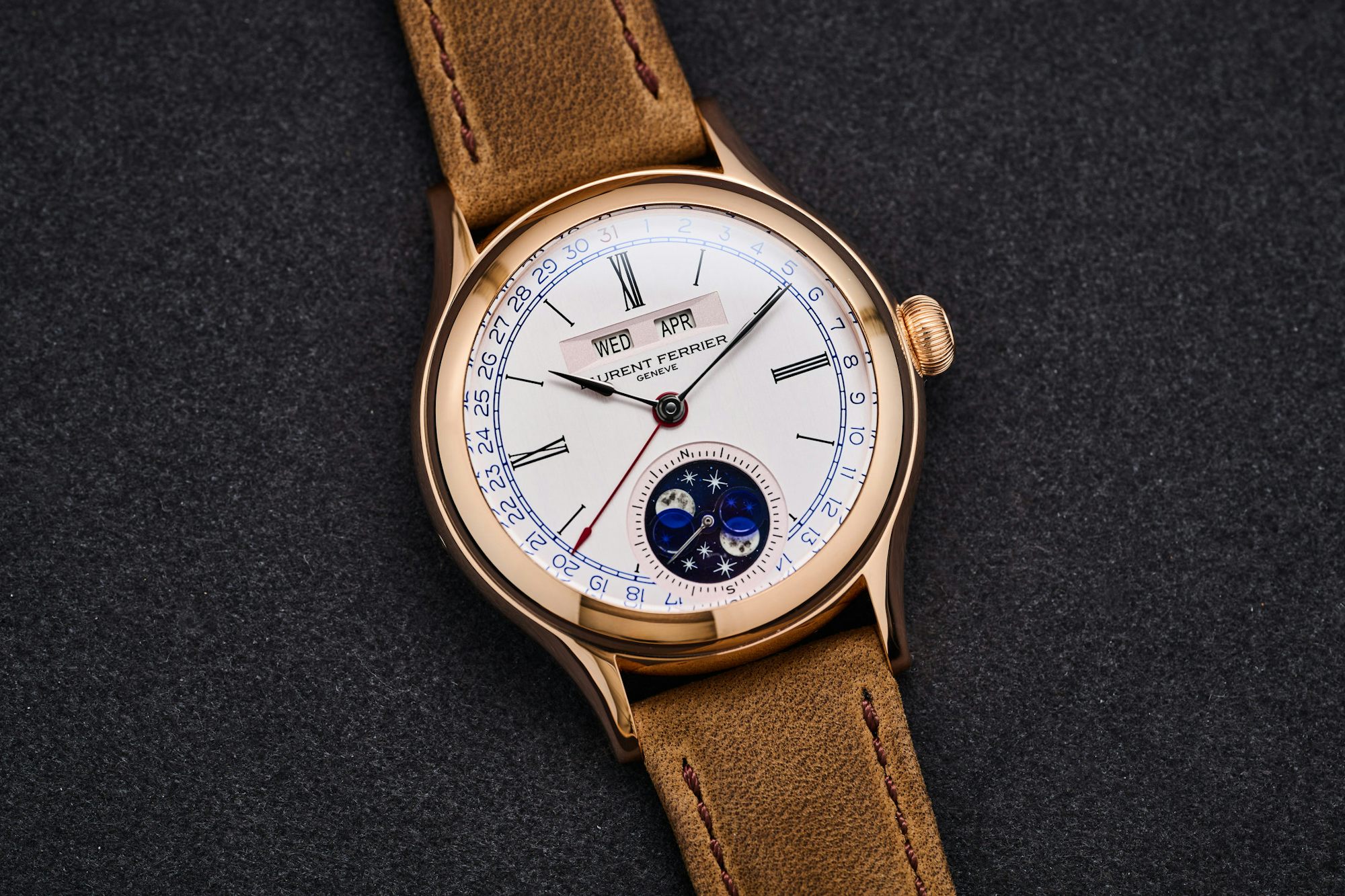
Finally, we shouldn’t omit watches from smaller but still beloved brands like Laurent Ferrier and its Classic Moon. Offered in rose gold and measuring 40mm across, the aesthetic is closer to that of the Padellone, but we move up the range in pricing, with the Classic Moon carrying a price tag of CHF 80,0000 (~$97,000). It’s also thicker than the Rolex and doesn’t come with Laurent Ferrier’s signature natural escapement.
All of the above are lovely watches that offer a variety of takes on the annual calendar format while also all exciting around (or above) the price point of the new Padellone. Yes, it’s worth noting that options like the Patek, the Lange, the Blancpain, and the LF are from brands in a higher-end segment than Rolex (one in which we would expect a higher level of finishing and execution. But it’s not as though the Rolex has only industrial finishing, nor has the crown cut any corners on the new movement in terms of handling, tech, specs, or chronometer performance (many of the brands don’t even state the accuracy of their calendars).

I can totally understand some sticker shock when a new Rolex, even one in precious metal, launches in the high 50s/low 60s. It’s a lot for a Rolex, but not insane for this Rolex (if that makes any sense). Rolex prices its watches against its own benchmark, and the full rose gold treatment of the Sky-Dweller comes in at $64,900, offering a spin on the annual calendar function alongside a second time zone. Would it have been exciting to see where Rolex would price a steel model? Yes. Have we forgotten the price of the enamel-dialed Rolesium Daytona? No.
In this case, I think it’s safe to say that the price point reflects both where the new Padellone falls in the current Rolex catalog and what seems to be a consideration of the other popular options in the segment.
In Conclusion (by Mark Kauzlarich)
It’s an exciting day for a watch lover who stands exactly in my shoes: someone who loves vintage watches but is priced out of a lot of the classics that he loves. Someone who wants something with the elegance of those beautiful old watches but also loves the practicality, reliability, and wearability of something modern. Someone who thinks that the best way to read a calendar is still with two apertures up top and a pointer date (or date around the moon phase). I sat up in my seat when I saw the press release. And again when I saw pictures on James’ wrist. It’s always nice when you feel like someone made a watch that speaks directly to you. It feels like the brands are listening and, even if you’re not buying, it’s nice to be heard.
Sure, at north of $50,000 (over $70,000 for the way that I would want to wear it, on a bracelet), it’s still far out of reach for my budget and a lot of others. But it’s not as out of reach as finding a nice 8171, 6062, or even a Patek 1526, 2497, 3448, or the like. If you are me, or standing right where I am, you can imagine that one day you might luck your way into one. Now, if the roll-out of the 1908 is any guide, this won’t exactly be the easiest watch to get. No Rolex is, but these certainly will be far rarer. For the people who can buy it, however, you’ve all of a sudden got one of the most attractive calendar watches on the market, and one with a ton of accomplishments under the hood.
For more on the Rolex Perpetual Padellone, visit the brand’s website.