

What We Know
If you haven’t heard of the brand Split before, you’re likely not alone. The brand has not previously been distributed in the U.S., but it came to my attention when their chronograph, called “In The Skies,” launched with a fully luminous case made from a proprietary ceramic-and-polymer fusion called Ceramod+. At $2,053, it was an interesting and fun novelty, and cheaper than the IWC Ceralume Perpetual Calendar (though a vastly different proposition, to be fair). Now that material, sans lumen, is coming to the United States with a new, relatively affordable GMT.

But the watches are only a small part of the story for Split. The brand was co-founded by Edward Margulies, the third generation of a prominent family of UK-based Swiss watch distributors. His father, Marcus Margulies, might be known to some as the collector behind one of the most impressive collections of Audemars Piguet watches in history, which formed the basis for much of the AP museum. Edward moved to Switzerland at the age of 19 to train to follow in his footsteps.
While the press release talks about how he spent his life putting on a smile to hide a frown caused by burying trauma for years, his interview in the New York Times reveals something deeper. The reality is that, after decades of struggling with his mental health and taking traditional paths of therapy and antidepressants, his physical health had deteriorated, and he was prescribed fentanyl. “Next thing I know,” he said to the New York Times, “I’m five years into being basically a heroin addict, falling asleep at the dinner table.”

The green color looks far more green in renderings and less seafoam, unlike what is shown in the provided image. Photo courtesy Split.

Rendering courtesy Split.

Rendering courtesy Split.
He also told the Times that coming out of treatment and into recovery, he found that the only things he knew were mental health and watches. And that’s why it’s important to provide some context for the watches we see here today (including the fact that the brand asked me to set the time to 7:23, a shape that contrasts with the 10:10 “smile” we usually see). There’s also the blend of the music component—the other co-founder, Dara Amjadi, is a musician-turned-consultant—and the entire story that tugged at my heartstrings for personal reasons.
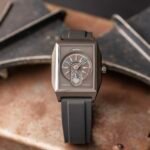
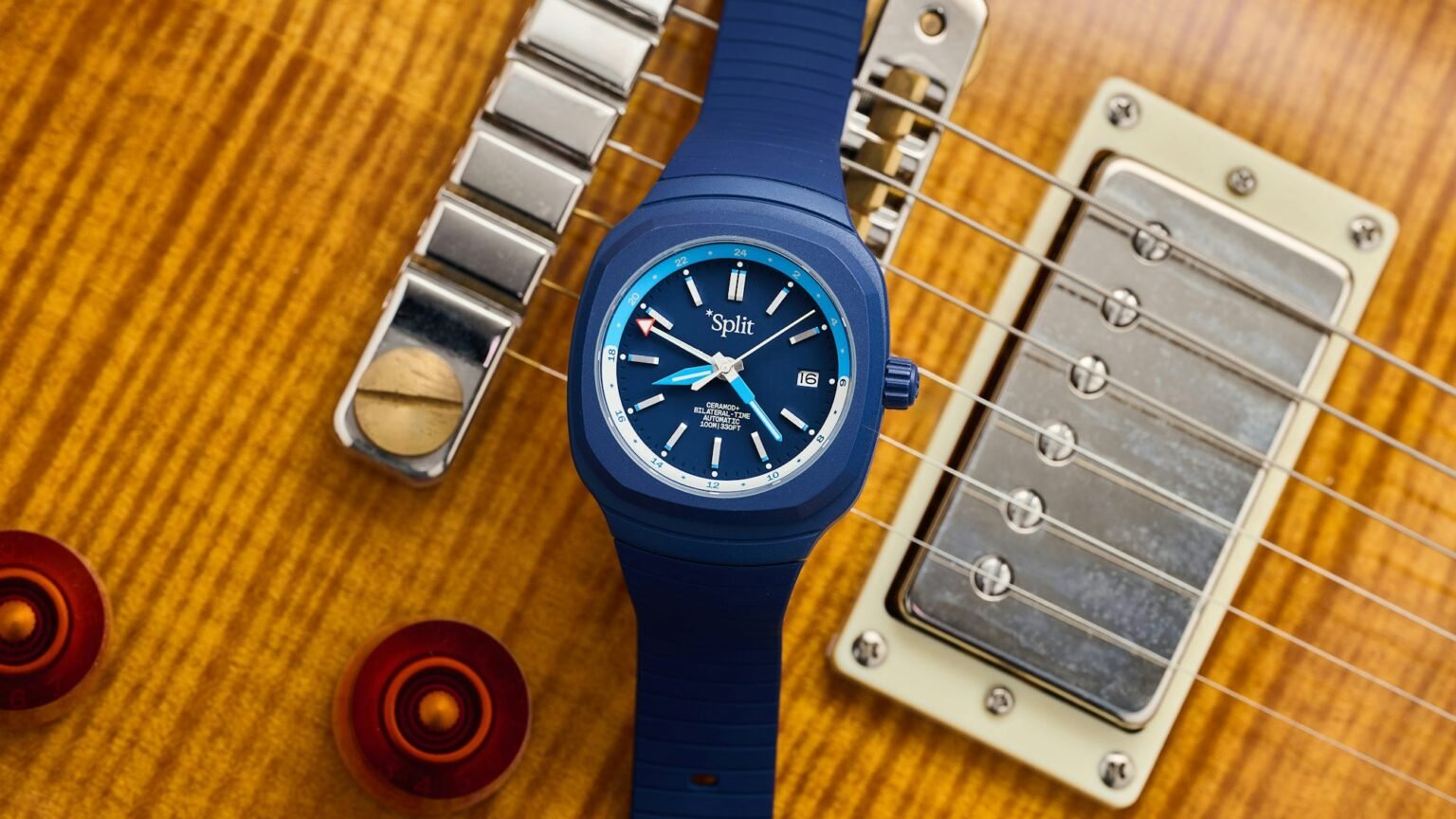
Their new watch, simply called the GMT, comes in four colors inspired by various rivers close to important locations in music history: Delta blue for the Mississippi Delta (I’d recommend putting on some Son House), Hudson for the Hudson River (the Ramones in New York), Rea for the river near Birmingham (Black Sabbath or ELO will do), and Westbourne (where you need The Clash). All the cases are made of Ceramod+, a proprietary combination of ceramics, polymers, and nylons, measuring 40mm by 12.9mm thick.


The case has a really interesting property—kind of rubbery, actually—that matches the texture of the attached FKM rubber strap. The dial has an inner 24-hour scale with a color combo that complements the case material. The one I got to see was the Delta blue, which was appropriate because I own a custom shop Martin 00-18 12-fret slothead with sinker mahogany, Adirondack spruce, and a vintage 1933 Ambertone sunburst that was designed specifically to play Delta blues (that’s for all you guitar lovers out there). You can see the other colors above, though the provided photos of the green version appear a bit more aqua than in the rendering. There’s also a light touch of lume on the watch, though I wouldn’t call it extremely legible in the dark.


The watches are powered by the Miyota 9075 automatic movement, a “flyer” GMT with an independently-set hour hand. The brand (and Miyota) calls it a “true” GMT, which James and I are similarly in agreement is a poor term to use because people like their GMTs to do different things, and one isn’t more “true” than another. I like this style; however, I could see this as being useful on a summer vacation somewhere warm, tropical, and in another time zone. The Split GMT should get around 42 hours of power reserve, and they seem to have left the 4Hz movement largely untouched. The sample I got was missing the caseback “Star,” but you can see the photo further down.

Rendering courtesy Split.
The Split GMT retails for $980, with each color limited to 250. The brand’s motto is “Time for Change,” and for every watch sold, Split funds one hour of therapy through its partnership with MusiCares, supporting young people’s access to mental health care.
What We Think

I quite enjoyed the Split GMT in person. Yes, I have my quibbles with some things—like the usage of “true” for the GMT or the fact that the brand calls this a “single pusher GMT” on their website when there is only a crown and no pusher—but this feels like a good watch for the money and in support of a good cause. Other Miyota 9075 watches sell for around the same price, so that’s a check. It’s not too stuffy or serious, but still a solid quality, which is another check. On the wrist, it does feel a bit thicker than I would have expected from the measurements, but I think that comes down to the strap being robust and tapering in thickness starting at the case, giving an integrated-bracelet feel.
While I don’t know that anyone necessarily buys a watch for the charity portion that goes along with it, instead of just donating to charity yourself, I do have to give some extra props to the Split team for partnering with MusiCares. That’s a charity that’s been near and dear to my heart as a music lover, musician, and someone who has known (and lost) too many people to mental health and substance abuse over the years. Sure, a lot of brands donate to causes, but sometimes there’s some hand-waving and a bit of mumbling about how much they donate and to where, but this is a charity you can stand behind. It doesn’t hurt that the watch is cool, too.

The Basics
Brand: Split
Model: GMT
Diameter: 40mm
Thickness: 12.9mm
Case Material: Ceramod+ in various colors
Dial Color: Various, depending on model
Indexes: Applied
Lume: Yes, unspecified
Water Resistance: 100m
Strap/Bracelet: Rubber, 19mm wide

The Movement
Caliber: Miyota 9075
Functions: Hours, minutes, seconds, date, “Flyer” GMT
Power Reserve: 42 hours
Winding: Automatic
Frequency: 4Hz
Chronometer Certified: No
Pricing & Availability
Price: $980 — One hour of therapy donated per watch through MusiCares
Availability: Now
Limited Edition: Yes, 250 pieces of each watch.
For more, click here.