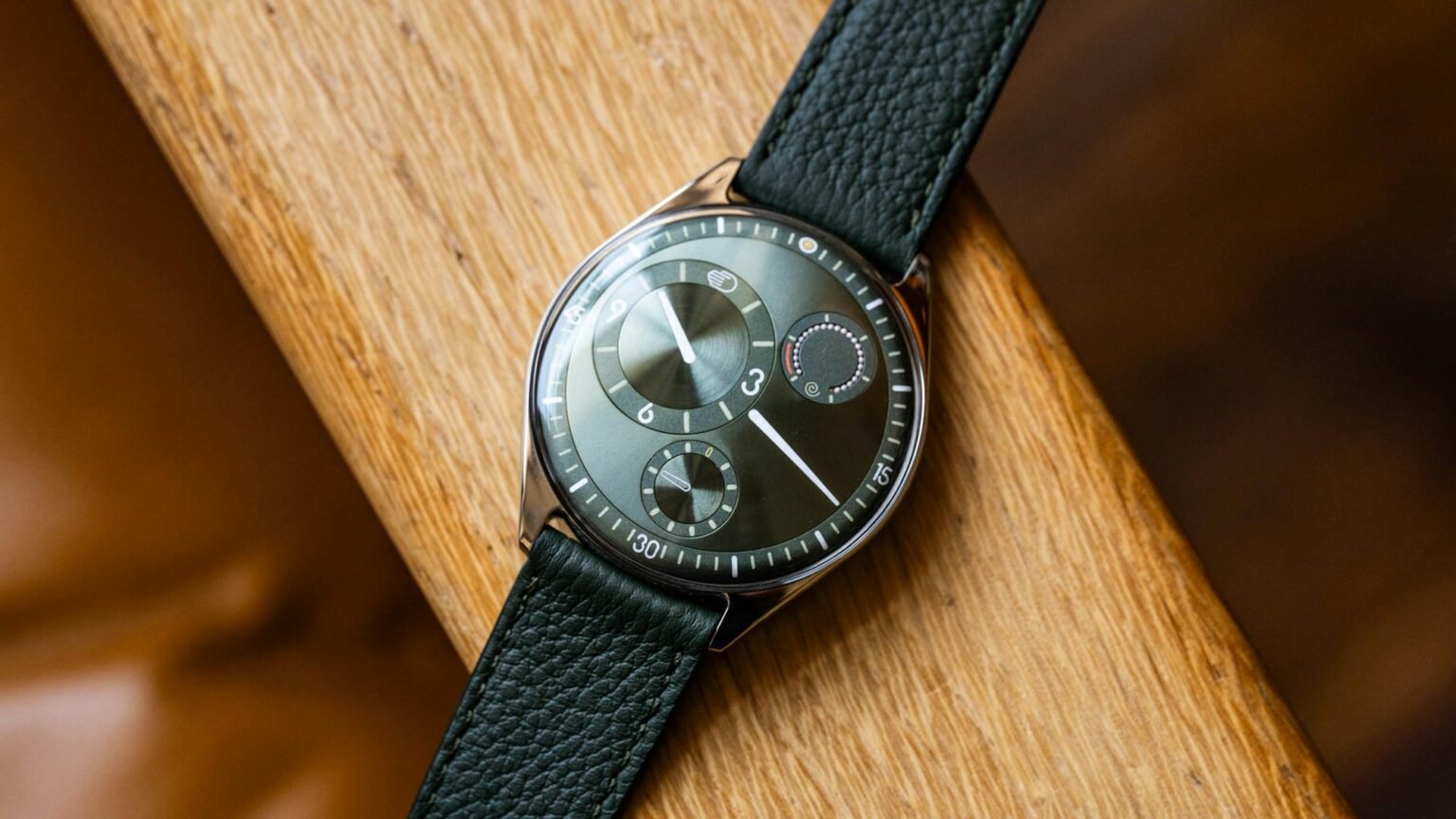


At a glance, the Ressence Type 11, which launched earlier this year at Watches and Wonders, might feel like every other Ressence. That’s kind of the point. Distinct as it is within the collection, the Type 11 keeps the brand’s visual language intact while changing what’s underneath it. The biggest change is under the hood—it’s the first Ressence to feature the brand’s own integrated caliber, replacing the usual combo of an ETA base with Ressence’s Orbital Convex System on top.


Before we get to more on that, let’s take a look at the Type 11’s exterior. The 41mm by 11mm case, in grade 5 titanium, continues the trend seen in many of Ressence’s recent releases toward more compact cases and feels like an evolution of the Type 9, in a sense. A fully polished, almost tonneau-shaped case features a short 45mm lug-to-lug measurement, while the lack of downturning of the lugs means the case still maintains quite a bit of presence on the wrist. On the Type 11, the lack of a bezel means the dial and crystal extend to the edges of the 41mm diameter. It’s this kind of seamless visual effect that has lent models like the Type 1 and the Type 3 a distinctively futuristic look, and here it works very well with these lugs. Water resistance is bumped up to 3 ATM (as opposed to the typically “splash resistant” rating of its non-dive watches).
On the dial side, we get the satellite display that Ressence is best known for, showing the hours, running seconds, and a power reserve indicator within three orbiting subdials, while the minutes hand points to a track on the perimeter of the dial. My favorite new addition, by far, is Ressence’s interpretation of the 60-hour power-reserve indicator, via a track of miniature colored ceramic ball bearings. Rather than a hand, a yellow ceramic ball indicates the power reserve on the scale. If the power reserve is at zero, the yellow ball sits at the beginning of the scale, and the rest of the track is filled with black ceramic balls indicating that the watch needs winding. But as the power reserve gradually increases, the yellow ball travels around the scale, revealing white ceramic balls behind it to fill the power reserve.

The power reserve starting to fill.

A full power reserve.

While it’s the first time we’ve seen this implementation of a power reserve, this concept actually stems from the Type 1 Squared X from 2020, which introduced a “Time By Color” system that marked the passage of 24 hours through a changing color composition using small ceramic balls. While you could argue that the idea was rooted in philosophical frivolity, using this system as a power reserve indicator is a bit more practical. And yes, it is incredibly fun to manually wind this watch and see the balls progress on the track. In a dial that’s already quite cramped with moving parts, it’s kind of a magic trick to think about the sheer number of ball bearings needed for both the dark and light portions underneath the hood.
I have a hunch that we’ll be seeing this ball-bearing implementation in future watches, with the power-reserve functionality part of this new RW-01, the first Ressence caliber designed in-house. Now, that wording means the caliber is not being produced or assembled in Belgium, but the movement’s architecture and styling are 100% the mind of founder Benoît Mintiens and his team. A fully integrated caliber is surely meant to silence the detractors who have (in my opinion, understandably but wrongfully) bemoaned the usage of an ETA 2892 underneath the previous ROCS module, but there are quite a few improvements here that I’m glad to see.

Ressence Caliber RW-01

RW-01 images courtesy of Ressence.
First, of course, is the improved 60-hour power reserve, which had previously hovered around 36 hours in other models. This new power reserve indicator replaces the typical day-of-the-week subdial, which, as a Ressence owner, I found incredibly annoying to set and not all that useful as an indicator. Ressence points out that the orbital system now uses titanium ball bearings, which should improve the display’s feel. In the time I had with the Type 11, I do think the overall display felt a bit more stable than in the previous modular setup, but it wasn’t a particularly dramatic change.

The biggest improvement the RW-01 brings to the table, however, is the elimination of the “winding zone” that was a distinct trait of past designs. Previously, to wind the watch via the caseback, you would essentially have to find a point in the caseback’s rotation with higher resistance and twist the caseback back and forth over that specific portion of resistance to wind the watch. But here, that is no longer the case, and turning the caseback clockwise will continuously wind the watch. Of course, the RW-01 has a rotor, which means automatic winding is also available.
The RW-01’s curiously symmetrical architecture shows off its two mainspring barrels in a triangular top-half, while the balance wheel sits at the bottom center for a trifecta of circles. It’s all obscured by the caseback, however, which only offers a small window to show off the beating balance wheel at work. What you get instead is a handle that hinges out from the caseback, which significantly eases setting the time and manually winding the watch. I strongly believe that no Ressence should be made without this handle, as it single-handedly makes or breaks how easy you can operate one of these watches.
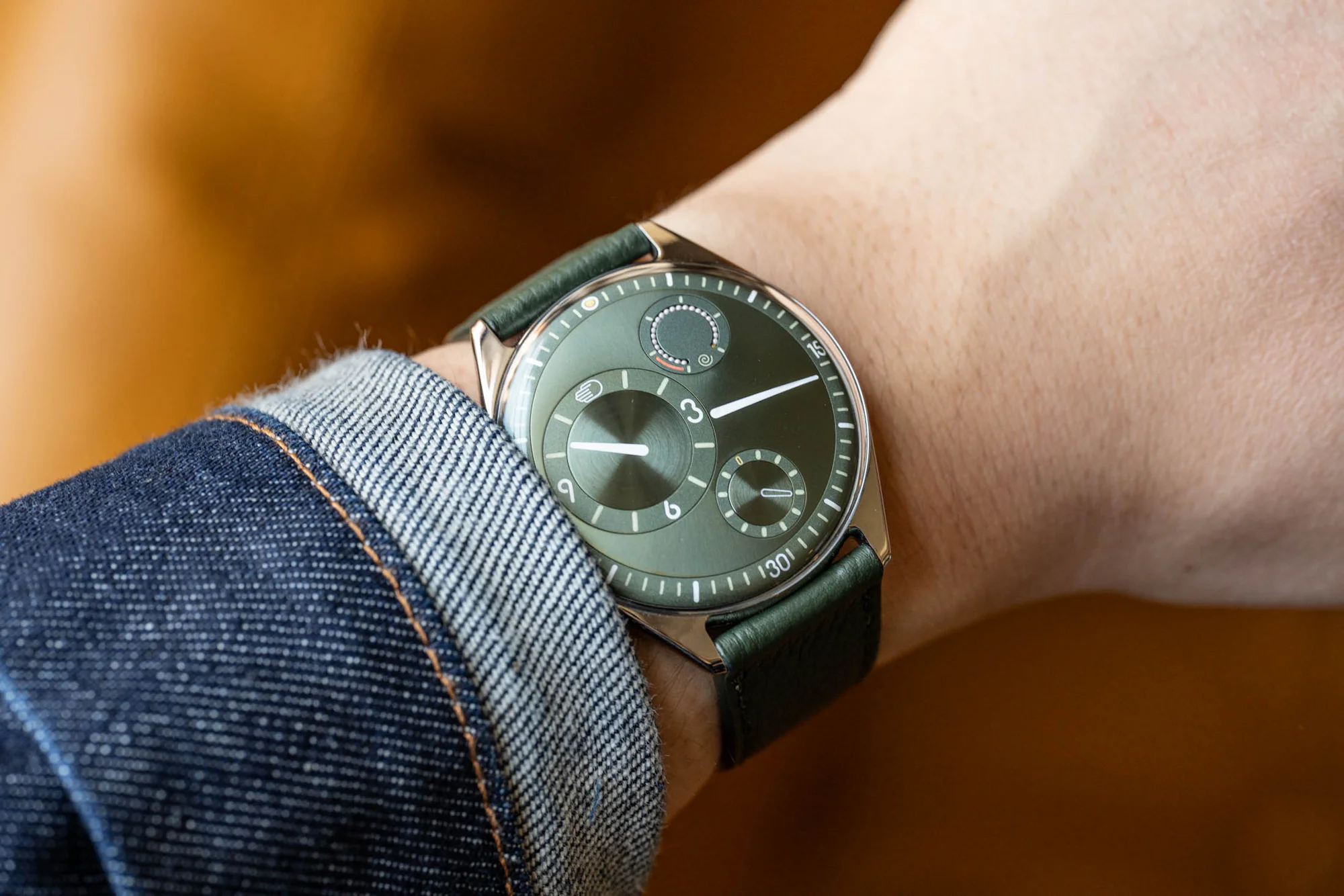
While the RW-01 is surely a welcome change for the brand, it also comes at a price. For those who have already found the Type 1too expensive, the Type 11 need not be considered. Compared to a traditional Type 1, which retails around $25,000, the Type 11 is priced quite a bit higher at $31,400. But you are getting quite a few substantial changes here, mostly in that proprietary RW-01 caliber, with bumped-up specs and a completely unique power reserve implementation. It’s also a more compact watch, partly thanks to the new integrated movement, which fits well even on smaller wrists (like mine). In a sense, the Type 11 feels like the most Ressence take on a Ressence to date – a playful spin with a good number of improvements that manages to preserve the brand’s distinctive design.