

Cybèle Vigneron and Carla Lanfranchini first met at the Strate École de Design outside of Paris, arriving at the institution with enviable backgrounds: Lanfranchini had served as an artistic director and graphic designer at Dom Pérignon and Château de Pommard, while Vigneron honed her career in store design planning and visual merchandising at Cartier, Bulgari, and Berluti. The two became fast friends. After both earning dual degrees in design as well as business management, they established Version Watches in 2024.
They were entering a crowded field where microbrands have never been more popular, with even greater opportunities for designers and watchmaking visionaries to express themselves. Over the past two years, as they worked in separate cities and handled branding, design, distribution, and a successful Kickstarter launch, the two-person team were motivated by uniqueness: “we wanted to approach watchmaking from a pure designer’s perspective rather than just assembling off-the-shelf components or relying purely on nostalgia,” said Vigneron.

We first saw Vision on display in New York at Tempus Takumi, a showcase of independent watchmaking that pointedly focuses on watches made outside of Switzerland. Alongside the design-driven, accessible collections from Germany’s MeisterSinger and Japan’s Minase, Version fit right in. Both founders were present and clearly happy to show off their creations, making their debut to an American audience. Accessibility is one of the most appealing aspects of investing in microbrands; one can hear from designers, watchmakers, and the founders themselves the justifications behind every design choice, no matter how minute or outré.

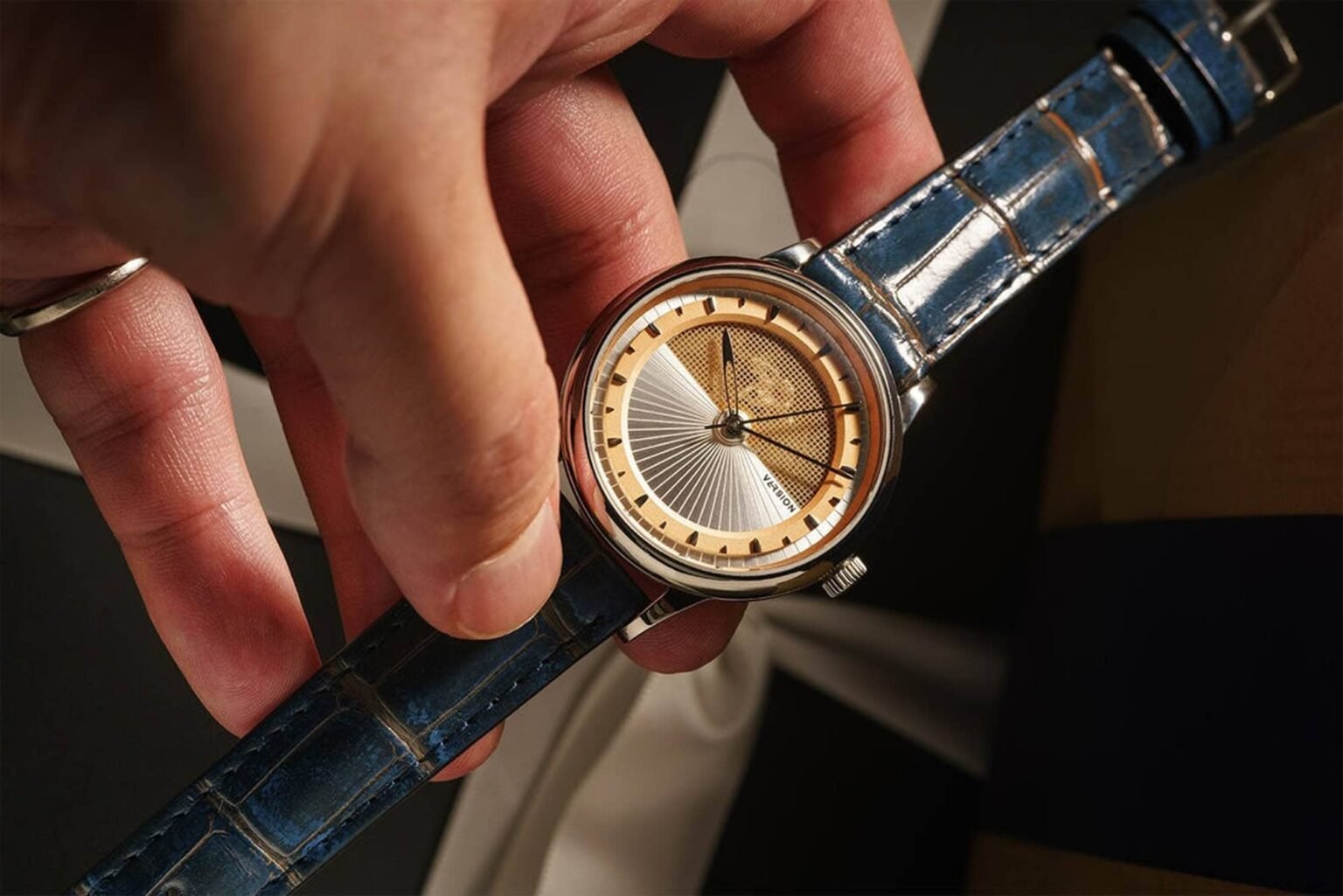
And all three models in the current line, the V01-LCC ($1,850), make a compelling first impression: layered with depth and contrasting patterns, the watches feature proudly intricate dialwork that are a marked departure from anything we’ve seen in a while—yet with vintage proportions and case shapes, still seem altogether familiar.
The first thing you notice is the bisected dial. It features a lattice pattern on the top half and a series of converging etched lines on the bottom, heading to the center of the watch like a grid map to the horizon. The crisscrossing lattice sets itself apart with contrasting colors: gold over a white and silver lower half, on one model, white over a deep and shimmering navy blue on another. Behind the latticework, a reliable Sellita SW200-1 automatic movement peeks through.

It is Version’s take on a skeleton dial. So many watches are either completely closed or fully skeletonized, Version’s founders explained: “it’s an invitation to lean in, look closer, and lose yourself in the micro-architecture of the dial and the beauty of fine mechanics.”
The Sellita movement is also on display via a clear caseback, with the addition of one cozy detail: one can see right through the watch to the grid on the other side. Around the two halves of the dial is a wide hour and minute track, and the rounded, bullet-shaped markers echo the curvature of the wide hour hand, whose elongated and open shape recalls the fat end of a sewing needle. The modest case is 38mm in size, capped top and bottom by otherwise conventionally-shaped lugs; perhaps with so much intricacy going on with the dial, there’s no need to reinvent a recognizable case shape.

Vision’s founders drew inspiration from so much more than just conventional watch tropes. Instead of relying on the growing cliches of stone dials and diamonds, or the machismo of heritage-inspired divers and field watches, they sought to evoke architecture, automobiles, and industrial furniture: chiefly, the geometric forms of Bauhaus design, the curves and proportions of the Aston Martin DB5. And even more specifically, the LC4 Chaise Longue by Charlotte Perriand, an ergonomic lounge chair formed from curving steel tubes and flowing leather that was considered too avant-garde when it debuted in 1928. Perriand’s work was eventually overshadowed by the likes of Marcel Breuer and Le Corbusier (who gave design input, but the result was entirely hers); here, it served as a guide to how the watch could be constructed through the pure form of metallic framing.
Alongside the metaphorical mood board, Version’s founders included the Citroën SM, the Alpine A310, and the (delightfully obscure by comparison) Matra Bagheera. These three wedge-shaped Gallic legends that made their greatest impacts in the 1970s, perhaps a little later than the midcentury or Bauhaus aesthetics cited on Version’s website. Yet, their engine louvers and rear window grilles (jalousies, in French) inspired the notion of a semi-hidden mechanical heart. “What fascinates us about automotive design is that it is a total art form: it demands complete aesthetic and functional harmony, from the exterior bodywork down to interior ergonomics. Watches operate on the exact same principle,” explained Vigneron.

Version is preparing to launch a second collection in September 2026: this time, the V0201-TH collection shifts toward French aeronautics, namely the Concorde: instead of a lattice grille, translucent colored elements aim to suggest the view of a smoky, dramatic sunrise through the windows of a supersonic cockpit.

Being so attuned to French design, of course, Vigneron and Lanfranchini couldn’t stop there: for the next collection, they draw inspiration from interior architect Andrée Putman. Look her up, if you haven’t already: her work includes the interior of said Concorde. If speaking to design history leads fellow watch enthusiasts down Wikipedia rabbit holes of inspiration, then Version will have done their job: finding an artistic foothold in the ever-growing world of independents. Version Watches