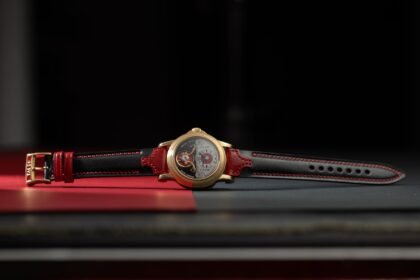
It’s fairly likely that I’ll never get tired of writing about the Freak. Ulysse Nardin’s avant-garde masterpiece is one of the central characters in the ongoing story of modern watchmaking. All of your favorite adventurous independents owe something to Ulysse Nardin for creating something so brash and, pardon the overused phrase, disruptive. Over the many years of the Freak, it’s existed in a variety of forms, from the relatively simple to the head spinning complexity. The latest, a purple enamel version of the Freak S, is decidedly in the latter camp, at least in terms of its mechanical ingenuity.

One of the things that’s so charming about the Freak is the way it combines forward looking mechanics with classical watchmaking techniques. The movement, which is in constant rotation is used to read the time instead of traditional hands, is a radical rethinking of how a mechanical movement can work, and unlike anything else on the market. But the Freak frequently borrows from centuries old techniques that are often associated with more traditional watchmaking.

To that point, this Freak S is in a titanium case and features a purple enamel dial surface (not really a “dial” of course but you’ll forgive the use of the term for the purposes of this description). Enamelling is a watchmaking craft that has been in use for as long as watchmaking itself. For this version of the Freak S, we get a guilloche-flinque enamel hour disc that sits below the caliber that is the centerpiece of every Freak. The disc is made in-house at the Donzé Cadrans workshop.

The real star of the show, of course, is the mechanical caliber that allows Ulysse Nardin to make the unique claim in watchmaking that their watch has “no hands, no dial, no crown”. The caliber UN-251 is made of 373 components and rotates around its own axis. The movement is designed to make a full rotation every 60 minutes, allowing for an intuitive display of the current minute via a pointer integrated into the movement design. The purple disc rotates as well, providing a reading of the hours, also via a pointer.
The movement is operated without a crown by first unlocking it via the safety positioned at 6:00 on the case. Time can then be set in both directions by rotating the bidirectional bezel. Winding the watch is accomplished by rotating the caseback counterclockwise, which transmits energy directly to the movement’s barrel.
The movement architecture on the display in the Freak S has many innovations, including two inclined silicon balance wheels, and what the brand says is the world’s smallest differential, which constantly averages the rate of the two balance wheels. It’s also the world’s first automatic watch with a double balance movement.

This is the type of watch that outsiders to the hobby (and cynics) look at and say “What’s the point?” It’s wildly expensive, overly complex to the point of absurdity, and there are, frankly, easier ways to read the time and operate a mechanical watch. That, obviously, is not the point of the Freak. This watch and others in the Freak collection exist to challenge watchmaking norms while at the same time celebrating the inescapable time honored traditions of classical watchmaking. I don’t think any watch finds the balance between those two ideas better than the Freak.
The Freak S in purple enamel is limited to 50 pieces, and the retail price is $174,400. Ulysse Nardin