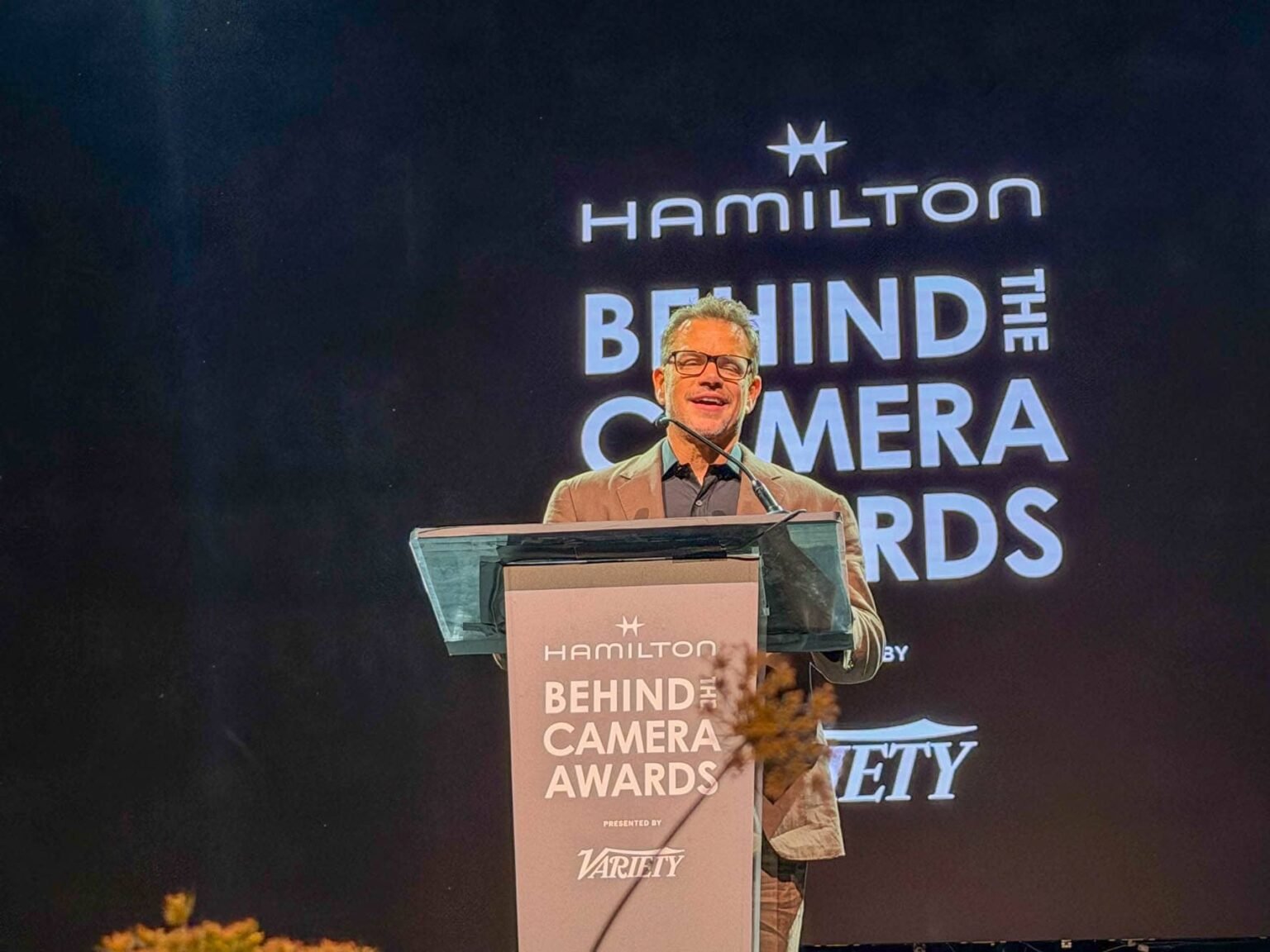


Hamilton and Variety held their annual Behind the Camera Awards on Friday evening, an awards show in Los Angeles that has become a staple on the watch media press trip circuit, but that I’ve personally never been able to attend (you can find our previous coverage of the event here and here).
With an opening on my calendar and an invite from Hamilton in my inbox, I jumped at the chance to finally attend the unique event, co-sponsored by the watch brand and the trade paper of record for the last 15 years. The Behind the Camera Awards are not an awards show like the Academy Awards or the Grammys where nominees gather and a winner is pulled out of a mystery envelope. It’s more of a curated presentation that aligns with Hamilton’s longstanding tradition of building relationships in the film industry as the main supplier of on-screen watches to feature films large and small.

The relatively simple concept here is that the awards are presented by stars (in front of the camera) to notable behind the camera talent. The headliners, then, are really the presenters, and we got some genuinely big stars this year honoring their behind the camera colleagues. Matt Damon (The Odyssey), John Malkovich (Wild Horse Nine) and Dune director Denis Villeneuve among them (Denis of course is himself behind the camera talent, but has become something of a brand name unto himself among filmmakers, so he gets a pass here).
The honorees included the sound team from The Odyssey (Willie Burton, Craig Henighan, Gary A. Rizzo & Kevin O’Connell), Wild Horse Nine director Martin McDonagh, and cinematographer Linus Sandgren for his work on Dune: Part Three. My single favorite speech of the night was for the screenwriting award, shared by Rashida Jones and her writing partner Will McCormack, who co-wrote The Invite, a personal favorite of mine. Their speech, about their 20 year friendship, the ups and downs of life, and how it informs their work, was funny and moving.


Writing about events like this after the fact is usually a fairly straightforward proposition, because there’s almost always a watch to discuss which becomes the center of the piece. The Behind the Camera Awards are a little different, because at least this year, Hamilton did not use the event to focus on a new release or to spotlight a collection. The entire time I was in Los Angeles, I don’t think I was ever actually handed a Hamilton watch that the brand wanted me and other members of the media to write about. The focus was entirely on the awards and Hamilton’s larger connection to the film industry.

Hamilton did take the opportunity to bring a handful of watches to the event from their archives for display purposes. Presented under glass, these are some of their most historic pieces from their decades of being involved in the film industry. Among the most interesting, a period correct and rare gold version of a Flintridge, similar to the one that appears in Shanghai Express from 1930, one of the earliest examples of a Hamilton appearing in a feature film. Hamilton also brought a Khaki Field worn in Pearl Harbor and a black on black Khaki Field worn in The Dark Knight Rises, a far more low-key Hamilton appearance in a Nolan film than the ones we normally discuss.


As a movie lover, I’m of course interested in watches that appear in films and take notice of when unusual or particularly interesting choices are made. But I have to admit that as I’ve gotten deeper into the watch industry and have come to understand that many of these decisions are built around existing endorsements and deals that on-screen talent has with watch brands, I’ve become a little more cynical about the whole thing. Often, the choice of which watch appears on the wrist of a featured player comes down to relationships rather than an artistic choice.
But Hamilton seems to have a different approach. While there is undoubtedly a business relationship that forms between the brand and the production companies involved with the films they provide watches for, there are many, many instances of Hamilton watches that appear in movies that are relatively unsung, and the fact that they have prioritized putting their watches onscreen for nearly a century says a lot.
The Behind the Camera Awards, as a media trip, was refreshing in that it wasn’t focused on selling us something specific to make ephemeral social media from, but to immerse those in attendance in a core component of what the brand is actually about. Hamilton