
TAG Heuer, which was founded as Heuer Watchmaking by Edouard Heuer in 1860, built much of its modern reputation as an innovator in chronograph watches for automobile racing. Its most iconic models, the Heuer Carrera and Heuer Monaco, both debuted in the 1960s and remain inextricably linked with motorsports. By the end of the 1970s, however, the company was exploring a new realm of sport-oriented timepieces that would be at the forefront of its transition from the family-owned Heuer firm to the modern era that began in 1985 when it was acquired by Luxembourg-based high-tech manufacturer Techniques d’Avant-Garde (TAG). The watches from this pivotal period would form the foundation of today’s TAG Heuer Aquaracer collection, which continues to grow and evolve today.
[toc-section heading=”Aquaracer Ancestors: Ref. 844 and Beyond (1978-1998)”]

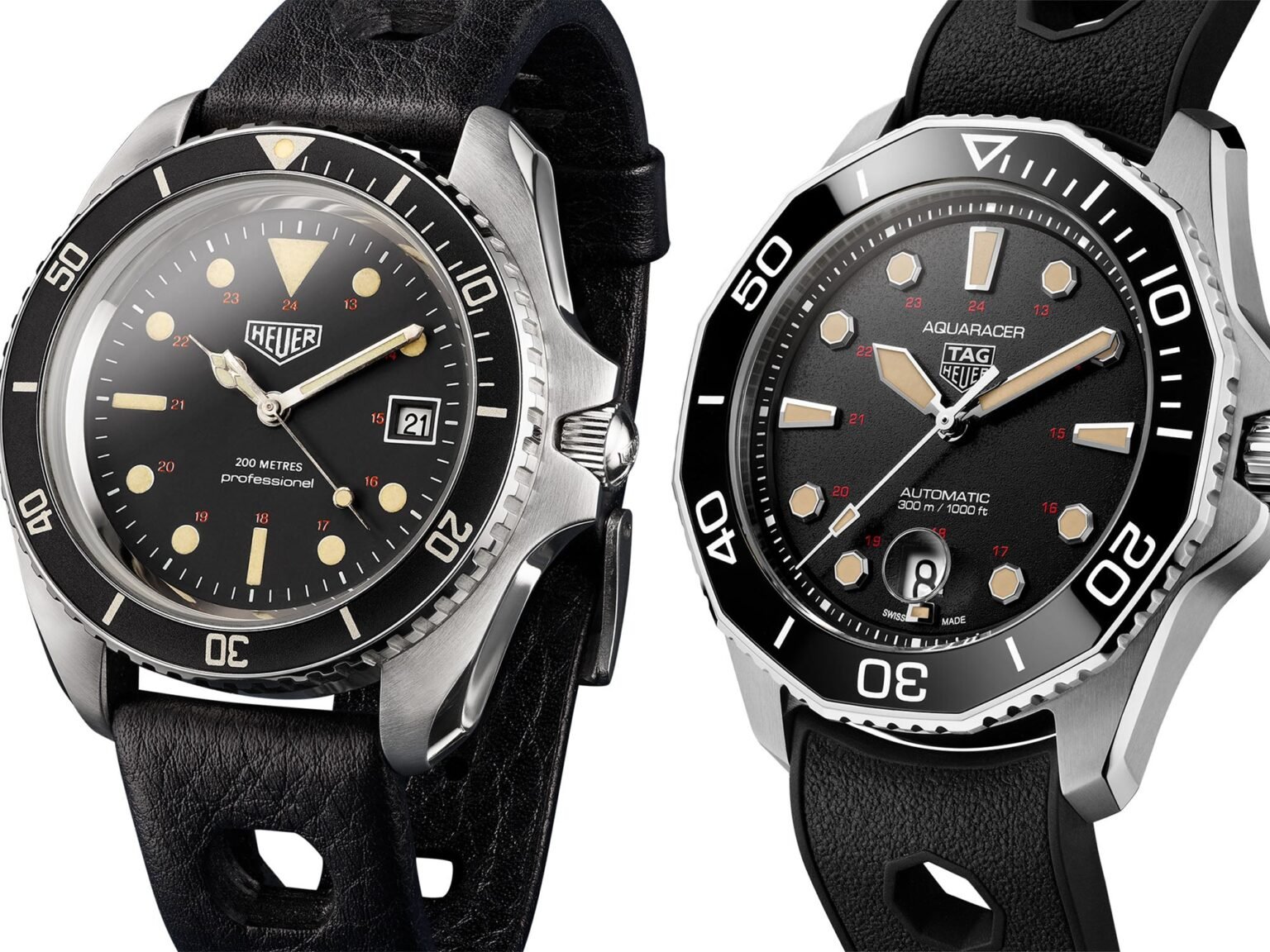
In 1978, Heuer launched the now-legendary Ref. 844 (above left, next to the 2021 Revival edition), the forerunner of its 1000 and 2000 series of divers’ tool watches that paved the way for the Aquaracer collection. Ref. 844 — the brainchild of company scion Jack Heuer, who also created the Carrera, the Monaco, and numerous other enduring models — featured a 42mm steel case, water-resistant to 200 meters and containing mostly quartz and a few mechanical movements. The dial was distinguished by an inner 24-hour scale of red numerals and large geometric hour markers reminiscent of those on the Rolex Submariner, a model Jack Heuer has readily acknowledged as an influence. TAG Heuer’s first dedicated divers’ watch, it kicked off the popular 1000 Series that spanned the 1980s.

The 1000 Series “Deep Dive” model (Ref. 980.023) followed in 1982, offering a larger, thicker case and crystal and a corresponding 1,000-meter depth rating. Two years later came the “Super Professional” Ref. 840.006 (above, via Analog Shift), with a sleeker and more avant-garde design: its steel monobloc case boasted the same 1,000-meter water resistance as the Deep Dive but added raised, spoke-like grips for the rotating divers’ bezel. The 2000 Series debuted alongside the 1000 Series in 1982 and was distinguished by a more pedestrian 200 meters of water resistance and a more fashion-oriented aesthetic overall. This series also included the first divers’ chronographs in the expanding collection. As Heuer evolved into TAG Heuer, the venerable watchmaker’s diving-oriented timepieces — including the S/El, which became the Link — proved to have both cultural appeal and staying power, sustaining the company through the difficult transitional years between the 1970s-’80s Quartz Crisis and the Mechanical Revival of the 21st Century. One of the 1000 Series “Night Diver” models, named for its fully luminous dial, even found its way into a James Bond movie, 1987’s The Living Daylights, on the wrist of lead actor Timothy Dalton.
[toc-section heading=”Proto-Aquaracer: 2000 Classic, 2000 Sport, 2000 Exclusive (1998-2002)”]

On the cusp of both a new era of corporate ownership (the LVMH luxury group acquired the company in 1999) and a new millennium, TAG Heuer released the watch series that spawned the direct ancestor of the Aquaracer, the third generation of Series 2000 (vintage ad above), which was segmented into Classic, Exclusive, and Sport models. The 2000 Classic were further evolutions of the fashion-focused 2000 watches from the previous generation, while the 2000 Exclusive timepieces had a bolder, heavier, tool-watch look and build. The 2000 Sport line, now considered the prototypical Aquaracer, featured an aluminum divers’ bezel, Mercedes-style hands similar to those on the earliest Heuer dive watches, and prominent luminous-filled numerals on the dial. Most notably, the 2000 Series established the “Six Features” criteria that TAG Heuer would apply to all of its dive watches going forward: a unidirectional rotating bezel, a screw-down crown, water resistance to 200 meters or more, luminous elements on the dial, a sapphire crystal, and a double safety closure on the bracelet and/or strap.
[toc-section heading=”Original Aquaracer series (2004 – 2009)”]

The 2000 Sport was short-lived, discontinued by 2002, but resurrected in 2004 as the TAG Heuer 2000 Aquaracer, the first watch to bear the Aquaracer name. Available with either a quartz or an automatic mechanical movement, the watch was water-resistant to 300 meters rather than the 200 meters of its predecessors. The quartz models had a 38.5mm steel case, the automatics a larger, 41mm case. The round unidirectional bezels had aluminum inserts in blue, silver, or black to match the dials, and the seconds hands were in bright yellow for legibility. The 2000 Aquaracer would represent the fourth and final generation of the 2000 series: the following year, TAG Heuer dropped the “2000” and opted to brand the entire dive watch collection under the name “Aquaracer.” Other models within that series had their names changed to reflect the rebranding, such as the Chronograph model, which became known as the Aquagraph. By 2005, the collection had already expanded significantly, adding two-tone versions as well as a slew of 27mm female-targeted Aquaracers with colorful mother-of-pearl dials. An automatic chronograph model, equipped with TAG Heuer’s ETA 7750-based Caliber 16, debuted in 2006.
[toc-section heading=”Aquaracer 500M and Original 300M Range (2009 – 2014)”]
 With dive watches (and luxury sports watches in general) surging in popularity in the 2000s, TAG Heuer introduced the Aquaracer 500M in 2009, which, as its name implies, pumped up the existing model’s water-resistance to an impressive 500 meters. This second-generation Aquaracer also added a new, bolder, more angular case design, 43mm in diameter with a helium-release valve and a rubber-ridged divers’ bezel with applied metal numerals. The dials sported a vertical ribbed pattern and a cyclops lens over the date window (at either 3 o’clock or 9 o’clock, depending on the movement inside, either quartz or the automatic Caliber 5). More evocative of Generation 1 were the Aquaracer 300M models introduced that same year, which retained a more rounded case and bezel design and included several complicated variants, including an automatic chronograph, a big-date version, and even a mechanical alarm.

For the third design generation of the Aquaracer in 2012, TAG Heuer softened the edges of the Aquaracer 500 case and downsized it slightly from 43mm to 41mm in diameter. The dial’s vertical ribbed texture gave way to a horizontal one. The innovative use of materials (remember, this brand still has the initials for “Avant Garde” in its name), which began with the blackened titanium case of 2009’s “Full Black” edition, continued to ramp up with the use of ceramic for the dive-scale bezel inserts. By 2014, and what is generally regarded as the fourth generation of the Aquaracer lineage, the Aquaracer 500 had been discontinued, and the Aquaracer 300 models had a more streamlined bezel design, with flat rather than serrated edges, Models with cyclops lenses over the date window arrived shortly afterward and in 2016, a new series of 43mm versions of the Aquaracer 300 debuted, along with the first all-ceramic models (case and bracelet), in the smaller-sized Aquaracer Lady family, with both 27mm and 32mm choices available. The first modern iteration of the Aquaracer GMT arrived in 2017, and a trio of “Carbon” special editions with marbled-pattern, carbon-injected bezels and dials paired with black PVD titanium cases (above), followed in 2018. The soft revamp of 2016 also brought a choice of unidirectional bezels, either with ceramic inserts or all in steel with studded grips and engraved numerals.
[toc-section heading=”Current Collection”]
Aquaracer Professional 500 Date

Price: $5,400, Case Size: 42mm, Crystal: Sapphire, Water Resistance: 500 meters, Movement: COSC-certified Calibre TH30-00
Launching at Watches & Wonders 2026, the new Aquaracer Professional 500 Date filled the gap between the line’s more standard 300-meter depth rating and the now-discontinued 1,000-meter Superdivers in the Aquaracer family. At 42mm, this case is maybe a little larger than an easy everyday wear, but its lightweight titanium build helps offset any perceived bulkiness. Launching in a duo with respective black and orange and black and blue colorways, these watches are equipped with a ceramic bezel insert and powered by the COSC-certified Calibre TH30-00 within, concealed under the engraved caseback. The helium escape valve is positioned at 10 o’clock and is in black DLC titanium, which helps keep the key functionality both stealthy and easy and safe to use during decompression.
Aquaracer Professional 300/Professional 300 Date

Price: $4,250 – $5,400, Case Size: 36mm/42mm, Crystal: Sapphire, Water Resistance: 300 meters, Movement: COSC-certified Calibre TH31-00
The 300-meter water-resistant three-handed Aquaracer underwent a significant evolution in 2021, adding “Professional” to its name and making some subtle but noteworthy aesthetic and technical upgrades, while still retaining its signature 12-sided bezel. This included the introduction of scratch-proof ceramic inserts to the entire line, and outfitting the bezel itself with a new internal tooth profile that enabled smoother and quieter rotation. Additionally, wider sword-shaped hands were added, and the cyclops magnifying lens over the 6 o’clock date window was incorporated into the underside, rather than the top surface, of the sapphire crystal as part of the case’s overall slimmer profile. The relief-engraved diver’s-helmet motif on the solid caseback, a visual element dating back to the first Aquaracer of 2004, was also redesigned for a more angular look, complemented by an engraved hexagonal background.
The collection received additional updates in 2024, this time focusing on the case dimensions and movement. Inside the modern 42mm lineup, 1mm smaller than previous iterations, the Calibre TH31-00 boasts COSC certification and offers more than double the power reserve of the previous generation, increasing to a substantial 80 hours.
Aquaracer Professional 300 GMT

Price: $5,000, Case Size: 42mm, Crystal: Sapphire, Water Resistance: 300 meters, Movement: COSC-certified Calibre TH31-03
TAG Heuer introduced the first Aquaracer GMT models in 2017, equipping them with the automatic Caliber 7, based on either the ETA 2824 or Sellita SW300, depending on the year of manufacture. The “Professional” version, with the same movement plus the updated Professional 300 design details, hit the market in 2022. Like its predecessor and its non-GMT sibling, it featured a 43mm case in stainless steel, with shoulder-like crown guards flanking a screwed fluted crown and a sapphire crystal with a cyclops lens over the 6 o’clock date display. Following a similar pattern to the Professional 300 Date, the latest Aquaracer Professional 300 GMT models take advantage of a new movement (offering COSC certification and 80 hours of power reserve) and reduce the case size to 42mm. Available in several colorways, each version of the current generation features a wave-form textured dial and a ceramic bezel insert.
Aquaracer Professional 200/Professional 200 Date

Price: $2,550 – $5,850, Case Size: 30mm/40mm, Crystal: Sapphire, Water Resistance: 200 meters, Movement: Solar/Quartz/Automatic
Expanding the Aquaracer series into a more “casual,” outdoors-oriented realm, the Professional 200 collection debuted in 2022, bringing more modest case sizes and a less robust but still “Professional” water resistance rating of 200 meters. Following a consistent string of releases over time, today’s wide-ranging collection includes solar-powered, automatic, and quartz options, with case sizes spanning from 30mm to 40mm.

Another factor setting the 200 apart from the 300 series is the former’s rotating divers’ bezel, opting for all metal (steel or titanium depending on the model) rather than ceramic. Additional notable differences that set the line apart include the absence of a cyclops lens over the date, the ring of trapezoidal hour markers (rather than the 300 model’s combo of trapezoids and octagons), and the relief compass on the solid caseback instead of the revamped diver’s helmet. The 40mm models feature the familiar horizontal pattern recalling a ship’s deck on the dials, while the 30mm models, arguably more feminine in their appeal, expand the palette into colorful smoked motifs and mother-of-pearl with diamond indexes.
Aquaracer Professional 200 Solargraph

Case Size: 34mm; 40mm Price: $2,550; $3,100 Crystal: Sapphire Water Resistance: 200 meters Movement: Solar-Powered Quartz Caliber TH 50-00
Also taking its introductory bow at Watches and Wonders 2022 was the Aquaracer Professional 200 Solargraph, which featured the debut of a new, solar-powered quartz movement, Caliber TH50-00. Developed exclusively for TAG Heuer in a partnership between the brand and Swiss movement specialist La Joux-Perret, the movement requires only a two-minute exposure to sunlight — any light, actually — to charge up with enough power for an entire day; after a full charge of about 20 hours in the sun, it will run for up to six months without any additional light exposure. Its ultra-efficient rechargeable battery can even power up after just 10 seconds to restart a watch that has stopped ticking. The watch’s dial, with a sunray finish and the familiar ribbed pattern, is partly translucent to allow light to penetrate through it to charge the movement, as well as the Super-LumiNova elements on the dial and bezel (as below). The first Solargraph debuted at Watches & Wonders Geneva and had a black PVD-coated steel case in the 40mm size. Following it up just shy of a year later at LVMH Watch Week was a new model (above) in a sandblasted titanium case of the same dimensions, mounted on a titanium link bracelet and a polar blue dial designed to evoke the Northern Lights in the Arctic Circle.

In 2024, the Aquaracer Professional 200 Solargraph got yet another update, and this time, with even more sizing options. A ladies-oriented, 34mm size hit the scene, maintaining the key design features and design personality of its larger-sized siblings in a more compact package. 2026 has also proven to be another big year for the brand’s solar-powered divers, with a fleet of 40mm models in both steel and titanium with subtle yet impactful updates to the case, with enhancements to the interchangeable strap and bracelet system.
Aquaracer Professional 100 Solargraph

Price: $3,050 – $6,600, Case Size: 28mm, Crystal: Sapphire, Water Resistance: 100 meters, Movement: Solar-Powered Quartz Caliber TH51-00
Debuting in 2026 alongside the updated Aquaracer Professional 200 Solargraph models, the Aquaracer Professional 100 Solargraph is the smallest within the collection yet. Launching with four 28mm models and expanding later in the year to include additional mother-of-pearl variations, each Aquaracer Professional 100 Solargraph features diamond hour markers, making this extension of the collection lean decidedly into more luxurious territory, while retaining most of the sporty design elements. As you might have guessed from its name, these 28mm models are less rugged in their dive-ready appeal, reducing the water resistance to (a still very capable) 100 meters. The easy-breezy solar-powered appeal is still well accounted for, utilizing the TH51-00 Solargraph Caliber, which offers an impressive eight months of power on a single, full charge.
[toc-section heading=”Final Thoughts”]

One final fact about the Aquaracer that may come as a surprise to many: it is the TAG Heuer product family with the longest continuous production, more than 40 years, going back to the launch of the 2000 series. Both the Carrera (launched in 1963) and the Monaco (launched in 1969) were discontinued for periods during the Quartz era, the former from 1984 through 1996, the latter from 1975 through 1998. And if the growth of the Aquaracer family in the last few years is any indication, one would be wise to expect the streak to continue.
For more information, visit the brand’s website here.