

As decades march on, no conflict has captured and maintained as much attention globally as World War II. Sure, that sounds like a dry opening statement for an AP History exam, but it’s hard to deny the pervasive influence of WWII on world culture, national identity, and yes, even horology. Eighty years on, we keep making movies about the conflict, keeping the 1940s and its aesthetic surprisingly prime in the cultural zeitgeist. Jimmy is one of those movies, due in theaters in November, and featuring a smattering of real Bulova timepieces from the period, courtesy of the brand’s museum. In celebration of the iconic Type A-11 watch that Bulova provided to the United States military starting in 1942, a re-release called the Jimmy A-11 Hack is ready for deployment.
I have long been a fan of mil-spec field watches, though not because I am some sort of military history buff or avid outdoor enthusiast. No, the main appeal for me—and I think for many folks, especially non-watch nerds—is the simplicity. No date window, no chronograph subdials, no functions other than the absolutely vital. It’s kind of refreshing in 2026 to wear a purpose-built piece of machinery that does one thing very, very well, and a classic field watch is the epitome of that catharsis. Of course, hacking seconds is one of the most historically important features of a proper WWII-era design, allowing for soldiers to sync their watches to time operations, but for the average horology enjoyer of today, the relief of three hands, twelve numerals, and a minute track as your only visual cues is a serious factor in the style’s pervasive popularity.

So what makes the Bulova Hack stand out from the crowd? Historical pedigree is one thing, but many watch brands were commissioned by the government in the US and abroad to make wartime watches and timekeeping instruments for military forces. Honestly, I think the Hack has survived (and thrived) in large part due to its unwillingness to stray from the original design. Others, like the Timex Weekender, sprung out of period field watch designs but carved their own niches as the decades progressed—the Hack maintains not just the core functionality of its forebearer, but the basic design, too.
There is one thing that’s been modernized across Bulova’s various modern Hack models, though: sizing. The Jimmy is no different, measuring in at a very contemporary “medium” 37mm in diameter. This is for the best; modern watch buyers don’t typically opt for smaller watches in the everyday wear category. Over the three weeks I spent with the Jimmy, I found it to be just the right size on my average-sized wrist. This tidbit may not set the world on fire, but it’s an important modernization that allows Bulova to maintain historical accuracy in other areas, where it really counts.
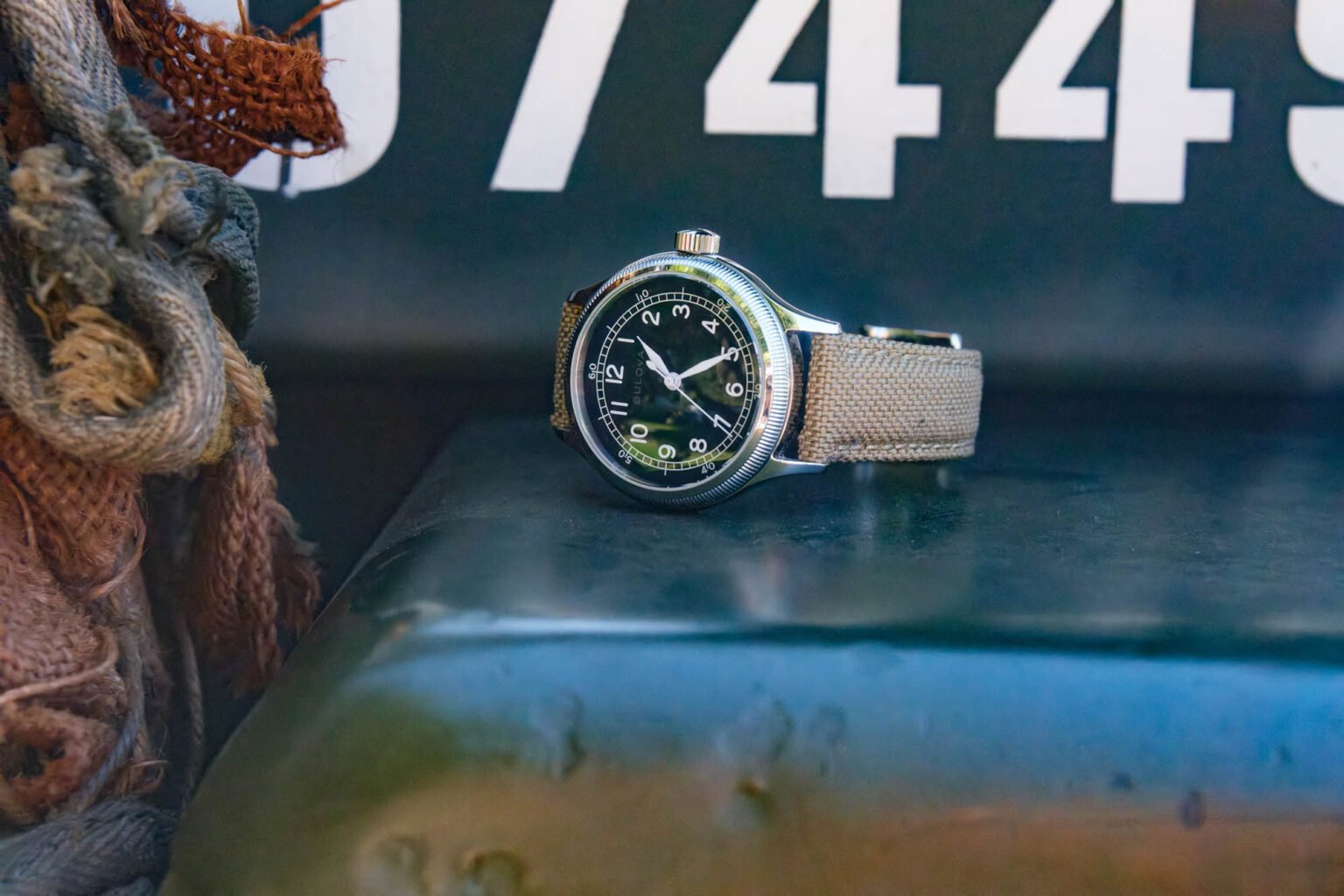
The first thing to note about the Jimmy aesthetically is that it doesn’t vary too wildly from other A-11 models, which do away with the inner 24-hour ring that crowds the dial on otherwise similar Hack models. The Jimmy features a matte black dial and bright white hands, numerals, and minute track, giving it extreme contrast on the wrist; that minute track is another small difference from modern A-11 pieces, as it comes in the form of a railroad track rather than individual indices, which is the more modern convention that Bulova has used on previous Hacks. This gives it a more period-authentic flair, echoing the aesthetic proclivities of the 1940s. Similarly, the Bulova name below 12 o’clock is finished in a handsome subdued gray, allowing the functionality of the watch to take center stage, rather than the branding. While wearing (and photographing) the Jimmy, I found this to be a rather welcome choice, with so little to distract my eyes from wandering while checking the time.

That isn’t to say that the Jimmy is devoid of character or flair, though. The most iconic feature of the A-11 Hack line is the coin-edge bezel, which returns here in fine form. I was rather struck by the amount of people who commented specifically on the bezel when I showed them the watch, whether to admire its texture or to ask if the watch was vintage. This is the real mark of an effective re-release: confusion for the original. Even my good friend, an ex-watch designer with an eye for vintage pieces, did a doubletake when I first showed him. The only detail that clued him into the watch’s modern provenance was the convenient divots at 1 and 7 on the back of the case, allowing for much easier removal of the caseback for servicing—a feature the WWII originals wouldn’t have had.
That being said, the caseback itself was my favorite hallmark of the watch, and one of the coolest historical nods made just for this special edition. It features vertically-stacked acid-etched text markings as an homage to the military-issued nomenclature of WWII, and despite the simplicity, feels like a really special easter egg. I am the unusual enthusiast who prefers a special etched caseback over an exhibition window, so perhaps I am overexcited about this one feature, but it really does put the finishing touches on the historical authenticity of the Jimmy.

A Miyota Caliber 9039 automatic movement with hacking seconds and handwinding capability is controlled by the simple crown at 3 o’clock. It’s a durable and eminently serviceable movement choice that brings 42 hours of power reserve. The case has 50 meters of water resistance, and combined with the double-domed sapphire crystal, gives the watch a 11.2mm height measurement—significantly less than previous A-11 models’ thickness of 14.2mm. This improves wearability and indeed, the most clarifying statement I can make about the everyday comfort of the Jimmy is that it basically disappeared on my wrist. The provided strap helped with this high level of comfort: the textile band with a lovely mil-spec olive tone has a leather inner lining that was impressively soft and prevented the usual chafing that tends to steer me away from similarly-styled textile straps. The quick release function is always supremely welcome, and allows for easy strap swapping if you prefer, though it’s hard to argue with the thematic cohesion of the Jimmy’s stock setup.

Overall, my time with the Jimmy was wonderfully unobtrusive from a sensory and functional perspective—the highest compliment I can give an everyday carry watch. What I wasn’t expecting, though, was the level of attention the watch got from anyone I showed it to. Most of my non-watch enthusiast friends will nod politely when I shove a timepiece in their face, duly giving me the “that’s cool” response as I describe the movement and bezel action. Not so with the Jimmy—every normally uninterested friend I showed it to had something nice to say, whether about the accurately vintage design, the impressive legibility (aided, of course, by BGW9 Super-LumiNova coating on the hands and markers), or just the slim form factor. I am often accused of wearing busy, big watches whose functions are more like party tricks to my exact use case, and I will stand by that accusation as accurate. The Jimmy, though, brings a level of sophisticated simplicity without being dull or boring; the historical background will entice a maximalist with a taste for eras of design, where the contrasting dual-color dial will likely appeal to a minimalist who is stressed out by a complicated color scheme or vestigial functions. It’s about as close to a “best of both worlds” type of watch as you can get, and that will be the determining factor of its popularity. In fact, I’d wager that most people interested in buying the watch will not give a single rat’s behind about the film it features in; Jimmy looks to be a decent-enough historical drama based on the life and enlistment of Hollywood star Jimmy Stewart, but I struggle to find any motivation to look back at a past conflict when so much of our current world is in turmoil. Perhaps I’m jaded, but another WWII biopic is not what draws me (and likely so many others) to the A-11 Hack Jimmy—Bulova’s keen sense of accuracy and historical adherence combined with their savvy knowledge of what a burnt-out 2026 watch buyer may want on their wrist is the greatest boon here. It also feels like an appropriate evolution of other A-11 and Hack models in Bulova’s line, and I wouldn’t be surprised if we see an un-filmified version pop up in different colorways once this run is over.

Bulova has done a terrific job here in delivering a movie tie-in that doesn’t feel cheap or greedy, and their improvements on the Hack design are all for the better. A thinner silhouette, more intentionally vintage aesthetics, and monochrome contrast make the Jimmy a perfect everyday carry piece and I imagine it will very quickly become one of the most popular A-11 models the brand has seen. Will it help sell tickets to the movie? Maybe. But that’s not the reason I would reach into my own wallet for one, and Bulova was right to lean on their design strengths instead of Hollywood influence to build what could be the springboard for a new generation of affordable mil-spec field watch favorites.
The Bulova A-11 Hack Jimmy retails for $795. Bulova