

- What is a Rattrapante Anyway?
- Patek’s History of Split-Seconds Pocket Watches (1878 to the 1970s)
- Patek Philippe Victorin Piguet-Based Single-Button Splits (1923 – Approx. 1939)
- Reference 1436 — The First Serially-Produced Rattrapante Wristwatch — 1938 to 1971
- Reference 1563 — The First Waterproof Rattrapante Wristwatch — 1943 to 1950
- An Interlude of Unique Splits (And One Other Serially-Produced Watch)
- Reference 2512 — Unique Piece — 1950/1952
- Reference 2571 — The First Perpetual Calendar Split Seconds — 1955
- The Curious Case of the “Ref. 2499 Split”
- Reference 3973 — Unique Piece for Mr. Philippe Stern — 1989
- The Reference 5004 (1994/1995 to 2012)
- Reference 5959 (2005 to 2018)
- Reference 5950 (2010 to 2019)
- Reference 5951 (2010 to 2015)
- Reference 7059 (2011 to Unknown )
- Reference 5204 (2012 to Present)
- Reference 5370 (2015 to Present)
- Reference 5372 (2017 to 2022)
- Reference 5373 (2022 to Present)
- Reference 5308 (2023 Limited Edition, 2025 to Present)
You could make the argument that, among all brands, models, and complications, the Patek Philippe split-seconds wristwatch is one of the most overlooked, underappreciated, and least understood in any catalog. “That’s because no one ever sees them,” said Ben, when I made that very argument in the office recently. True. It’s hard to call a watch underappreciated when the entry point for buying one is in the low six figures. But let me explain.

The Patek Philippe ref. 5373.
Think about this: the first chronograph wristwatch Patek ever made was a split-seconds. The first. Oh, and it was the first made by any brand. And while people are clamoring for perpetual calendar references like the 2497, 3448, and 3940, Patek has made at least 44 different perpetual calendar wristwatch models over the years (not counting different case materials, gems, or the 3971). How many serially-produced split-seconds references? Well, about 12 or 13, depending on how you count them.
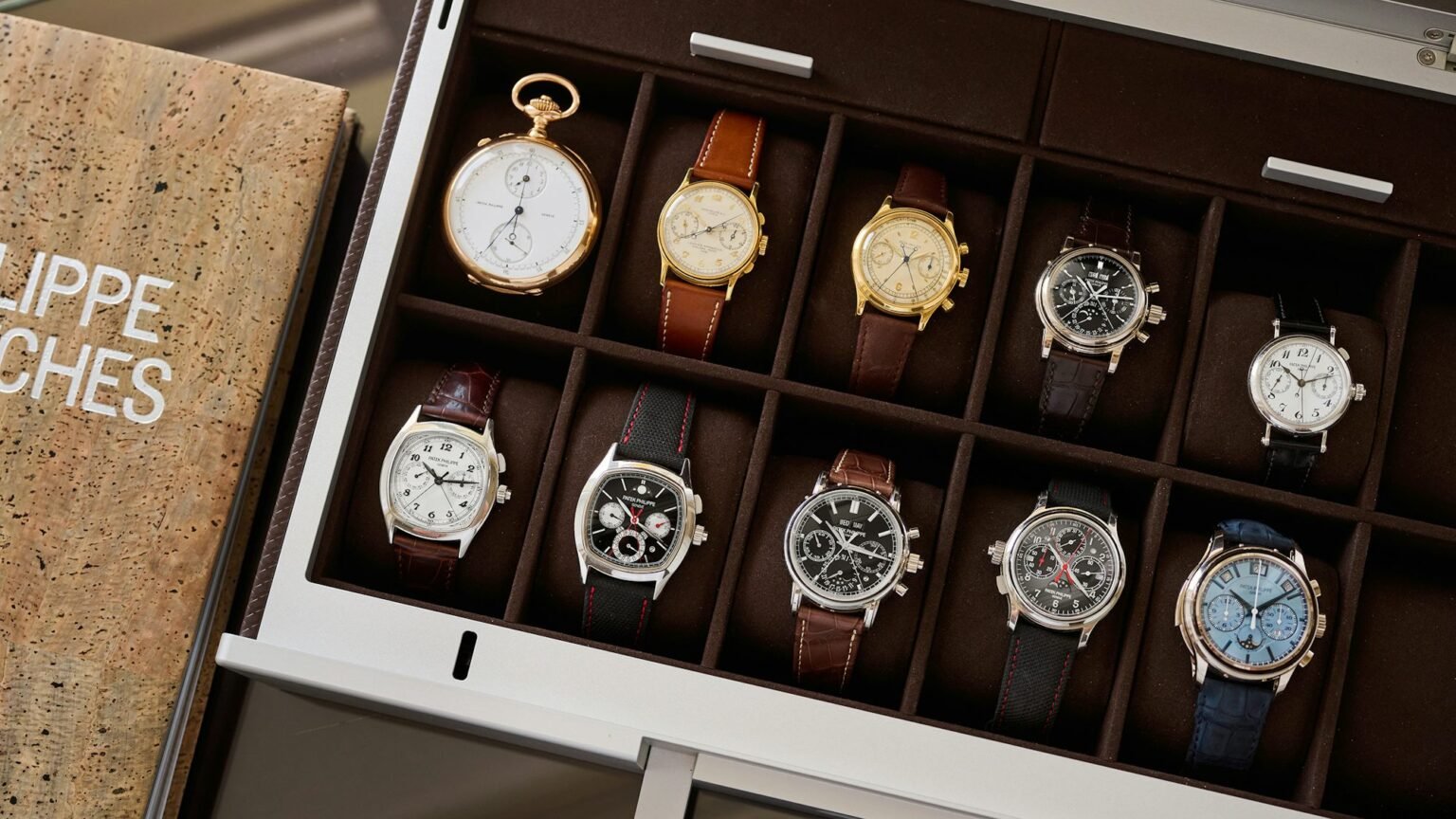
It wasn’t until recently that the reference 5004—the first modern serially produced perpetual calendar split-second watch from Patek—began to receive its due at auction, and it finally broke a 13-year-old record for the reference. A 1436, the first serially produced rattrapante, can still be had for less than an F.P. Journe Chronomètre Bleu. That, frankly, is ridiculous. They’re rare birds, and it’s all the more impressive that we have nine of them on the table today, all from the same owner.

The Patek Philippe ref. 1436 “Hilaleah Park.”
A quick point of clarification. When I say serially-produced, I mean that more than one of that reference was made in a batch, whether it’s two cases ordered together or two or three watches made at the same time.
In addition to all the models fitting that definition, there are a handful of unique references or versions made as bespoke pieces, a few of them specifically for Patek Philippe and its former CEO and later Honorary President, Philippe Stern, who recently passed away. I’d argue that you can mostly credit Philippe Stern for keeping the rattrapante mechanism alive for the brand, reviving it in the reference 5004 shortly after taking the reins from his father in 1993. Bespoke or not, we will cover them all.

The recently departed Philippe Stern (left) and his father, Henri Stern. Photo courtesy Patek Philippe.
Not discounting the financial outlay required, it’s a pretty remarkable dedication to put together a collection like this. Some of the watches are “standard” versions (the first variation offered, the most common style, etc.). Many are much rarer or even unique. The newest split-second wristwatch on the table was actually the second example delivered by Patek just last year.
Almost all are well-worn and incredibly loved (some might say even a bit beat up) by an owner who dedicated most of his collecting focus to learning everything he could about these watches and then wearing them every day. With utmost appreciation, I want to thank the owner of this collection for his kindness, patience, knowledge, and hospitality for hosting us at the Beau-Rivage Palace in Lausanne, Switzerland, where we were able to film and photograph. A thank-you as well to Arthur Touchot, co-founder of Marteau & Co. and a former senior editor at Hodinkee, for introducing us to the collector and for joining me in the video.

Yes, this is the first reference points where we’re missing a few pieces, but there’s a good reason for it, which we’ll explain. Fair warning: if you read this story, you’re going to need to take it in quite a few smaller chunks. Grab your favorite beverage (or three, maybe at least one with caffeine), and let’s dive in.
What is a Rattrapante Anyway?
First things first, we have the term split-second chronograph, or rattrapante. Top line: the rattrapante mechanism features two superimposed chronograph hands, allowing you to time two different intervals simultaneously. This mechanism didn’t become commercially viable until the 1870’s and, based on the number of split-second chronographs retailed by American jewelers, it proved extremely popular in the United States.

A vintage Minerva Split-Second wristwatch.
“A split-seconds chronograph is so difficult to make because it asks an already demanding mechanism to do even more without using much extra energy,” explains Sebastien Chaulmontet, Chief Product Officer at Sellita Watch Co. and Manufacture AMT. “Even a standard chronograph puts a noticeable load on the movement, so adding a second stopwatch hand means every part has to be carefully designed and adjusted to keep everything running smoothly.”
“The other challenge is simply how everything has to fit together. A split-seconds chronograph has two stopwatch hands mounted on the same central axis, with one turning inside the other. They must move independently, while fitting together with microscopic precision—if the fit is even slightly off, friction increases and the mechanism won’t perform as it should.”
As for the design itself, here’s how it came to be.
The Historical
Among watchmaking innovations, the chronograph is relatively recent. Interval timing, developed from a rudimentary piece by Samuel Watson (the Physician’s pulse watch) in 1695, to the first generally accepted “chronograph” made by Louis Moinet. His 1/60th-second timing device, the Compteur de Tierces, was completed in 1816 and used for astronomical observation. For a number of reasons, the Moinet stopwatch wasn’t particularly practical (or even really known, until recently). The watch ran at an outrageous 30Hz and was essentially trying to blow itself up the entire time. It also couldn’t be easily reset to zero.

The Louis Moinet Compteur de Tierces from 1816. Photo courtesy Louis Moinet.

A Nicole & Capt chronograph minute repeater from ca. 1867, just five years after the creation of the first fully-functioning chronograph. Photo courtesy Christie’s.
By 1844, that problem was solved (in theory). Adolphe Nicole filed Great British Patent No. 10,348 for a keyless winding system and a cam-actuated zero-reset mechanism while working at his firm, Nicole & Capt, in the Vallée de Joux. The keyless winding system made its way into nearly everything. However, here the important thing was that the chronograph mechanism allowed the watch to continue running while the timing function could be reset to zero instantaneously. That feature has been central to nearly every commercial chronograph mechanism used since. In 1862, Henri Féréol Piguet (working with Nicole & Capt) integrated the patent into a functioning pocket watch for the first time.
Meanwhile, prior to Nicole’s invention, the rattrapante mechanism had already been created. As a first step, in 1831, Joseph Thaddeus Winnerl, working in Paris, introduced what he called a chronoscope. Not a split-second chronograph, the main achievement was that the central seconds hand could be stopped and restarted independently of the going train. The watch itself continued to keep normal time while the second hand was manipulated, allowing an interval to be measured without stopping the watch.

An E.J. Dent, London watch with Nicole’s Patent keyless mechanism and a duplex split-seconds chronograph. Photo courtesy Heritage Auctions.

You can see that the keyless works system of Nicole’s patent was integrated into a movement that had a subsidiary seconds dial where, by depressing a button, one hand will stop, and you can track an interval before releasing that button for that hand to catch up. The seconds hand, however, always kept running and never reset to zero, so you had to calculate the elapsed time with some math. Photo courtesy Heritage Auctions.
Between 1831 and 1838, Winnerl refined his design into the first split-seconds mechanism, with two superimposed central seconds hands and one hand that could be stopped independently. Releasing the stopped hand caused it to “catch up” (rattraper in French) with the running hand. However, without the invention of the heart cam zero-reset mechanism, resetting to zero was a chore. It wasn’t until the 1870s that the two systems were combined into a commercial product; it’s unclear who first brought it to market. The last name that deserves some credit is Charles-Auguste Baud, who invented the modern configuration in which the mechanism was on the rear, simplifying adjustment and assembly.
Patek’s History of Split-Seconds Pocket Watches (1878 to the 1970s)
When preparing this story, you can imagine that my research on split-second Patek pocket watches got a bit, well, let’s just say “unwieldy.” So instead of inundating people, we’ve turned that story into an addendum, which you can read here. But since we were lucky to have a rare version of one of these watches on the table, here’s a brief overview.
It only took about eight years for Patek to jump on the achievements of Nicole and Piguet and start making their own simple chronographs. While the brand would eventually lean more heavily on outside suppliers, the first Patek chronographs apparently used an in-house movement, according to examples in the Patek Philippe Museum.

An example of an early Patek Philippe ébauche chronograph, with added calendar (date) complication, from circa 1870. Within a short period, Patek would stop making their own base movements (and with that decision, the architecture would become far more elegant). Photo courtesy Bonhams.
By the 1880s, Patek started using complications specialists in the Vallée de Joux who could provide a basic ébauche that they could finish themselves (or have the finishing done by the suppliers). It was also around that time that Patek started making split-second chronograph pocket watches. Patek’s most important supplier, by far, was the brothers Victorin Émile Piguet and William Alfred Piguet, who were already making their mark as experts in the field of complications.
Judging by the watches in the Patek museum, it used at least seven suppliers for its split-seconds pocket watches, starting with Piguet Fréres, which would eventually become Victorin Piguet & Cie. You can read the full list and see more examples in an in-depth story we’ll publish next week. In our reference points video, we get a brief glimpse of a special, early Piguet Fréres pocket watch with a regulator-style design.

A Patek Philippe & Co. split-seconds wristwatch, movement no. 66’1xx with a 19”’ Piguet Fréres ébauche, likely from around 1886-1887.


In the early days, Patek made a few unusual pocket watches in which the normal center post was far off-center, and the hours and minutes were in a subdial. In 1886, Patek made three watches (movements numbered 66’088 to 099) with more traditional regulator-style layouts, with a central minute hand, and hours on a subdial. Apparently, they made more than just those; we have another one here (also from around the same period). Eventually, Victorin Piguet settled on what most people would consider a more traditional dial layout. But despite all their work and innovation, neither Patek nor Victorin Piguet could fight the change in demand driven by wristwatches.
Patek Philippe Victorin Piguet-Based Single-Button Splits (1923 – Approx. 1939)
By the 1910s and 1920s, requests for wristwatches had grown. By the 1930s, the market for wristwatches was twice that of pocketwatches. You’d think that Victorin Piguet would continue their dominating run as a supplier, and for a brief time, they did. In fact, they did so with a bang. The first complications in Patek wristwatches were minute repeaters with movements by Victorin Piguet. The next? A split-second chronograph.
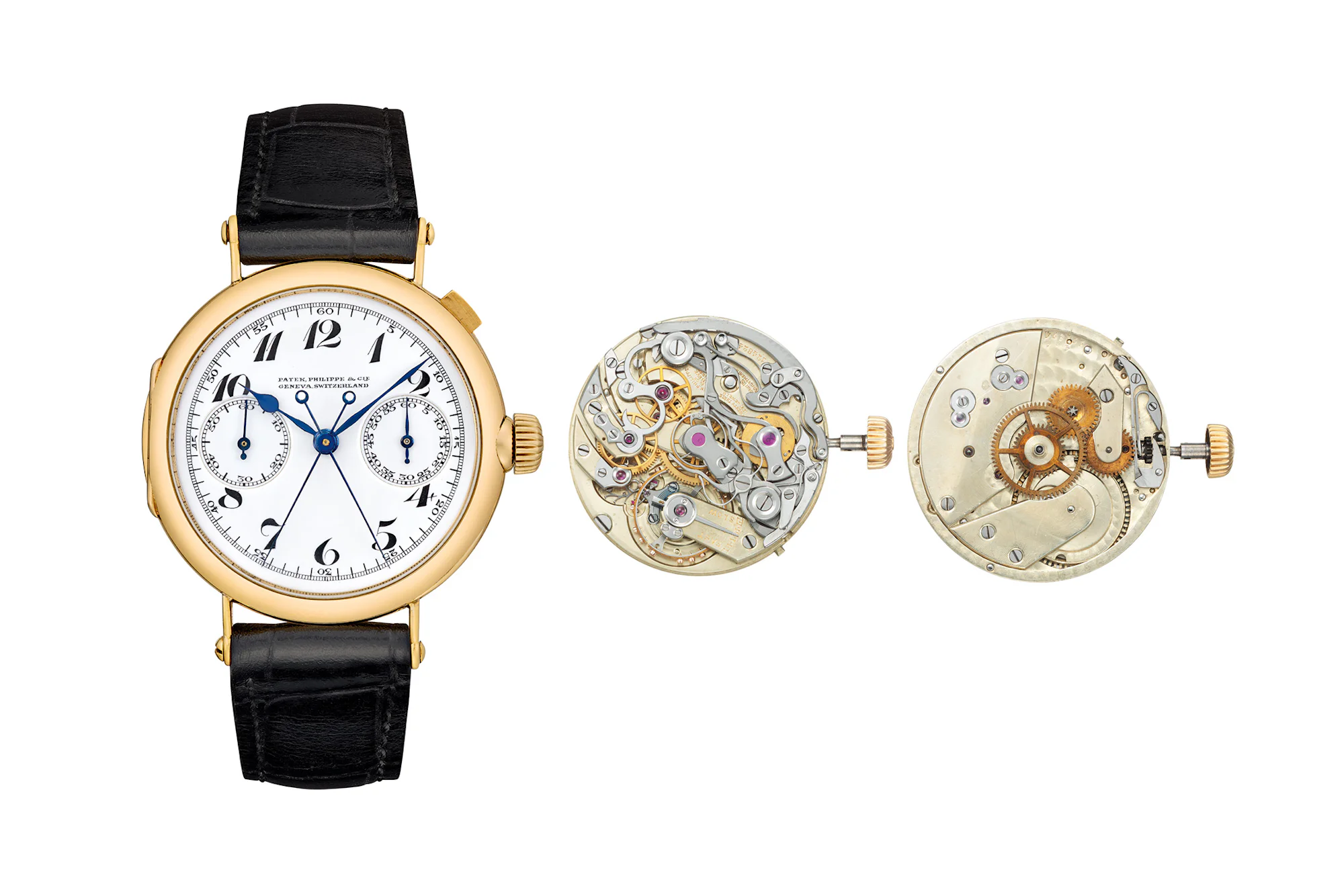
Patek Philippe’s first chronograph wristwatch, which was also a rattrapante, was made in 1923. Photo courtesy Patek Philippe.
The first Patek Philippe chronograph wristwatch was, in fact, a rattrapante, the first-ever split-second chronograph wristwatch by any maker. Made in 1923, one year before they made their first simple chronograph, the watch used an incredibly small 12” extra-flat Victorin Piguet base. The movement (no. 124’824) was actually made in 1903 but wasn’t cased (into case no. 235’326) and sold until twenty years later. It measured only 33mm by 11.1mm and used a movement base that was 11.279mm smaller in diameter than any split-second pocket watch Patek had made to that point.

A Patek Philippe single-button Victorin Piguet-based split-second wristwatch that belonged to famed racer Henry Segrave and later to Amelia Earhart, both of whom died tragically while pursuing record feats. The watch was sold in 2024 at Monaco Legend Group’s spring auction for $1.86 million.
That watch is now in Patek Philippe’s museum, and if you value “firsts” from what is arguably the most prolific complications expert of the 20th century, you could argue it’s among the most important watches in the brand’s collection. This would begin a short period of about 10 years, during which Patek ordered split-second wristwatch movements. While they didn’t take delivery of any after 1930, that stock was enough to carry them through deliveries until the late 1930s (indicating slow demand). Only 11 such watches were known, and all were made on a Victorin Piguet ébauche.
Of those watches, four actually had cases from the ref. 130 and one carried a separate reference number, 97. If you want more information on the Victorin Piguet single-button split, we have an in-depth look (with technical analysis) in an upcoming article as well.
Reference 1436 — The First Serially-Produced Rattrapante Wristwatch — 1938 to 1971

Henri Stern and Jean Pfister in 1958, twelve years after Pfister’s retirement.
Our story really starts here, with the ref. 1436, the world’s first serially-produced split-second wristwatch. But to avoid some whiplash, it’s important to understand how a brand known for its largely bespoke watchmaking went from one-off pieces to producing simple and complicated watches at scale.
By 1932, major changes were underway at Patek Philippe. Charles and Jean Stern, owners of dial supplier Cadrans Stern Frères, realized that Patek’s American importer, Alfred Stein, was failing in health and approached him about acquiring his shares in the company. Soon, they became the majority owners and bought out the remaining shares to consolidate their control. They poached a young technician from the Swiss Jura, Jean Pfister of Tavannes Watch Co., as technical director to overhaul the brand, modernizing and standardizing production. Pfister also trained a young Henri Stern (son of Charles) while shifting the brand from one-off production to a more industrialized powerhouse.
It was only four years after the first serially produced chronograph, the ref. 130, Patek launched the first serially-produced split-second chronograph wristwatch, the ref. 1436 in 1938. The 1436 was produced for 33 years, until 1971. That was only two years less than the iconic 2499 and 7 years less than the ref. 96. Compared to 349 examples of the 2499, only about 140 of the 1436 were made. According to Sotheby’s, around 120 were done in yellow gold, about 15 in pink gold, and a mere 4 in stainless steel (only three surviving). To this day, only 59 yellow-gold examples are publicly known.

A Patek Philippe ref. 1436 in steel, when this example appeared for the first time at auction in 2009 and Antiquorum.
That includes this watch, from 1939, known as the “Hilaleah Park.” This is one of the most unusual split-seconds among the watches we have today (or among any of the splits Patek ever made) and, in many ways, shares much more conceptually with the Victorin Piguet-era approach, given the extent of Patek’s customization. Although it was made in 1939, it was sold on January 24, 1941, and found itself headed for the United States.

Split-second pocket watches were a massive hit in the U.S., not just for Patek but for watchmakers like C.H. Meylan, who made much of his living selling private-label splits to jewelers. This success was probably due in part to the massive horse-racing industry there, as evidenced not just by this watch but by others as well. So when the chance came to start selling wristwatches with the complication, a good number were destined for America.

Like many American market watches, this example has Breguet numerals. But what it has that no other split does is an engraved enamel customization reading “Leading Apprentice Hialeah Park 1941.” Unlike retailer signatures, which were almost always stamped on the dial, this was almost certainly done while Stern Fréres was making the dial. Like the rest of the dial text, the customization was not printed; instead, a small channel was cut into the silver dial, filled with black enamel, and then baked (often causing the enamel to rise above the dial surface). Strangely, despite being given to someone with a horse-racing background, this is one of the few examples that doesn’t have a tachymeter, though horse trainers are likely more interested in lap times than in speed. Without the tachymeter, the subdial counters were made larger.

After its delivery, the watch was awarded to American jockey Wendell Eads. Eads had a massively busy and successful year of racing. Out of 844 mounts in 1941, Eads won 150 races, placed in 110, and showed in another 110, earning his employers a total of $343,556 that year—equivalent to over $7.5 million today. However, after his contract at Hialeah Park ended in 1943, he retired from racing at the age of 20. Eads passed away in 1997 at the age of 73.

Market Wise, with Wendell Eads up, after winning the McLennan Handicap at Hialeah Park in 1942. Market Wise was owned by Calumet Farms, which won the Kentucky Derby six times with its horses, including in 1941 with Whirlaway. Whirlaway went on to win the Triple Crown, but Eads was too small and light to control the horse and lost the chance to ride for his employer. Photo courtesy the Keenleand Library, with Credit to the Morgan Collection.
This watch was acquired in 2024 at Phillips’ New York auction by the current owner for what feels like a relatively affordable sum—considering the watch’s unique nature—of $304,800. Before that, it spent about 12 years in the collection of former Continental Airlines CEO Gordon M. Bethune, who purchased it at Christie’s in 2012 for $182,500. Bethune then sent the watch off to Patek for restoration, and the dial has clearly been cleaned (especially evident compared to an unrestored dial, as we’ll see on the 1563). In old photos from the Christie’s sale, you can immediately see some patina on the indices from oxidation and some discoloration at 9 o’clock, but overall, it looks quite fantastic, and it’s unlikely it would have been restored similarly today.
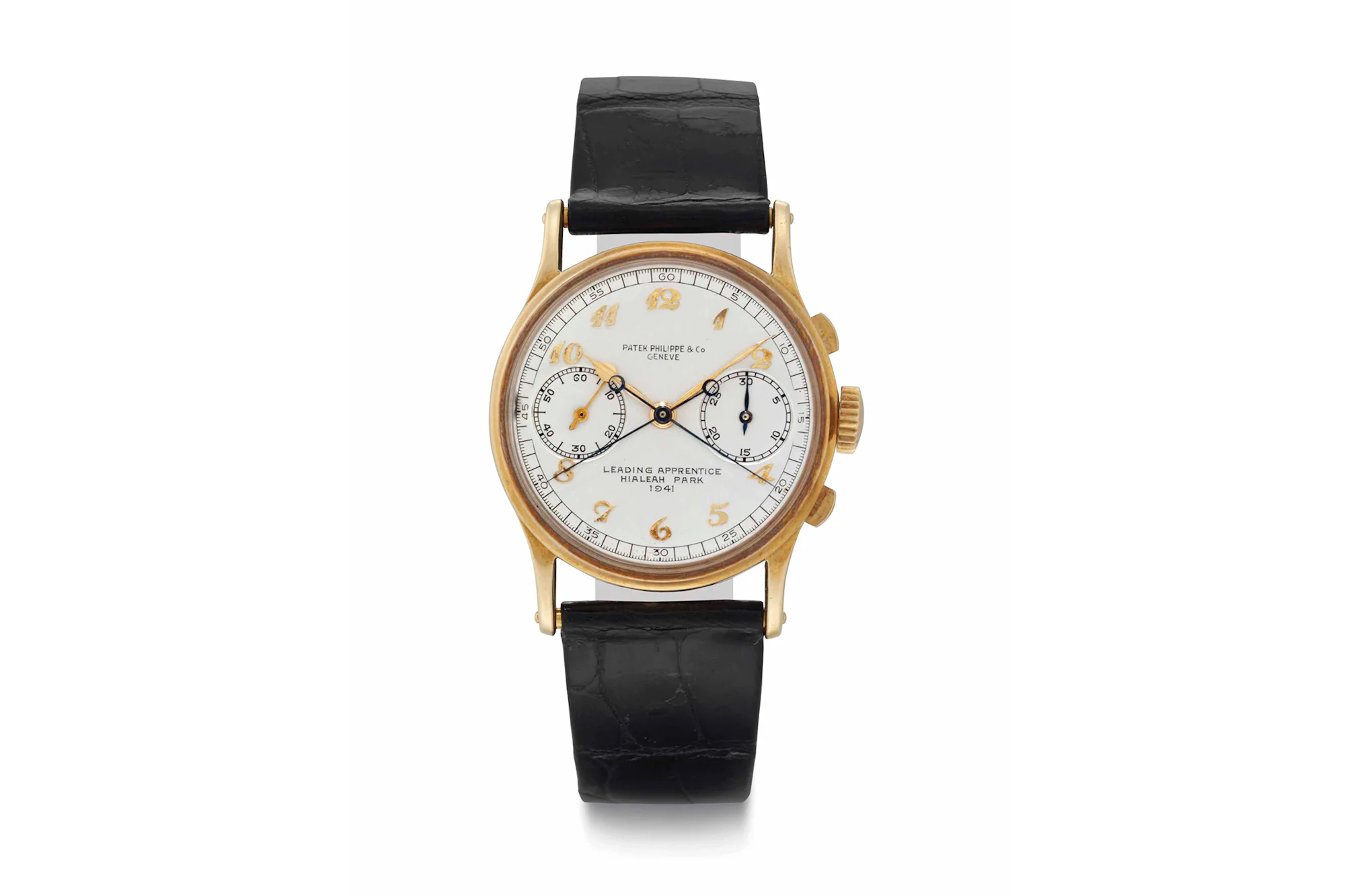
The “Hialeah Park” in 2012 before the dial restoration. Photo courtesy Christie’s.

An example of a 1436 dial (without applied numerals) that has undergone minor restoration, with an aged zapon layer. Photo courtesy Sotheby’s.

The watch after restoration. You can see that the subdials have lost some definition at the edges, the numerals have had oxidation removed, and the text has also lost some enamel. Photos courtesy the owner.

Post-restoration photo of the back, where the numerals were removed and reapplied afterward. The dial number stamp has been removed at the owner’s request to prevent potential forgeries. Photos courtesy the owner.

The black engraved enamel on the watch, seen under a microscope, reveals some of the brushed surface post-restoration and missing enamel in several places. Photos courtesy the owner.
Dial restoration is a touchy and complex subject that we will cover in a future article. You also need to know how dials are made to fully understand the subject. In this example, after restoration, you can see that the dial has more sloping edges to the subdials, some vertical striations on the surface from sanding to get down to layers that were not impacted by oxygen eating at the silver dial, and some missing black enamel that was a part of the signature and personalization at the bottom. Make no mistake, the watch is still fantastic, but it just goes to show what can happen after a dial is restored.

This example is a part of the first series of the ref. 1436, made into the 1950s (though less and less common after 1950), which featured a buttonless crown and cases made by Emile Vichet. Just like with the Victorin Piguet designs, the crown itself sits slightly off the case, serving as a button to operate the split-second chronograph. The top button starts both chronograph hands, the crown starts and stops the split function, and the bottom resets everything.

In the second series, the cases were made by Ponti, Gennari & Cie., with what may look like shorter lugs but a large button protruding from the oversized crown. By this post-war period, production really slowed down, and demand wasn’t as strong as the world recovered from the economic impacts of two World Wars in close succession. Therefore, Patek made substantially fewer of the ref. 1436 over the next 20 years or so—somewhere around two per year—and less than 50 of these second series cases were made.

A second series version of the Patek 1436 with a Ponti, Gennari & Cie. case with coaxial crown pusher. Photo courtesy Christie’s.
Despite the lack of demand at the end, the ref. 1436 is one of the most impressive feats of early 20th-century watchmaking, not just from Patek Philippe but in general. These were small watches, only 33mm by 12mm to 12.5mm, depending on measurements and series, which is remarkable compared to the oversized split-seconds watches from brands like Universal Genève, Minerva, Rolex, and others that would come later. The Universals measure 44.5mm by 14mm or 15mm thick. All of this is due to the caliber 13-130 CCR (Compteur Chronographe Rattrapante), or 13-130 R, as Patek calls it in the museum catalog. This movement would make up over half a century of history for Patek Philippe. And it was much, much better finished.

Patek’s caliber 13-130 R was a modification of the 2.5Hz, manually wound, lateral clutch Valjoux 23—heavily modified, in fact—which had already been adapted to create the movement that gave the ref. 130 its name. Pfister himself chose the Valjoux column-wheel movement, but made some major changes.
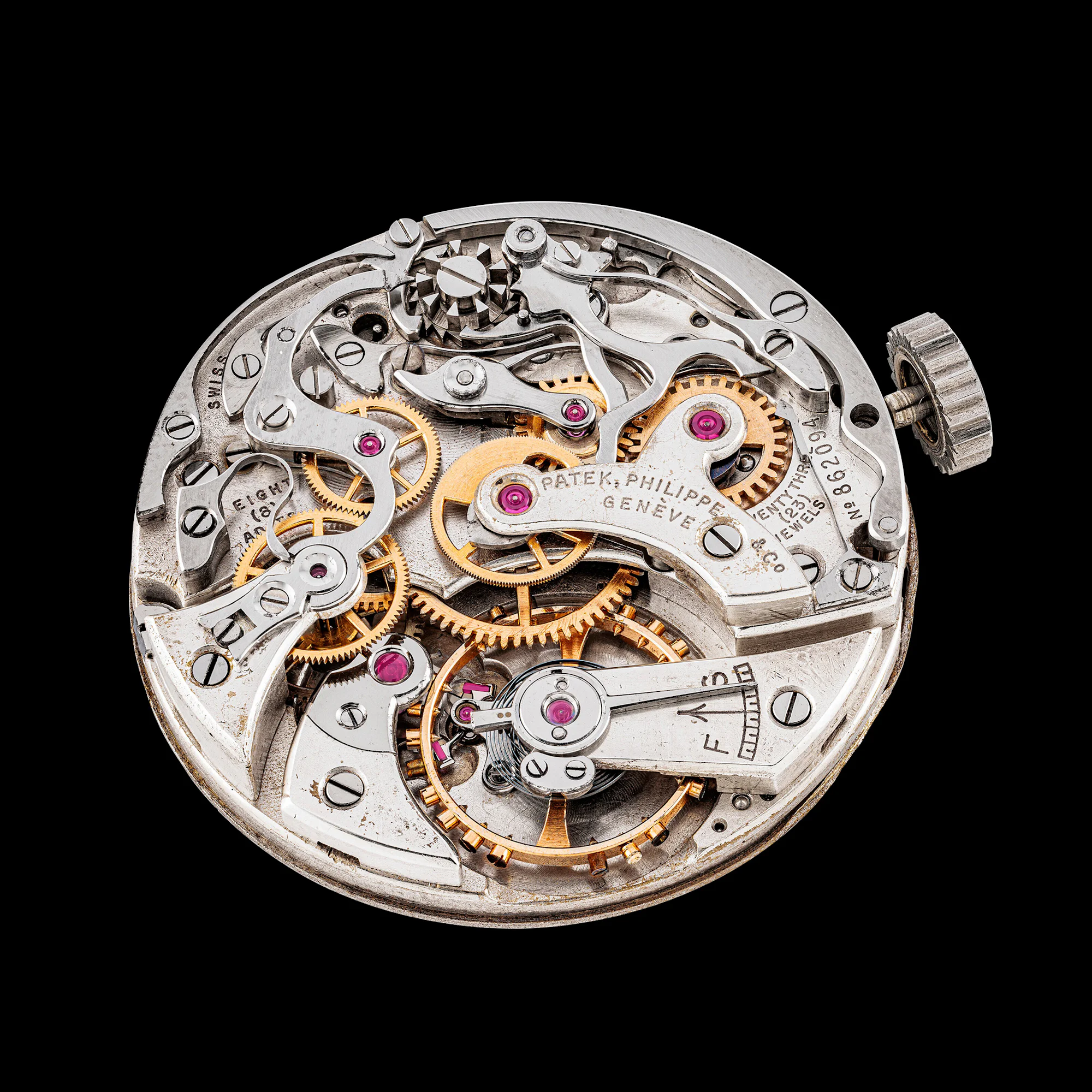
A Caliber 13-130 from a ref. 130. Photo courtesy Christie’s.

A version of the Valjoux 23 found in an Eberhard. Photo courtesy Gisbert A. Joseph Watches.
The team capped the column wheel and redesigned the entire chronograph bridge and clutch, introducing a new pivot point that made it concentric with the fourth wheel arbor. As best as I can tell (and after asking Sebastien Chaulmontet, who is an expert on chronograph construction), there really doesn’t seem to be any major advantage of that pivot, aside from aesthetics. “There may be some technical advantages, but I don’t think they’re fundamental,” said Chaulmontet. “A concentric clutch pivot gives a very clean and elegant geometry, and it may help make the clutch action more consistent or less sensitive to tolerances”

The 13”’ Victorin Piguet movement at left, with the successor Valjoux 23-based caliber 13-130 R. Photos courtesy Patek Philippe.
You can also see that Patek switched from a scissor-like brake system, in which the clamp and the spring are separate components. In the Valjoux 23-based mechanism, the spring is integrated into the clamp, forming a single component in which the clutch is placed closer to the center post, pushing outward on the center of the brake arms and releasing them when the clutch is engaged. This, it seems, was a cost-saving measure (like not capping that central column wheel) and part of the industrialization and standardization that Pfister was there to implement.
“That reduces the number of parts, simplifies assembly and adjustment, and lowers production costs,” says Chaulmontet. “From a functional standpoint, both designs work very well when properly made and adjusted. The latter design wasn’t really an improvement in performance—it was primarily a more efficient and economical construction. You find the same system from Venus, for example, in the Venus 179 and 185.”
The watch featured a swan-neck regulator to change the hairspring’s active length. Near that regulator is where this specific movement was stamped PXP for U.S. export.

Here you can see the PXP marking for U.S. export, plus the two Geneva seals and the swan-neck regulators.
For aesthetics, the watchmakers cut out a separate bridge to suspend the escape wheel, fourth wheel, and center wheel, and highly finished all of it. The movement now has a contre-pivot on the escape wheel limit endshake (play along the Z-axis) of the pivot, with a mirror-polished steel plate held to the end of the bridge, solely for aesthetic purposes.
The movements used a Glucydur balance with screws and a self-compensating Breguet balance spring. To further upgrade the base caliber 13-130, they added a rattrapante mechanism with its own column wheel and clutch, which added 1.5mm of thickness to the caliber and necessitated the removal of the “Y” bridge that held the minute recording wheel and chronograph runner. And yet, it only added about 1-2mm of height to the watch versus the caliber in the ref. 130 (up from 10.5mm or 11mm).

The capped column wheel for the base chronograph section of the chronograph works.

A relatively thin watch, in addition to the small 33mm size.
While the brand had standardized case and movement construction, dial and handset configurations were still somewhat of a grab bag. The 1436 came in dozens of configurations, and the reference deserves its own story. While “Hialeah Park” stands out, in fact, many of them are unique or likely unique. Different colors include silver, doré, pink (on pink-gold cases, of course), and two black-dialed examples (one of which was a later dial). Some watches have large subdials (though seemingly only in the first series). While there’s some variance in hand style (baton/stick, leaf, dauphine, and spade-and-whip) and indices (baton, Roman or Breguet numerals, printed scales, etc.), it seems that most of the second generation featured baton indices and leaf or dauphine hands.

A unique yellow gold 1436 with hard enamel Breguet numerals and oversized registers. This is a very early example, made in 1942, and it looks the part. Photo courtesy Sotheby’s.

A pink-on-pink 1436 signed for the retailer Freccero, made in 1952 with a first-series case. Photo courtesy Antiquorum.

A Gübelin-retailed 1436 in yellow gold with second series case and a dial lacking any chemin de fer to separate the minute and tachymeter scales. Photo courtesy Antiquorum.
Applied Breguet numerals aren’t uncommon, another sign of the American market demand, while applied Roman numerals and stick indices are most frequent, followed by applied Arabic numerals and stick indices, and watches with just stick indices. One has black hard-enamel Breguet numerals (out of 26 with Breguet numerals in yellow gold). In addition to this watch, two other versions stick out as particularly attractive.

An example with a two-tone sector dial and Walser Wald retail signature, which was last seen at auction in 2012, when it sold for CHF 255,000. Photo courtesy Christie’s.
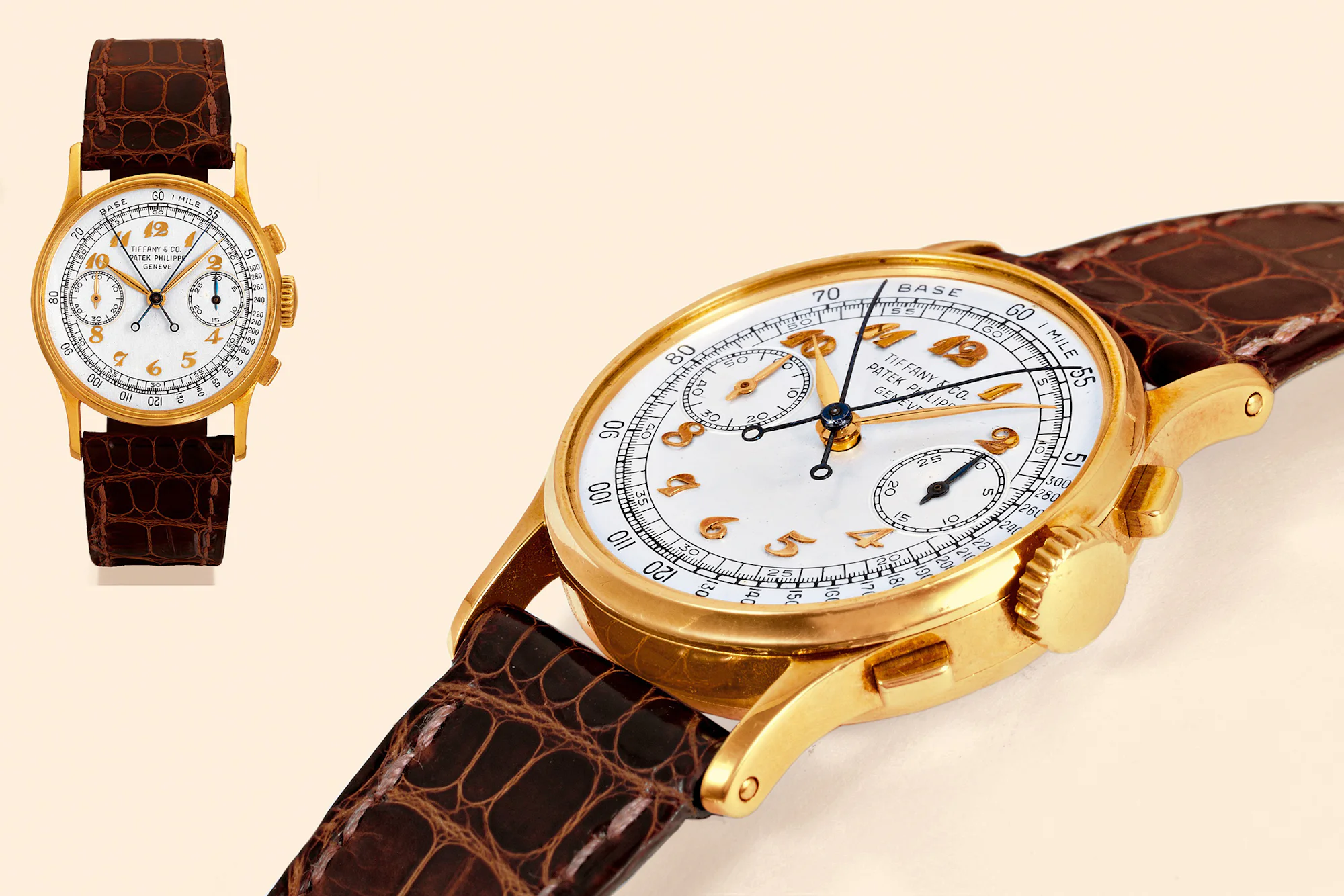
A 1436 with Breguet numerals, retailed by Tiffany & Co., made in 1955 and last sold in 2005. Photo courtesy Antiquorum.

Another 1436, this one retailed by Cartier, with a second series case and a more standard baton/baton dial indices and handset combination. This watch was made in 1968 and last at auction in 2010. Photo courtesy Christie’s.
My favorite is probably the example with a two-tone opaline sector dial signed Walser Wald. Retailer signatures aren’t all that uncommon, and it seems that Tiffany & Co. is the most frequent, with five unique examples. This one, however, is just really gorgeous. Another super interesting watch has a sterile, flat, scientific dial with very unusual numerals that remind me of some Universal Genève watches. My only caution to collectors is to trust your gut; many of these unusual dials appeared in an era when collectors and dealers were more likely to “mess” with dials and could get Extracts that were less than truthful. Just because a watch looks unlike any other configuration doesn’t mean it’s wrong. It also doesn’t mean it’s right either.

A sterile tachymeter dial Patek 1436, made in 1950 and sold in 1951. It was last seen at auction in 2003, where it sold for what is still one of the highest prices for the reference, CHF 619,500. Photo courtesy Antiquorum.
Reference 1563 — The First Waterproof Rattrapante Wristwatch — 1943 to 1950
If the ref. 1436 is a legend, the ref. 1563 is a myth. There are some similarities between the two, of course; the watches use the same caliber as the ref. 1436, the caliber 13-130 CCR. And while it looks a lot like the famous waterproof “Tasti Tondi” ref. 1463 (and one of them has that reference in the caseback), they’re certainly very different from each other. Oh, and compared to the 750-or-so examples of the 1463, there are only three examples of the 1563.

Siblings, yet very different. The successor, the 1563, on the left, and the 1436 on the right.
Imagine this: it’s 1943, during the height of World War II, and you’re the owner of the complicated and recently released Patek Philippe ref. 1436, having purchased it on July 19, 1941. After two years of ownership, you start to feel a grinding sensation in the back of your mind. There’s this other watch you’ve been seeing in the Patek catalog, the ref. 1463—released in 1940—and while it lacks the split-second mechanism, you like that it’s a bit bigger and waterproof.
What do you do? Well, you send your watch in to Patek with these thoughts and somehow, against all odds, convince the brand to order new 35mm water-resistant screw-down caseback cases from Taubert (patented by François Borgel), and make something new. And then, since you’re a doctor, you request a two-tone pulsation dial as well. Decades later, the watch is now known as “the Doctor’s Split” or just “the Doctor.”

“The Doctor,” a unique reference 1563 with a dial graduated for 15 pulsations, used for measuring heart rates.
According to documents compiled by the current owner, this is believed to be exactly what happened here. The first two examples of the ref. 1563 has a version of the 35mm water-resistant screw-down Taubert/Borgel case used on the famous ref. 1463 (non-split second chronograph) with a slightly thicker 14mm (versus 13.8mm) case. That makes these the first water-resistant split-second chronographs in the world (narrowly beating out the Breitling Duograph ref 762).
This watch is the reason why I’d argue this is probably the most complete collection of Patek split-second references in private hands. While others may have more examples of 5004s or other references, or maybe have multiples of multiple references, period, there are only three 1563s, two that could be owned, and unless the other owner lays their cards on the table, right now, this is the only known collection that ticks this many boxes.

The Taubert/Borgel case on the final reference 1563 (a watch that actually used a 1463 case). The case is otherwise the same visually from the back. Photo courtesy Sotheby’s.
The biggest challenge here was the engineering of the crown, which served as a pusher for the split, just like the 1436 and Victorin Piguet watches before it, but now had to be waterproof. Then there’s the pushers. Just like the 1463, the 1563 has the iconic mushroom pushers with small ridges for better grip and functionality. Which is great for the two people who get to own them—the other is in Patek Philippe’s museum and is permanently off the market.

Two examples of the caliber 13-130 R, but you can see that the example on the left, the 1563, has a larger case diameter and room in the case for the screw-in caseback and inner caseback that allowed it to be waterproof.


The inner (lower right) and outer caseback of the Taubert/Borgel case.
All three examples of the ref. 1563 all have different dials, making each unique, but the differences go beyond the dial. This is where we can debate whether there are 12 or 13 serially-produced references. None of these were made in close succession. Instead, these seem to have been made on order, though no public records exist about how those orders were placed or by whom. Their unifying feature, the reference number 1563, wasn’t apparently publicly known until the auction of Duke Ellington’s personal example at Antiquorum in 1998, when Patek issued an extract for the watch and shared its internal reference number.


The split-second mechanism of the caliber 13-130 on the ref. 1563

You can see that the movement has the Poinçon de Genève on the base plate and the finger bridge for the escape wheel pivot.
The first one is the one we’ve got here, the “Doctor’s Split.” It’s also probably the one that saw the most use. It’s also the oldest and originated as a ref. 1436 with movement number 862’420, making it one of the few cases where a vintage Patek is worth more after being modified. During its refit, the watch was fitted with a new pulsation dial and a new case, numbered 630’552. This was one of two cases that Patek ordered from Taubert for this use, and this is the latter case number. The case is stamped with both the “Key 11” and “FB” marks for both Taubert and Borgel (mainly for his design patent).

The case is a bit softer, probably polished over its life, and as a whole it feels quintessentially vintage, with a softer, almost pink hue, very modern numerals and indices, and the smaller pentagonal bullet/baton indices. But the massive appeal here is the unrestored nature of the two-tone pulsation dial, which has taken on a nice patina that has faded it to a very beautiful, almost doré color. The two-tone quality is incredibly subtle until you remove the dial from the case.
The pulsation dial is really cool, though I’m not convinced a doctor might frequently use a split-second watch to count pulses. Which almost makes it better. The watch previously belonged to Jean-Claude Biver, who bought it in 2010. Below, you can see that the dial has been untouched by any restoration, making it easier to compare how the front and rear of a dial like this should look with the “Hialeah Park.”
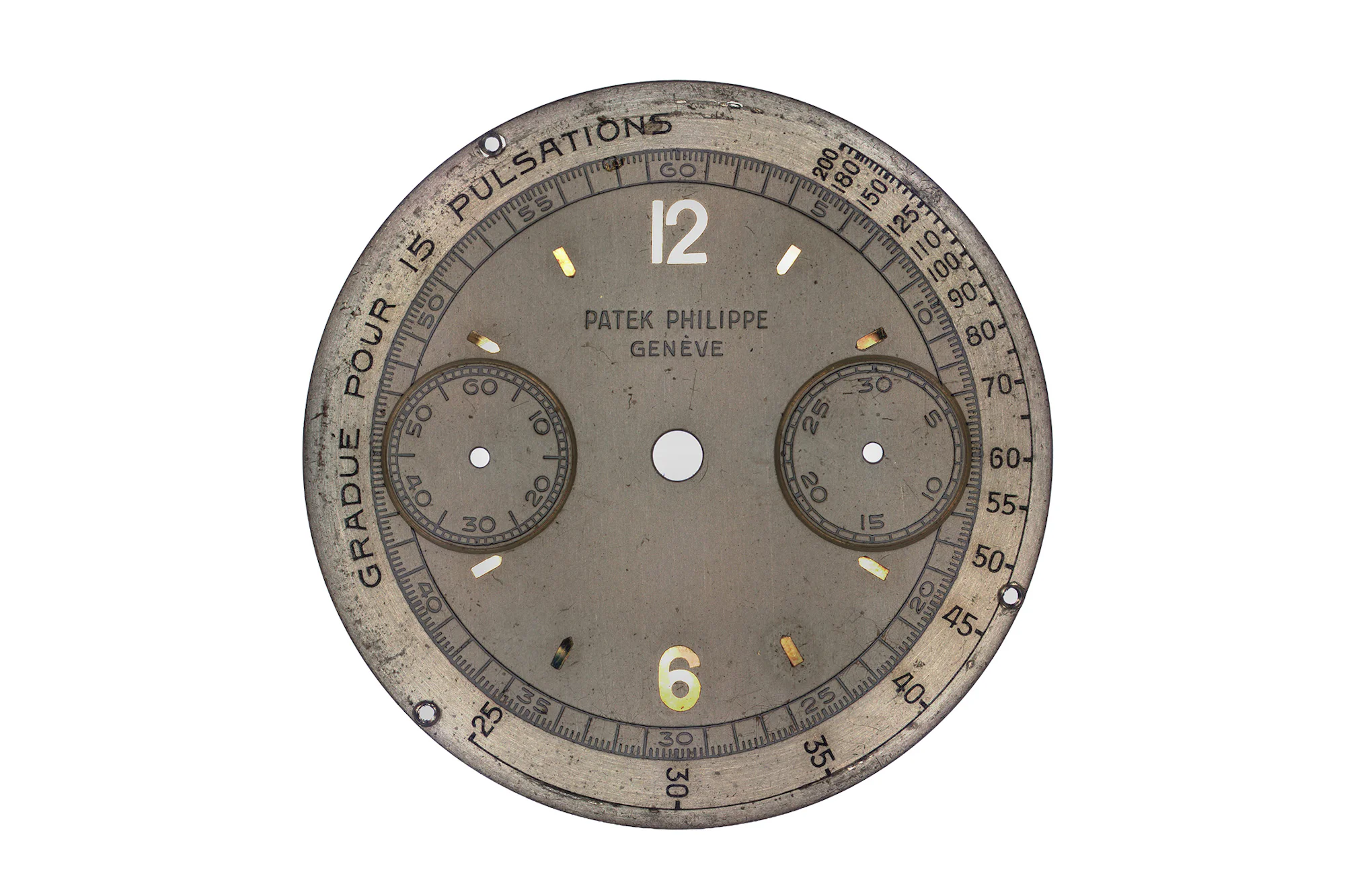
A photo of the pulsation dial out of the case. You can see that there are multiple abrasions around the dial and a lot of spotting. But, for most collectors, this is exactly what you want to see. You can see the outer circular brushing and the opaline center finishing. Photos courtesy the owner.

A close-up of the spotting on the dial that happens when oxygen gets through the protective zapon layer. Photos courtesy the owner.

The rear of the dial (with stamping removed per the owner’s request, to protect against counterfeits), where you can see the indices haven’t been removed. Photos courtesy the owner.

A close-up of the signature, including the accent over the È. Photos courtesy the owner.
The second example Patek made is maybe the most famous and the most widely seen because it’s in Patek Philippe’s museum. While the first ref. 1563 was made in 1943, the second—bearing movement number 863’791 and case 630’551—was made in 1946 and was sold to one of the most famous jazz musicians of all time, Duke Ellington, on July 28, 1948. The watch was later purchased at an Antiquorum auction (from which many of the museum lots came) in 1998 for $673,000. This has what appears to be a very modern dial design, with Arabic indices at 12 o’clock and 6 o’clock and long, rectangular stick indices, along with a partially reprinted tachymeter scale. It’s curious that the watch has the earlier of the two sequential case numbers that were ordered together; the movement, on the other hand, was probably pulled from production and fitted directly into the case.

The “Duke Ellington” 1563. Photo courtesy Patek Philippe.
The final example—”the Breguet 1563″—features engraved hard-enamel Breguet numerals filled with luminous material and yellow-gold lume-filled ‘lozenge’ hands, an outer minute track with concentric fifth-of-a-second divisions, and a tachymeter scale. When you look at references like the 1463 (the non-split version of this watch), Breguet numerals are normally found on steel versions, often made for the U.S. market. Unsurprisingly, the movement is stamped H.O.X., confirming it was exported to the United States (furthering the U.S. connection with split-second chronographs). This watch has movement no. 867’196, case no. 657’132, and was manufactured in 1947 and sold on June 30, 1950. Most recently, the watch was sold in 2024 by Christie’s for CHF 3,360,000; before that, in 2013, for around CHF 1.4 million.

The Breguet luminous 1563.
Here’s the curious thing: that last example has a ref. 1463 inside caseback stamp. I spoke with someone who has had a chance to compare the measurements and construction of the two watches and feels confident that this is, in fact, in a 1463 case. Because it was cased later, instead of ordering a third case, Patek apparently found a way to reduce the space between the dial, movement, and caseback—according to that source, the dial is slightly closer to the crystal and the watch lacks the internal secondary caseback found in the two Taubert cases—so the watch measures the same thickness as any other ref. 1463.

The Taubert/Borgel case on the reference 1563 (a version that actually used a 1463 case). Photo courtesy Sotheby’s.
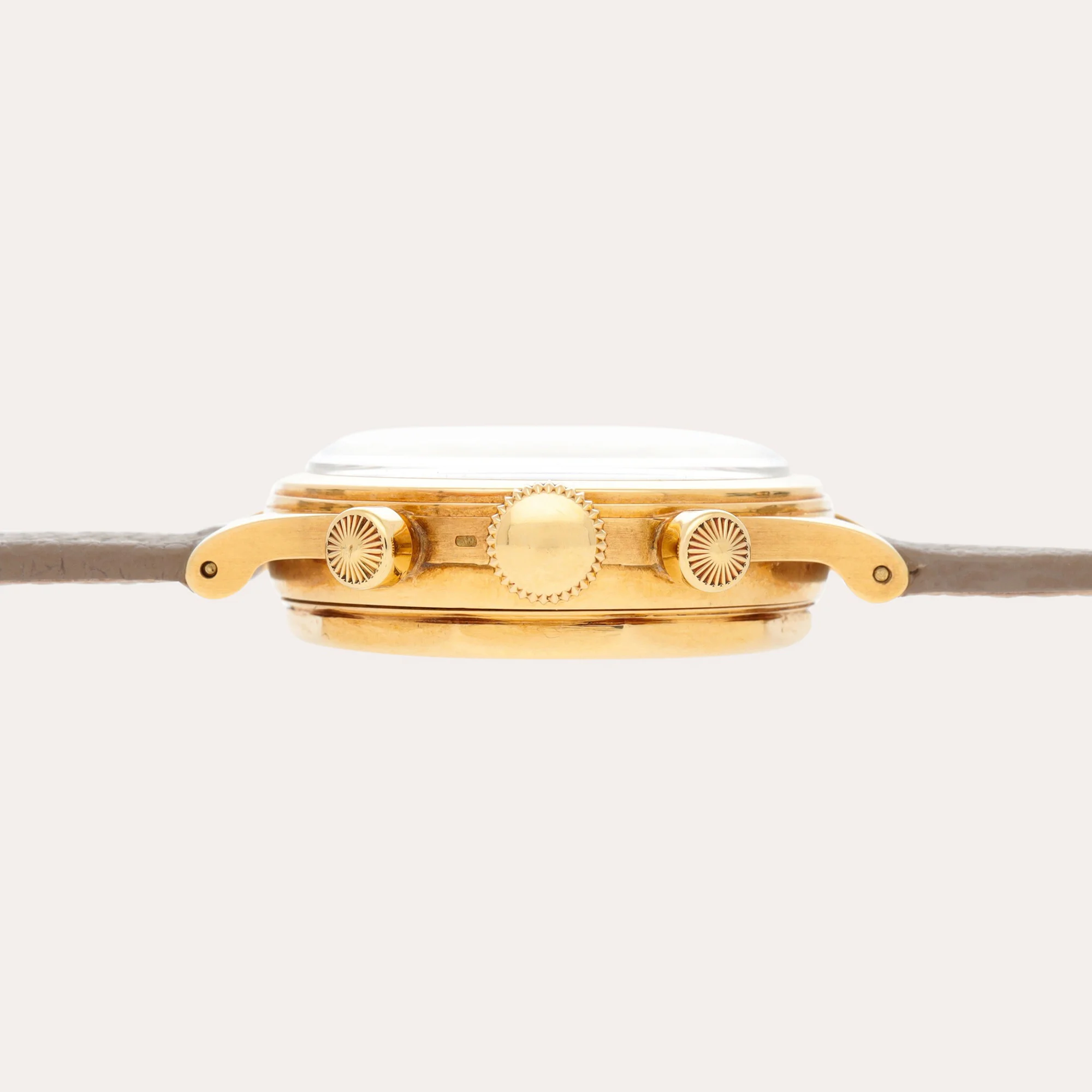
The Taubert/Borgel case on the reference 1563 (a version that actually used a 1463 case). Photo courtesy Sotheby’s.
There’s not much more that can be said about these watches—arguably the most important split-second-only wristwatch model in Patek’s history. While it’s more fair to call these prototype or bespoke pieces, by another metric, the reference is also tied for the lowest serial, or quasi-serial production total of any split-second wristwatch from Patek, and set a new standard for modernization with a waterproof case.
An Interlude of Unique Splits (And One Other Serially-Produced Watch)
In the video, we’re mostly talking about serially produced watches, but you can’t tell the story of Patek’s split-second wristwatches without acknowledging a few special ones that, for the most part, only exist in the Patek museum. You know I’d rather err on the side of being a completist. I’m sure there will be plenty of “but what about this?” if I don’t include the following. Plus, it gives me a chance to talk about my white whale, a watch I believe would easily be worth $50 million if it could be found.
This section is also the reason why this isn’t a complete reference points video. I think that if not for reference 2571, we could have delayed the recording long enough to get every other serial-production watch on the table. I tried for months to chase rumors of its existence—others have chased those rumors for decades—but it was like chasing a ghost. So no, we don’t have these in front of us in the video, but we’re not going to ignore their importance.
Reference 2512 — Unique Piece — 1950/1952

The Patek Philippe ref. 2512, with caliber 13-130R. Photo courtesy Patek Philippe.
The first time we see a unique reference for a Patek split chronograph—post-acquisition by the Stern family—is the ref. 2512, made between 1950 and 1952, with movement no. 867’857 and the case is no. 672’137. This is a unique yellow gold watch with a black lacquered metal dial and large, painted luminous Arabic numerals, and uses the same caliber 13-130 R as found in the 1436 and 1563. The oversized subdials cut off the numerals 2, 4, 8, and 10, and the case is stepped and oversized, measuring a pretty massive 46.2mm by 13.4mm. Add to that the gold dauphine hands match the long, counterpoised split-second chronograph hands, and it’s got a very modern look. Or maybe that’s just because the watch inspired the ref. 5070, which was launched in 1998. The single example now resides in the Patek Philippe Museum.
Reference 2571 — The First Perpetual Calendar Split Seconds — 1955
Here we have one of the most impressive, most coveted, and maybe one of the greatest “missing” watches of all time. It was 1955, one year after the discontinuation of the world’s first perpetual calendar chronograph, the ref. 1518, which was succeeded by the ref. 2499. But then, Patek went further. Taking the same base movement and making it a rattrapante, the brand created a massive watch called the ref. 2571. Essentially, this is a 1518 or 2499 with a split-second chronograph. If you found, I think it might be the most valuable watch in history.

The ref. 2571, with the same Valjoux 23-based movement. Photo courtesy Patek Philippe.
The rose (yes, rose) gold case measures 39.9mm by 14.7mm (versus the 34.9mm by 13.5mm of the 1518 and 37.7mm by 13.4mm). There were three made, and one is in the Patek museum. That example has a dial that is similar to a second-series 2499, with rose-gold-applied baton indices, dauphine hands, counterpoised chronograph hands, and a case more reminiscent of the 1518, with a less complex lug style. It also has a tachymeter scale, like the 1518 or the first- and second-series 2499. As for the others, well, most collectors are unsure whether the watches survive. Some, including the collector whose watches are featured today, have built entire dossiers on these watches in the hopes of finding them.

The movement of the 2571. Photo courtesy Patek Philippe.
A final note about these watches is that the dial on at least one had a Gübelin signature; rumor has it all of them did at one point. There are various origin stories, but one says that because these watches were so large and expensive, they sat unsold until Gübelin took on the challenge of selling them. However, a recently rediscovered auction catalog (thanks to a tip from @pieceunique_ on Instagram) from Christie’s offers a different narrative, which, I believe, we can share online for the first time. The May 1986 catalog says the following:
“This watch is in virtually unused condition and was commissioned by Gubelin and executed in 1955. It is apparently one of only three examples made. The bracelet was supplied by Gubelin.” The estimate was CHF 80,000 to 100,000.

The “missing” ref. 2571 Gübelin. Photo courtesy Pièce Unique on Instagram.
Until recently, the only other known photo of the watch (in black and white, above) showed Breguet-style counterpoised chronograph hands. While I had often heard that the example in the Patek museum was the pictured one, cleaned of any signature and with a swapped handset, we now know that’s not entirely the case.
The watch’s movement number in the museum, 868’331, matches the watch (reportedly from a Munich collection) that was sold at a Christie’s auction in May 1986, as shown below. Comparing the running seconds subdial “3” and “4”, you can very clearly see that the font is entirely different between these two old photos. That means the circulated black-and-white photo is probably a separate example, offering some hope that the two remaining watches could still be rediscovered.

A newly unearthed photo of the 2571 in the Patek museum. Photo courtesy Christie’s.
The Curious Case of the “Ref. 2499 Split”
Then things get strange. There is apparently a split-second chronograph bearing reference 2499, but it’s not a perpetual calendar. I have heard conflicting stories about the origins of this watch, so I won’t dig into it too deeply, as I don’t want to be quoted telling a story that turns out not to be true. All that to say, there’s a watch that was, at some point and for some reason, recased by Patek Philippe from a steel 1436 (possibly a $4 million watch in original condition) into the case of a yellow-gold ref. 2499, with a dial reportedly from a ref. 530. The watch is pictured in Osvaldo Patrizzi’s three-volume “Collecting Patek Philippe Wristwatches.”
Reference 3973 — Unique Piece for Mr. Philippe Stern — 1989

The unique 3973 made for Philippe Stern. Photo courtesy Patek Philippe.
Finally, again existing only as a unique piece in the Patek Philippe museum, is the reference 3973. Yet again, using the caliber 13-130 base, the watch looks a little like a 3970 (as the number suggests), but still uses that old base and is therefore much closer to a 2499. The watch was made over four years of work for Philippe Stern, then President of Patek Philippe, to mark the company’s 150th anniversary in 1989. It features a coaxial crown pusher and blued split-second hands, but the dial, with a ring around minute and second tracks at the edge, also resembles that of a 2499 fourth series.
The Reference 5004 (1994/1995 to 2012)

Patek Philippe went around 35 years without making any split-second chronograph wristwatches other than unique pieces. That’s an incredibly long time without one of the brand’s most important complications. During that gap, Patek ran out of their stock of Valjoux 23 base movements to modify and switched to using the Lemania 2310 ébauche, which also formed the basis for the Omega 321 and for movements from Vacheron, Breguet, and others. Patek released the ref. 3970, the successor to the ref. 2499, in 1986, and what came next is one of my favorite watches in history.


Reference 5004, announced at Basel in 1994 and first delivered in 1995, was a watershed moment for the brand as the first fully commercialized Patek split-second perpetual calendar chronograph. Measuring 36.7mm by a very thick 15mm, the modernized case earned the nickname “cheeseburger” or “hamburger” from collectors, many of whom took some time to connect with the watch. Produced from 1994 to around 2010, the 5004 with the manual-winding CHR 27-70 Q caliber, is finally seeing big numbers on the secondary market due to increased collector appreciation and recently saw a new record price at auction with the sale of one of Eric Clapton’s (multiple) unique pieces of the reference.

One of Eric Clapton’s (many) Patek 5004s, this one in white gold with a custom tachymeter Breguet salmon dial. It sold for $5.2 million in Phillips’ 2026 New York spring auction.
Since the watch is a modern Patek piece, we don’t have exact production numbers. But I’ve done a lot of research on this watch, as it’s one of my top five favorite references. In fact, I had an 8,000-word article waiting in the wings when Collectability beat me to the punch earlier this year. I’ll still post it someday if people have enough interest.
Regardless, Patek is generally quoted as saying they made about 16 of these per year for 16 years; in that case, there would be fewer than 300 of the 5004. But over 200 have been sold on the secondary market. We also know a few commonly held facts about the reference are wrong, such as the oft-repeated figure of only 50 in steel for the final run. In fact, two sets of 50 were made, plus some unique steel pieces that have never been seen or specifically mentioned. So how many were made?

A Patek Philippe 5004 in steel (one of 75 to 100, not 50 as often reported).
My rough estimate is that at least 600 were made. Based on auction data and widely accepted scholarship, white gold is the rarest, accounting for approximately 11% of the total output in the reference. In fact, the vast majority of white examples that have appeared on the market were produced between the late 2000s and 2010. The next rarest examples are yellow gold (around 17%) and rose gold (20%). Finally, approximately 44% of the examples were made in platinum, which is quite unusual for Patek Philippe. And, as mentioned, there are at least 75 to 100 in steel.

The caliber CHR 27-70 Q found in the 5004.
In the interim years, Patek Philippe changed its movement nomenclature, and with the new ref. 5004, it introduced the CHR 27-70 Q. The movement was based on the one found in the ref. 3970—the CH 27-70Q—which itself was based on that Lemania 2310, and took the 353-part original caliber and turned it into a 407-part movement. Much of the similarity between the two is hard to see, as key features from the 3970, such as the y-shaped bridge, chronograph wheel, column wheel, zero-reset, and others, are covered by a large bridge plate that forms the base for the split-second mechanism.
The fact that it’s a split-second watch stares you right in the face, especially if the watch is fitted with its display caseback (almost every example came with both display and closed casebacks). Another noticeable feature is a unique octopus-like isolator gear that manages the amplitude. Since the octopus wheel rotates in only one direction, it must always return to its home position together with the split-second lever. The isolator wheel spring accomplishes this automatically as soon as the split-second clamp opens again.

The split-second bridge and isolator.
With the CHR 27-70 Q, there are three series of movement designs. Other sources differ on the date ranges, but this is what my research found. From 1994 to 1996/1997, there was a large, unsigned, oversized “block” bridge over the rattrapante wheel. That block, which was vertically grained, resulted in functional issues with the reset mechanism and the isolator failing to engage properly. Patek offered to replace that bridge, so these are rare, and even seasoned collectors and dealers might never have seen one or might think that this was some aftermarket job.
The second system, used from 1997/1998 to 2001, is a more delicate, shaved-down bridge attached with only one screw, still meeting at the center post. The bridge has a bit of a dogleg shape, with the end seemingly attached to a pin that goes into the rattrapante plate. After 2002 (though some say 2004), the third series was developed into a more secure final form, held down by a screw passing through the isolator, thereby preventing flexing. Any era of watch could have been updated during Patek servicing to the final design, so date ranges don’t reflect what you should see, but what you could see. One other thing to note is that later era movements seemed to oxidize for some reason, and often need a clean-up during service.

A first-generation “block” movement of the 5004 made in 1997. This style of movement was made from 1995 to 1998. Photo courtesy Christie’s.

A second-generation “dogleg” movement from Patek was made from 1998 to 2002/2004. Photo courtesy Phillips.

A third-generation movement for the Patek 5004, made from 2002/2004 to 2012.
On the dial side, the main difference to note is that earlier versions of the watch had a short crown with a coaxial pusher. Originally, the crown extended only about as far as the pushers above and below it, with the split pusher extending a few millimeters beyond them. Later, in an effort to increase ergonomics and make the crown easier to operate, Patek extended the crown beyond the top and bottom pushers (and made the co-axial pusher longer as well).

A Patek 5004 from 1998 with the standard configuration of a platinum case and a silver opaline dial. However, this is one of the last examples with a short crown and short hands. Photo courtesy Phillips.
It’s somewhat unclear exactly when that changed—certainly by the end of 1998, in my experience—partly because, like the movement, Patek would update the crown during service. Similarly, in the first two years or so, the chronograph hands were not counterpoised and were basically cut off just past the center post. These were also often changed during service as well. Finding a short crown, a short-hand version of the watch, likely means a less reliable, less ergonomic, but rarer version of the 5004 than average.

The first dial designs of the 5004 in platinum, white gold, rose gold, yellow gold, and platinum with diamond indices. You can see that all watches except for the black dial have long crowns. All photos courtesy Christie’s.
When the model was initially launched, it featured five combinations of dials and materials, plus calendars in English, French, German, or Italian. Each of the four precious metals is most commonly seen with silvered dials featuring large Arabic numerals for hour indices, color-matched to the case. Platinum cases typically featured this configuration, but Patek also offered a black dial for the 3971, with princess-cut diamond hour markers, a single baguette at 12 o’clock, and baton hands. There are other small differences, including the moon’s color (often silver for white metals, though not always) and its treatment (usually smooth, though not always), but we can save those for a future breakdown.
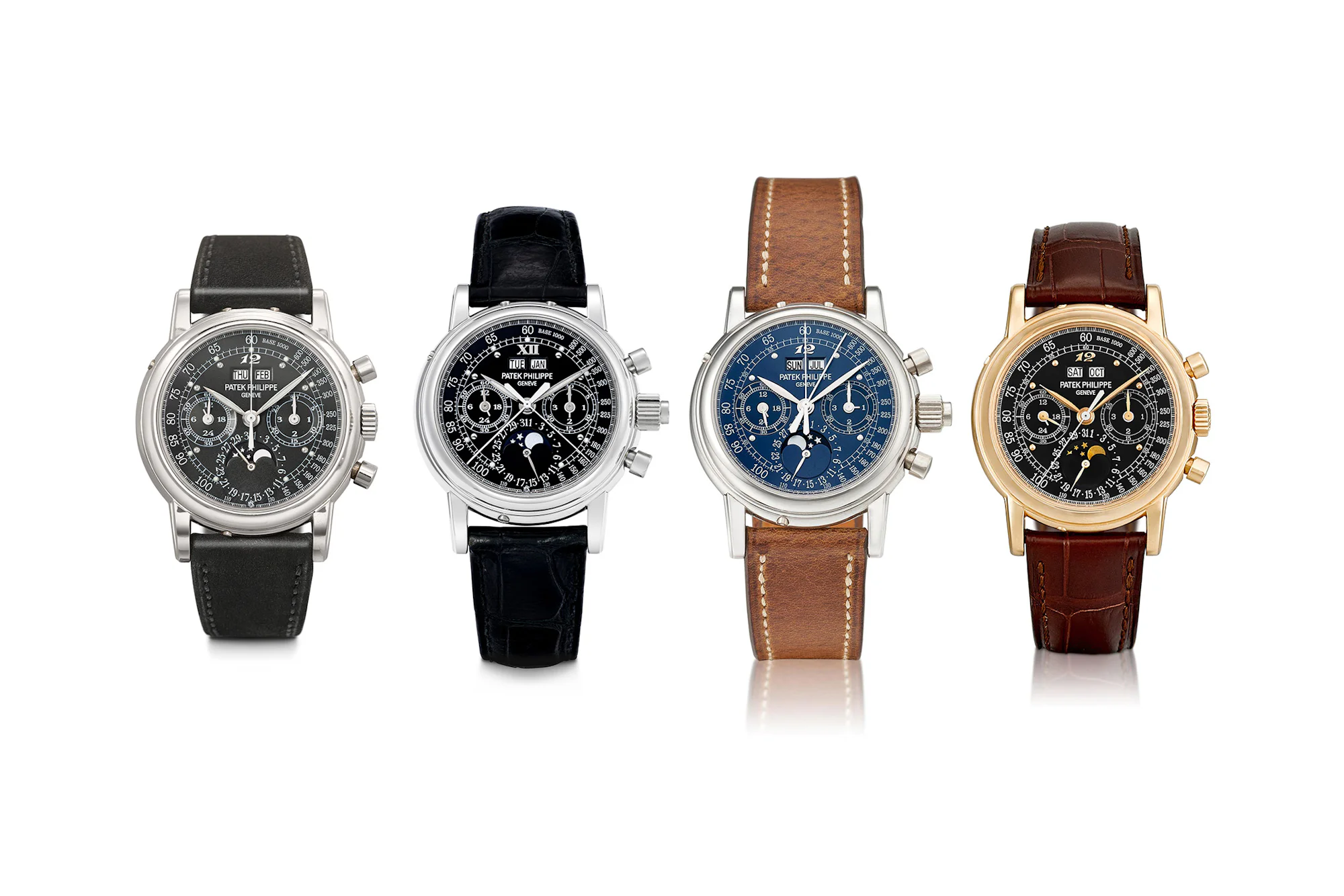
The watch on the left, a ref. 3970P, was made as a special order for Michael Steven Ovitz, along with the 5004P next to it. Both were delivered in 2008. A year later, Eric Clapton took delivery of a blue dial 5004P with the same dial design as Ovitz’ 3970 (minus initials). The 3970R, at right, was made in 2016 for the 175th Anniversary of Patek Philippe. You can see the inspiration drawn from Ovitz’ taste. Photos courtesy Christie’s and Sotheby’s.
The introduction of the 3970 (and, to a somewhat lesser extent, the 3940) marks the point at which the levee began to break for Patek, offering more short-run or unique pieces for VIP customers. The 5004, however, was a whole new level in multiple ways. Buyers really didn’t take to the 5004 at first, and multiple sources have told me that Philippe Stern, in an effort to get some energy into the model, decided to offer more dial variants to their best customers to get the ball rolling. Variety wasn’t unheard of—the 1436 and 2499 are two examples of watches with a wide range of variants—but the extent to which customers could take control had never been seen before. For instance, Michael Steven Ovitz—one of Patek’s all-time great modern clients— put his initials on the dial. Not since J.B. Champion had that been done.

John Mayer wearing his unique 5004G with luminous hands and salmon dial in our Talking Watches 2.
There are dozens of unique examples, far too many to talk about in this story. This includes the famous ones for people like Eric Clapton (the blue dial and salmon dial versions, among others), John Mayer (who showed his in his second Talking Watches), and a number of unique versions for Michael Ovitz, whose designs inspired others (including Clapton, Eric Singer, and Mayer himself). Salmon dials seem incredibly popular, and Eric Clapton’s 5004G just sold at Phillips New York auction in 2026 for over $5 million, more than doubling the record for a 5004 outside of charity auctions. Otherwise, the steel 5004 still reigns supreme in terms of sales numbers.

A Patek Philippe 5004R with ruby indices. One of these was made as part of a set, and then more were made. Photo courtesy Christie’s.

From the same set, a 5004G with sapphire indices. Photo courtesy Christie’s.

The Patek Philippe 5004T for OnlyWatch in 2013. Photo courtesy Patek Philippe.
Beyond just special dial colors and scales or even the standard 3971-style diamond dials, there are watches with baguette-cut diamond indices, others set with radiant-cut stones (some of which have never been published before), special scales, and more. One custom set with gem indices inspired a short run of rose gold watches with silver dials and ruby indices; Jay-Z owns one of these. A weird but relatively common request was to order a black dial with one Arabic numeral in red (often for Chinese clients). Frequently, the biggest VIPs ordered 5004s in sets, with all four precious materials (some with bracelets, some without) and variations on a dial theme. There is also, of course, the 5004T, a version made in Titanium for the OnlyWatch auction in 2013

The rare 5004G in our Reference Points video.
The example in the video is a rare 5004 in white gold with a glossy black dial, baton hands, and baton indices. Glossy dials, soleil dials, and matte black dials are among the rarest finishes. As for this particular watch, in addition to being in the rarest case material (outside of titanium), it seems that only about five of this configuration were made. This watch is the owner’s daily-wear watch, and it has the scars to prove it. Patek Philippe officially discontinued the watch in 2012, though a number of examples with later sales dates have come to market.
Reference 5959 (2005 to 2018)
The 5959 was a monumental moment in Patek Philippe’s history, most notably for its movement. Instead of a Nouvelle Lémania, Valjoux, or Victorin Piguet base, Patek was forced, due to a conflict with the Swatch Group, to go its own way and, under the instructions of Philippe Stern, decided to make its first in-house chronograph. And yes, it was a split.

Reading between the lines, this was both a callback to Patek’s history (their first chronograph wristwatch was a rattrapante, and all) and proof of capability, emphasizing the importance of split-second chronographs for the brand. The watch was built around the caliber CHR 27-525 PS, a 27.3mm by 5.25mm manually wound movement that, at the time of launch, was the world’s thinnest column-wheel split-seconds movement. It was also a flyback chronograph. There was probably no wilder way for Patek to assert its dominance.

Patek Philippe’s first split second chronograph (left) and the 5959. Photos courtesy Patek Philippe and Christie’s.
You can clearly see that the 5959 is based on the first vintage Victorin Piguet-powered monopusher rattrapante from 1923. The watch had a 33mm diameter but a total thickness of only 9mm, with long officer-style lugs. As a sign of the times, the 5959 was initially cased in platinum rather than yellow gold, unlike the original watch. An interesting anecdote here (according to the owner) is that this example was one of the first handful made, and Patek didn’t have a pusher designed and manufactured, so instead, it’s basically just a block of platinum in its place.

The original 13”’ Victorin Piguet-based caliber and the in-house CHR 27-525 Q launched in 2005. Photos courtesy Patek Philippe.
Similarly, the architecture of the CHR 27-525 PS is more reminiscent of the old Victorin Piguet calibers, with individual finger bridges for the escape and third wheel, plus the scissor-style brake arms for the split-second mechanism. Instead of remaking the old caliber, Patek innovated by changing the chronograph gear wheels to a new, patented shape that reduced tooth play and helped prevent the chronograph hand from vacillating or jumping. Because of this, the movement was more efficient, had lower friction, and was more reliable.

With the design changes, the watch no longer had an instantaneous jumping minute counter but instead had a continuously advancing counter for the 60-minute indicator. There’s always direct contact with the cannon-pinion to drive the minute hand in the counter. However, anyone who owns one of these CHR 27-525 PS-based movements can tell you that they still are quite finicky to use and don’t always reset perfectly.


Patek also focused on aesthetics, with chamfering, polishing, decorated bridges, and more. Both column wheels are covered with polished protective caps. Rubies are set in gold settings. This also launched the brand’s new Haute Horlogerie section. Each small atelier had five or six master watchmakers who focused on a single type of complication. They do all the filing, chamfering, polishing, and adjusting. Then they assemble, check, disassemble, readjust, and complete the final construction.

A Patek Philippe ref. 5959R-001. Photo courtesy Christie’s.
The original version, the 5959P-001 seen here, featured a white dial with black painted Breguet numerals. The 5959P-011 was also made, apparently limited to around 10 pieces, with a black-lacquered dial and painted silver numerals. Finally, the 5959R-001 was an ultra-rare, limited-edition model of 15 pieces, with a rose-gold case and a black dial with rose-gold numerals. In all cases, the watches were delivered with both an interchangeable solid platinum case back and a display back. Even the original was produced in small numbers, and, due to its size, the watch apparently sold pretty poorly. Visually, they look even smaller than a 33mm 1436. However, for someone with vintage tastes and an appreciation for the movement style, it’s kind of a must-have. The watch was discontinued in 2018.


Reference 5950 (2010 to 2019)

The 5950 is one of my favorite modern Patek watches. Launched in 2010, the watch uses the same CHR 27-525 PS movement as its predecessor, with some vintage touches but in a much more modern case. Unsurprisingly, a 33mm split-second watch was a niche item—especially in an era when other brands were doing oversized, bold designs (like the AP Offshore Grand Complication launched in 2013 and JLC’s Hybris series, which had been in production since 2003). After five years of flexing their muscles on a small watch, it was time to modernize.


The 5950 took the same small movement but upsized to a 37mm-wide-and-long, 45mm-lug-to-lug, 10.15mm-thick cushion case with a cushion-shaped dial opening, a printed central dial, applied Breguet numerals, and “Belle Epoque” scroll engravings on the corners of the dial and the buckle. Those engravings are the same as those found on watches from the Victorin Piguet monopusher era, including one from 1923 in the museum.

The best part, to me, is that almost all of these were made in stainless steel and issued as application pieces. The first pieces (5950A-001) were in steel, with a creamy silver-white opaline dial and blackened numerals and hands (as would be found on the 5004A later), and on a bracelet (5950/1A-001). In 2014, the brand offered the same watch in two versions: a 5950/1A-011 (salmon/rose-gold sunburst dial with blackened numerals and hands) and a 5950/1A-010 (blue sunburst dial with silver numerals and hands), all with stainless steel beads-of-rice-style bracelets and limited to 10 pieces. The final steel options, a black sunburst dial (5950/1A-012) and a silver opaline dial with rose-gold numerals and hands (5950/1A-013), were released in 2015, again limited to 10 pieces.

Six of the eight Patek 5950 variants. The only one not pictured in this story is the watch in live pictures above, with the steel bracelet shown on some of these models. Photos courtesy Sotheby’s, Phillips, and Christie’s.
In 2016, the brand shifted materials and introduced the 5950R-010, a pink-on-pink watch with a satin-polished rose gold dial and blackened hands and indices, limited to 15 pieces, and finished things off with the 5950R-001, which was either limited to 15 pieces or made in very small numbers. The market has recognized how compelling these watches are, so if you were hoping for a steal (on steel), you’re a bit late to the party. But man, it’s fun to dream.
Reference 5951 (2010 to 2015)

Among the shortest runs of Patek split-second chronographs (and perpetual calendars), the reference 5951 was a bit of a shock. Using the same 37mm cushion-case shape and the base of the CHR 27-525 PS, Patek created the CHR 27-525 PS Q, adding 148 components yet keeping a thickness of only 7.3mm (2.05mm more than the original movement). That resulted in a watch that was 37mm wide but 12.35mm thick, only 2.2mm thicker than the 5950.


The watch was bold and incredibly surprising. The design significantly shifted the dial’s layout. The chronograph counter subdial was placed at 3 o’clock, the running seconds at 9 o’clock, but now the moonphase disc was at 12 o’clock above the brand signature. The date was in a large 6 o’clock subdial. But on each side is a day/night indicator (left), a leap-year indicator (right), and two trapezoidal apertures for the day of the week and the month. Patek had never done anything like it before (or since).

The three other versions of the 5951. Photos courtesy Christie’s and Patek Philippe.
The first series in 2010, seen in the video, featured a black dial with an outer chemin de fer track (without a tachymeter), silver subdials, and red accents, including the chronograph hands. Some people say this was so aggressive for Patek that it’s no wonder they announced the 5951P-012 in 2014, a platinum version with a more traditional white lacquered dial and applied blackened-gold numerals. That same year, they also made the 5951P-013 with a black dial and Breguet numerals. Not many of these were made. The last version kicked things up a notch. The 5951/500P-001, made in 2015, had a hand-engraved case, hour/minute hands, a black dial, and Breguet numerals. It’s not clear how many were made, and only one has ever appeared on the market. After the watch was discontinued, Patek Philippe has not made another cushion-shaped grand complication.
Reference 7059 (2011 to Unknown [2019 or possibly earlier])
I bet you didn’t know this existed. It actually may be the biggest oddball out of all the watches in this story. Launched in 2011, the reference 7059 was marketed as the first ladies’ split-second monopusher chronograph. Funny enough, it was larger than the 5959 by 0.2mm to accommodate the two rows of brilliant-cut diamonds around a rose-gold bezel, with another row around the sapphire caseback.

Photo courtesy WatchesBySJX.
There was only one version, the 7059R-001, and it was produced from around 2011 to 2016. The movement and basically everything else (including the officer-style case) remain the same as the ref. 5959. The dial had a very boldly grained, creamy-white finish with applied Breguet numerals in pink gold. But it must not have been the most in-demand watch from Patek. We covered it back in 2011 when it launched, as did SJX, who seems to have the only live pics around. Not a single example seems to have sold at auction, though two are currently listed for sale by dealers, so it does exist!
Reference 5204 (2012 to Present)

The Patek 5204 (left) and the 5004.
Next up is the spiritual successor to the Patek 5004. The 5204 was launched in 2012 with the new CHR 29-535 PS Q movement. Unlike the CHR 27-525 movements, the new movement was built on the back of the 2009 introduction of the CH 29-535 PS manual-winding, column wheel chronograph found in the 5170. Next came the addition of a perpetual calendar to the 5270 movement in 2011. It took only one more year for the brand to launch the 5204.

So why launch a larger, thicker movement when you already have the 5959 and its family? Well, improvements in specifications often require compromises, and the CHR 27-525 was anything but a perfect movement. The CHR 29-535 was only 2mm wider and 0.1mm thicker, but it has a higher power reserve (65 hours) and a higher beat rate (4 Hz) than the thinner-caliber base. It also had six patents from the base movement, including optimized tooth profiles to eliminate backlash, self-setting reset hammers, and a precisely jumping minute counter, and a seventh for the new isolator for the split-seconds lever and a mechanism that improves the alignment of the split-seconds hand with the chronograph hand.


On the dial side, the general subdial layout falls in the same lineage that goes back to 1518. But there are some distinctions from the 5004. First, it’s a much more modern size: 40mm in diameter and 14.3mm in thickness. The lug profile is different: instead of just having steps on the outside of the lugs, there are steps on the inside as well. Because of the lug profile, the entire watch feels a bit more round. And then there’s the moonphase, which is now inverted. You can also see that because of that base movement, the subdials are all lower than the center post. Patek says this is for balance, since the eye is pulled upward by the apertures at the top and now back down by the moonphase.

The first version, launched in 2012, was the 5204P-001, a platinum watch with a silver-white opaline dial, which was surprisingly sporty. Next, in 2014, was the 5204P-011, another classic version with a black dial and white gold indices. Then came the 5204R-001 in 2016, a rose-gold case with a black dial and rose-gold bracelet, which marked the first perpetual calendar split-second chronograph serially produced with a bracelet (a blue off-catalog PVD sunburst dial is also available in a similar configuration 5204/1R-010). In 2021 came the 5204R-011, also rose gold with a slate grey sunray dial but no bracelet, followed a year later (2022) by the 5204G-001 with an olive-green sunburst dial.

Photos courtesy Patek Philippe.
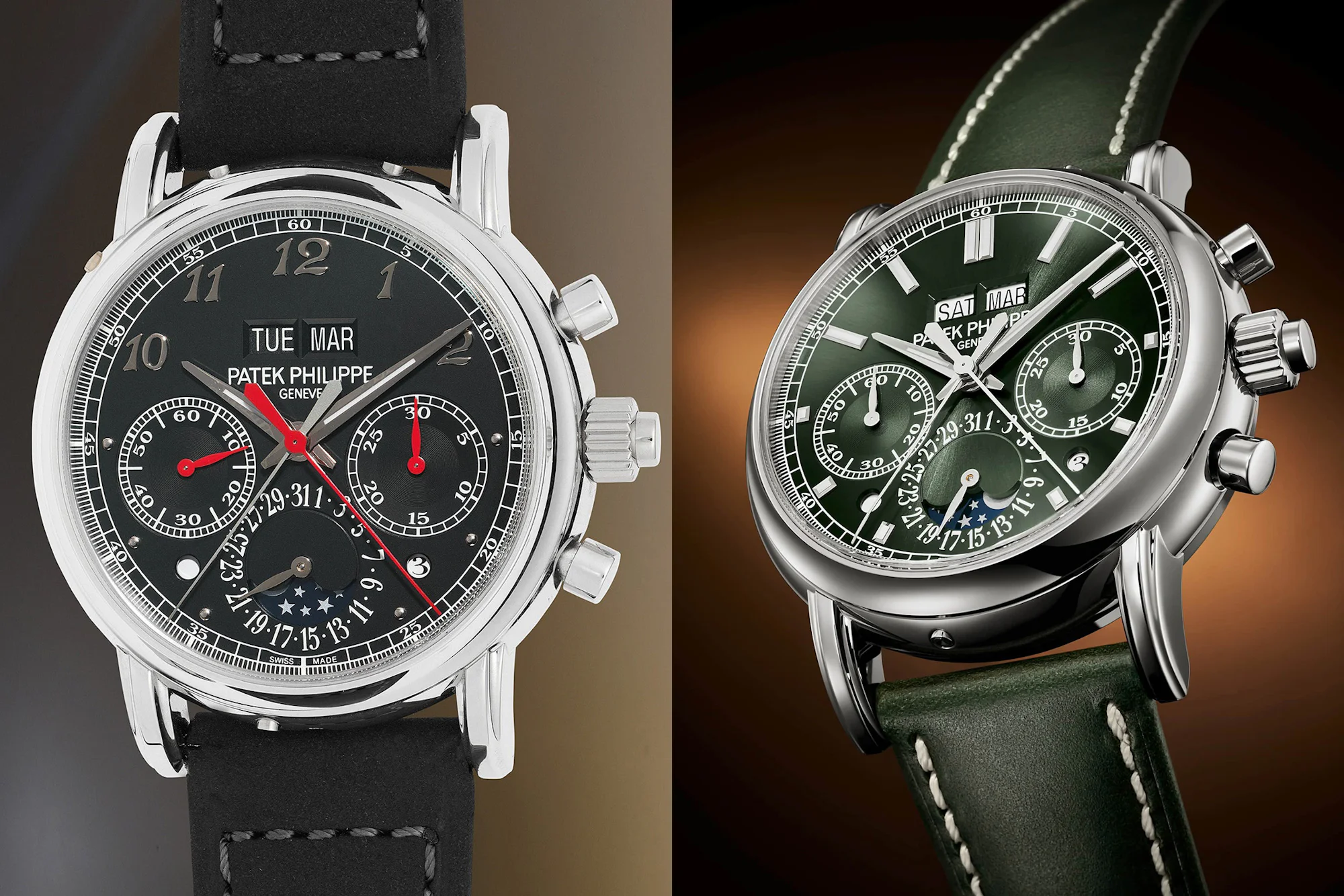
Photos courtesy Philipps and Patek Philippe.
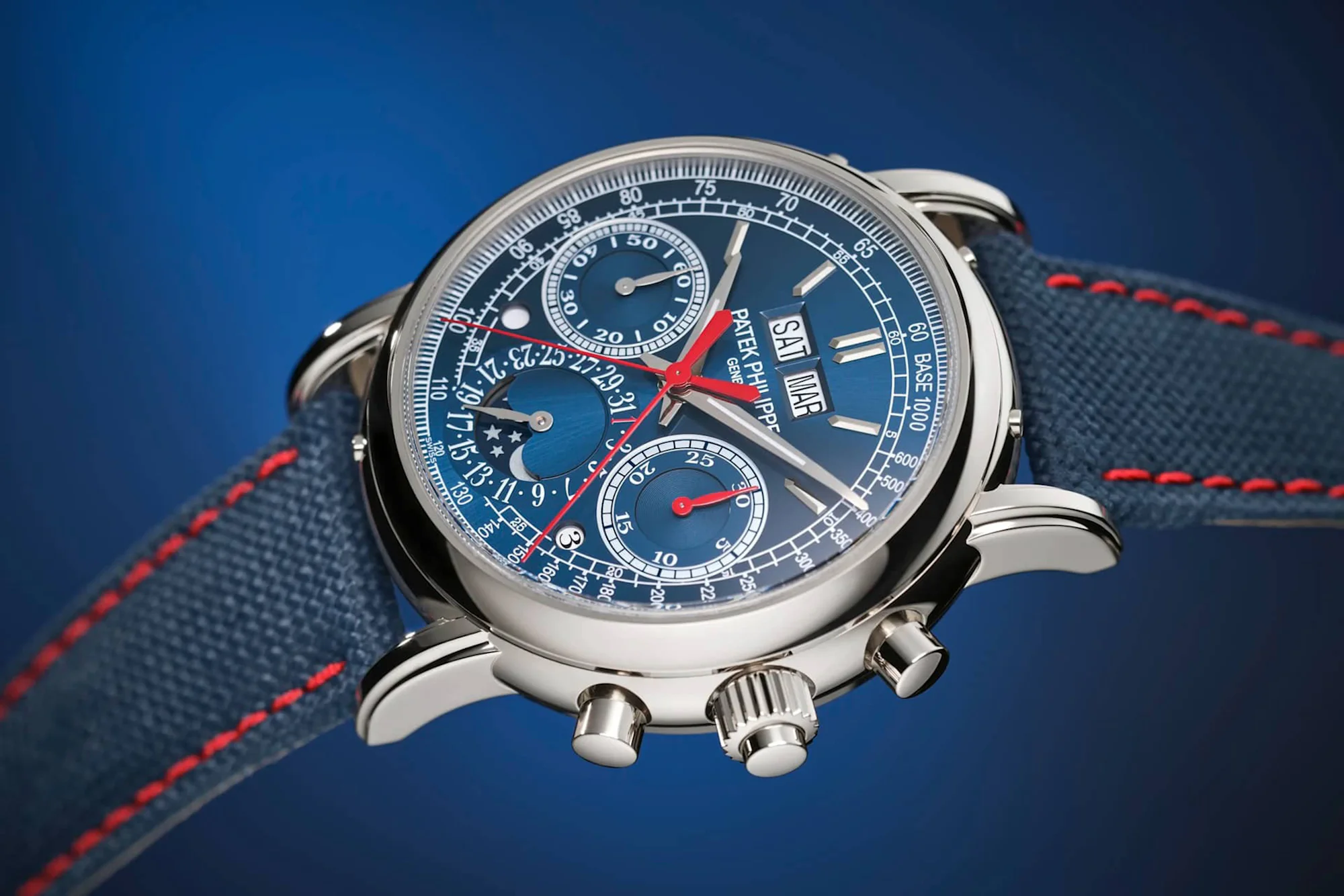
Photo courtesy Patek Philippe.
Most recently, the brand launched the 5204G-010 at Watches and Wonders in 2026 with a blue sunburst dial and red accents. This was the first version of the watch without luminous hands and indices, but instead, the brand added a tachymeter. It’s an incredibly modern look. There’s also at least one possibly unique version with a black dial and Breguet numerals (5204P-021). Now, having been made for 14 years, the 5270 and 5204 represent the longest run of in-house perpetual-calendar chronographs that Patek has produced to date.
Reference 5370 (2015 to Present)
One of the most under-appreciated watches, if the secondary market is to be believed, is the most modernized version of the split-second chronograph, the ref. 5370. Launched in 2015, the 5370P-001 featured a deep-black Grand Feu enamel dial with applied white-gold Breguet numerals and a tachymeter scale, which is arguably a must-have for a split-second chronograph (or chronograph in general). It was a stunning watch—still is, actually—but for some reason (maybe the size), collectors really haven’t gravitated toward it. Maybe that’s because it’s a more modern size: 41mm by 13.56mm

The original 5370P-001. Photo courtesy Christie’s.
The watch, like the 5204, is based on the CH 29-535 movement, this time just the CHR 29-535 PS, with the slightly sunken subdials and three pushers (one in the crown), versus the two on the thinner sibling movement. The case had thinner, sloping lugs with screwed lug holes and a case measurement of 41mm by 13.5mm. It’s dressier, more refined, and—in a rare instance—a watch that actually came out after the more complicated sibling. That’s actually why the collection featured in the video doesn’t have one of these watches; he already has the more complicated movement of the family.

The blue enamel dial 5370P-011. Photo courtesy Patek Philippe.
A follow-up refresh came in 2020 with a blue enamel dial in the 5370P-011, later succeeded by the 2025 launch of the 5370R, which brought a brown enamel dial with a white tachymeter ring and white subdials. Over the 11 years the watch has been in production, options have ranged from classic to sporty, depending on your tastes. My pick is the black-dialed version; at release, it retailed for $249,200, but it can be picked up now for about $100,000 less. The 5370R seems to hold its value best on the secondary market—a frequent result of being the most eye-catching option from the brand.

From our Hands-On with the 5370R.
Reference 5372 (2017 to 2022)
Tied for the second-shortest run in the modern split, the 5372 was a stunning launch from Patek, but we already know quite a bit of the story. Earlier, the brand used an extra-thin CHR 27-525 PS movement from the 5959 to create the CHR 27-525 PS Q movement for the reference 5951. That watch (like this one) would only be made for five years and, in addition to being complex and rare, was not a collector’s favorite at the time. The apertures on the dials were in odd locations compared to past Pateks, as was the moonphase, and the watch had a tonneau case (something that never sells quite as well as a round watch.

The Patek 5372. Photos courtesy Christie’s.
With the 5372, Patek made a lot of changes. The layout of the dial is a bit different, with the day and month windows relocated to the left and right subdials, while the moonphase remains at 12 o’clock. It’s not quite the standard layout we’re used to, but it helps make the area around the date subdial a little less crowded. The round case was also a more standard commercial decision, and one that began to interest collectors. It’s also more classically sized than the 5204, measuring 38.8mm wide and 12.93mm thick. The monopusher design—necessitated by the movement—is a very vintage callback and makes it only the second perpetual calendar split chronograph with a monopusher. Instead of playing off the 5004 case design, the lugs were like those on the 5370, with the screwed strap bar.

The movement of the 5372, built on the same base as the 5959 and shared identically with the 5951. Photo courtesy Christie’s.
Patek made two versions, both with a platinum case. One had a rich blue sunburst dial with white-gold Arabic indices, while the other had what the brand called a rose-gold dial (collectors would call it salmon) with vertical brushing and blackened hands and Arabic indices. The watch was discontinued in 2022. The only reason the owner of this collection doesn’t have this watch is that he has the same movement in the successor reference shown below.
Reference 5373 (2022 to Present)

Out with the 5372, in with the 5373, where the brand turned things around (literally). A left-handed split-second wristwatch isn’t without precedent; it had just been 97 years since Patek Philippe had done one. Yes, back in 1925, the brand made a left-handed Victorin Piguet single-button rattrapante, and it’s a watch that the owner of this collection we filmed has been chasing for years as a left-handed person himself.

A unique left-handed version of the Victorin Piguet split-second Patek wristwatch, most recently sold by Christie’s in 2006. Photo courtesy Christie’s.
There’s not much to say about this reference, as cool as it is. Patek essentially just rotated the entire case and movement and oriented the dial upside down, meaning the moonphase is on the bottom, the date is on the top in a subdial, and the indices are all more bottom-heavy. The Patek logo is now at the bottom as well. The dial is now sportier, with a vertically grained dark black dial (which can trend a bit brown) and red chronograph hands (and a hand for the 60-minute counter). The entire package measures 38.3mm wide and 12.93mm. And as a quirk, the diamond usually found between the bottom lugs on a platinum watch is now at the top (because the bottom lugs host the calendar adjuster buttons).


The Patek Philippe 5950 and 5373.


The Patek Philippe 5959 and 5373, the base movement and the most recent execution
For those not in the know, watches with the crown on the left-hand side are generally considered for left-handed people (who wear their watches on the right wrist) with the thought being that it’s easier to wind or use the crown while on the wrist (which, as a PSA, is a bad idea in the first place since it puts lateral pressure on a very delicate winding stem). Functionally, the watch actually almost works better as a left-handed version when worn on the left wrist. That way, you can use your thumb to operate the pushers. It also represents the last in a lineage of watches based on the brand’s first in-house chronograph movement, the CH 27-525. At least for now.

Every watch based on the CH 27-525 movement, except for the 5372.
Reference 5308 (2023 Limited Edition, 2025 to Present)
This is the most recent addition to Patek’s history with the complication; by far, it’s the most complicated wristwatch the brand has ever made with the split-second chronograph. It’s also one with which we’ve done a full-fledged Hands-On.

The reference 5308 was launched in 2023 at the Tokyo Watch Art Grand Exhibition. This is what Patek Philippe calls a “Quadruple Complication.” That’s a bit of a misnomer, as one of the complications is a simple chronograph and the other is a split-second chronograph. In Patek’s own museum catalog, they don’t call the split-second two complications. Anyway, the other complications are an instantaneous perpetual calendar with a radial display and moonphase, and for the first time ever, a minute repeater. The watch was launched as a 15-piece limited edition in a 42mm by 17.71mm platinum case (with skeletonized lugs) and a salmon dial and blackened indices and hands.


The caliber R CHR 27 PS QI movement is a powerhouse and an evolution of the R 27 minute repeating caliber introduced in 1989. That means it is an automatic movement with a microrotor. Because of this, you can see through the caseback that the split-second mechanism and perpetual calendar are on module plates on the dial side. In that way, it’s the least complex-looking rattrapante movement of the bunch.

From our 2025 Hands-On.

From our 2025 Hands-On.

From our 2025 Hands-On.
The example here was the second piece delivered by Patek Philippe: the non-limited (though very low-production) follow-up, the 5308G, launched in 2025. Rumor has it that the brand makes fewer than five of these per year. With a white gold case and ice blue dial, this contrasts a hyper-modern design with the very traditional, vintage-inspired treatment of the 5308P, and it signals a future for the brand’s complications development. But to the owner of the watch, that’s all well and good, but you need to wear your watches. His watch bears the scar of a doorknob ding, as many good watches do.

Thank you for the support and information shared by the owner of the collection, Dr. Peter Friess and the Patek Philippe Museum, Patek Philippe, Sebastien Chaulmontet, Auro Montanari, @pieceunique_, and the resources and research from Everywatch, Phillips, Christie’s, Sotheby’s, Monaco Legend Group, Antiquorum, Collectability, and others.
TKTK CREDIT PRODUCER AND VIDEO CREW