

We’ve all been told at least once in life to stick to our own lane. It’s an old trope that historically holds merit. Stick to one discipline, master it, and you’ll succeed. But in 2026, the rulebook has changed in almost every aspect of life, and sometimes those one-trick ponies aren’t the ones leading the charge; they’re actually left in the stable.

La Montre Hermès S.A in Brugg, Switzerland.
In watchmaking, it transpires that the latest crop of brands to realize this are the names we most associate with being wider fashion houses. Empires sustained by hand-stitching legacy into cloth, amplified in the theatre of the catwalk, now play in the watchmaking arena. We’ve witnessed many of these names turn to watchmaking as an additional arm to their already bulletproof name, and crucially, they’re delivering watches with real merit.

For Hermès, despite having a presence in watchmaking since the early 20th century, with Universal Genève as the brand’s watchmaking partner from the 1930s and the production of exclusively Hermès-signed pieces such as desk clocks, this rise has been built brick by brick since the 1970s.
Outfitting horses came first, then their riders, and it quickly proved that true luxury comes from mastery, not scale. During the 1970s, the maison decided to build schools to train artisans the Hermès way, passing along hand-stitching, leather cutting, and scarf-printing techniques from master to apprentice. While other names pursued mass production or outsourcing, Hermès focused on the long game by investing in education to cultivate a workforce that embodies the brand’s DNA, ensuring that each bag, saddle, and scarf was finished to its exacting standards, even as production increased. Since demand for Hermès has grown significantly, the quality of work hasn’t diminished. As such, it has become a cornerstone of luxury and, in my eyes, the very pinnacle.

During the same decade, Hermès decided to drastically reshape its relationship with watchmaking, laying the foundations to participate in the craft through an equally in-house lens. In 1978, La Montre Hermès was founded by Jean-Louis Dumas-Hermès, a direct descendant of Thierry Hermès. Jean-Louis was responsible for many of the now-cornerstone evolutions at Hermès, from ready-to-wear to shoe manufacturing. He was also the man behind the chance meeting with Jane Birkin that would eventually birth arguably the most significant handbag silhouette of all time.

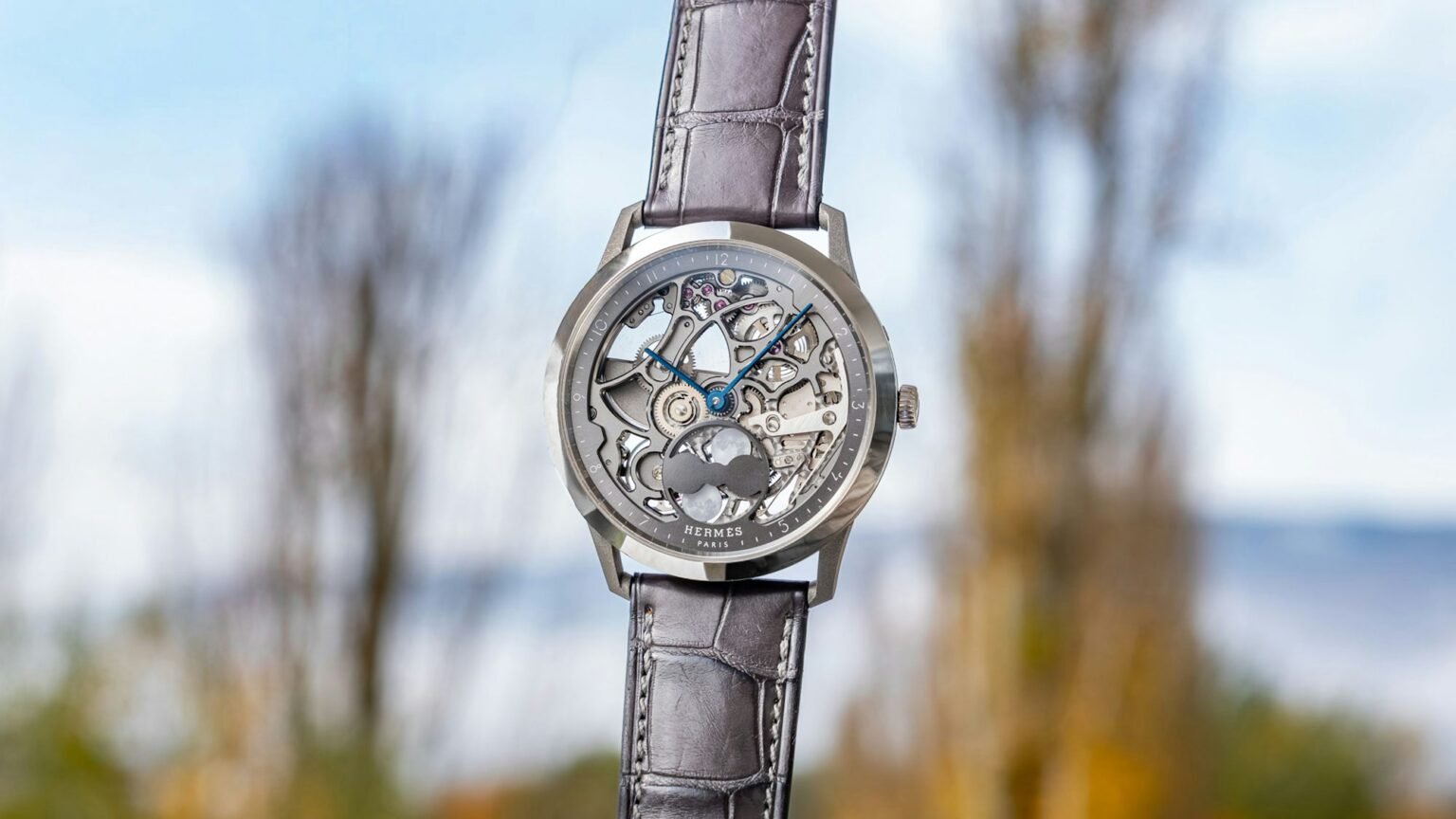
The Slim d’Hermès, the H-08 Chronograph, and the Cut.
“The mission that I had when I arrived at Hermès was to develop the mechanical watchmaking here”, Philippe Delhotal, the creative director of Hermès Horloger, tells me. Delhotal has held this position since 2008, with previous roles at Vacheron Constantin, Piaget, Jaeger-LeCoultre and Patek Philippe.
“What motivated me the most was creativity, the chance to be able to be at a maison of creation with a lot of different jobs. For me, it was an opportunity that allowed me to see something other than traditional watchmaking.”
Watchmaking at Hermès is split across two sites: production takes place in Le Noirmont, Switzerland, while final assembly, strapmaking, and QC are handled at the atelier in Brügg.

Even the coat hangers are branded.

The cup and saucer, yes, but peep the stirrup-shaped spoon as well.

The Hermès Cut remains one of my favourite models from the brand, one I’d love to have in my watch box.
In 2006, the brand acquired a 25 percent stake in Vaucher Manufacture Fleurier, and in the same year, the La Montre Hermès S.A. site in Brügg was established. Hermès Horloger then expanded its expertise by acquiring Natéber (dials) in 2012 and Joseph Erard (cases) in 2013 before the official creation of Les Ateliers d’Hermès Horloger in 2017. Today, Hermès Horloger operates as a fully integrated manufacture, overseeing everything from cases and dials to straps and final assembly.

The Hermès H08.
To understand how that philosophy translates into the watches themselves, I visited Hermès’ manufacturing facilities over two days to see exactly how production, assembly, and the leather workshop operate, with plenty of time spent handling the watches throughout.
Casemaking
The birth of a watch at Hermès begins at its manufacture in Le Noirmont, Les Ateliers d’Hermès Horloger. The site is currently undergoing a major expansion, scheduled for completion in 2028, that is expected to nearly double the existing facility’s size, enabling greater growth and efficiency for the brand. This is where case and dial production takes place, covering every step from raw material to finished form. For the most part, Hermès still relies heavily on the human hand throughout the process.

The first step is to form the shape of the case, which is done by cutting and stamping.

This process involves multiple rounds of stamping via case molds.

Here you can see the stamping progress, from the rough outline of a Cape Cod to something more refined.

The first and last step of case stamping for the Cape Cod.

Heure H cases.

Every single person we encountered during the visit was wearing Hermès watches, starting strong with the Arceau Chronograph 42.


Solid casebacks of Hermès pieces also go through a stamping process to add an insignia.

During multiple rounds of the stamping process, the cases, here the Cape Cod, head to a kiln, a process which is repeated until the cases are at an appropriate level.

As you can see, these look a lot more familiar as a watch case than how they started, but they’re far from being at a finished, high polish level.

A trio of Kelly cases mid case cutting and refining. Make a note of the Kelly, as it’s a watch we’ll see a lot more of at all stages during this visit.

Another caseback stamping, step one complete.

Many of the cases we saw being worked on were highly polished, including the casebacks of the Kelly.

An appropriately stacked Galop d’Hermès, worn by Manon at Hermès.

The polishing process required for the tiny lock of the Kelly requires an elite level of patience.


Those who work on polishing these components handle every stage of the polishing process, from removing larger imperfections first to applying the final polish used to achieve the desired glow.

Once the desired finish is achieved, the watches are then wrapped and head to the next stage.

While every case goes through a slightly different finishing process, the level of QC checks undertaken at every stage is remarkable.

Dust removal on a Heure H crystal.

A finished caseback insignia.
Dial Production
Much like case production at Hermès, dial manufacturing begins with stamping. Once again, Hermès relies heavily on the human touch at this stage, with much of the process’s success resting on the craftspeople’s proficiency. After speaking to numerous artisans throughout the visit, it’s clear that expertise isn’t lacking, with many coming from prestigious traditional manufacturers before beginning lengthy tenures at Hermès.
What stood out most here, compared to many other manufactures, was the openness of the artisans themselves. Many were more than happy to stop what they were doing to explain techniques, demonstrate processes, and show genuine pride in their work. It created a very different atmosphere from environments found elsewhere in watchmaking, as many of the people working were more than happy to stop what they were doing to show us exactly how they operated.
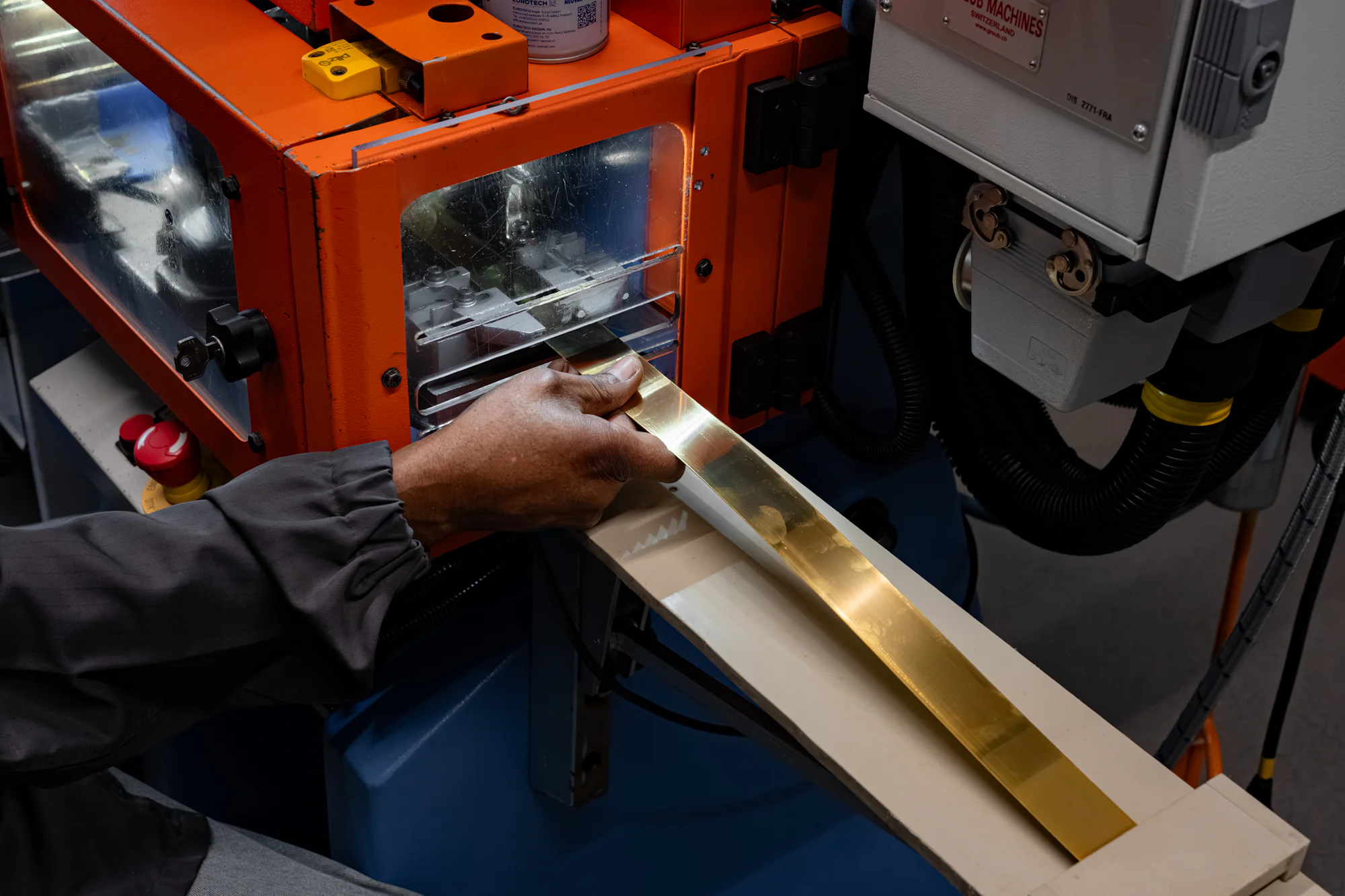
Dial stamping from a sheet of brass.

Here you can see two dials: one with holes added for the hour markers, and one before that process has taken place.

Arceau Le Temps Voyageur dials ready for the smoothing process.

Achieved by hand, this step is crucial as it removes any imperfections, something which, if not removed upon polishing later, would cause issues.
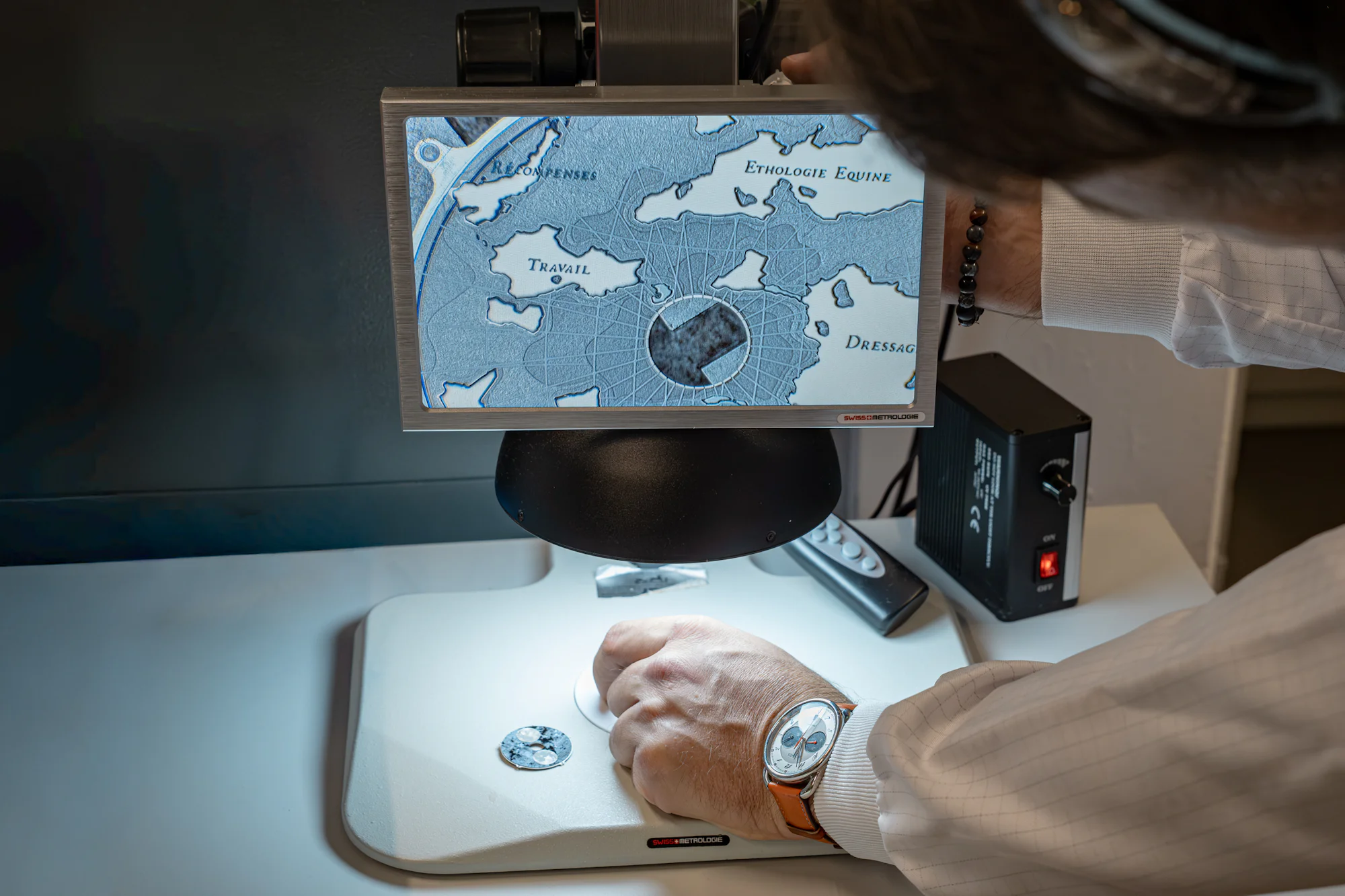
An Arceau Le Temps Voyageur dial again, this time later in the manufacturing process and under inspection.

Each step of the Arceau Le Temps Voyageur dial production process.

A moment to compare to what we see on these final dials.
Strapmaking at the Leather Workshop
Once these components are all manufactured and QC checked, they then move over to Hermès’ main Swiss headquarters in Biel/Bienne, La Montre Hermès S.A. This location is home mainly to the final assembly and main offices, but it’s also where Hermès makes its leather straps. By hand, of course. Strangely, for me, this was the part of the visit I was looking forward to the most. The craft behind leather goods is something of a quirky, adjacent love affair of mine. The fact that this ancient way of producing goods is still being used today is enough of a justification in my mind, but when it’s perfected by someone such as Hermès, that level of affection increases tenfold.

Here we’re taken through each of the steps involved in making leather straps at Hermès.
Going down a few floors in the elevator at La Montre Hermès S.A., we were led to a leather workshop, and suddenly the entire mood of the trip shifted. What was initially two days of pragmatic, process-driven manufacturing suddenly became playful and energetic. Music played from speakers rather than individual headphones, and conversation among artisans was open and banterous. Even when the people here were working individually, collaboration was in the air. There was time and space carved out for creativity in this energetic environment.
Hermès silk scarves hang from the ceiling, and towers of orange boxes in all sizes were arranged as decoration. Walking through the doors, we’re met with artisans who feel more akin to encouraging art teachers fuelling talent than highly skilled makers working for one of the largest luxury houses in the world. This felt like a deeply personal workshop, defined by the personality of the skilled hands who occupied it and reflected in the Hermès-stamped goods leaving its doors. I don’t think I’ve ever visited a space within a watch manufacture with this much camaraderie.

From sanding down the edges.

Before and after.

To heat-sealing the leather.

And even hand stitching the keeper together.

Yes, the ‘H’ the stitching pattern forms is deliberate.

The GPHG Artistic Crafts Prize from 2018 for the Arceau Robe du Soir, alongside a step-by-step process on how the dials are crafted.

Some of those leather pieces are so small they look like dust.
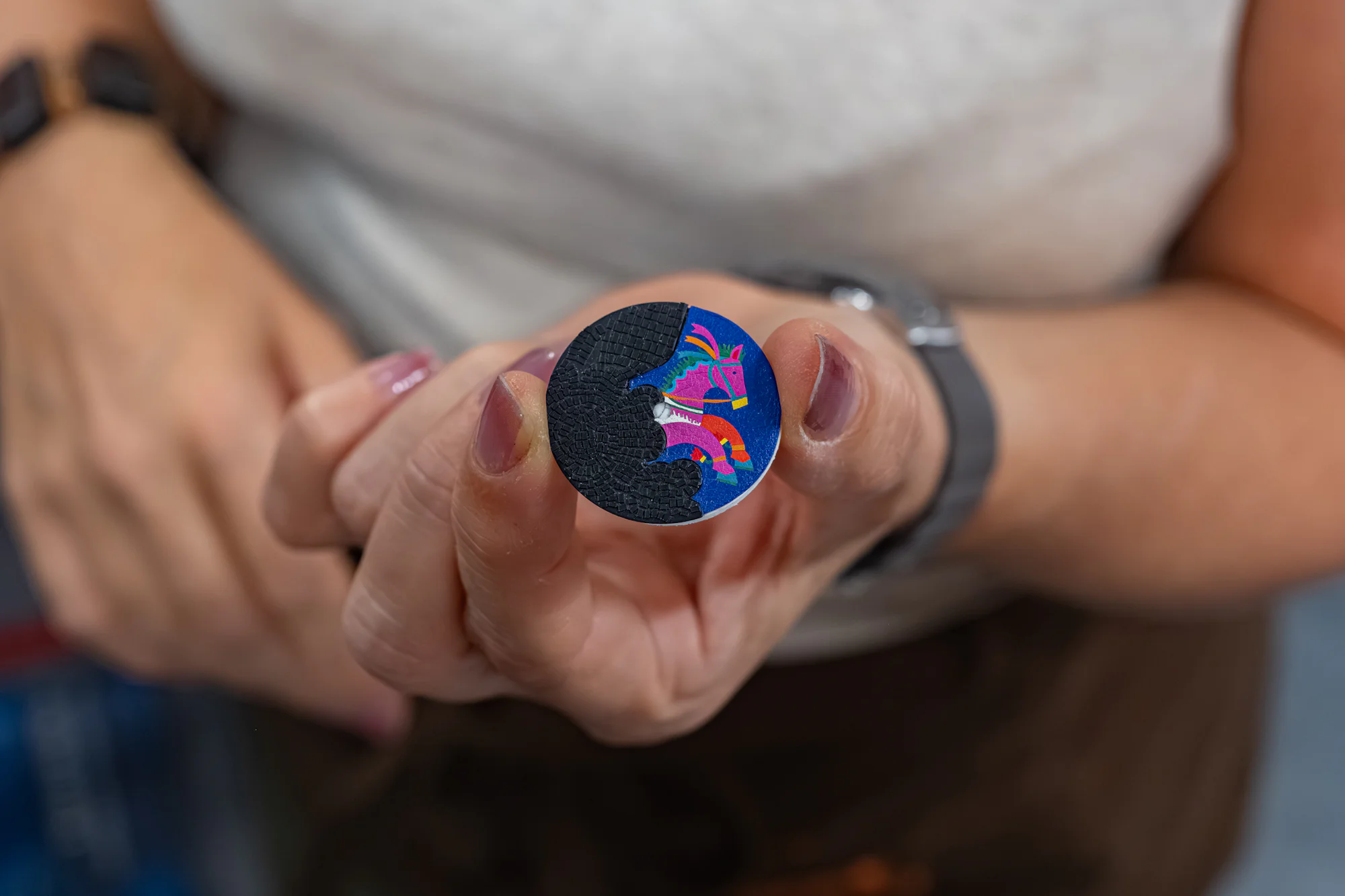
Once everything is stuck together, the end product looks something like this (although this is a prototype).

Zoom in, and you can see the dancer on the right even has a piece of leather for his socks.

This Dinosaur head prototype dial had an insane about of individual pieces.

See?

Take note on this prototype leather marquetry leopard dial of the whiskers. These are impossibly thin additions with darker sections that add visual depth being achieved through heating the lines rather than specific pieces of leather.

The final straps all produced and fitted.

Final Assembly and Quality Control
The final step of the entire process is assembly and quality control, handled upstairs from the strapmaking at La Montre Hermès S.A. Here, rows of benches house watchmakers responsible for the final stages of production: assembling cases, setting hands, casing movements, and fitting straps. Although QC takes place at every stage of production, this is where the final checks occur before the watches are distributed, and there’s no room for error.
Coming from the leather workshop, the atmosphere here feels entirely different, with hushed voices reflecting the room’s slower, more methodical tone.


Final checks on the Cape Cod before its cased.

Each case element of this diamond set Arceau is set out before being checked and assembled
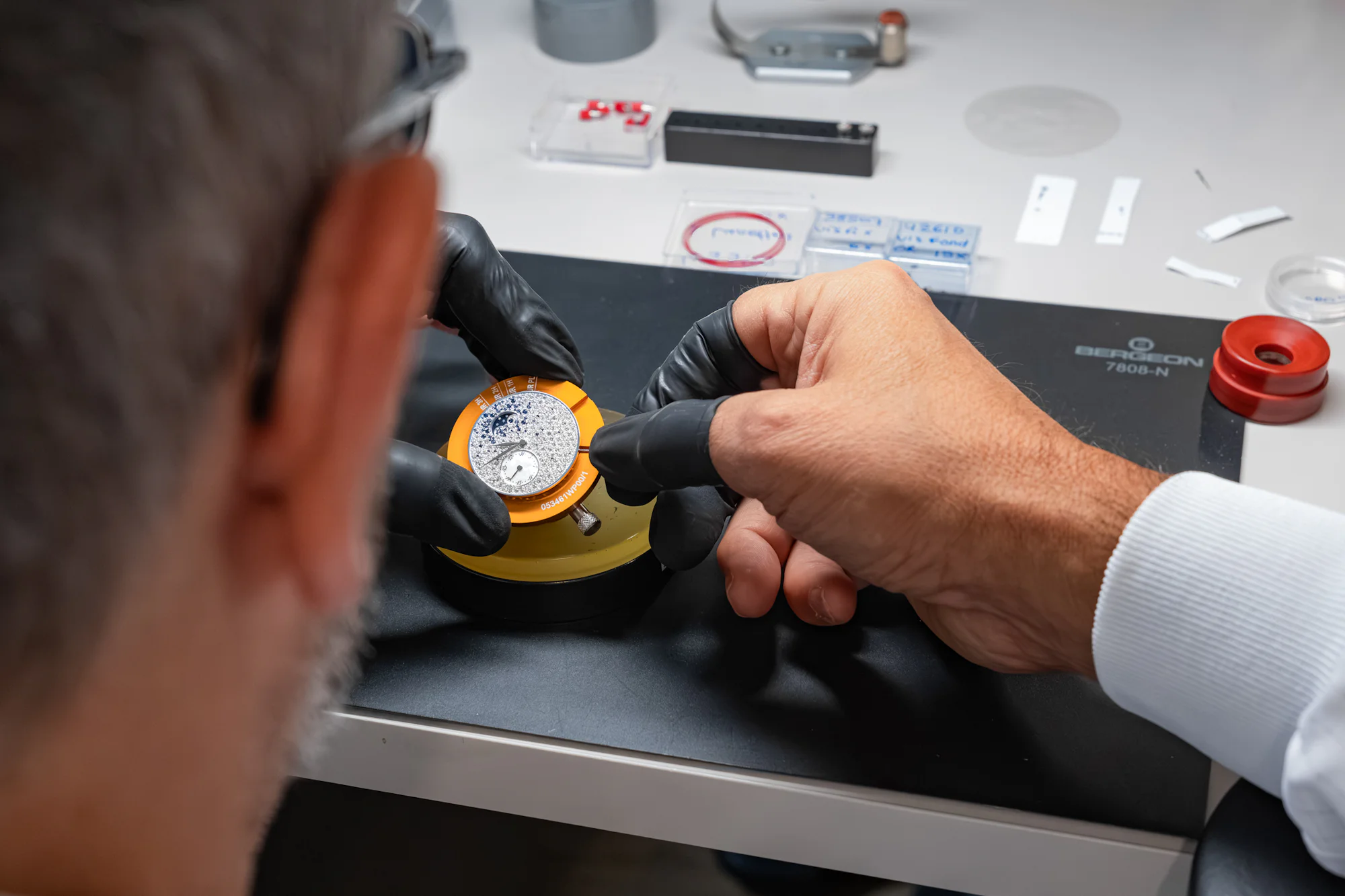

Et voila.

All aspects of assembly take place here including fitting the movement.


Even the screwdriver holder is Hermès orange.

After the stamping of the case, finishing, and polishing, the Kelly has arrived at its final stop.

Once again the dial is inspected.

And eventually it is cased.
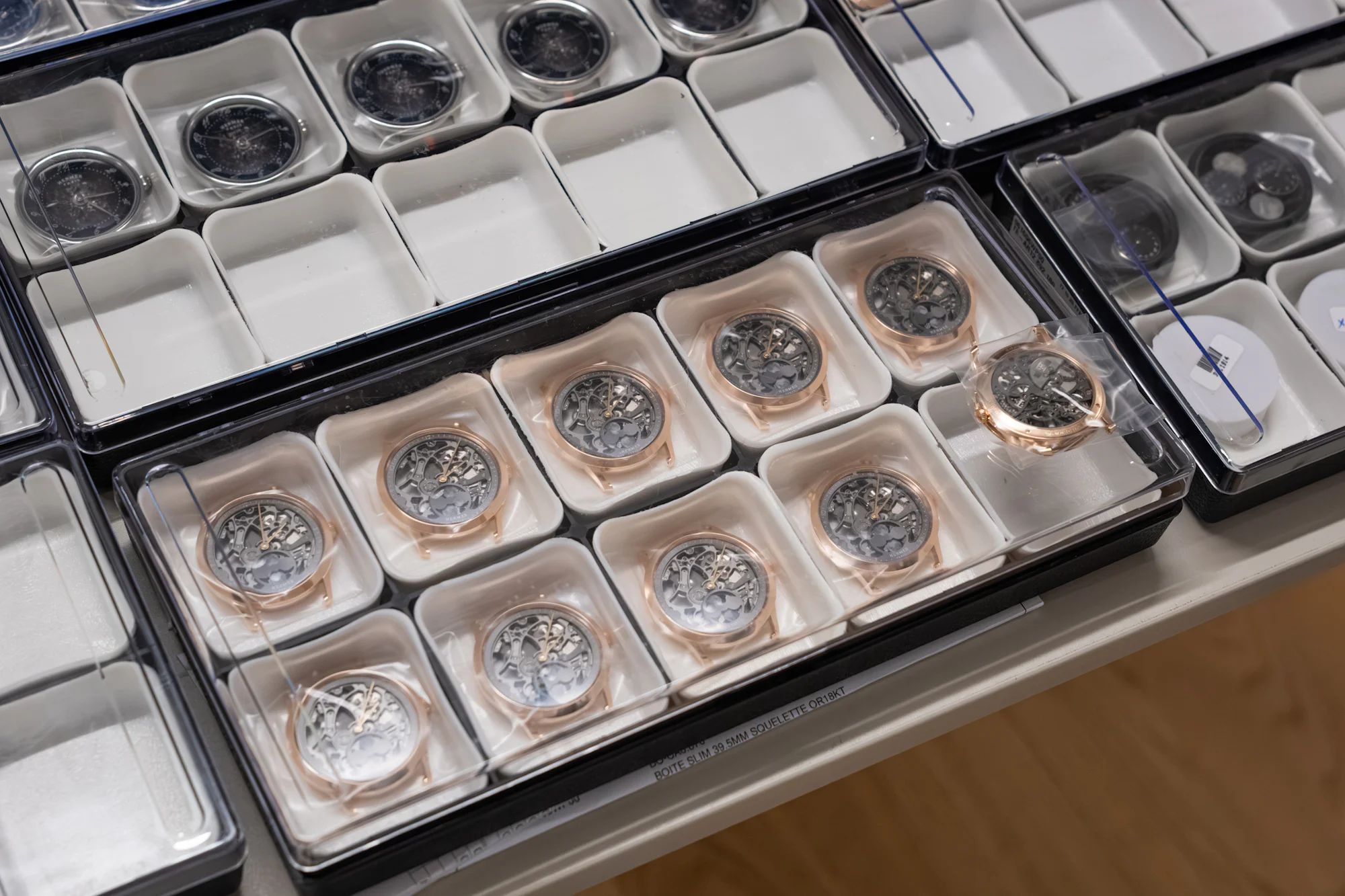

Getting very close to the final product.

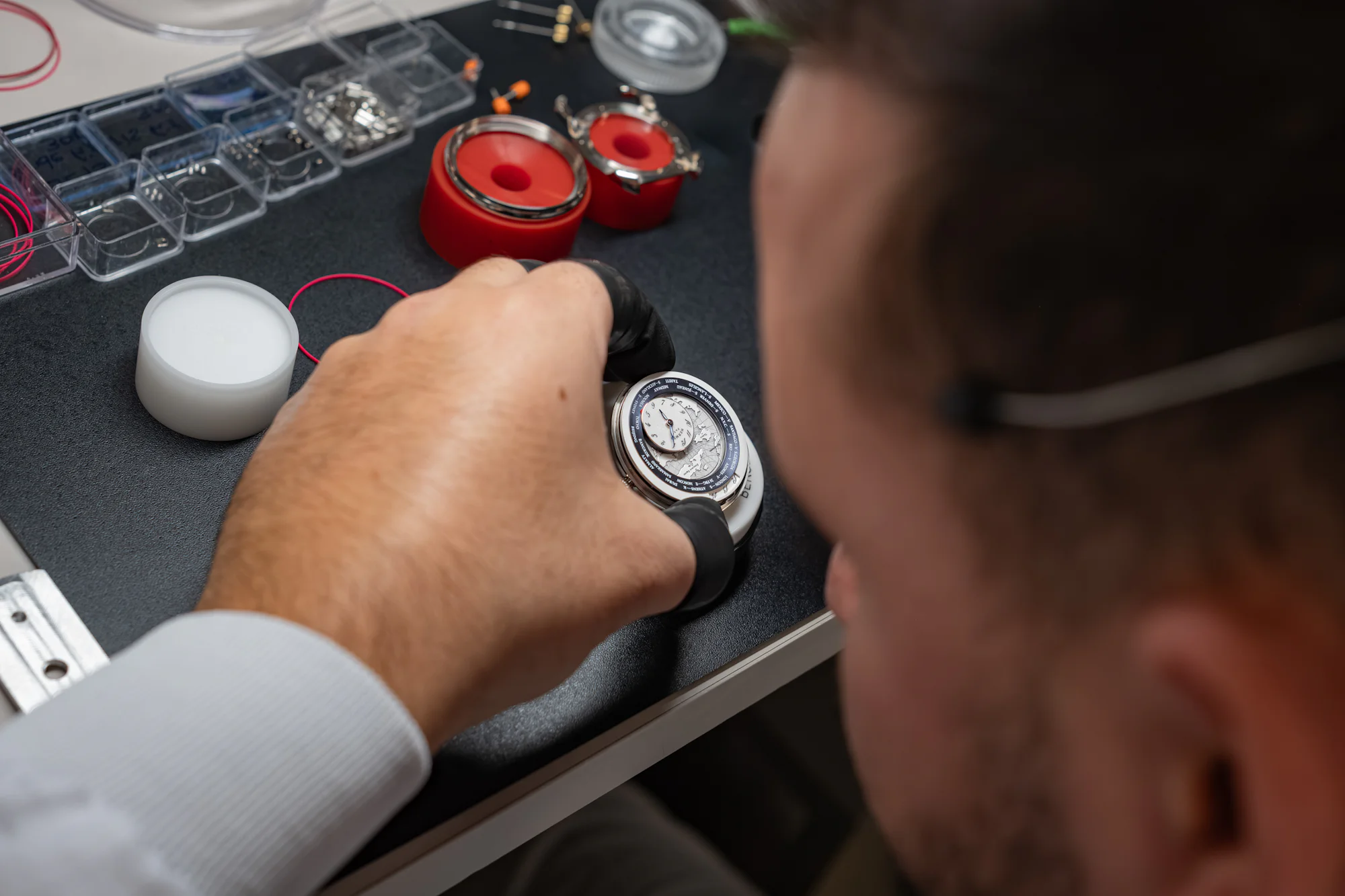

Everyone we saw was wearing Hermès on the wrist, and not just new models, older pieces such as this gem as well.

Some of the final steps of QC.
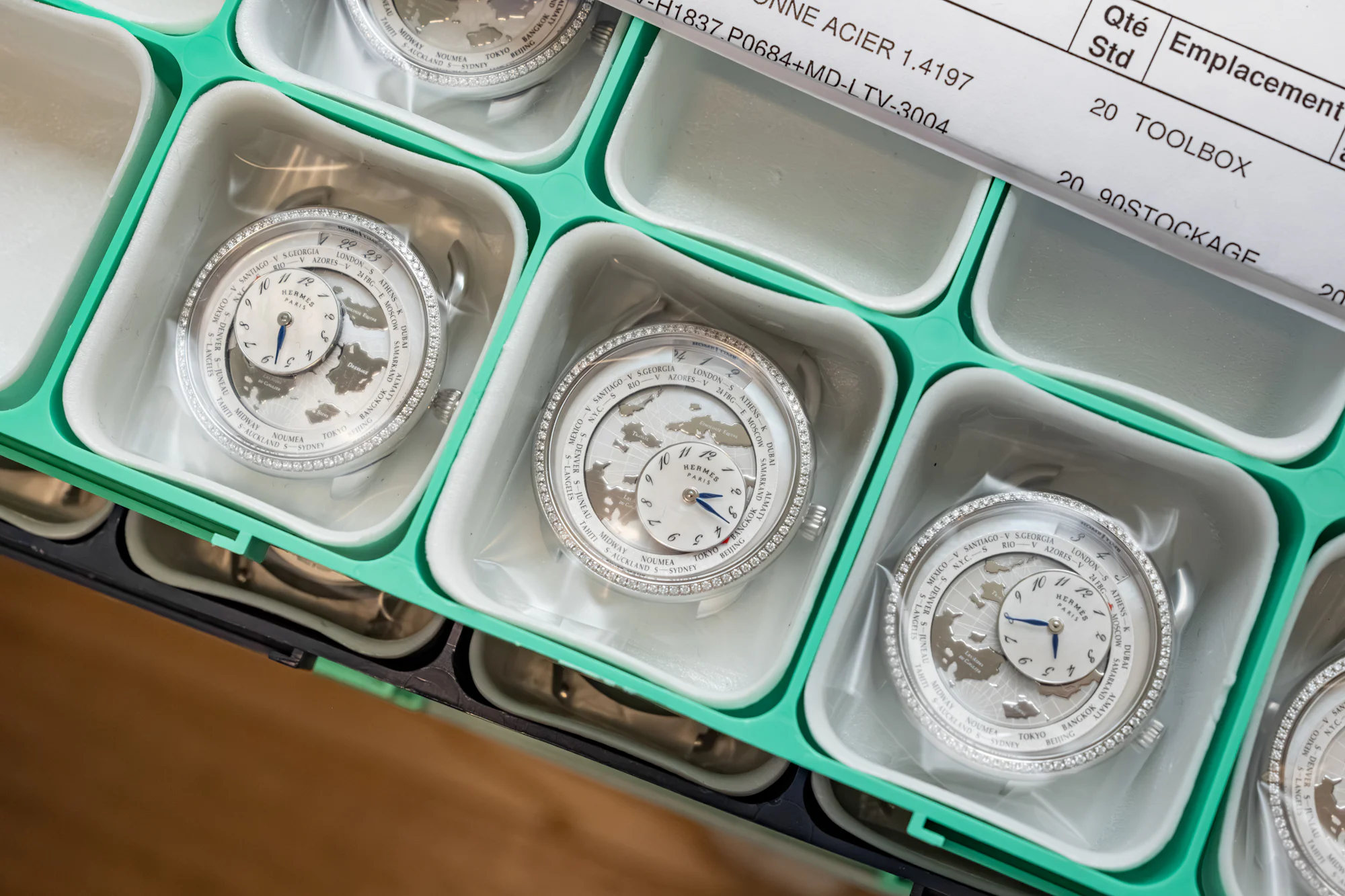

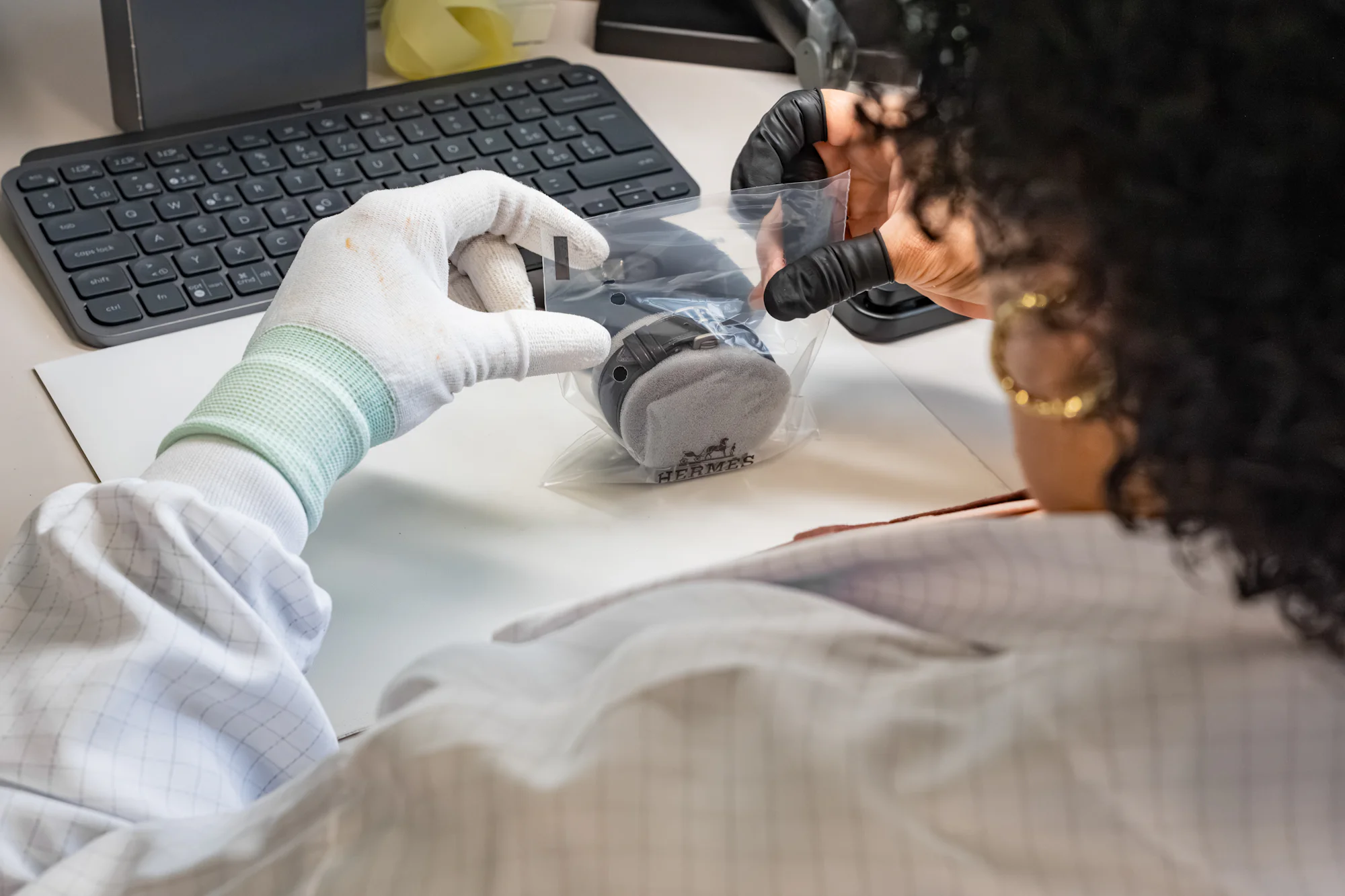
The final seal.

And here they are.
Lasting Impressions
In the past few years, Hermès has risen right to the top of my personal list of favorite modern watch brands, and it’s not just because of the products themselves, but because of the world surrounding them. There’s a warmth, confidence, and playfulness to the brand that feels increasingly rare at the top end of luxury, and after spending time inside its watchmaking facilities, it became clear that spirit isn’t manufactured for marketing purposes, but is actually initiated by the people who make these watches a reality, at every step.

That was the thing that stayed with me most after leaving. I’ve visited manufactures of every scale over the years, and often the overriding feeling is precision above all else: quiet rooms, clinical processes, systems engineered for perfection. Necessary, of course, but sometimes the soul is left to be expressed through the watches exclusively. But Hermès felt different.

Across both sites, there was an unmistakable sense that the people here genuinely enjoyed what they were doing. From the leather workshop to the benches during final assembly, there was openness between artisans, pride in individual craft, and an eagerness to explain not just how something was done, but why it mattered. Many people here had spent years at other traditional watch manufacturers before joining Hermès, yet they spoke about the house with a kind of personal attachment rather than any form of corporate obligation.

Perhaps that’s ultimately what makes Hermès so compelling in modern watchmaking. The technical processes themselves exist across the industry, but the spirit behind them is entirely its own. There’s a playfulness to Hermès that never feels forced. Few brands can move between producing a relatively accessible Cape Cod and a six-figure métiers d’art piece while maintaining such a coherent identity, and even fewer can do it without becoming self-important.

At Hermès, the brand still feels in service of the product rather than the other way around. In an industry that can sometimes take itself too seriously, that’s overwhelmingly refreshing.