

I occasionally have a hard time understanding why some brands are so popular. It’s not that they don’t deserve to do well, but I see brands that don’t seem to be doing anything much different from their peers, let alone special, yet are many times more hyped. Why does one Calatrava-esque watch with Breguet numerals outperform another? But with Ōtsuka Lōtec, I get it. In fact, I don’t just get it, I’ve fallen for it. Then again, Ōtsuka Lōtec isn’t like any other brand.
Jiro Katayama, the brand’s founder and lead designer/watchmaker, works from a different playbook. Where other brands pursue finishing and neoclassical elegance, he seeks beauty in the raw and industrial. Inspired by analog machines, measuring instruments, gauges, and the industrial design of the pre-digital age, there is something rough and unintentional (though completely intentional) about his watches.

Considering he taught himself watchmaking in a workshop nestled in Tokyo, there is a certain logic to this aesthetic. It’s not born in the farm-strewn hills of Jura, but rather in one of the densest cities in the world. Nor is his education from a lineage of tradition. You won’t find perlage or anglage; surfaces are typically raw, brushed metal, and rarely painted, with only the occasional red highlight.
While potentially a love-it-or-leave-it aesthetic, it has resonated deeply with the watch community, touching on a pure joy of mechanics. But, there is more to it as well, as his watches go beyond looks. Built on Miyota movements, each model displays time in an alternative fashion, utilizing in-house-developed complications. These, at times, employ unconventional solutions, such as using a guitar string as a spring. It’s this bit of watchmaking that takes the brand from one with simply a unique design perspective to one with horological prowess as well, all at approachable price points* thanks to the Miyota base calibers. *I’m talking retail, not resale.
Owner’s Review: the Ōtsuka Lōtec No. 8
Stainless Steel
Miyota 90S5 w/ In-House Module
Gray/Open
NA
Sapphire
Rubber
30m
31 x 47.7mm
10.8mm
24mm
Push-Pull
Yes
$6200
This latter point came to a head last year when the No. 9 was announced. A fully in-house creation, the No. 9 featured a tourbillon, a jump hour, rewinding minutes (essentially a retrograde disk), piston power reserve, and a sonnerie au passage (hourly gong). It took fans by surprise by debuting several new features, including a rectangular case, a shaped crystal, a tourbillon, and a six-figure price tag. While an impressive display of creativity and engineering, the concern was that the brand would move upmarket.
Our collective concerns were dissuaded a few months later when the No. 8 was announced. Bearing some similarities to the No. 9, yet also being completely different, it felt as though the lessons from one watch informed the other. Thankfully, however, the No. 8 was back to a Miyota base, thus priced in line with the rest of the catalog and, logically, more available than a fully in-house model.

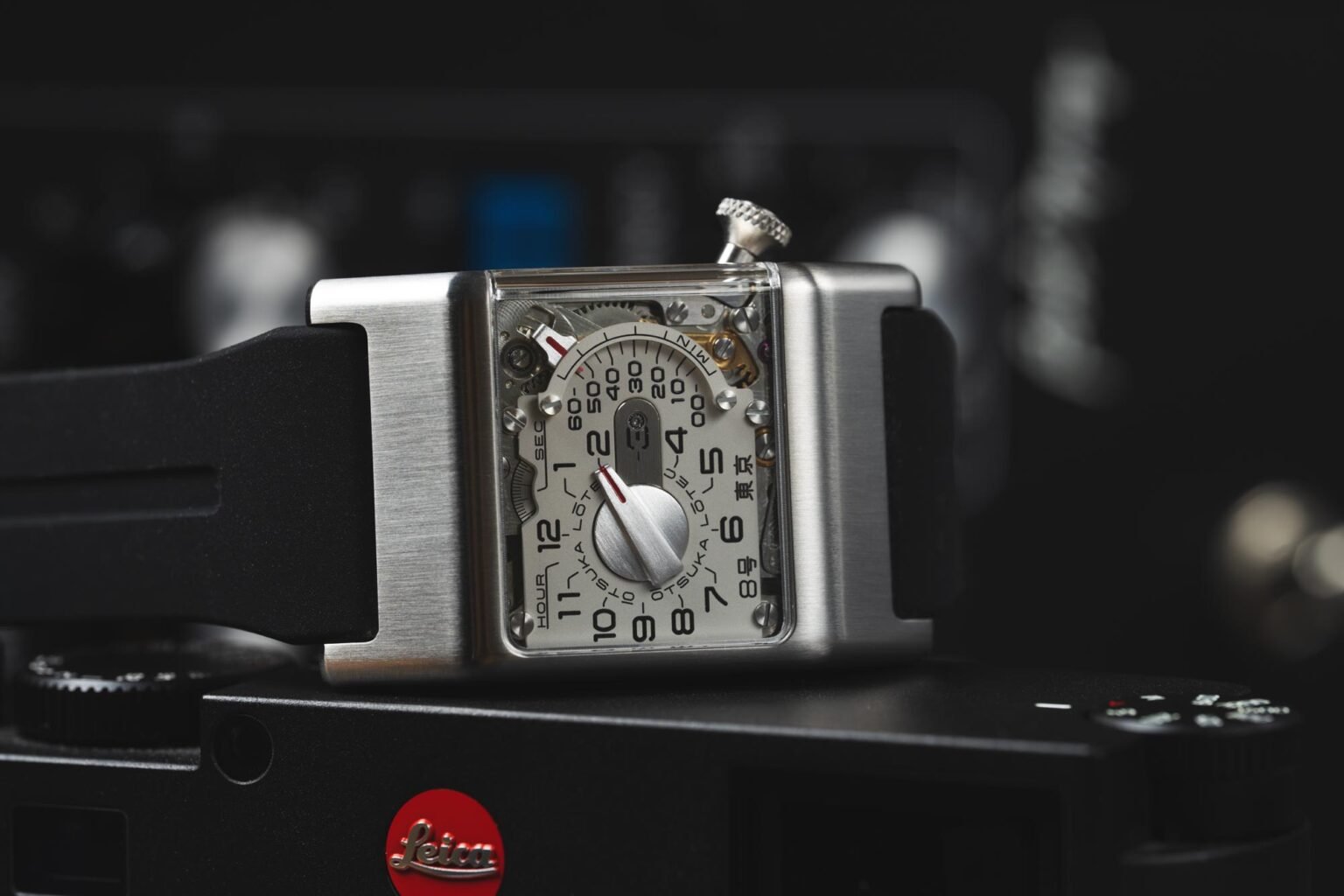
That all aside, though every model in the Lotec catalog is quite different from the next, and quite radical in general, the No. 8 felt like the greatest departure thus far. Inspired by the analog mixing consoles found in recording studios, specifically the famous Abbey Road studio, it combines an unusual case shape with a striking crystal, a unique set of complications, and a partial dial that feels like it’s growing out of the movement. Though all of Mr. Katayama’s designs are challenging, this felt like the most so far.
As a fan of the brand’s aesthetic to begin with, and an owner of the No. 7.5, I was taken with the design at first glance, but it was when I read about the complications that I knew I had to have one. In one sense, the No. 8 is a regulator, separating the hours, minutes, and seconds displays; something I love. But it goes much further than that. All decentralized, each is displayed by a different method. The seconds are via a disk, which is the most straightforward, though there is more to it than meets the eye. The minutes are retrograde, read via a sliding indicator. Finally, the hours are told with a large hand, but there’s a trick here as well: the hand doesn’t crawl, it jumps at the top of the hour.

The idea of a “jump hour regulator” has been on my mind for a while, but such watches are very rare. Frank Muller made one in the early 2000s, and currently, Klanic has one in the works, as does Interim Lamb, another Japanese indie. While there are likely a couple of others, they are few and far between. The closest I’ve come in my collection is the Habring2 Josef, which is a regulator with jump seconds. Right mechanism, wrong hand. Similarly, watches with different methods of displaying the time per unit are highly uncommon, with the most famous likely being the Chronoswiss Delphis, which claims to have been the first to do so in 1996, featuring a jump hour, retrograde minutes, and traditional seconds.
Seeing these concepts come together not just in a single watch, but one that is wholly unique in its design, by an indie brand, and one that is not European at that, makes the No. 8 a unicorn, at least in my book. Of course, strange complications and aesthetics are all well and good on paper or in a social media post, but how are they in person? Well, I’ve been lucky enough to have been able to add a No. 8 to my collection, and in the last few weeks, I’ve hardly taken it off, so here’s what I think.


Case
There is nothing conventional about the No. 8, starting with the case. Measuring 31mm wide and 47.7mm lug-to-lug and 10.8mm in height, the No. 8 is a long and flat, yet somewhat narrow rectangle, at least from above. From the side, the unique shape is visible. Rather than being a box, the areas of the case above and below the dial opening taper down toward the wrist, creating large, solid metal surfaces that eventually lead to small lugs. The entire case is brushed vertically for an even sheen all around.
An immediate point of departure: though rectangular watches have had a bit of a resurgence in recent years, they are typically traditional and dressy in appearance. Yet, there is something blunt and purposeful about the shape of the No. 8, evoking the machinery that inspired it. Furthering this, the top edges of the case are rounded with a large radius, giving the feel of sheet metal molded over a form.

The most eye-catching feature of the case is the crystal. A wide rectangle that takes up most of the flat area of the top of the case, the left side ends as one would expect, with some material between its edge and the case’s side. The right side, however, doesn’t just end; the crystal takes a turn, creating a radiused corner that matches the case’s, then drops a couple of millimeters, ending about 40% of the way down the case’s side.
This is a very complex crystal. It’s sapphire, which shouldn’t be a surprise, but given the shape, it must have been milled from a single block. Additionally, because it doesn’t rest on a flat surface, sealing it is likely trickier, which could explain the 30m water resistance. With that said, as a visual feature of the watch No. 8, it truly stands out, adding to its overall exotic appeal.

Finally, the crown of the No. 8 is found coming out at an angle on the right side, attached to a tube that passes into the case. Once again, very industrial in its aesthetic, the crown features a knurled edge for grip and an undercut that makes it easy to grasp while also creating clearance between the crown and case. While functional and a necessity, given the angle and the way it breaks from the case’s clean, straight lines, it is a bit jarring. Of course, Ōtsuka Lōtec watches are some of the few for which “jarring” isn’t necessarily out of character, but I can’t help but want to see a version with a hidden crown.