

Favre Leuba is a slightly curious brand. Despite being able to trace its origins back to 1737 (beaten only by Blancpain), the brand has undergone a succession of relaunches in recent decades as it attempts to re-forge its identity. As a result, it doesn’t perhaps register on the radar of many watch enthusiasts in the same way as other storied names. On their website, Favre Leuba are rightly proud to present a timeline of important events in their history, and it’s worth checking out, but the abridged version begins as follows: Abraham Favre begins making watches in Le Locle in 1737. The family business becomes A. Favre & Fils in 1792 under the stewardship of Abraham’s son and two grandsons. By 1815, the next (fourth) generation of the Favre family joins forces with August Leuba, and the Favre-Leuba name is seen for the first time. Many important developments are scattered through the next century and a half, including single-button chronographs, altimeters and barometers, and collaboration with Jaeger-LeCoultre.
As was the case with many Swiss watch brands, the Quartz Crisis had a severe impact on Favre Leuba. The Favre family’s eighth generation was the last to be involved in the business before ownership was first transferred to Benedom SA, then LVMH, and Valentin SA. In 2011 the Titan Company Limited took ownership, and it was under their stewardship that the watch I’m writing about today was made. The Raider series of watches was influenced by cushion cased watches offered by the brand in the late 1960s and early ‘70s, upscaled in both size and water resistance. The brand has since undergone a further ownership change in 2023, with a relaunched collection inspired by an earlier period in their history.

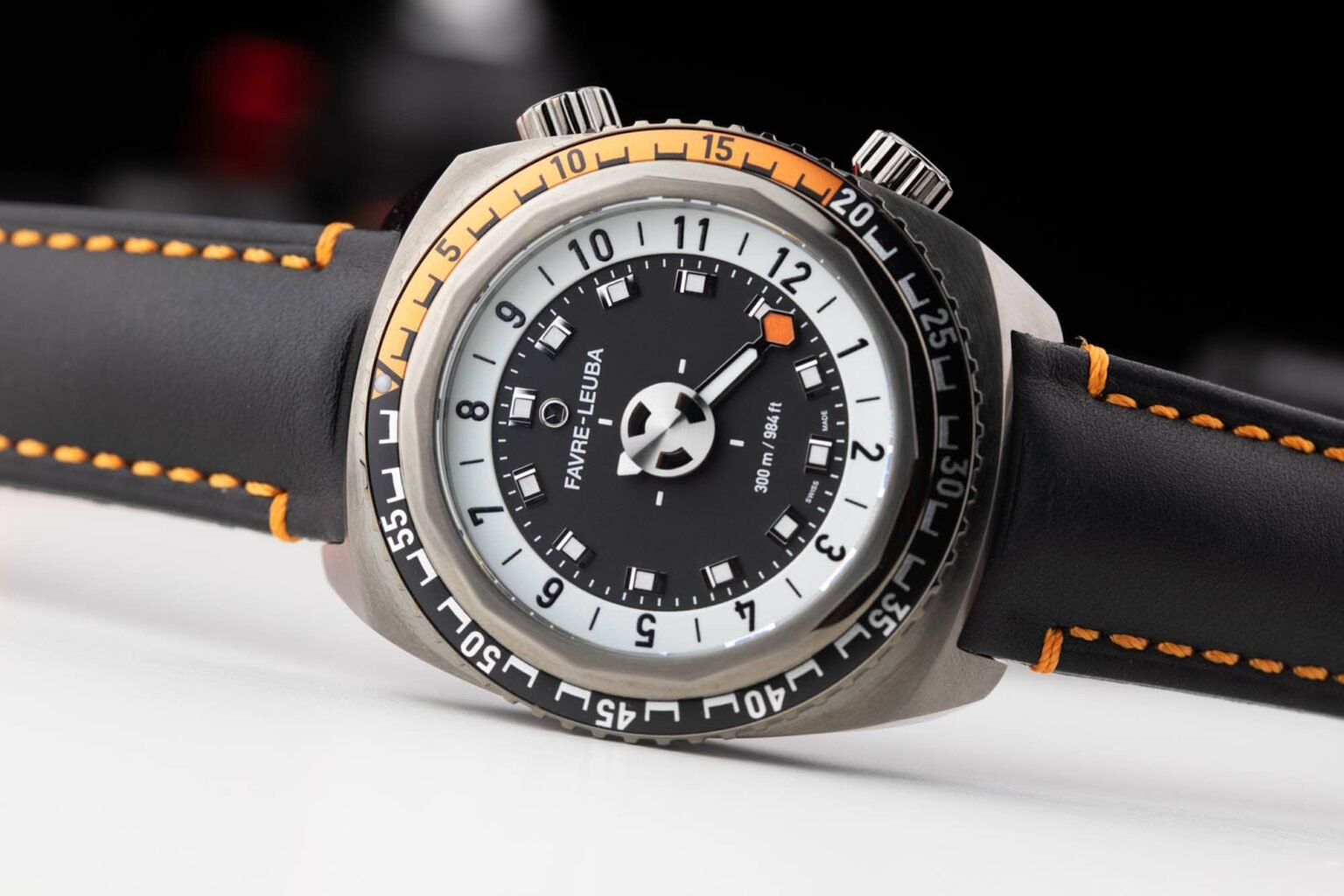
It was 2018 when Favre Leuba made its lasting impact on me, at London’s SalonQP event. What intrigued me about the Raider Harpoon was the clever way of displaying the time with just one hand. Now, Meistersinger (among other brands) show the time with one hand, but during a short period of ownership of one such watch I was surprised at how frustrated I was having to accept a fairly rough read rather than knowing the precise time. The genius of the Raider Harpoon is that, as the minute hand travels a full 360 degrees in an hour, the outer hour ring travels only 330 degrees. So, if the 12 marker is at the top of the dial with the minute hand pointing squarely at it, an hour later the 1 marker takes its place at the very top of the dial. Reading the time does require a slight mental shift to first look at the minute hand, and then to read which two hour markers it is currently sitting between. Once you have got that mastered, it suddenly makes a lot of sense to just read the hour and minutes simultaneously rather than separately.

Despite enjoying the unique way of reading the time and the overall aesthetic, that original Raider Harpoon’s 46mm diameter put an end to any thoughts of buying one almost before they started. A year later, however, a more sensible 42mm version was launched, and ever since then I’ve had a hankering to pick one up. This year, I finally found a NOS model in the black/orange colorway with gunmetal PVD coating for a price I couldn’t pass up (original retail was a little under $4,000). There’s always a huge risk that goes with buying a watch that I’ve wanted for the best part of a decade. Even ignoring how my own tastes have changed, 8 years is a long time to let the anticipation build, especially as I hadn’t handled another one since that fleeting encounter. Does the watch stand a chance of living up to my own expectations?

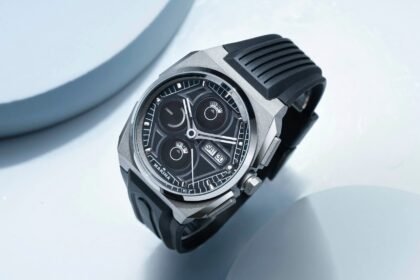
Starting with what makes the watch special, the Raider Harpoon’s unique functionality is delivered by a bespoke module fitted on top of a Sellita SW200-1 automatic movement, creating the FL301 caliber. The base movement gives the watch a 38-40 hour power reserve, and beats at 28,800 bps. The relative smoothness of the seconds hand is difficult to see though, as it takes the form of a small central disc with only a stubby, lumed arrow pointing out. The only ‘regular’ hand isn’t all that long either, extending only as far as the markers on the minute track. A large portion of the watch’s 42mm diameter is taken up by the rotating hour ring, stepped fixed bezel and rotating 120-click dive bezel. Writing this review has caused me to look at each individual detail in a more objective manner and as I do so, the less each one seems to make sense. However, I’m of the opinion that when you pull back a little and experience the watch for a few days, it all comes together rather well.

It was the introduction of a 42mm case size that changed the Raider Harpoon from an interesting novelty to a longer term hankering, but it’s still a rather large and heavy watch. Despite the reasonable 42mm diameter, the watch still clocks in at 50mm from lug to lug owing to the cushion case design. Those dimensions are right about the edge of my own comfort zone, which means that I was unlikely to dismiss the watch immediately upon arrival. The PVD gunmetal finish on this particular model hides a little of the overall size, especially around the sharply downturned lugs. My own trepidations were more based on its thickness. At almost 15mm, I’ve found that the right strap and fit is essential to making sure the watch sits comfortably and doesn’t move around or overhang. Although the black leather with orange stitching seen in the photos is without doubt the best visual pairing I’ve tried on this watch, I spend well over 90% wearing it on a cut-to-size black rubber strap. I have found that this option helps the watch sit correctly by cutting each piece of the strap accordingly, and also offers a little more friction to keep the watch in place.


I’ve long been told that on a serious dive watch it’s only the minute hand, and a reference point, that is important (as well as a visual reference to be confident the watch is running), and Favre-Leuba’s stripping away of other hands plays into that archetype. With 300m of water resistance and a Helium Release Valve operated by the second crown, the Raider Harpoon offers more protection than I would ever need. Each time I return indoors I’m also struck by the impressive lume. Anti-reflective coating is applied both internally and externally. The early outcome is that it’s doing an outstanding job, though I always worry about external coatings getting scratched or being slowly worn away in areas.

So, what’s the Favre-Leuba Raider Harpoon like to live with? As briefly mentioned above, it’s a watch that needs to be worn for a couple of days to get used to focusing on just a single hand and where it points to on the chapter ring. I often change watches after only a day or two of wear, so the Raider Harpool forces me to alter my wearing habits somewhat. I’ve owned moonphases and chronographs, jump hours and GMTs. A watch that exhibits something different always excites me, but I’m aware that once that neophilia has worn off, the rest of the watch needs to stand up on its own if it is to remain a part of my collection. So far, I believe the case angles and 1970s aesthetics tick the right boxes. Favre Leuba