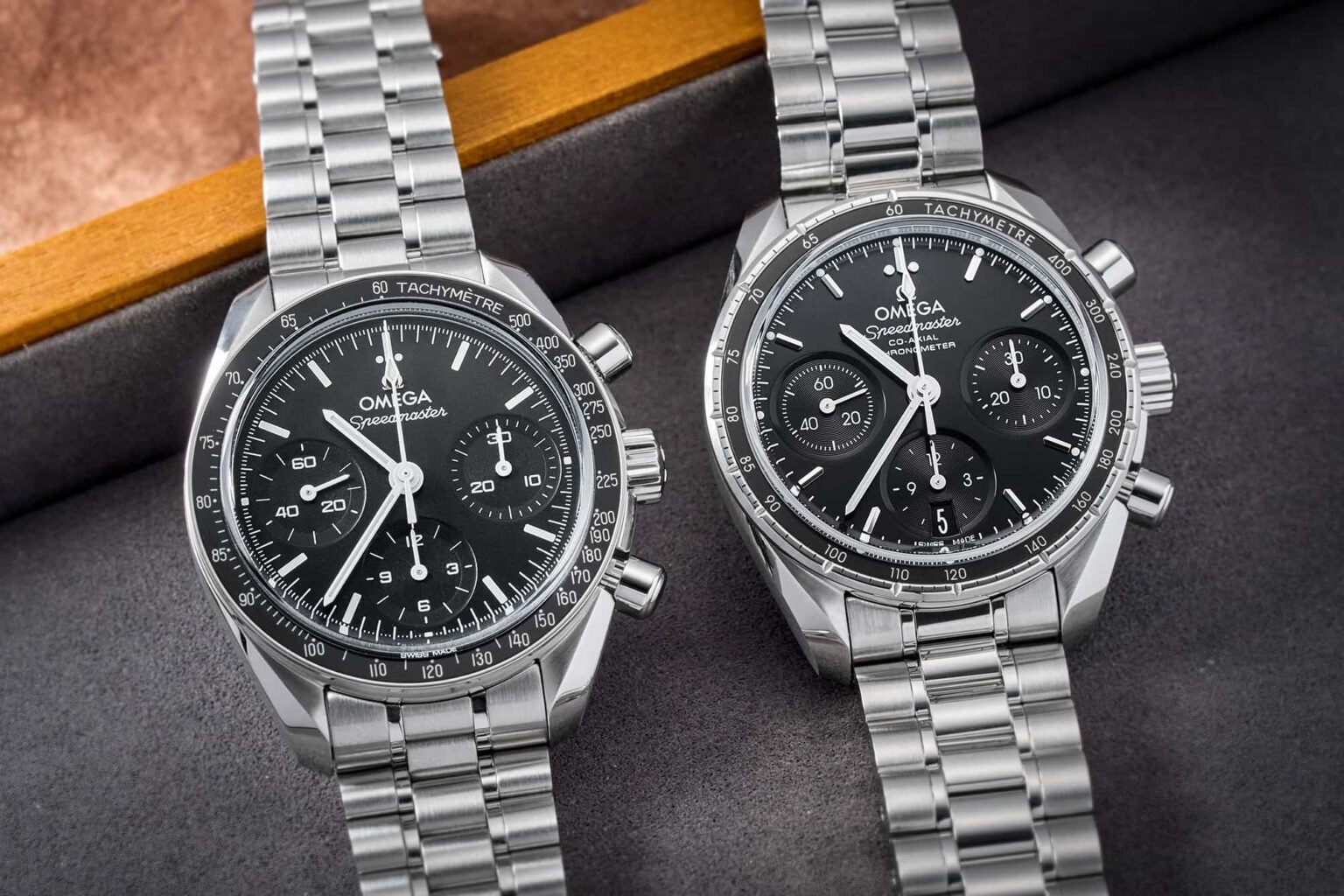

It’s official. Omega has finally reimagined the Speedmaster 38 for the die-hard Speedy fans. All of the nitpicky complaints that have been launched in the most compact take on the line’s direction have been, for the most part, righted in one fell swoop. With the subtle yet undoubtedly impactful changes Omega debuts today, the collection is closer to the design codes and spirit of the iconic Speedmaster Moonwatch than the previous generation, and, given the aesthetic variety of the seven references, we can safely say that there is now a Speedmaster 38 for just about everybody.
[toc-section heading=”Some Context”]

[shoppable-product-slim handle=”speedmaster-chronograph-38mm-black-on-bracelet”]
[shoppable-product-slim handle=”speedmaster-chronograph-38mm-white-on-bracelet”]
Of course, we can’t really talk about the Speedmaster 38 without paying a little bit of airtime to the automatic Speedmaster Reduced, which is the original small Speedy offering. Launched in 1988, this model has proven to age like fine wine, though some collectors were skeptical of it at the time. Still, its trim dimensions and convenient automatic movement made it quite popular while it was on the market; since its official discontinuation in 2009, it has become one of the most sought-after vintage references.
With the Speedy Reduced shelved, there was a gap in the Omega lineup that remained wide open until 2017, when the modern Speedmaster 38 hit the scene. The return of the smaller-size Speedy went in the more luxurious direction, and, while it was still a strong seller, many fans were divided – especially when it came to the shift to oval-shaped subregisters and the date window within the subdial at six o’clock. Additionally, there were now several models in precious metals, and some with jeweled bezels. To be sure, you could still get a smaller Speedmaster in steel with a black dial, but the look was just…different, and as a result, hardcore Speedy fans were somewhat…indifferent. Today, the luxe-forward look of the 38 is still available, but now, fans have what they’ve been asking for: a smaller Speedmaster in the classic Moonwatch style.
[toc-section heading=”Case And Wear”]

While the seven new references we’re gathered here today to marvel at are novel, somewhat cheekily, Omega introduced this new format before our eyes with the Speedmaster 38 Milano Cortina special editions nearly a year ago. Because these were so specialized at the time, the subtle refinements compared with the previous generation didn’t kick up much of a stir. But the move away from those somewhat contentious oval-shaped subdials was right there under our noses, along with notable shifts in the typeface moving in a more markedly vintage-inspired direction compared with the 38mm lineup at the time. In addition, the case bevels were reconfigured, with a slightly more pronounced taper than before, and the bezel insert had now become wider, closely matching the look of classic Speedys. It was right there in front of our faces, but as they say, hindsight is 20/26.
[shoppable-product-slim handle=”speedmaster-chronograph-38mm-ivory-on-bracelet”]

There’s a minute dimensional difference to keep in mind when it comes to the newly contoured case design compared with the previous generation and the models debuted today. The 38mm diameter remains, but the new models have upped the case thickness just a tad. This difference is slight, and we really mean slight – measuring a total of 14.73mm in height as compared with 14.7mm of the previous generation. The lug-to-lug has also gotten a subtle bump, now at 44.96mm vs. the previous 44.9mm. While these on-paper dimensions are practically imperceptible, somehow, the result is that the feel and looks of these models are closer to the Moonwatch. This is also no doubt due to the reconfigured bezel, now in a single piece of aluminum with the iconic “dot over 90” thankfully present, and the more graceful taper of the lugs.
Along with the dial (which we’ll get to in depth later), the bezel is really where the new watches have strayed farthest from the two-part look of their predecessors. As for the rest of the case details, the finishing offers a mix of brushed and polished surfaces, and there’s still 100 meters of water resistance, a signed push/pull crown, pump pushers, and a solid stainless screwed-in caseback. The caseback still features the traditional Omega “Hippocampus” seahorse design done in relief, forgoing the “column wheel” text found on the previous version, with a callout of the water resistance as the lone spec.

The most impactful result of this update comes in with the wearing experience. Across the board, you’re going to get a feel that’s much closer to that of a scaled-down, modern Moonwatch. Across the new references, each is paired exclusively with an updated (and improved) bracelet. Immediately, the look is very Speedy Professional, with the three larger links done in a vertical brush, separated by a hint of flash from the polished intermediary links. As a side note, some of the other colorways feature polished center links on their bracelets, but the black version sticks close to the Moonwatch script. Like the modern Speedy Pro bracelet, you’ll get a really nice drape from the articulation offered by the end links (something that was a bone of contention with older Speedmaster bracelets). The 18mm lug width is in perfect proportion to the case, with further refinement coming from the improved clasp. Sharp-eyed fans will recognize the new design as a descendant of the full-sized version on the Speedy Pro, now with Omega’s patented comfort release adjustment system. It offers two additional positions and a total of 2.3mm of adjustment to fine-tune the fit, a welcome upgrade. Finishing on the foldover design is as nice as you’d expect, with milled construction and a handsome outer section with striped detailing, signed with the Greek alphabet Omega logo in relief.
[toc-section heading=”Dial Details”]

Given the scope of the watches debuted, it feels fitting to begin this section with a rapid-fire round of all the dial colorways introduced. As a brief aside, it’s key to note that, aside from the black model (again, the model closest in spirit to the Moonwatch), all the dials feature a date window within the subregister at six, a design cue found in the previous gen, but here, it manages to feel somewhat less obtrusive.


[shoppable-product-slim handle=”speedmaster-chronograph-two-tone-18k-moonshine™-gold-and-steel-38mm-opaline-silvery-on-bracelet”]
[shoppable-product-slim handle=”speedmaster-chronograph-two-tone-18k-sedna™-gold-and-steel-38mm-ivory-on-bracelet”]
Alongside the über-classic black-on-steel model, there are two additional steel models to take your pick from. First is a lacquered white, featuring a blue ceramic bezel insert and blue CVD-coated hands and indices, bearing more than a little resemblance to the Silver Snoopy Award Anniversary Series, minus NASA’s favorite beagle. Next we have an opaline PVD silver dial, highlighted with brown and Sedna rose gold PVD hands and indices, mated with a warm gray aluminum bezel.


A duo of two-tone models has entered the chat as well. First, we have what’s been nicknamed the “capuccino” colorway, which pairs a vintage-leaning ivory and brown panda-style dial, which uses solid Sedna gold for the dial furniture, pushers, crown, and smaller bracelet links, all brought home with a brown aluminum bezel. The other two-tone contender goes for Moonshine yellow gold accents and details set against an opaline silver dial, and receives a nice contrast with the green aluminum bezel insert.


Continuing on with the luxurious-leaning options established in the earlier generation, we also have a pair of diamond-set bezel models, which are both in steel and offered with either an ice blue dial or a mother-of-pearl dial.
[shoppable-product-slim handle=”speedmaster-chronograph-38mm-white-mother-of-pearl-diamond-set-bezel-on-bracelet”]
[shoppable-product-slim handle=”speedmaster-chronograph-38mm-ice-blue-diamond-set-bezel-on-bracelet”]

Turning focus back to the model that enthusiasts will likely be most drawn to, the Omega has really stuck the (lunar) landing on the most Moonwatch-adjacent reference here. This truly looks like a Moonwatch, from the omission of the date at six, to the white Super-LumiNova that shows a tritium-like green glow when the lights go down. For a somewhat busy dial, the Speedy remains one of the most legible, thanks to the use of white against the matte black backdrop for the handset and markings, with the sharp printing of the subregisters highlighted by the use of the classic Speedy Pro typeface.

Dial text has also been pared back from the previous-gen 38mm models, now consisting of three lines below twelve, with the applied Omega logo above the printed wordmark and Speedmaster script. The subdials also look the part, with their form returning to the less fussy format, with the dished design adding some dimension. In short, the dial is everything you expect from a Speedmaster Professional: legible, balanced, and an unimpeachable icon of 20th-century design.
[toc-section heading=”The Movement”]

Under the hood, we’re working largely with the same movement as in the previous generation of the Speedmaster 38. The date versions all utilize the 31-jewel Calibre 3330, an automatic column wheel chronograph descended from ETA’s A08.L01, which itself is based on the Valjoux 7753. The 3330 features the Omega Co-Axial escapement, which we’ve covered at length before, so we won’t rehash all the details here. Since the 3330 features a date display, the specific movement used in the black-dialed version of the 38 is the Calibre 3332, the no-date variant. It runs at a rate of 28,800 vibrations per hour, or 4 Hertz, features hacking and hand-winding, a silicon balance spring, and a power reserve of 52 hours. While the new Speedmaster 38 models aren’t Master Chronometers, the two calibers are COSC-certified and offer fine accuracy of -4/+6 seconds per day.
[toc-section heading=”Final Thoughts And Pricing”]

Ultimately, with this new fleet of Speedmaster 38 references, Omega addressed nearly all the details that collectors nitpicked at on the previous generation. These new models have successfully moved the most compact line much closer to the beloved script of the Speedy Pro. The bracelet has been upgraded, and, though it isn’t a Master Chronometer, we’ve still got an Automatic COSC-Certified Co-Axial column wheel chronograph within. The well-established formula of the OG Moonwatch has proven to be a winning one, regardless of size, and it’s a much-requested move by the enthusiast community to bring this model family more in line with the classic Moonwatch DNA in look and feel.
Pricing is as follows: steel models begin at $6,500 with the black on steel model, and go up to $7,100 for the white lacquer dial model; two-tone models are both $11,700; for the diamond-set bezel models, the blue dial model is $12,300, while the mother-of-pearl dial model is $13,100.
For more information, visit the brand’s website here.